Automated Financial Spreading for Commercial Loans
Automation tackles the spreadsheet grind so analysts can actually analyze commercial loans.

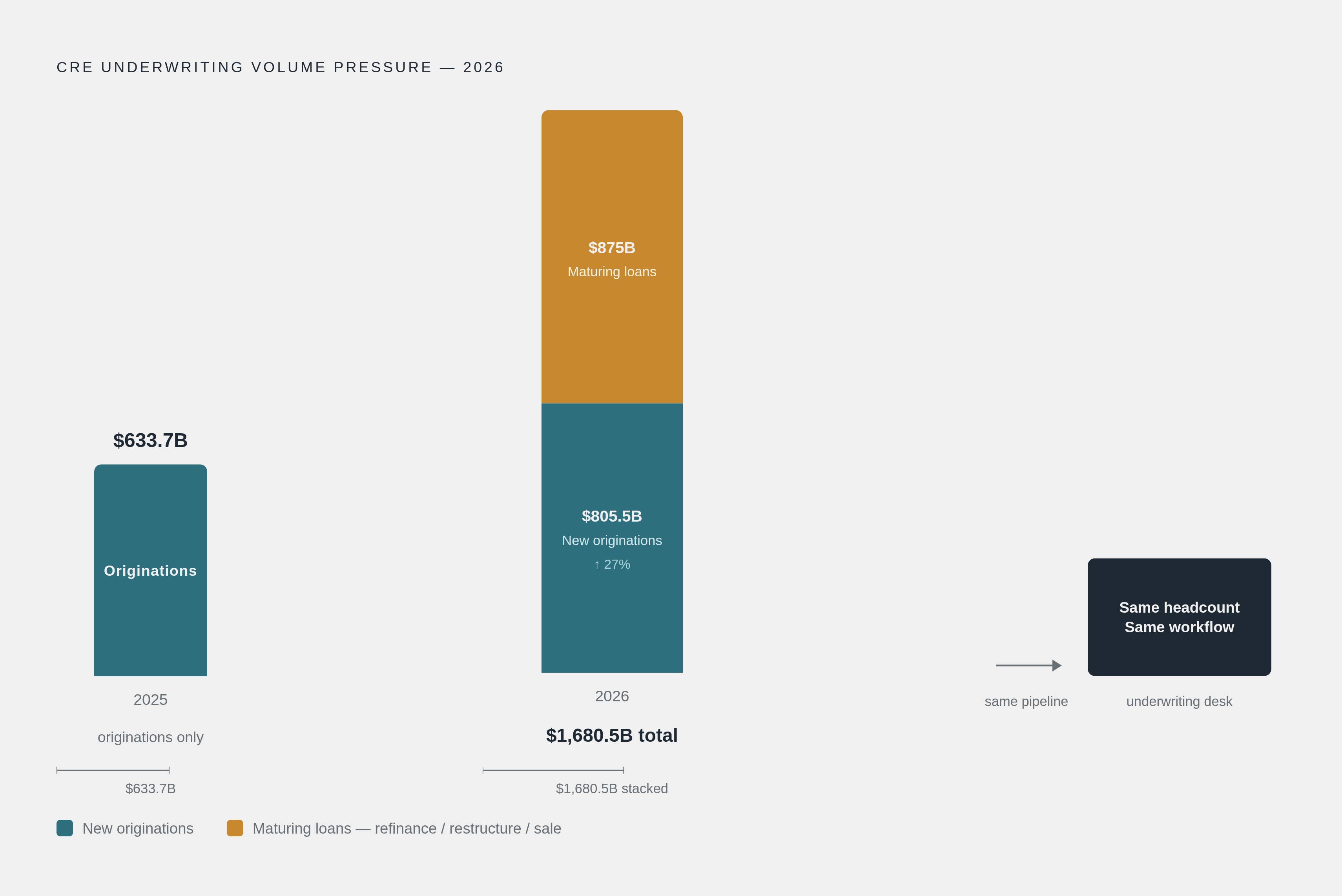
The commercial mortgage market has a volume problem, and no underwriting team can hustle its way out of it. MBA projects total commercial mortgage originations climbing to $805.5 billion in 2026, up from $633.7 billion this year. That's a substantial jump in deal flow landing on the same desks, the same headcount, the same Friday scramble to get a credit memo out before committee, and it doesn't even count the other half of what's coming.
Separately, $875 billion of the $5.0 trillion in outstanding commercial mortgages comes due in 2026, per MBA's 2025 Commercial Real Estate Survey of Loan Maturity Volumes. Break it down by who holds the paper: $396 billion at depositories, $200 billion tied up in CMBS, CLOs, and ABS structures, $163 billion sitting with credit companies and warehouse facilities. Every maturity forces a decision: refinance, restructure, or sell, and each of those runs through the same underwriting pipeline as a brand-new deal. The spreading queue for 2026 isn't just growing by 27%, then; it's absorbing a second wave of maturity-driven underwriting stacked right on top of the first.
Running the numbers leaves little room for optimism. An analyst team that handled 2025's volume, working the same hours with the same tools, cannot absorb a 27% origination increase plus a maturity wave that size without something giving. Cycle times will stretch, quality will slip, or both will happen quietly enough that nobody catches it until an examiner does. This piece isn't really about artificial intelligence, at least not at first. It's about capacity, and about one specific piece of the underwriting process, financial spreading, where that capacity problem either gets solved or turns into next year's headline.
What financial spreading actually is and where it sits in the underwriting workflow
Financial spreading is the unglamorous work of taking a borrower's raw documents and turning them into something a credit committee can compare side by side. Income statements, balance sheets, cash flow statements, tax returns, bank statements, rent rolls, operating statements, personal financial statements, debt schedules: all of it goes in one end, and out the other comes a standard set of figures mapped to the lender's own template, plus the ratios that matter (DSCR, LTV, debt yield) and how those numbers have moved over time.
Spreading functions as the foundation beneath the rest of underwriting. The credit memo, the committee's approval, the covenant thresholds set for the life of the loan, all of it rests on the spread. Sloppy or incomplete spreading means everything built on top is standing on a foundation nobody actually checked.
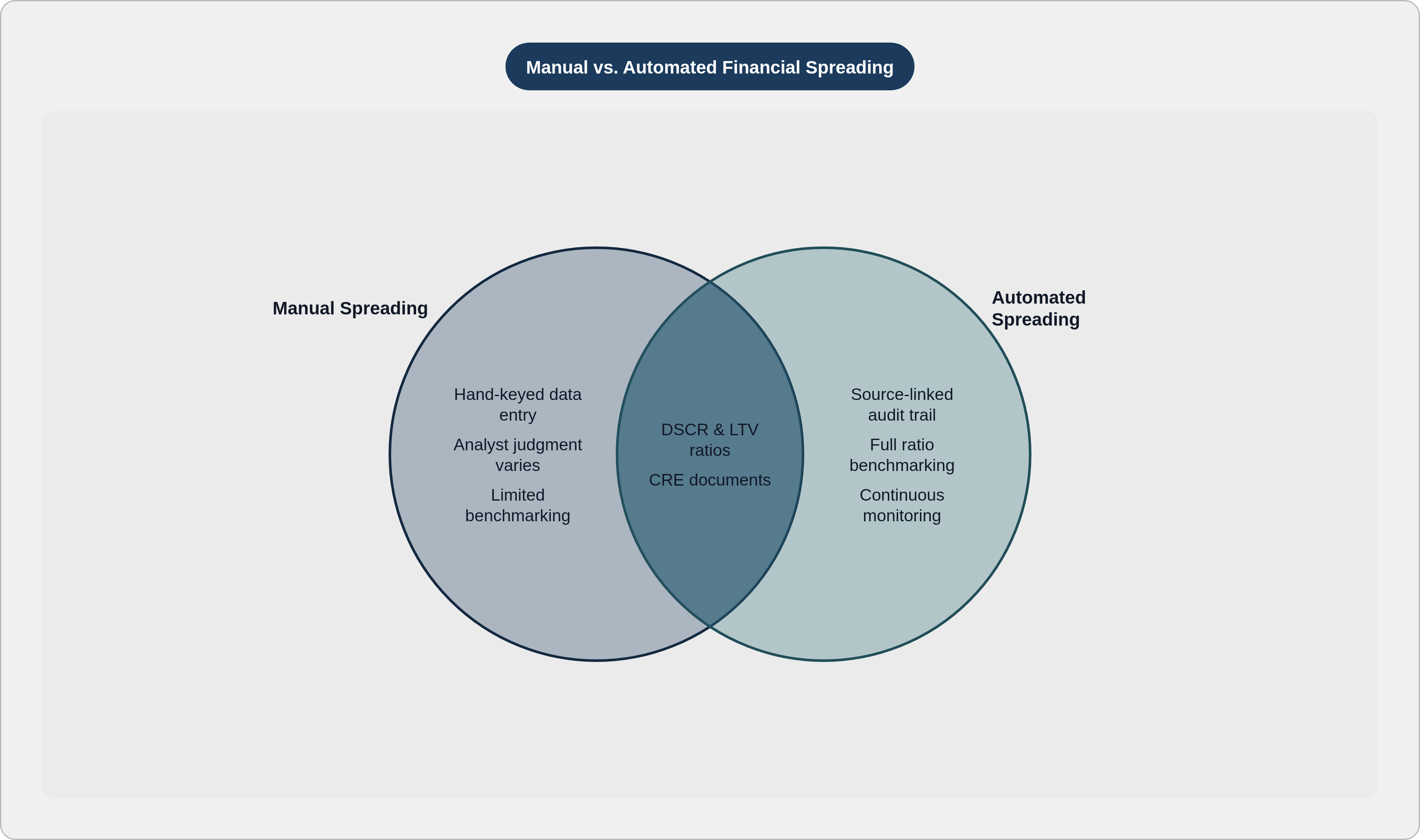
Here's what that looks like at most shops right now. An analyst sits with a stack of PDFs, or worse, paper statements scanned at an angle, keying numbers into a spreadsheet by hand. Ratios get calculated by formula or sometimes from memory, benchmarks pulled from whatever reference sheet happens to be open in another tab. Under deadline pressure, only the metrics that matter most for that day's committee get calculated, and footnotes buried in the statements, the kind that say "this NOI figure excludes a one-time insurance settlement," go unread more often than anyone wants to admit. Worse, every analyst brings their own judgment to what gets normalized, so a portfolio review comparing Loan A to Loan B might really just be comparing Analyst A's habits to Analyst B's.
No statistics are needed here, since the point isn't to measure the manual process; it's to describe it clearly enough that the automated version, which we get to next, reads as a real contrast instead of a sales pitch.
How automated spreading works: from raw document to decision-ready output
Automated spreading runs through five steps, and the line between each one matters because vendors love to blur "we read your document" into "we understood your document." Those are not the same claim, and a lender who conflates them finds out the hard way.
Step one is ingestion. The system takes the same documents analysts already handle, PDFs, scanned statements, tax returns, rent rolls, without requiring anyone to reformat first. Step two is extraction, and this is where basic optical character recognition falls apart by comparison: the system reads not just the numbers on the page but the footnotes and qualifications sitting next to them, the context a rushed manual spread tends to skip entirely. A good system knows a subtotal is a subtotal and a period label is a period label, rather than treating every character on the page as equally meaningless noise.
Step three, normalization and mapping, is where a lender's own institutional knowledge actually gets used. The extracted figures map to the lender's own spreading template and taxonomy, not some generic vendor format that needs a second pass to reconcile. This matters more than it sounds like it should, since if a bank defines adjusted EBITDA a certain way, or has a house view on what "stabilized cash flow" means for a lease-up property, that definition applies the same way on every spread, instead of shifting analyst to analyst the way it does under a manual process.
Step four is ratio calculation and benchmarking: running the full set of financial metrics against industry benchmarks, historical trends, and peer comparisons, not just the handful a busy analyst has time to reach for. Step five is source-linked output, where every number in the spread traces back to the exact document and page it came from, building an audit trail that holds up under examiner review. That traceability isn't a nice-to-have. Revised interagency guidance under SR 26-2 and OCC Bulletin 2026-13, along with community-bank standards under OCC Bulletin 2025-26, expect exactly this kind of trail.
None of this replaces analyst judgment; it replaces the data entry that keeps analysts from ever getting to the judgment part.
The speed and accuracy gains that automated spreading produces
Start with the number that gets quoted most: banks using AI underwriting report time-to-decision reductions of 50 to 75%, according to research from V7 Labs. That headline actually understates the shift. A manual underwriting cycle running one to four weeks, compressed by 50 to 75%, doesn't mean "a little faster." Weeks become days, and at the fast end, days become hours. For a lender competing on speed to close, that's a decisive edge.
Baker Hill's research on document processing found a similar pattern from a different angle: a 50% cost reduction, with tasks that used to eat days of analyst time down to minutes for financial spreading specifically. Accuracy tells a related story. AI-powered underwriting shows 15 to 30% higher accuracy in predicting defaults compared to manual-only processes. That gain isn't only about typos caught or transposed digits avoided, though those matter too; it comes from a system testing more metrics per deal, catching footnote-level qualifications a rushed analyst would miss, running every spread against benchmarks manual processes skip because there's simply no time.
There's a quieter effect underneath all this. One commercial bank reported a 45% drop in credit analyst turnover after deploying AI, per V7 Labs, and the logic isn't hard to follow: fewer people quit jobs that stop being about retyping numbers from a PDF and start being about actual analysis.
These figures deserve a raised eyebrow, though, not blind faith. Vendor-reported speed and accuracy gains shift depending on document complexity, loan type, and how well the implementation actually fits the workflow already in place. A lender evaluating a platform should test it against their own document mix, warts and all, rather than assume the best-case number in a case study transfers cleanly to a portfolio full of ground leases and mixed-use rent rolls.
How spreading quality at origination determines covenant monitoring quality throughout the loan's life
CRE loan covenants track the property, not the borrower's overall balance sheet the way a corporate loan might. DSCR, typically with a minimum between 1.20x and 1.35x at origination, LTV, usually capped around 80%, and debt yield: these are the tests checked throughout the loan's life. Here's the part nobody loves to say out loud: the baseline for every one of those tests gets set at origination, using the spread. If that spread was inconsistent, incomplete, or built on an analyst's Tuesday-afternoon judgment call, the monitoring threshold sitting on top of it is unreliable from day one, no matter how carefully anyone checks it later.
Most community banks monitor covenants with a manual, ad hoc workflow: a spreadsheet, a Smartsheet, an Outlook calendar reminder. That works fine at twenty relationships, but it starts leaking at fifty to a hundred, each carrying three to six covenants on staggered reporting schedules, and the leak shows up as a breach discovered at the next annual review instead of the quarter it actually happened. By the time anyone notices, options have narrowed considerably.
There's a second problem hiding underneath the first: calculation drift. When underwriting and monitoring run on separate systems, the same metric, say adjusted NOI, can get defined and calculated one way at origination and a slightly different way at the annual review. Examiners increasingly expect those numbers to reconcile across both stages, and a platform running spreading and covenant testing on one calculation engine kills that drift by design, not as a policy reminder someone has to remember to follow.
Most credit policies treat covenant headroom under roughly 10% of the threshold as an early-watch trigger, with anything inside 5% requiring a credit memo update. Automated monitoring can enforce that threshold on every loan in the book, consistently, rather than only on the loans an analyst happens to remember to check that week.
What earlier breach detection means for non-performing loan outcomes
Documented implementations of AI-powered early warning systems show non-performing loan formation dropping 12 to 25%, with a Nordic bank consortium reporting a 25% reduction among small-business borrowers specifically. That's a wide range, and the width itself tells you something: the gap between 12% and 25% likely comes down to portfolio makeup and, more importantly, how early the system gets to flag a problem in the first place. The institutions landing at the high end trigger alerts well before technical default, not the moment a covenant actually breaks.
Here's the timing logic in plain terms. A lender who discovers a borrower's DSCR has slipped to 1.26x, inside a 1.32x watch trigger set against a 1.20x covenant, still has real options: a conversation about debt service relief, an updated appraisal, maybe a reserve requirement. A lender who discovers the same borrower at 1.05x has almost none of those options left, and the conversation shifts from "how do we help" to "how do we minimize the loss."
With $875 billion of commercial mortgages maturing in 2026, the population of loans entering their most credit-sensitive stretch is unusually large this cycle. That's a wider window for proactive intervention than it first appears, but only for lenders whose monitoring runs continuously instead of once a year at renewal. OCC's Fall 2025 Semiannual Risk Perspective flagged CRE credit conditions and refinancing risk directly as areas warranting ongoing attention, which tells you examiners are already asking the exact question that matters here: can a lender show consistent credit standards from origination through the life of the loan, or does the story change depending on which quarter you ask.
What the gap between AI adoption and AI execution reveals about implementation risk
Here's a gap worth sitting with. JLL's 2025 Global Real Estate Technology Survey found 88% of institutional investors, owners, and landlords have started piloting AI. In the same survey, only 5% reported hitting all of their AI goals. That gap is the real story of AI adoption in this industry, and it means a lot more than the adoption number on its own.
So what's going wrong for the vast majority? Usually not the AI itself; usually it's a general-purpose tool pointed at a job it was never built to do. A horizontal AI product can pull numbers off a page well enough, sure, but it doesn't know a lender's specific definition of stabilized NOI, doesn't know that firm's covenant threshold logic, doesn't know the house spreading template that took years to standardize. The output comes back needing manual correction anyway, and the analyst ends up doing the same job as before, just now they're also fact-checking a machine on top of it.
A related trap: buying spreading and covenant monitoring as two separate tools that don't share a calculation engine. That setup recreates the exact drift problem automation was supposed to fix, with a different interface wrapped around it. The intent to keep spending is real too, with 96% of CRE firms planning to increase AI spending over the next year, but pouring more money into the wrong architecture doesn't fix a mismatch, it just makes the mismatch cost more. The question at this point isn't whether to automate spreading; that decision's basically already made. The real question is whether the platform in front of you was actually built for CRE lending, or just repurposed from something built for an entirely different job.
What to look for when evaluating automated spreading platforms for CRE lending
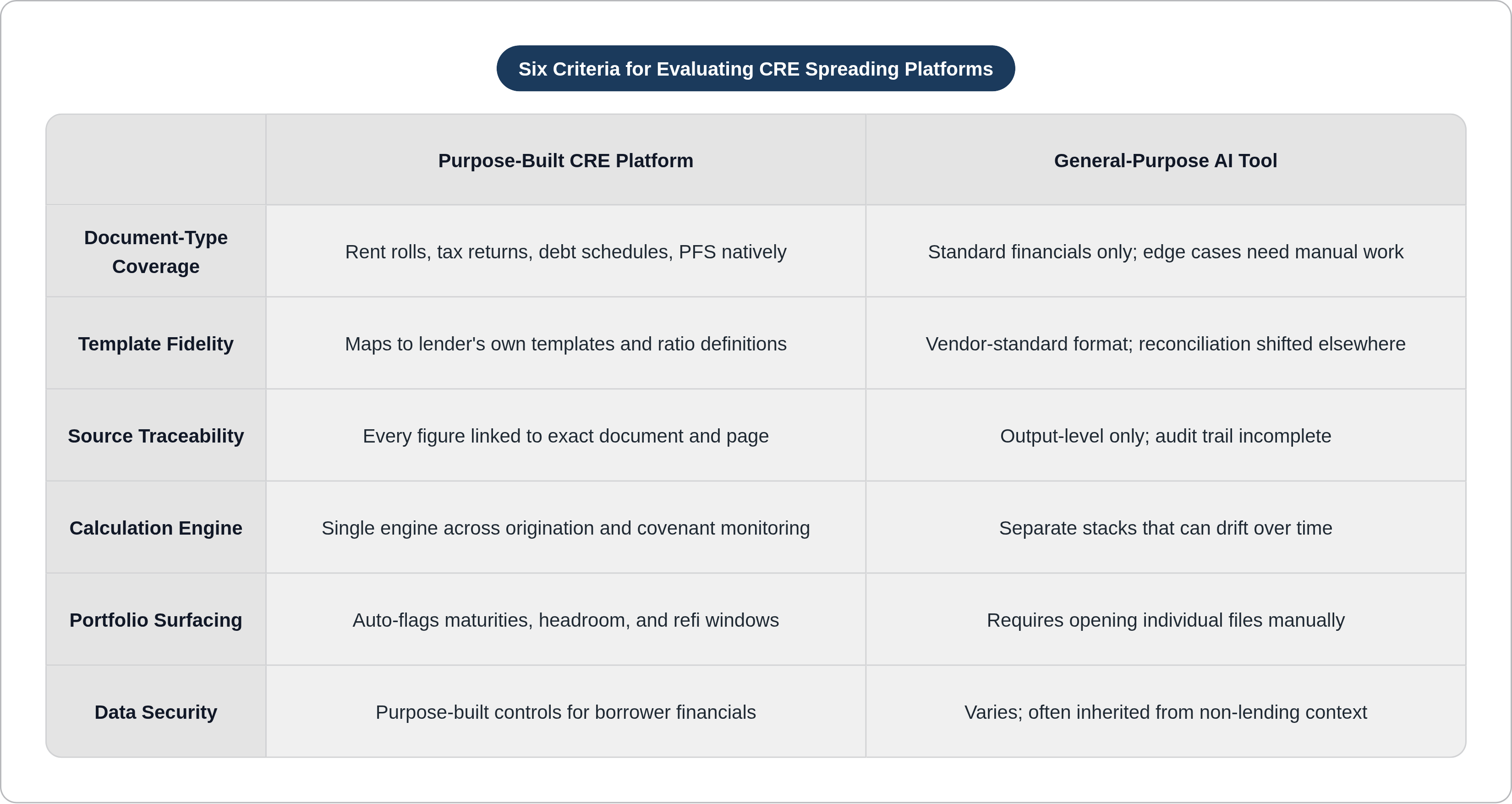
Six things separate a platform that actually fits CRE lending from one that just looks the part in a demo.
Document-type coverage comes first: does it natively handle the full CRE mix (rent rolls, operating statements, tax returns, debt schedules, personal financial statements) or only the standard financial statements that make for an easy sales pitch? Template fidelity comes second: does it map to the lender's own spreading templates and ratio definitions, or force everything into a vendor-standard format that just moves the reconciliation work somewhere else? Third is source traceability: can every figure be traced back to the exact document and page it came from, meeting the expectations laid out under current interagency guidance?
Fourth, and this one gets skipped constantly: is there one calculation engine running both origination spreading and ongoing covenant testing, or are those two functions sitting on separate stacks that will eventually disagree with each other? Fifth is portfolio-level surfacing: does the platform flag maturing loans, tightening covenant headroom, and refi windows automatically across the whole book, or does someone still have to open a hundred individual files to find the same information by hand? Sixth is security and data handling, and given the sensitivity of borrower financials moving through these systems, solid data privacy practice isn't a selling point, it's table stakes.
A few platforms are worth running through these six tests directly. Hypha was built specifically for CRE asset intelligence by people who've closed billions of dollars in CRE transactions themselves, and its pieces (automated spreading mapped to a lender's own templates, covenant monitoring, source-cited extraction, portfolio dashboards) come as one connected system rather than a general AI tool bent into a lending shape after the fact. Baker Hill runs a documented AI lending platform with spreading and origination workflow tools built for commercial lenders. aLoan.ai covers the document types common across CRE and C&I lending, with audit-trail features built with examiner review in mind. Beyond these three, the category is crowded and uneven. Some platforms were built for CRE from the ground up; others got adapted from broader financial services tools or from horizontal AI products never designed with a rent roll in mind, and running any candidate through the six criteria above tends to surface which camp it falls into fairly fast.
One honest caveat before closing: a large majority of CRE firms already use AI for document analysis in some form, per Dealpath's survey, which means most lenders reading this aren't starting from zero. The real question isn't whether to adopt automated spreading, it's whether the tool already sitting on the desk clears these six bars, or whether there's a gap that a more purpose-built platform would close.