CRE Debt Service Coverage Ratio Calculation Methodology
Lenders use different adjustments to NOI and debt service.

DSCR is one formula and about a dozen ways to get there. Divide net operating income by annual debt service and you get a number: above 1.0x, the property throws off more cash than it needs to cover its loan payments; below 1.0x, it doesn't. A property with sufficient NOI against lower annual debt service clears at 1.25x, meaning income covers the loan by that margin. Simple enough that you could explain it to someone at a dinner party before the appetizer arrives.
Except the formula is the easy part. What goes into NOI, and what counts as debt service, is where lenders, borrowers, and appraisers quietly diverge, and where two people can run the same deal through the same math and land on different answers, each one defensible on its own terms. The number that actually clears underwriting isn't the DSCR you calculated. It's the DSCR your lender calculated, using their credit policy, their adjustments, their view of what's real income and what's a rounding trick. Everything below walks through where that gap opens up, deal type by deal type, so you can see it coming instead of finding out at the closing table.
How NOI is built, and where the construction goes wrong
NOI starts as gross income, minus vacancy and credit losses, minus operating expenses. Operating expenses generally means property taxes, insurance, maintenance, and management fees. What gets left out, in theory, is capital expenditures, depreciation, interest payments, and income taxes. That's the textbook version, and it holds up fine until you hit the exclusions, which is where the textbook stops being useful.
Take depreciation. It's a non-cash expense, so you'd think everyone treats it the same way. They don't. Some lenders back it out entirely; others fold it into total expenses depending on internal policy, and that one decision, buried in an appendix somewhere, can move NOI enough to flip an approval into a decline. CapEx has the same problem. Most underwriters exclude it as a one-time, non-recurring cost, but "how and when" is a house-by-house rule, not an industry standard. Ask five credit officers how they treat a roof replacement in year three of a hold period and you'll get five slightly different answers.
Then there's the income side, which breaks in a more basic way. Potential rental income is not the same thing as effective gross income; you have to apply a realistic vacancy and credit loss assumption before you ever get to operating expenses. The common mistake, and it's common enough to be almost routine, is running the calculation off budgeted or scheduled rent without adjusting for actual vacancy. That produces an NOI that looks great on a slide and falls apart under a trailing-twelve-month statement. The Urban Land Institute's 2024 Emerging Trends report flagged exactly this: mismatches between rent rolls, operating statements, and offering memorandums show up as one of the most frequent issues in early due diligence. Not a rare edge case. A pattern.
A modest overstatement in NOI can shift DSCR by roughly 0.06 to 0.10x. That's the difference between clearing a 1.25x threshold and missing it. Five percent isn't a wild number, either; it's the kind of gap that shows up from a lazy vacancy assumption or an optimistic rent roll nobody double-checked. The fix isn't complicated, just tedious: rebuild NOI to match the specific lender's credit policy before you present the deal, not after they hand back a redline.
Debt service inputs and how loan structure changes the denominator
If NOI is the part everyone argues about, debt service is the part everyone assumes is fixed. It isn't. Annual debt service covers principal amortization, interest, and any fees baked into the loan structure, and depending on how that loan is built, the denominator moves around more than people expect.
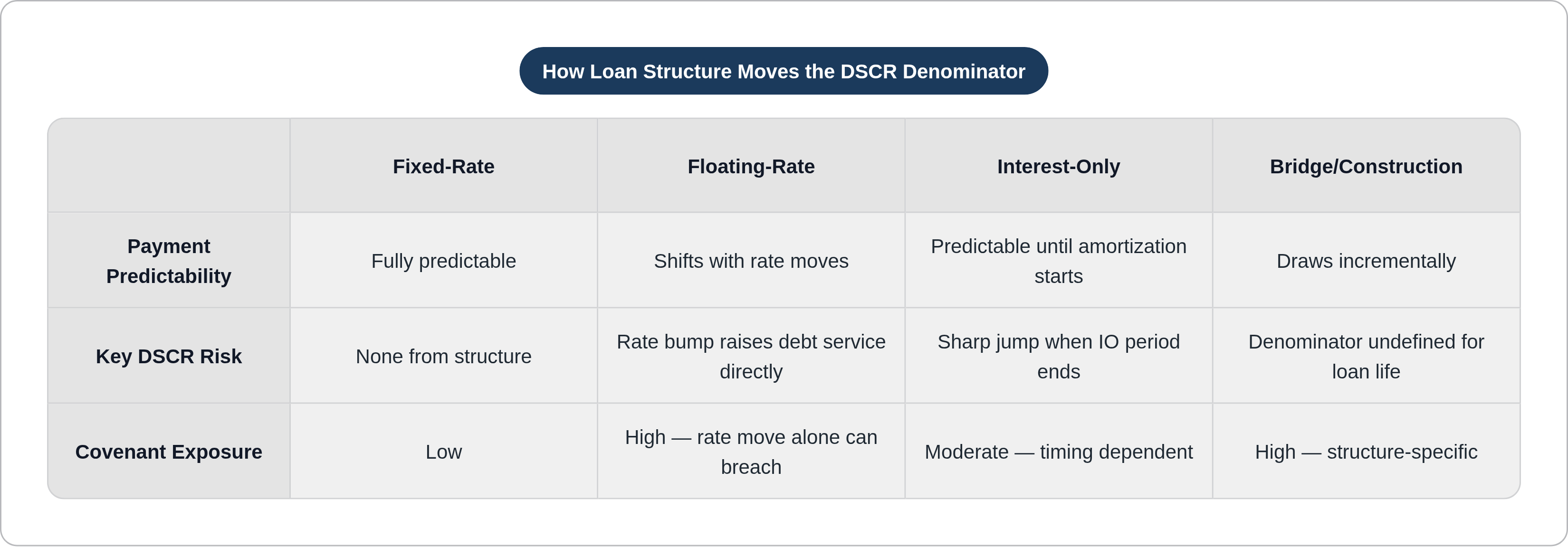
Fixed-rate loans are the easy case: predictable payment, predictable denominator, no surprises. Floating-rate loans are a different animal. A 1% rate bump on a sizable loan adds tens of thousands of dollars to annual debt service, and that flows straight into DSCR with no offset unless NOI happens to rise at the same time, which it usually doesn't. Interest-only periods create the opposite illusion: DSCR looks strong during the IO window because there's no principal component dragging the payment up, but that number doesn't reflect what happens the day amortization kicks in and the full payment lands.
Amortization schedule matters too, and it's easy to gloss over. A 25-year schedule and a 30-year schedule on the identical loan produce two different annual payments and two different DSCRs, purely from a term choice that has nothing to do with the property's actual performance. Bridge and construction loans add another layer: debt service might draw incrementally, or a reserve account might be structured to cover payments during lease-up, which means the "denominator" isn't even a single number for the life of the loan.
The practical rule here is straightforward, even if it's frequently ignored: model DSCR for a refinance using the actual structure of the new loan, not a generic stand-in. And this matters after closing too, not just at origination. A variable-rate loan bakes interest rate risk directly into covenant compliance. A rate move that felt entirely survivable when the deal was signed can trip a DSCR covenant with zero change in how the property is operating. The building didn't get worse. The denominator got bigger.
In-place versus pro-forma DSCR and what lenders actually accept as evidence
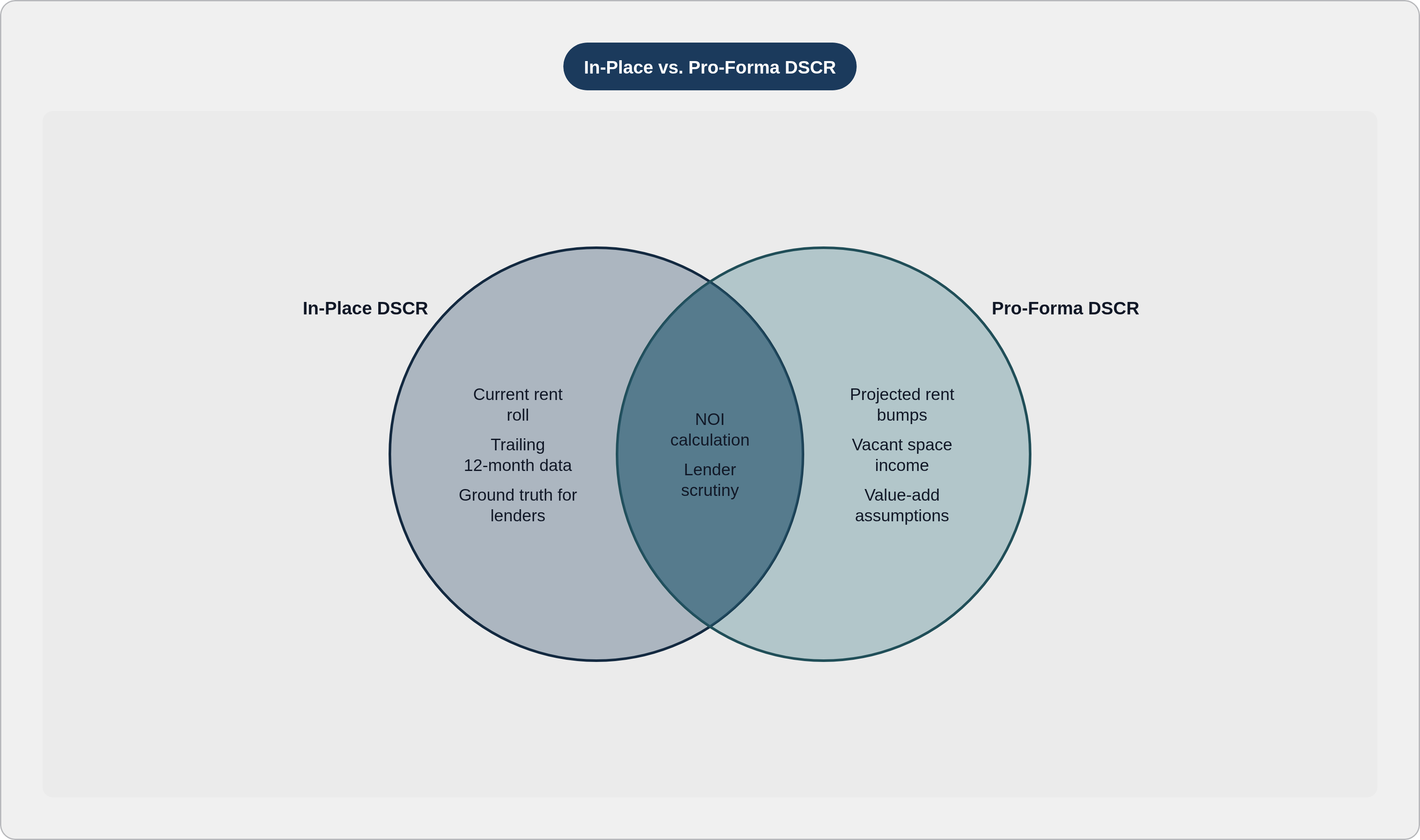
In-place DSCR is calculated off what's actually happening: the current rent roll, trailing twelve months of operating statements, the property as it exists today. Lenders treat this as ground truth. Pro-forma DSCR is forward-looking; it bakes in projected rent bumps, vacancy burning off over time, cost savings from a management change, or income from space that isn't leased yet. It's the backbone of every value-add and lease-up pitch you'll see.
The gap between the two is where deals live or die, and it comes down to one question a lender will ask, politely but repeatedly: what evidence backs this up? Not what the sponsor believes will happen. What's actually documented. A defensible pro-forma usually has comparable lease transactions from the submarket, signed letters of intent or executed leases on the vacant space, historical rent growth specific to that asset class and location, and vacancy assumptions that lean conservative rather than best-case. Four pillars, and if one is missing, the whole projection starts to wobble under questioning.
Here's the trap: a deal underwritten on pro-forma DSCR, if a lender later reclassifies it as in-place, produces a materially different result, sometimes no approval at all. So the practical move is to walk in with both numbers ready, in-place and pro-forma side by side, and be able to defend every single assumption in the pro-forma line by line. Showing up with only the optimistic number and no supporting data isn't confidence. It's a gap lenders have seen enough times to spot from across the room.
Seasonal income patterns, trailing averages, and when point-in-time DSCR misleads
Not every property earns money at a steady pace across twelve months, and that's not a red flag, it's just how certain asset classes work. Student housing is the clearest case: DSCR might sink well below 1.0x over the summer when campus empties out, then climb past 1.5x during the academic year. Grab a single quarter's snapshot and you'll misread the property no matter which quarter you happen to pick, because neither one tells the full story on its own.
Resort and hospitality-adjacent properties run into the identical distortion, just flipped. Peak season income looks fantastic and quietly hides an off-season shortfall, if the analysis leans on one strong quarter instead of the full year. That's why a lot of lenders test seasonal assets against a trailing twelve-month average rather than any single quarter: it keeps a predictable low season from tripping a covenant that was never actually broken in any real sense.
Which raises a question worth asking before signing anything: does the loan agreement even specify TTM testing, or does it test quarterly? That distinction determines whether a normal summer dip becomes a technical breach or just gets smoothed out by the averaging method. It's the kind of clause that sits on page 40 of a loan agreement and nobody notices until August. So the practical move for borrowers on seasonal assets is to model DSCR quarter by quarter well before closing, specifically to find any window where a technical breach might occur under the lender's actual testing schedule, not the schedule you assumed they'd use.
Global DSCR and how multi-asset portfolios are evaluated differently than single properties
Standard DSCR looks at one property. Global DSCR zooms out and aggregates coverage across a borrower's entire portfolio, and lenders reach for it selectively, usually with experienced, multi-asset sponsors where the strength of the broader book is genuinely relevant to the credit decision.
Here's how it plays out in practice: an office asset limping along at 0.9x DSCR can get absorbed into a portfolio that also holds strong multifamily and industrial assets, and the blended global ratio clears the lender's requirement even though that one office building, standing alone, would not. That's not a loophole anyone's exploiting. It's a lender making a deliberate call that the portfolio, taken as a whole, represents acceptable risk, weak link included.
The catch is that global DSCR can obscure exactly the kind of asset-level trouble that matters most. A lender leaning on the blended number without also tracking individual property performance can miss deterioration in one asset until it's already spreading into others. Worth asking, if you're a sponsor structuring a request: does this lender underwrite on a global basis or strictly asset by asset? That answer changes which properties you'd want to present together and how you frame the request from the very first conversation.
What lender thresholds actually are and why they move with market conditions
There's no single DSCR minimum that applies everywhere; requirements typically fall between 1.20x and 1.50x depending on lender type, asset class, and deal structure. A stabilized property with long-term leases and creditworthy tenants can often qualify at the lower end. Something riskier, shorter leases, weaker tenant credit, needs a fatter cushion. Commercial banks generally want at least 1.25x, and prefer higher on anything already stabilized.
Thresholds aren't fixed in stone either; they drift with the market. In a rising-rate environment, lenders tend to raise minimum DSCR requirements on refinancing deals, and a shift from 1.25x to 1.35x isn't unusual when debt service costs are climbing across the board. Bridge and value-add lenders typically sit higher still, 1.35x to 1.50x or more, to account for the execution risk baked into those deals. And for the property types carrying more headline risk right now, office and retail in particular, requirements of 1.30x or higher show up even on assets that are already stabilized.
There's a regulatory layer underneath all of this too. The OCC's Fall 2025 Semiannual Risk Perspective flagged credit conditions and refinancing risk in CRE as something examiners are actively watching, checking whether origination files show consistent credit standards, which nudges banks toward tighter, more documented DSCR policies across the board. Basel III capital treatment adds a structural incentive on top: loans with higher DSCR get more favorable regulatory capital treatment, so banks have a built-in reason to document coverage carefully at the point of origination, not just check a box.
And DSCR never operates alone. A deal can clear its DSCR hurdle and still get declined because the loan-to-value ratio is too aggressive; both metrics have to land in range at the same time. Per CBRE, average LTVs in 2024 came in around 63.3%, up from roughly 62.2% the prior year, a modest climb that still matters when it's stacked against tighter DSCR requirements on the same file.
How the maturity wall is stress-testing DSCR at scale in 2025 and 2026
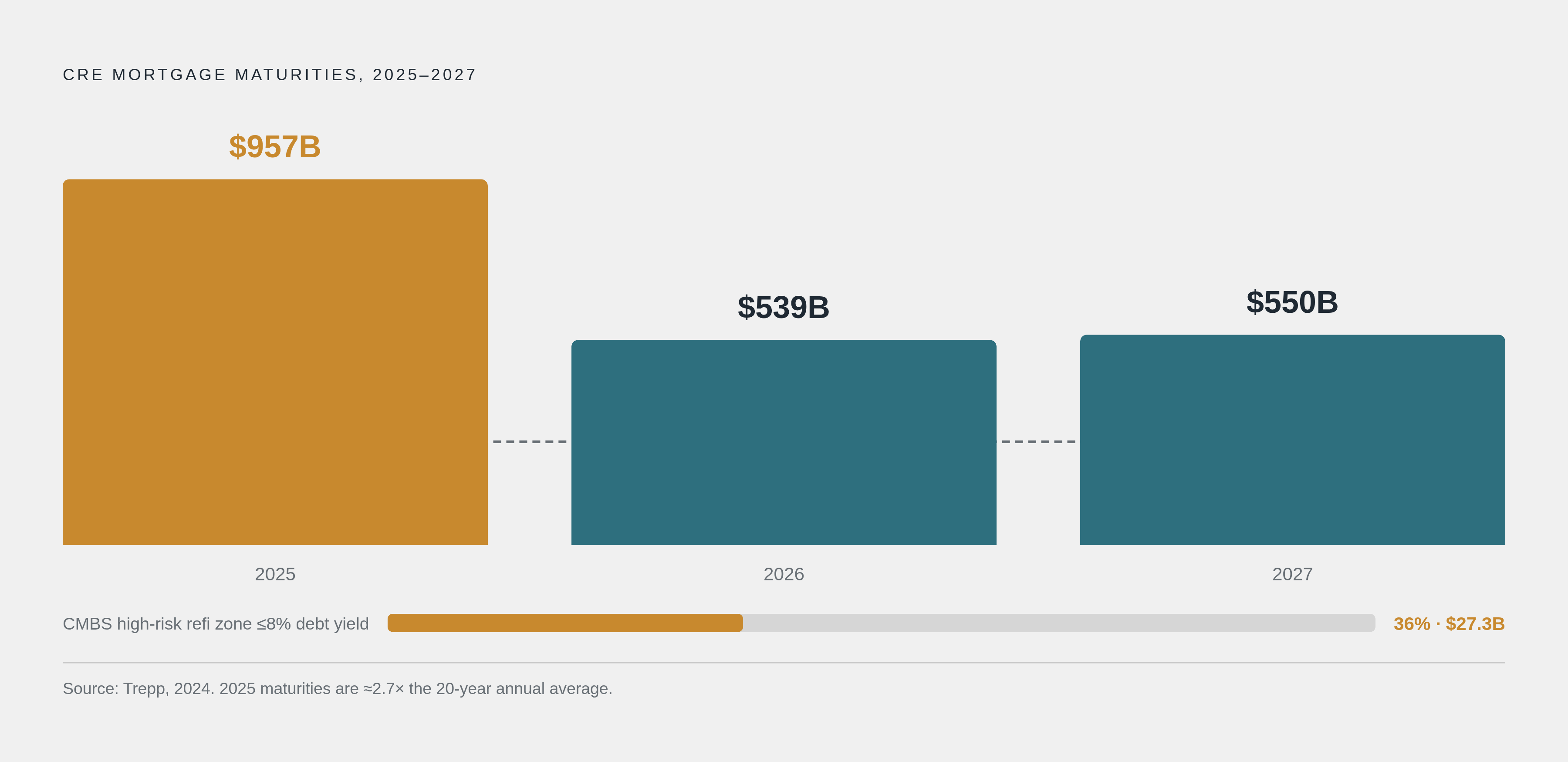
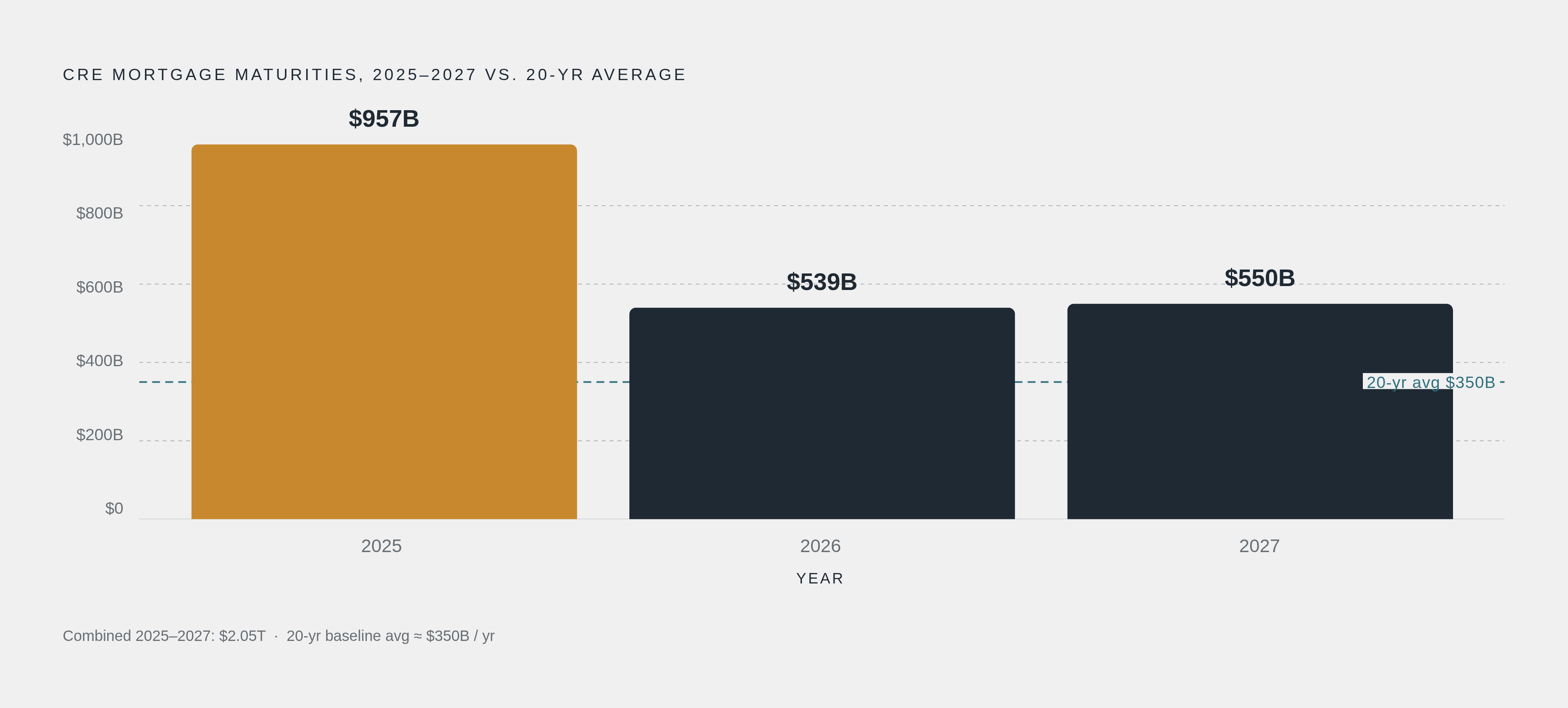
Here's where all this theory turns into a very large, very real problem. CRE mortgage maturities hit $957 billion by the end of 2025, with another $539 billion coming due in 2026 and $550 billion in 2027, a combined $2.05 trillion against a 20-year average of roughly $350 billion a year, according to Buchanan Street Partners. That's not a gradual wave. It's a wall, and it's arriving while rates sit well above where most of these loans were originally priced.
The same NOI that produced a comfortable 1.30x DSCR at origination can produce 1.05x or lower once it's run against today's debt service costs, with nothing about the property itself having changed. Trepp's data on 2024 through 2025 CMBS maturities draws the line sharply: loans that refinanced successfully carried average debt yields of 13% to 14%, while loans that failed to refinance averaged closer to 9%. That gap, roughly four to five points of debt yield, is the difference between survival and default in this cycle. Roughly 36% of hard CMBS maturities, about $27.3 billion, sit at debt yields of 8% or below, which Trepp calls the highest-risk zone for refinancing.
Office is the sector showing the strain most visibly. CMBS office delinquency hit 12.34% in January 2026 before easing slightly to 11.4% in February. Of 345 office loans totaling $13.72 billion coming due by the end of 2026, $2.38 billion carries DSCRs of 1.09x or below, the group most exposed to refinancing failure. And here's the part worth sitting with: these aren't properties missing their monthly payments. They're cash-flowing fine on an operational basis. They just can't clear the DSCR bar lenders now require, because rates pushed the denominator up without NOI following along. Which means stress-testing DSCR against rate moves, vacancy shifts, and expense growth isn't the cautious, belt-and-suspenders move anymore. It's the baseline for understanding what you're actually underwriting.
Stress testing DSCR beyond the base case and building scenarios that reflect real downside
A DSCR figure is a snapshot of one moment, not an ongoing account of performance. What lenders, and honestly any sponsor who's been through a downturn, actually want to know is how that coverage holds up when conditions turn, because the base case is rarely the case that determines whether a loan survives.
The simple version is sensitivity analysis: run the numbers with a 5% vacancy increase, a significant jump in expenses, a 100-basis-point rate move, one at a time or stacked, and see where DSCR lands against the covenant floor. A property sitting at 1.35x looks comfortably cushioned until you run that 5% vacancy bump and watch it drop to 1.15x. Suddenly the cushion isn't much of a cushion at all, and the covenant risk that looked theoretical is now one bad leasing quarter away from real.
The more rigorous version uses probabilistic scenarios, Monte Carlo simulation being the standard tool, assigning likelihoods to combinations of rate moves, vacancy shifts, and expense growth happening together, rather than testing one variable in isolation. Instead of a single DSCR number, you get a distribution: a range of outcomes with probabilities attached, which is a far more honest picture of risk than any single point estimate.
What you do with that distribution matters as much as building it. Find the specific conditions under which DSCR actually breaches the covenant, and be honest about how likely those conditions are to occur. Check whether the loan structure, reserve accounts, cash management triggers, curtailment provisions, gives anyone enough time to react if DSCR starts sliding, rather than discovering the breach the same day it happens. And for anything with floating-rate exposure, run rate scenarios directly against the loan's covenant testing schedule so you know exactly when and under what conditions a breach would actually get tested, not just whether one is mathematically possible. Lenders on bridge, transitional, and refinance deals are running these scenarios themselves regardless of whether the sponsor does; a base case with no downside modeling behind it tends to draw more questions, not fewer.
Covenant monitoring after closing and what DSCR compliance requires operationally
Closing isn't the finish line, it's the start of an ongoing obligation, and this is the part of DSCR that gets the least attention despite being where a lot of borrowers actually get tripped up. A covenant isn't a number you hit once at origination and forget about. It's tested on a schedule, quarterly in most cases, and every test is a fresh opportunity to either pass comfortably or discover a problem you didn't see coming.
Operationally, that means someone on the borrower's side has to actually track DSCR against the covenant threshold continuously, not scramble to reconstruct it the week before a lender's reporting deadline. It means knowing, ahead of time, whether the lender tests on a trailing-twelve-month basis or a point-in-time basis, because as covered earlier, that single distinction can decide whether a seasonal dip is a real breach or a non-event absorbed by the averaging window. It means understanding what remedies exist in the loan agreement before you need them: cash sweep provisions, additional reserve requirements, cure periods, because finding out what your options are after a breach has already occurred is a much worse conversation than knowing beforehand.
The maturity wall data from earlier makes this less abstract than it sounds. Loans that were healthy at origination are running into DSCR trouble now, not because anyone got sloppy running the property, but because the environment shifted underneath the loan structure. Ongoing monitoring is what catches that shift while there's still time to act, refinance early, negotiate a modification, build additional reserves, instead of finding out at the maturity date that the number doesn't clear anymore. DSCR was never a one-time hurdle to clear at closing. It's a number you live with for the life of the loan, and treating it that way from day one is the difference between managing a covenant and being managed by one.