Financial Spreading Software for CRE Lenders
Automation that traces CRE numbers back to source documents survives regulatory scrutiny.

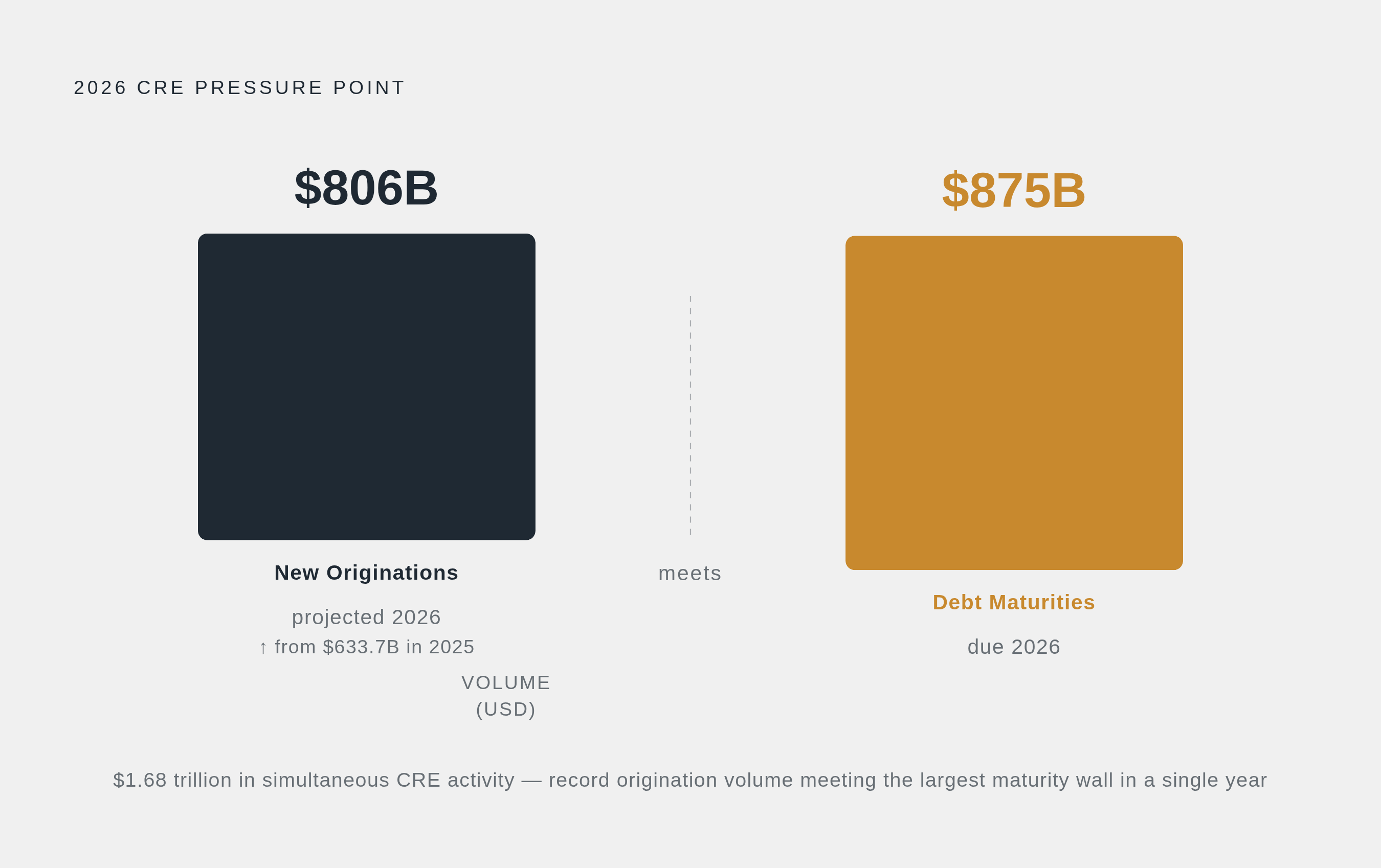
Financial spreading turns messy borrower paperwork into numbers a lender can actually underwrite against. Simple enough, until you look at what "messy" means in commercial real estate: layered entities, K-1 schedules, rent rolls, and tax returns that frequently disagree with each other. The Mortgage Bankers Association projects $806 billion in commercial mortgage originations for 2026, up from $633.7 billion in 2025, with $875 billion in CRE debt coming due that same year. Volume and refinancing pressure are landing at once, and every weak spot in the spreading process is about to get tested, whether the bank is ready for it or not.
What financial spreading actually involves in a commercial real estate deal
Spreading means pulling numbers out of borrower documents, putting them into a standard format, and reading them for credit risk. Tax returns, rent rolls, T-12 operating statements, entity financial statements: all of it gets pulled apart and put back together so a credit team can see what it's actually lending against.
The document list for a CRE deal runs longer and stranger than most outsiders expect. There's the Form 1040 with Schedule C and Schedule E attached, the Form 1065 for partnerships and LLCs with K-1 schedules trailing behind it, and Form 1120 or 1120-S for corporations, each with its own shareholder K-1s. Form 8825 shows up when rental activity sits inside a partnership or an S-corp. Add personal financial statements, debt schedules, accountant-prepared compilations, the occasional amended return, then the property-level stack of T-12s, rent rolls, offering memorandums, and appraisals. It piles up fast, and nobody hands it over in order.
What separates this from spreading a small business loan or a consumer credit file is the entity layering. A single CRE deal often has a borrower, one or two guarantors, and several operating entities, each with its own tax history and its own quirks. The analyst traces ownership across those entities and builds one view of the real credit exposure sitting behind the deal. Typing numbers into boxes takes time, sure, but the real risk hides in reconciling a clean-looking spread against a schedule nobody actually checked. This happens more than lenders like to admit, and it tends to surface at the worst possible time, usually right before close.
How much time manual spreading actually consumes, and what that costs a deal
A clean Form 1040 takes an experienced analyst twenty to thirty minutes to spread. A Form 1065 with continuation sheets and several K-1s can eat an hour, sometimes two, depending on how many partners are involved and how well the accountant organized things. Some of these packages arrive out of sequence, half-scanned, missing a page nobody notices until week three.
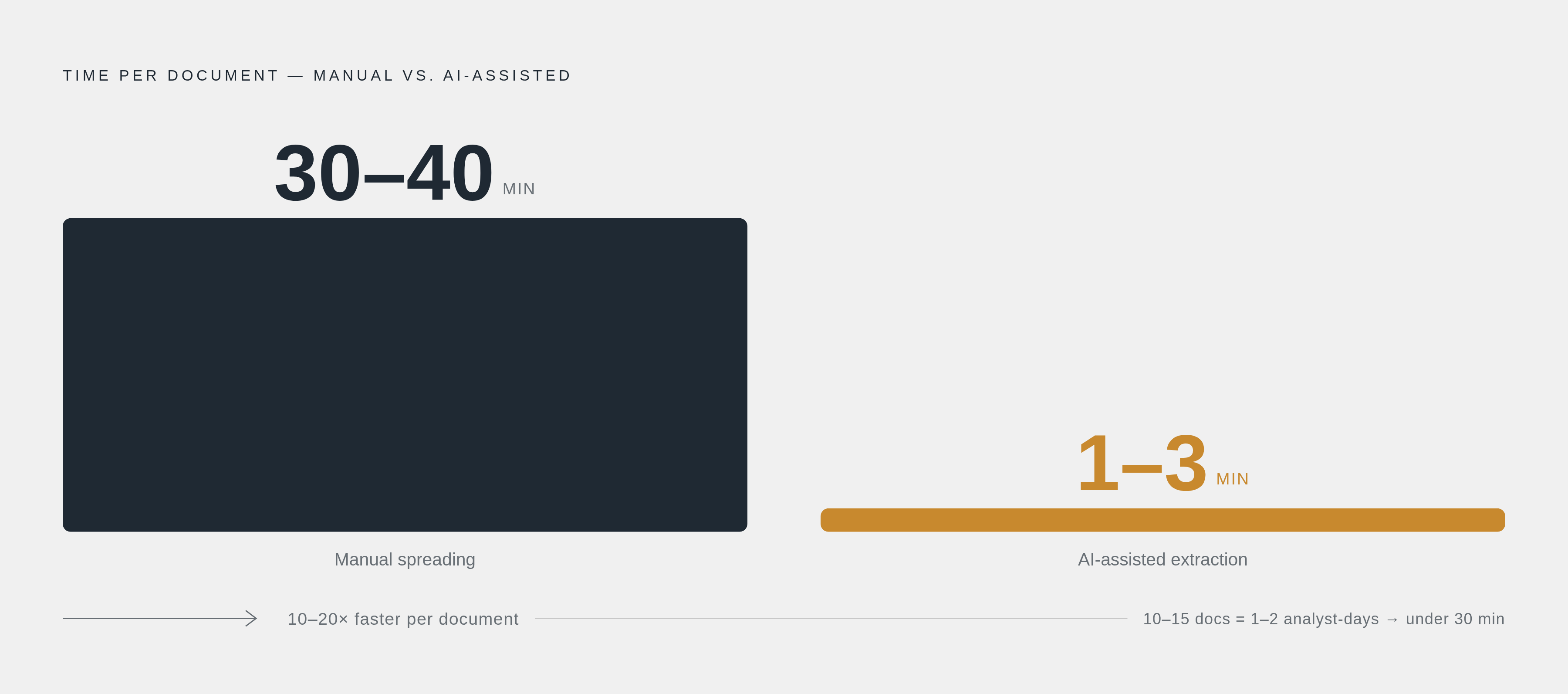
Multiply that across a typical deal. Borrower, one or two guarantors, three years of returns, three to five entities: that's ten to fifteen tax returns needing a spread before anyone gets near a credit decision. Call it one to two full analyst-days per deal, assuming nothing gets kicked back for a missing schedule. Something usually does.
In a stable market, that's a grumble-at-your-desk annoyance. But in a 2026 origination environment running at $806 billion, a two-day lag per deal compounds across an entire pipeline fast. A competitor who turns around a term sheet three days faster takes the deal regardless of whose underwriting was more careful. Time doesn't just cost money here; it costs the deal outright.
The quieter cost is what gets missed rather than what gets delayed. Manual spreading carries a real error rate, and reconciliation eats even more analyst hours than the first pass did. In a document package running fifty or eighty pages, a guarantor's Schedule E or an amended return slips through unnoticed more often than anyone wants on the record. Nobody plans to miss it; it just happens when the stack is thick and the deadline was yesterday.
Where generic automation tools break down on CRE document complexity
A lot of platforms marketed as "automating spreading" mostly automate document intake. They move paper from one folder to another faster, but that doesn't touch the judgment work an analyst still has to do by hand. Calling that a productivity upgrade overstates what actually changed.
Others got built for consumer lending or general workflow management, then got repurposed for commercial credit later. They weren't designed around tax return structures, and it shows. The clearest failure point is entity organization: most generic tools can't take financials from three affiliated entities and build a consolidated view on their own. The analyst rebuilds that view by hand anyway, which quietly defeats the whole point of buying the tool in the first place.
Tax form variability trips these systems up in specific, predictable ways. A tool that pulls a clean 1040 fine might fall apart on a 1065 carrying five K-1s, or an 1120-S with shareholder distributions that don't map onto a template built for simpler returns. Analysts keep finding that the hardest parts, K-1 tracing, multi-entity consolidation, normalizing cash flow across affiliated businesses, stay stubbornly manual even after the software gets installed and the invoice gets paid.
Industry observers flag the same pattern at the institutional level: banks that picked CRE-specialized platforms report better outcomes than banks that tried adapting general-purpose enterprise AI to commercial credit work. Point a tool built for one problem at a different problem, and you get roughly this gap, every single time.
There's a sharper risk buried in here too. Generic AI tools can spit out answers that look polished and confident with no way to trace that number back to the document it came from. Tracing outputs to source happens to be exactly what regulators are asking about now, which brings us to the next problem.
The audit trail requirement that spreading software cannot treat as optional
Every number on a spread should trace back to a specific page in a specific document, on demand, in real time, click-to-source, on the live file, right now, not eventually.
This is a governance requirement first, existing to satisfy examiners more than to make an analyst's afternoon more pleasant. April 2026 brought revised interagency guidance, SR 26-2 and OCC Bulletin 2026-13, replacing SR 11-7, and the standard reads plainly: the bank has to explain how every analytical output got produced, and every manual override needs a documented trail sitting behind it.
Tools that can't show click-to-source on a live file don't clear that bar. Examiners want documentation done in the moment, on request, regardless of what a system could theoretically reconstruct after the fact given enough time. A spreading tool that produces the right number without a traceable path back to its source creates the same documentation problem as a manual spread that never got saved properly. Correct and undocumented is still a liability.
There's a quieter payoff too, separate from the regulatory stick. When an analyst inherits a deal from someone who left the bank or switched teams, a spread with built-in source citations explains itself. No phone call, no guessing where a number came from six months back.
What purpose-built CRE spreading software does differently
Purpose-built tools treat the entire CRE document stack as the normal case, not an exception needing a manual workaround. An edge case that shows up on every single deal isn't really an edge case anymore. It's just the job description.
Multi-entity organization gets built into the architecture instead of bolted on after the fact. The platform reads guarantor structures and layered ownership on its own and surfaces a consolidated view without an analyst rebuilding it by hand. Industry speed benchmarks put AI-assisted extraction at one to three minutes per document, against thirty to forty minutes manually, though that number only holds if the tool actually handles the document type correctly to begin with. A fast wrong answer isn't progress; it's just a quicker way to be wrong.
Some platforms build scenario stress-testing right into the spread: interest rate shocks, vacancy dips, expense inflation, all modeled against the extracted financials instead of getting exported to a separate spreadsheet someone opens three days later, if they open it at all. And the data layer built at origination should carry forward into ongoing monitoring, so covenant tracking at renewal doesn't mean re-typing numbers that already existed six months earlier.
Templates should reflect the bank's own credit policy, shaped around the bank's needs rather than a generic format the bank has to bend itself around to fit. Some platforms, like Hypha, a CRE-focused AI platform that automates financial spreading, extracts fields from deal documents with source citations, and generates portfolio dashboards from a firm's own templates, are built around exactly that premise. And the audit trail described above should ship as a standard feature, not something a sales rep tries to upsell in month two.
The vendor landscape: what leading platforms offer CRE lenders today
nCino builds spreading and credit analysis into a full commercial lending platform serving over 2,700 customers, running one shared data model across the whole loan lifecycle. That matters most for institutions trying to standardize everything, origination through servicing, on a single architecture instead of several stitched together separately.
Baker Hill NextGen bundles spreading into the loan origination system community banks already run day to day. If a bank already runs Baker Hill end to end, the integration question mostly answers itself. That's half the appeal right there.
SpaceQuant uses its own AI models to extract and analyze unstructured property financial documents: rent rolls, operating statements, appraisals, offering memorandums. It delivers real-time property analysis through dashboards, and its strength sits at the property level. Entities and tax returns are a thinner story, worth knowing before evaluating it for K-1 tracing.
Newgen Software offers CRE-oriented spreading and portfolio monitoring capabilities, covering the workflow from initial underwriting through ongoing credit watch.
Moody's Lending Suite is positioned toward risk analytics and regulatory reporting within the commercial lending space, with less emphasis on document extraction.
Abrigo serves community and regional banks with credit workflow and compliance tooling, with a focus on regulatory and portfolio risk needs.
Kolena focuses on AI-driven approaches to CRE workflows, and is positioned for institutions that want to build underwriting logic around their own credit policy rather than a fixed template.
Whatever platform a lender looks at, the same four questions keep coming back around. Does it handle the full CRE document stack natively, and does it cite sources back to the live document? Does it organize multi-entity structures without manual rework, and does the spreading data flow into monitoring without getting re-typed later?
How spreading software connects to portfolio monitoring and covenant compliance
The spread produced at origination shouldn't sit frozen as a one-time snapshot. It should become the baseline that renewal decisions, loan modifications, and covenant checks get measured against later. Treating it as disposable paperwork wastes the single most valuable output of the entire underwriting process.
CRE delinquency at the largest US banks climbed to 1.86% in the third quarter of 2025, up 23% year over year according to Federal Reserve data. Hard to read that number as purely a credit failure; some of it has to be a monitoring failure too. The warning signs were probably sitting in the financial data well before delinquency showed up; they just weren't caught in time, because nobody was looking at the right file at the right moment.
Covenant monitoring needs the same data infrastructure spreading already produces. If the spread lives in a static PDF, or worse, a spreadsheet nobody else can find, covenant tracking reverts to manual calendar reminders and periodic re-entry: the exact workflow spreading software was supposed to replace in the first place. With $875 billion in CRE debt maturing in 2026, lenders sitting on structured portfolio data can spot refinancing candidates, flag loan-to-value deterioration, and prioritize outreach before a borrower calls in a panic. Lenders without that structure review loans one at a time, hoping nothing slips through the gaps.
The upside runs the other direction too. Automated surfacing of refi windows, lease expirations, and covenant triggers across an entire book falls out naturally once the spreading data is structured properly, rather than needing a separate analytics project bolted on afterward. An early warning system built on that foundation gives credit teams time to actually act on what they see. The same warning sign, arriving instead at the delinquency stage, gives them nothing but cleanup duty.
What lenders should actually evaluate when selecting a spreading platform
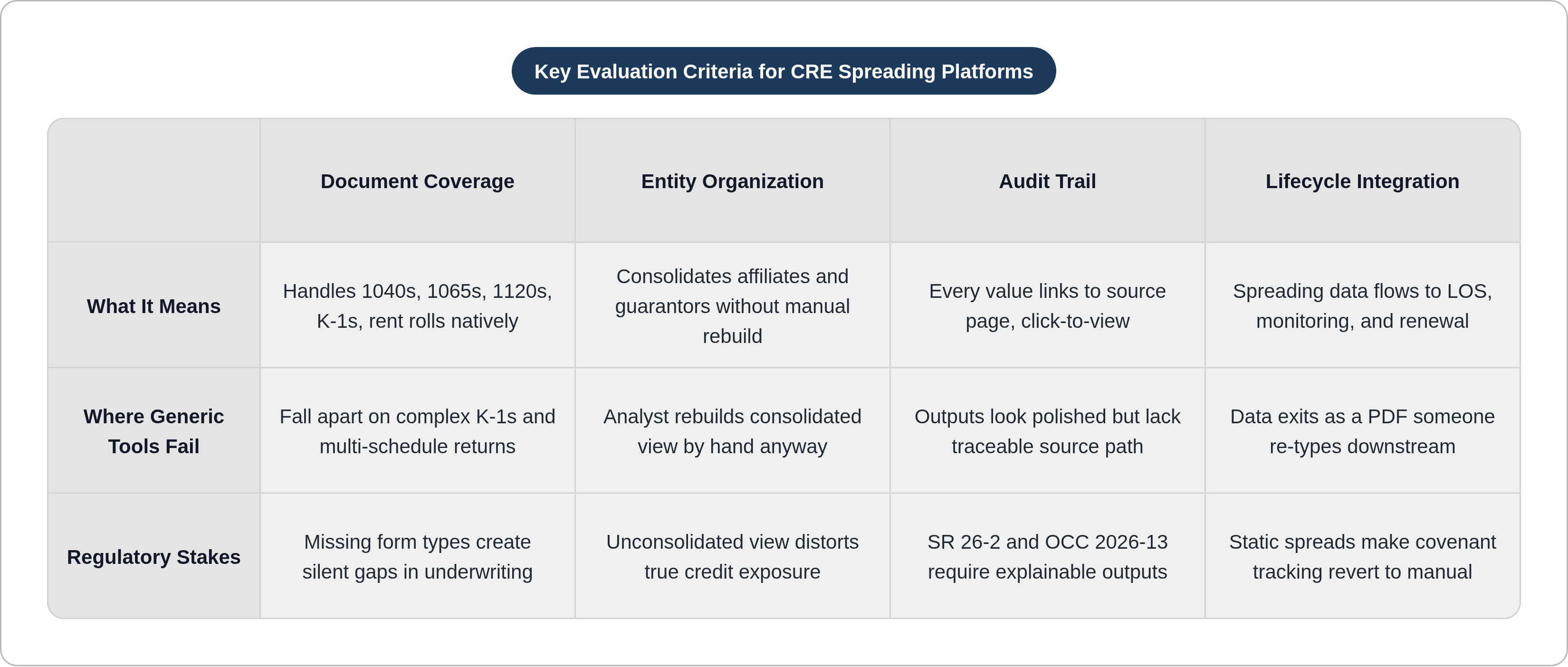
Document coverage comes first. Does the platform handle 1040s, 1065s, 1120s, 1120-S returns, Form 8825, K-1 schedules, rent rolls, and T-12s natively, or does it demand a manual override the moment a return gets complicated? Most fail this quietly, not loudly.
Entity organization matters just as much. Can it consolidate financials across affiliates and guarantors on its own, or does an analyst end up rebuilding that consolidated view by hand anyway? That's the exact problem the software was supposed to solve.
Audit trail outweighs any line item on the sales sheet. Every extracted value should link to a specific page in the live source file, viewable on click, not reconstructable after the fact if someone happens to ask three months later.
Template control gets underrated by vendors, understandably, since it's not something they volunteer up front. Does the bank own its spreading templates and credit policy logic, or is it locked into whatever format the vendor decided made sense five years ago and never revisited since?
Integration with the rest of the loan lifecycle decides whether the tool earns its keep long-term. Does spreading data feed the loan origination system, covenant monitoring, and renewal workflow on its own, or does it spit out a PDF someone re-types downstream anyway?
Speed needs testing under real conditions, not the vendor's demo conditions. The one-to-three-minute benchmark only holds up if the tool handles the lender's actual deal mix. Ask any vendor to run a real multi-entity CRE package through it, not the clean 1040 they picked because it makes the demo look good.
Regulatory posture needs a direct check too. Does the platform's output meet the documentation bar set by SR 26-2 and OCC Bulletin 2026-13: explainable outputs, override trails, files that are examiner-ready without a week of extra prep beforehand?
Whether AI belongs in spreading workflows at all isn't really the live question anymore. What's left is narrower and more useful: which platform actually fits the complexity of the deals a given lender closes, rather than the complexity a vendor's slide deck assumes it closes.