Pro Forma Financial Statements for CRE Deals
A pro forma is only as good as the assumptions buried inside it.

A pro forma is just a multi-year forecast of what a property will earn, spend, and pay its lenders under a specific set of assumptions. Read it right, and it answers one question: will this asset produce enough to justify the money going into it? Read it wrong, and you've financed someone's optimism.
That's really what this whole piece is about. Every number on a CRE pro forma traces back to a judgment call someone made, and the quality of the deal depends almost entirely on whether those judgment calls hold up. Commercial real estate gets valued by applying a cap rate to stabilized net operating income, which means the pro forma isn't a side document; it's the valuation model itself. Sponsors typically build these out five to seven years to line up with their exit strategy, and every year in that window carries assumptions that compound. Equity investors read a pro forma to see if the deal pencils and what their return looks like at exit. Lenders and asset managers read the same document to see if the property can pay its debt, and what happens when it doesn't.
Here's the wrinkle nobody says out loud at the closing table: a pro forma prepared by a broker for a sale is going to show the rosy version, because that's the broker's job. It's not lying, exactly. It's advocacy dressed up as arithmetic. The underwriter's job is to figure out which assumptions are grounded and which ones are wishful thinking wearing a suit. That's why you always read the pro forma alongside the trailing-twelve-month financials and year-end statements. One tells you what the property could do under favorable conditions; the other tells you what it has actually done. The gap between those two documents is where most of the real underwriting happens.
The income side of the pro forma, from gross potential to effective gross income
Every income projection starts at Gross Potential Income, which is the property fully leased at market rent with zero vacancy. Nobody actually gets GPI. It's the theoretical ceiling, the number you'd hit if every tenant paid on time, every unit stayed full, and the market never had a bad year. Treat it as a starting line, not a forecast.
From there you walk down to Effective Gross Income by subtracting vacancy and credit loss, then adding back other income like parking fees, storage, laundry machines, and the odd rooftop antenna lease. That "other income" line is small but it's also the one sellers love to lowball, because underselling it makes the eventual upside look better to a buyer running comps.
Vacancy assumptions deserve real scrutiny, because they don't behave the same across property types. Residential turnover vacancy usually runs a matter of weeks between one tenant moving out and the next moving in. Commercial vacancy between tenants, especially in office or retail, can stretch many months while a landlord builds out space for a new use and negotiates lease terms. A pro forma that applies a generic market vacancy rate instead of something tied to the asset's actual submarket and physical condition is doing math on the wrong building.
Credit loss is a separate animal from vacancy: it's a lease that technically exists on paper but isn't generating cash, because the tenant stopped paying. This shows up constantly in retail, where a struggling tenant might hang on for months before formally vacating, and it's the kind of thing an optimistic pro forma just quietly leaves out. Lease structure matters here too. Gross leases put expense risk on the owner, net leases shift it to tenants, and that distinction changes how a dollar of revenue actually turns into a dollar of NOI.
And then there's rent growth, which is where the optimism really pools up. A projection that assumes 4% annual rent bumps for five straight years needs to answer a simple question: does the submarket's actual comparable data support that, or did someone just pick a number that made the IRR look good?
Operating expenses and the assumptions that determine NOI
Property taxes are usually the single biggest expense line, and in reassessment states they can jump substantially the moment a sale closes, since the new purchase price becomes the new assessed value. A seller's pro forma built on the old tax bill is a landmine for the buyer who inherits the new one.
Insurance has become its own kind of problem, particularly in coastal and climate-exposed markets, where premiums have climbed sharply in recent years. A pro forma that holds insurance flat for five years isn't being conservative, it's being disconnected from what's actually happening in the market.
Management fees, typically a percentage of collected rent, get omitted entirely in a lot of owner-operated properties, since the owner isn't paying themselves a fee. That creates an apples-to-oranges problem for a buyer comparing that pro forma to a professionally managed comp. Repairs, utilities, landscaping, snow removal, these are the routine grind-it-out expenses that rarely surprise anyone. Reserves for replacement, the money set aside for a roof or an HVAC system or a parking lot, are a different story: chronically understated, because a smaller reserve line makes NOI look bigger today at the cost of a surprise tomorrow.
One useful discipline is benchmarking expenses per square foot for office and retail, or per unit for multifamily, against what similar assets in the market actually spend. A property showing operating expenses well below the norm isn't necessarily efficient; it might just be under-reserved or under-managed, and either way, that gap tends to close eventually, usually at the buyer's expense.
NOI is Effective Gross Income minus operating expenses, full stop. Debt service doesn't belong in that calculation, because NOI is meant to be a pre-financing number, the property's own earning power independent of how it's financed. That's exactly why it matters so much: divide NOI by the cap rate and you get the property's value; divide NOI by annual debt service and you get DSCR, the metric that decides whether a lender says yes. A pro forma that holds expenses flat over the hold period is almost certainly wrong, since real-world expense growth rarely takes a five-year vacation just because a spreadsheet needs it to.
Below-the-line items: debt service, cash flow, and what lenders actually read for
Net Cash Flow is NOI minus debt service, both principal and interest, and it's the number that actually lands in the equity investor's pocket. Everything above this line describes the asset; everything at this line describes the deal.
DSCR, the ratio of NOI to annual debt service, is the number most banks, agency lenders, and institutional debt sources care about above all else. Lenders generally want a cushion above a 1.0 ratio, and agency lenders in particular tend to set their minimums meaningfully higher, precisely because they want room to absorb a bad year without the loan tipping into default. Fall below that minimum and it's not just a bad quarter; it's a covenant breach, a contractual trigger, not a vibe.
Debt yield, calculated as NOI divided by loan amount, has become a common companion metric to DSCR because it doesn't care what interest rate you're paying. That matters because interest-only periods, which show up constantly in bridge loans and value-add deals, can make DSCR look great during the IO window and then compress sharply the moment amortization kicks in. A pro forma that doesn't clearly show that break is hiding the ball, whether intentionally or not.
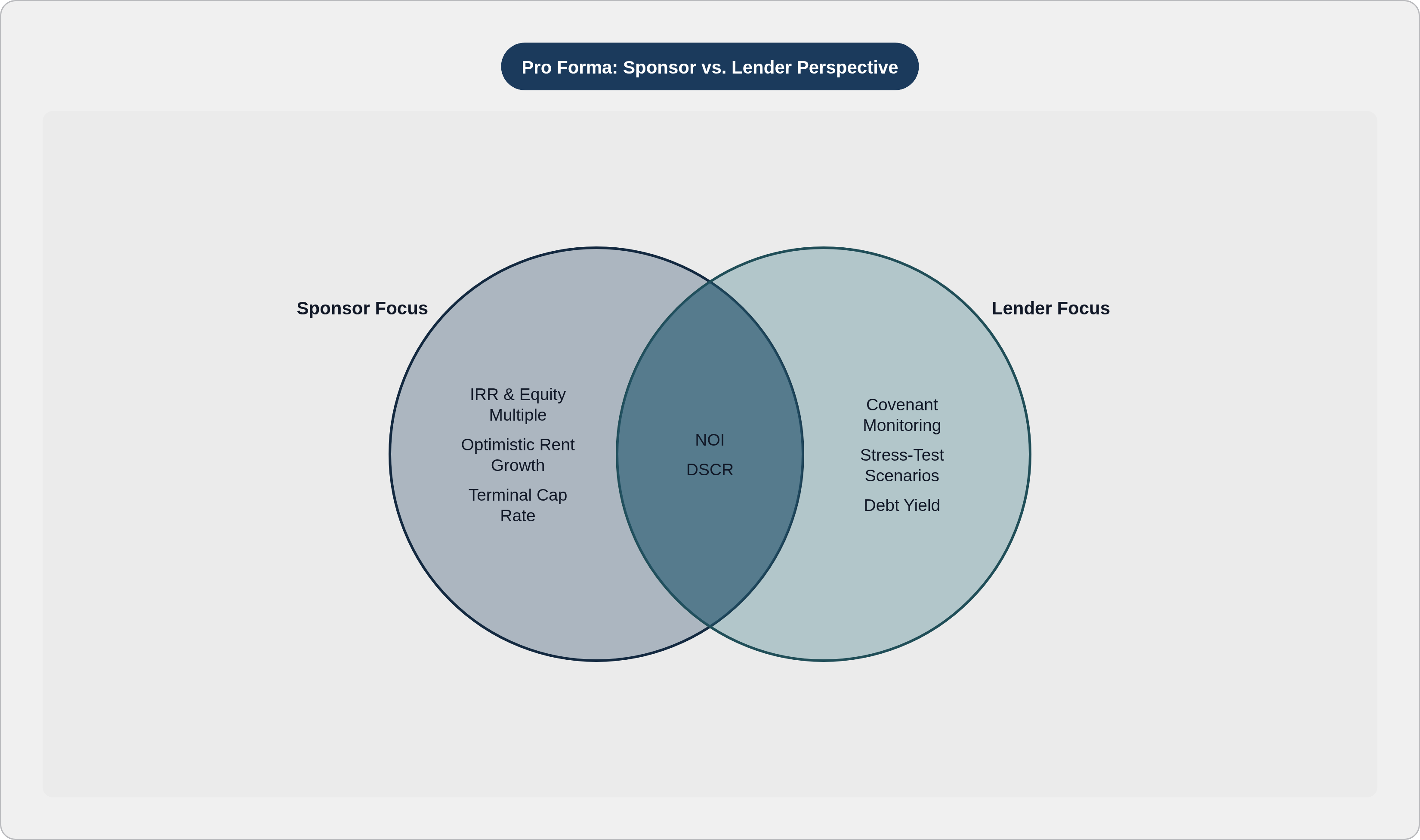
Loan-to-value depends on the pro forma's cap-rate-derived value, which means an aggressive cap rate assumption doesn't just inflate the property's estimated worth, it lets a sponsor justify more leverage than the asset can actually carry. Sponsors tend to model IRR and equity multiple, return metrics that hinge on exit assumptions years down the road. Lenders read the same pro forma for something different entirely: in-place and near-term DSCR, debt yield, and how the deal holds up under a bad scenario. Same document, two completely different reading strategies.
Exit assumptions and how cap rate selection shapes the entire model
Most five-to-ten-year pro formas end with a sale, and the sale price gets estimated by applying a terminal cap rate to the NOI projected for the year right after the hold ends. This one assumption, the terminal cap rate, might be the single most consequential number in the entire model.
Consider what happens if the terminal cap rate comes in a quarter point below the entry cap rate. The deal suddenly looks better, purely on paper, without a single operational improvement having occurred. Sponsors have a built-in incentive to lean into that kind of optimism, which is exactly why lenders should derive their own terminal cap rate independently rather than accepting the one baked into the sponsor's model.
Cap rates vary a lot by property type and geography; a stabilized multifamily asset in a major metro trades in a different range than a suburban office building or an industrial net-lease property, and grabbing the wrong benchmark for the asset class distorts everything downstream. There's also the matter of cap rate compression versus expansion. A pro forma built during a period of compressing cap rates and then tested against an expanding-rate environment can show a loss even if the property hit every operating projection along the way. That's not a hypothetical: the refinancing environment of the mid-2020s has demonstrated exactly this dynamic, with plenty of deals underwritten a few years earlier now facing a much less forgiving exit market.
Running a sensitivity analysis on the terminal cap rate is one of the more useful things an underwriter can do, since a shift of just 25 to 50 basis points in the exit cap can swing the modeled equity return dramatically. And it's worth remembering that reversion proceeds feed both investor returns and, in construction or bridge loans, the refinance takeout assumption, which is why exit assumptions matter to lenders too, not just to the equity side of the table.
Where assumptions concentrate risk: the four variables that move NOI the most
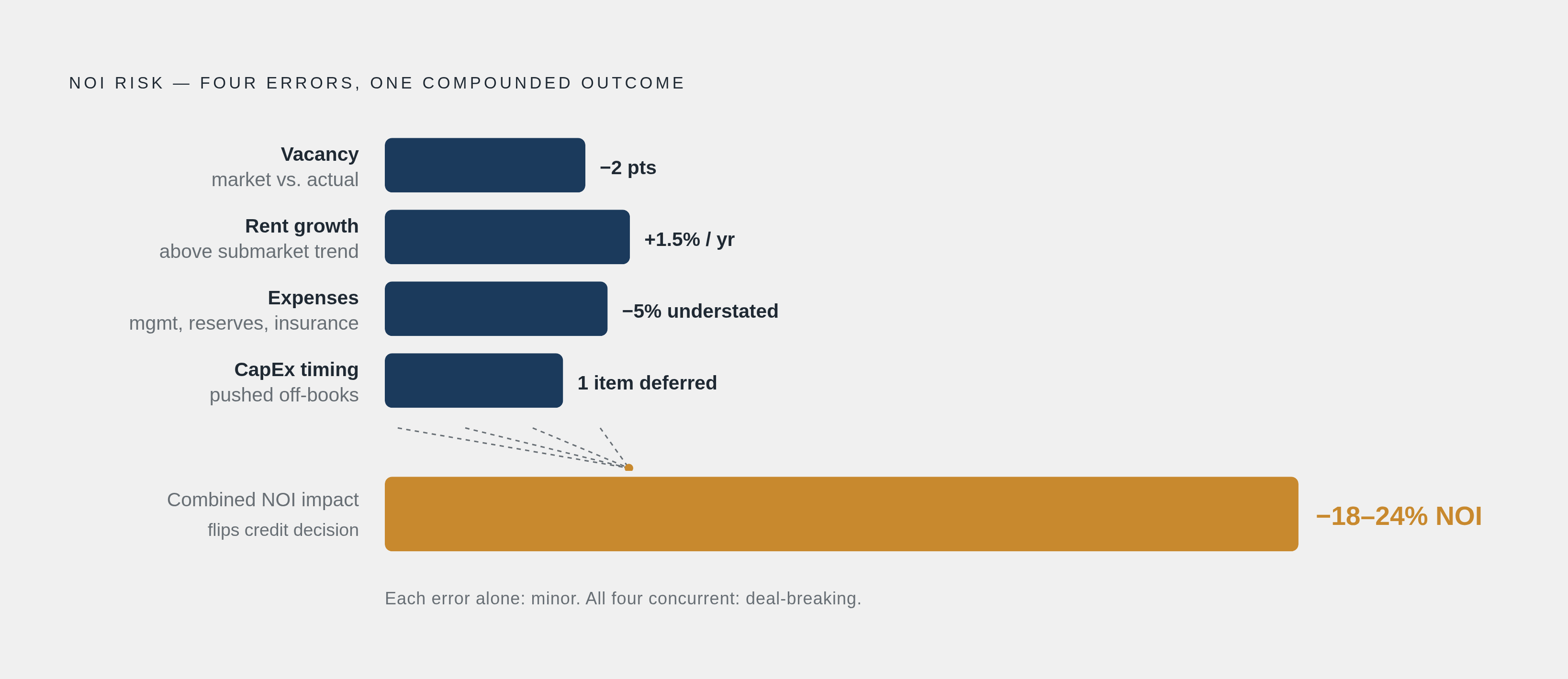
Four variables do most of the damage when a pro forma goes sideways. Vacancy rate tops the list, and the gap between a market vacancy assumption and something tied to the actual property is where most underwriting mistakes start. A building that just lost an anchor tenant, or one facing a wave of lease expirations, doesn't have the same vacancy profile as a stabilized comp down the street, no matter how tidy the comp set looks.
Rent growth is the second. Above-trend rent growth compounded over five years produces NOI numbers that look great on a spreadsheet and terrible in reality if the submarket's historical average doesn't support the assumption, or if the lease structure doesn't actually let the owner capture that growth.
Third: expense understatement. Seller pro formas routinely lowball management fees, reserves, and insurance, which is exactly why institutional underwriters tend to rebuild the expense schedule from actual historical figures rather than accept the seller's version at face value.
Fourth is capital expenditure timing. Big-ticket items like a roof replacement, an HVAC overhaul, or an elevator modernization often get excluded from the operating expense line and treated as a one-time capital event. How that gets funded, whether from reserves or from fresh equity, has a real effect on cash-on-cash returns and on how much cash comes out at refinance.
Here's the part that should keep an underwriter up at night: each of these four errors is small on its own. But when vacancy runs a little high, rent growth runs a little hot, expenses run a little light, and a capital item gets pushed off the books, the compounding effect on NOI can be large enough to flip a credit decision entirely. It's worth separating structural risk, meaning the market genuinely moved, from execution risk, meaning the sponsor just underperformed. A lender who's doing this right underwrites to the structural floor, not the sponsor's operational ceiling.
How lenders stress-test a pro forma before committing capital
Stress-testing isn't pessimism, and it's worth saying that plainly, because it gets mistaken for one all the time. It's the process of finding the exact performance level at which a loan breaks, and then asking how likely it is the property actually gets there.
A standard battery of stress scenarios includes a vacancy shock, where occupancy drops to a level consistent with a real downturn rather than a stabilized comp; a rent haircut, underwriting to today's in-place rents rather than the sponsor's projected market rents; and an expense inflation test, running costs above the sponsor's assumed growth rate for three to five years to see where NOI actually lands. For floating-rate and bridge loans, an interest rate sensitivity test matters too, modeling debt service at a stressed rate and checking whether DSCR still clears the minimum. And on the back end, exit cap rate sensitivity means modeling terminal value across a range of cap rates instead of trusting the one number the sponsor picked.
Debt yield earns its keep here because it doesn't move with interest rates, which makes it a genuinely stress-resistant way to test whether an asset can support a given loan amount regardless of what the Fed does next. Lenders also practice what amounts to a T-12 discipline: lining up the sponsor's projected income and expense figures against the actual trailing twelve months and treating every divergence as something that needs an explanation, not a footnote.
A lot of institutional lenders go a step further and rebuild the entire pro forma from scratch, using their own vacancy, expense, and cap rate assumptions instead of accepting the sponsor's model wholesale. The gap between the sponsor's version and the lender's version isn't just a formality; it's a due-diligence output in its own right. And that minimum DSCR requirement doesn't disappear once the loan closes. It functions as a covenant for the life of the loan, which means a property that clears the bar at origination but drifts below it three years into the hold has triggered a real contractual breach, not just a rough patch.
How pro formas inform ongoing asset management, not just the origination decision
The pro forma built at origination doesn't retire once the loan closes. It becomes the benchmark that every future quarter gets measured against, which is a role most people don't think about when they picture a pro forma as a one-time underwriting exercise.
Asset managers track the variance between projected and actual NOI, occupancy, and expense lines specifically because that's how problems get caught early, ideally long before they reach the kind of trouble that trips a covenant. Minimum DSCR, minimum debt yield, and maximum LTV covenants in the loan agreement typically get tested against actual financials on a set schedule, quarterly or annually depending on the deal. A property trending toward a breach gives a lender weeks or months to step in, ask for a cure, or start protective measures, but only if that monitoring happens in something close to real time rather than showing up as a surprise at the next scheduled test date.
This has taken on extra weight given how much commercial mortgage debt is maturing in the mid-2020s. Borrowers refinancing into materially higher rates than they locked in years ago, combined with properties that already fell short of their original NOI projections, creates a squeeze from both directions: NOI came in lower than modeled, and the new debt service costs more. DSCR gets hit twice at once. Lease expiration tracking fits into this same picture; a pro forma models a rent roll assumption years in advance, but someone still has to track actual lease expirations against that assumption and flag rollover risk before it shows up as an empty floor.
All of this is manageable, sort of, for a single asset with a spreadsheet and a diligent analyst. It stops being manageable the moment a portfolio has dozens of assets with layered covenants and staggered test dates, which is exactly where a lot of monitoring quietly starts to leak.
What manual pro forma workflows miss and where technology changes the math
Building a pro forma from scratch means pulling numbers out of rent rolls, T-12s, leases, and operating statements, typing them into a model, and then running scenarios by hand. That process eats a meaningful chunk of an analyst's week per deal, and manual data entry at that volume produces errors more often than anyone would like to admit.
The failure modes at scale are pretty predictable. A typo in financial spreading doesn't announce itself; it just quietly propagates into DSCR, debt yield, and NOI, and nobody notices until the numbers look strange for reasons nobody can immediately explain. Covenant monitoring across a portfolio with different reporting cadences, some quarterly, some annual, some whenever the borrower gets around to it, exceeds what one person tracking a spreadsheet can reliably manage. And scenario analysis, the whole point of stress-testing, becomes painfully slow to redo every time deal terms shift, which creates a lag between "something changed" and "someone actually re-ran the numbers."
This is where automation genuinely earns its place, not as a buzzword but as a fix for a specific bottleneck. Document extraction tools built specifically to read CRE documents, rent rolls, operating statements, lease abstracts, can pull the relevant figures straight into a model without someone retyping them line by line, cutting the hours-per-deal number down substantially. Financial spreading tools that extract and standardize borrower financials, then flag anomalies automatically, take out the most error-prone step in the whole underwriting chain. Scenario modeling that used to mean rebuilding a spreadsheet from scratch can now run instantly across a dozen parameter sets at once. And covenant monitoring that used to mean a quarterly manual check-in can run continuously against live property data, so a breach shows up as a trend line pointing the wrong way, not a surprise phone call three months later.
None of this changes what a pro forma fundamentally is: a set of assumptions about the future, dressed up in the language of certainty. What's changed is how fast you can test those assumptions, how many of them you can check at once, and how quickly a bad one gets caught before it becomes an expensive one.