AI Adoption Maturity Among CRE Lenders and Investors
Most CRE lenders are piloting AI, but only 5% are actually delivering results.

There is a version of this story told at every real estate technology conference, usually around slide three of a vendor deck. AI is transforming commercial real estate, adoption is accelerating, firms that move first will win. The story isn't wrong. It's just incomplete in a way that has cost organizations real time and real money.
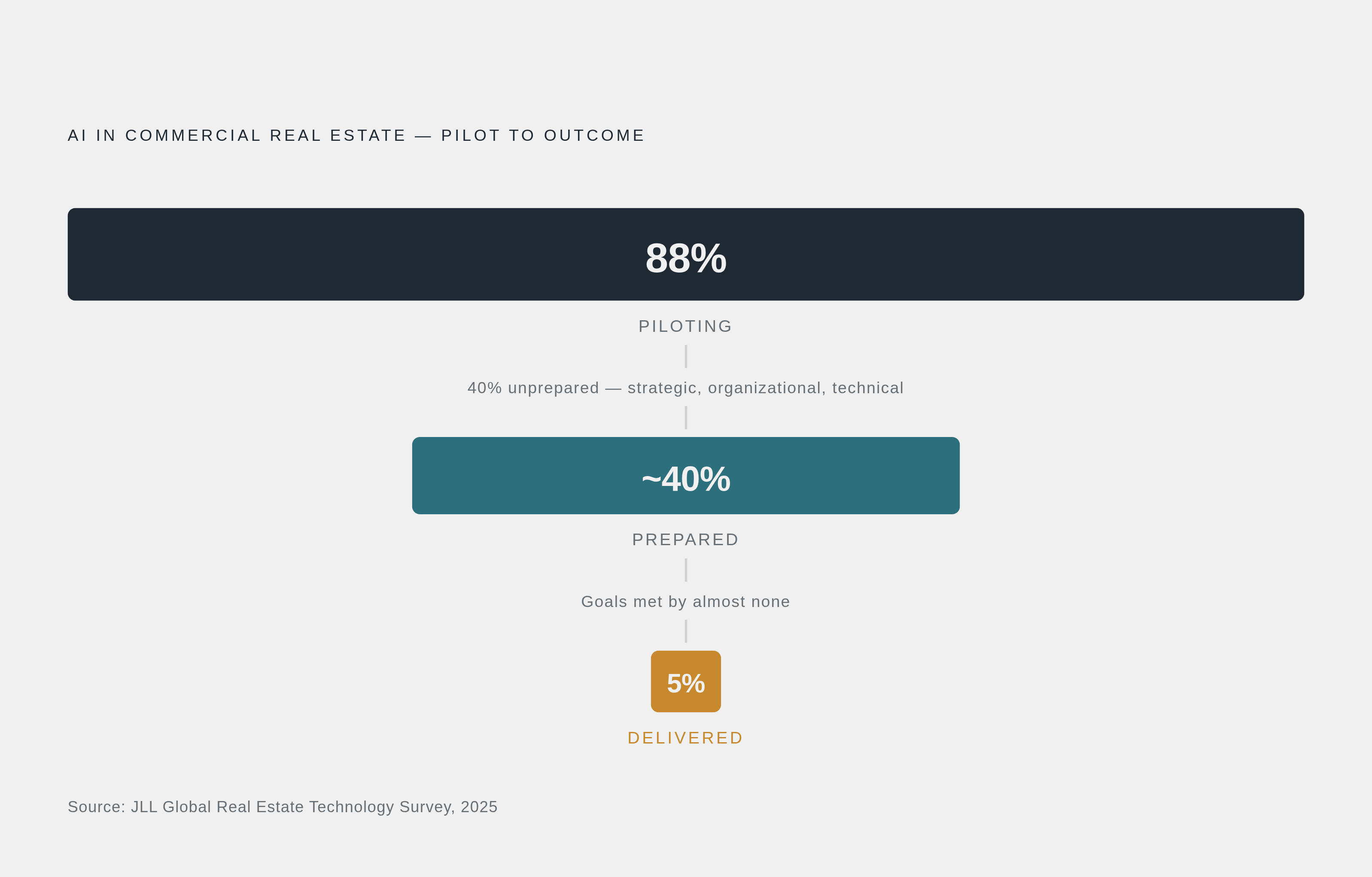
According to JLL's 2025 Global Real Estate Technology Survey, 88% of CRE investors and owners have initiated AI pilots. That figure gets quoted constantly, and it should: it represents a genuine shift from where the industry stood two years ago. But the counter-figure from the same research reframes everything. Only 5% of firms report achieving most of their AI program goals.
The average firm is running roughly five AI use cases simultaneously. On a board update, that looks like momentum. In practice, it signals diffusion rather than depth. More than three-fifths of firms describe themselves as strategically, organizationally, and technically unprepared to execute on their AI ambitions, even as the vast majority increase AI-specific technology budgets. The share of executives reporting "transformative" impact has fallen to a very small fraction. The gap between investment intent and realized outcome is not narrowing; it is widening.
The instinct is to frame this as a technology access problem. But that can't be right, because the tools are broadly available and the budgets are clearly there. What actually separates the 5% from the 88% still circling is a more inconvenient question, and it's the one worth sitting with.
How maturity varies by asset class and firm type
The adoption numbers obscure as much as they reveal, because maturity is not evenly distributed. Per the 2025 Keyway State of AI Adoption survey, the variance by asset class is pronounced. Student housing leads in enterprise-wide deployment. Office shows high experimentation with limited conversion to scale. Multifamily, the largest and most operationally complex asset class in the sector, shows the lowest level of enterprise-wide AI adoption. That pairing of scale and immaturity is either a massive opportunity or a warning sign about how structural complexity resists easy automation. Probably both.
On the capital structure side, the lender-investor divide is instructive. CRE lenders, whether commercial banks, debt funds, CMBS originators, or bridge lenders, face a comparatively clear ROI case because AI directly compresses the most expensive part of their operational stack: the interval between application receipt and credit committee. For equity investors, the maturity curve skews earlier, toward workflow automation, though momentum around deal sourcing and portfolio surveillance is building.
Per JLL, 92% of occupiers report piloting AI, outpacing the investor cohort on pilot rate. But pilot rate is a misleading proxy for maturity. The meaningful distinction is whether AI is embedded in core decision workflows or running alongside them, producing outputs nobody has fully committed to acting on.
That last scenario is more common than anyone at a conference will admit. A tool you've deployed but don't trust is a very expensive screensaver.
Where operational AI is already delivering in underwriting and document work
The bottleneck AI attacks first is the interval between application receipt and credit committee, and the returns to compression here are not marginal. Banks using AI underwriting have documented reductions in time-to-decision for commercial loans in the range of 50 to 75%, per V7 Labs research. For a lender trying to process volume without proportionally scaling headcount, that is a structural change, not an incremental one.
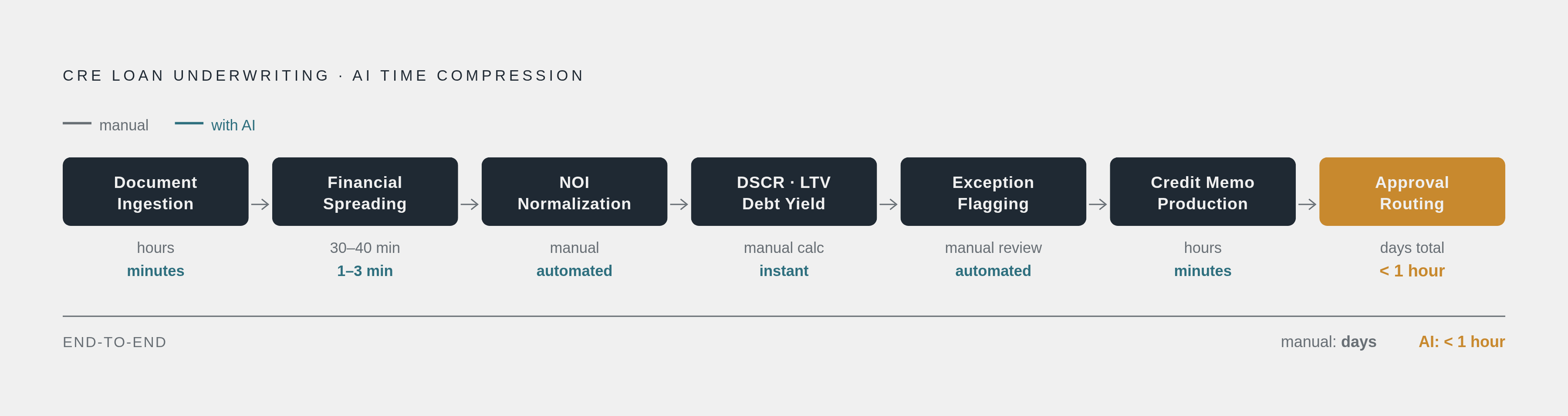
Document processing is where the analyst hours have long been hiding. A single financial statement that required 30 to 40 minutes to process manually can now be handled in one to three minutes, a reduction of more than 90%, documented through Smart Capital Center's platform and corroborated by JLL's separately reported figures on manual data processing time. Lease abstraction tells a similar story: natural-language models extract critical dates, escalation clauses, cap-ex obligations, and co-tenancy triggers across a full portfolio in a fraction of the time previously required.
Traditional workflows scale linearly. More deals require more analysts. AI breaks that relationship, and McKinsey's 2025 analysis of organizations integrating AI into core workflows documents this nonlinearity explicitly. The productivity gain is structural, not additive.
Financial spreading specifically illustrates why workflow design matters as much as the underlying model. Automated extraction needs to preserve context from footnotes and explanatory text, not just raw figures, or the output is technically present and practically incomplete in ways an experienced underwriter will distrust immediately. The full workflow, from document ingestion through financial spreading, NOI normalization, DSCR/LTV/debt yield calculation, exception flagging, credit memo production, and approval routing, can compress from days to under an hour for standard deals. That's documented across multiple lender implementations now, not projected.
One commercial bank documented meaningfully lower analyst turnover following AI deployment. When analysts spend less time on mechanical extraction and more time on judgment calls, they stay longer. That's not on any ROI spreadsheet I've ever seen, but it compounds.
The trust barrier that budget alone cannot solve
Investment committees and senior lenders have spent careers making eight-figure decisions on human-sourced analysis. Delegating even preparatory work to AI requires a level of confidence in accuracy, explainability, and consistency that most organizations have not yet developed. And here is the part that gets glossed over in vendor conversations: that confidence cannot be purchased. It has to be accumulated.
Per the 2025 Keyway survey, AI is increasingly accepted for efficiency-driven tasks: document extraction, market research summarization, memo drafting. Its use in high-stakes financial decisions remains limited, and a significant share of respondents report that investment committees distrust AI-generated analysis outright. That distrust is not irrational. It's a reasonable prior given how early most implementations actually are, and given how rarely the people building the tools have sat in a credit committee meeting and watched a deal die over a footnote.
Two trust problems are at work here, and conflating them is a common and expensive mistake. The first is explainability: can the system show its work in a form the credit committee will accept? The second is consistency: does the system produce the same answer given the same inputs, and can the firm audit that track record over time? These are distinct engineering and governance challenges. Solving one does not reliably solve the other, and firms that discover this mid-implementation tend to discover it at the worst possible moment.
Generic horizontal AI tools compound the problem. They are not trained on CRE workflows, cannot reference a firm's own templates and historical decisions, and produce outputs that experienced underwriters correctly identify as context-blind. The model is technically proficient and still wrong in ways that matter, because it has no idea what your firm's credit standards look like or how your committee has historically treated a ground lease with a 35-year term. That's not a knock on the model. It's a mismatch problem.
It is also worth noting that AI has dramatically reduced the friction involved in fabricating convincing CRE loan packages. A lender that cannot distinguish authentic borrower performance from AI-generated documentation is exposed in an entirely new way. The explainability requirement is not just a comfort issue; it is a risk management imperative, and it is becoming more urgent, not less.
Every firm I've watched stall in pilot purgatory shares the same underlying problem. It is not a better API they need. It's a change-management plan, an internal champion credible enough to move a credit committee, and the patience to accumulate a verified track record over time. Those are organizational tasks. You cannot procure your way out of them.
What continuous covenant monitoring changes for lenders managing at scale
The design flaw embedded in traditional CRE debt management is temporal, not technological. Periodic review, monthly reporting, quarterly covenant checks, annual appraisals, was designed for a world where risk also moved slowly. It no longer does. A DSCR that drops below covenant threshold mid-quarter will not appear in a compliance report until the following period. By the time it surfaces, the intervention window has often already closed.
Manual covenant review is manageable for a book of ten loans. It becomes untenable at fifty. At two hundred, it is operationally broken, and everyone in the building knows it. The standard workaround is adding headcount rather than addressing the underlying architecture, which is an expensive way to avoid an uncomfortable conversation.
Why does this persist? Partly inertia, partly the fact that the failure mode is gradual enough that no single quarter feels catastrophic. But the cumulative cost in missed early-warning signals is real. Per Trepp's CRE Loan Performance data, lenders that identify covenant stress signals early outperform peers on loss rates and workout outcomes. For most lenders running quarterly reviews, that early-warning window is being missed on a meaningful share of the book. Regularly. Quietly.
AI-powered monitoring changes the posture. Continuous calculation of DSCR, LTV, occupancy, and debt yield against covenant thresholds means alerts arrive the moment a threshold is approached, not after a breach has occurred and the reporting cycle has completed. Purpose-built platforms surface refinancing windows, maturing loans, and threshold breaches automatically at the portfolio level rather than requiring deal-by-deal manual review. The point is not to replace the lender's judgment; it is to ensure that judgment is exercised before the situation deteriorates, not in response to it.
That distinction matters more than it sounds. Reactive portfolio management is not management. It's triage.
How the firms that reached the 5% actually got there
The common thread among firms that achieved enterprise-wide deployment is not the tool they chose. It is the decision to ground AI in the firm's own institutional knowledge, rather than deploying it as a parallel, disconnected system that runs alongside existing workflows without ever becoming part of them. That sounds obvious in retrospect. It is apparently not obvious enough, given that 88% of the industry is still somewhere in the middle.
Sequencing matters more than selection, and the pattern among the 5% is consistent enough to be instructive.
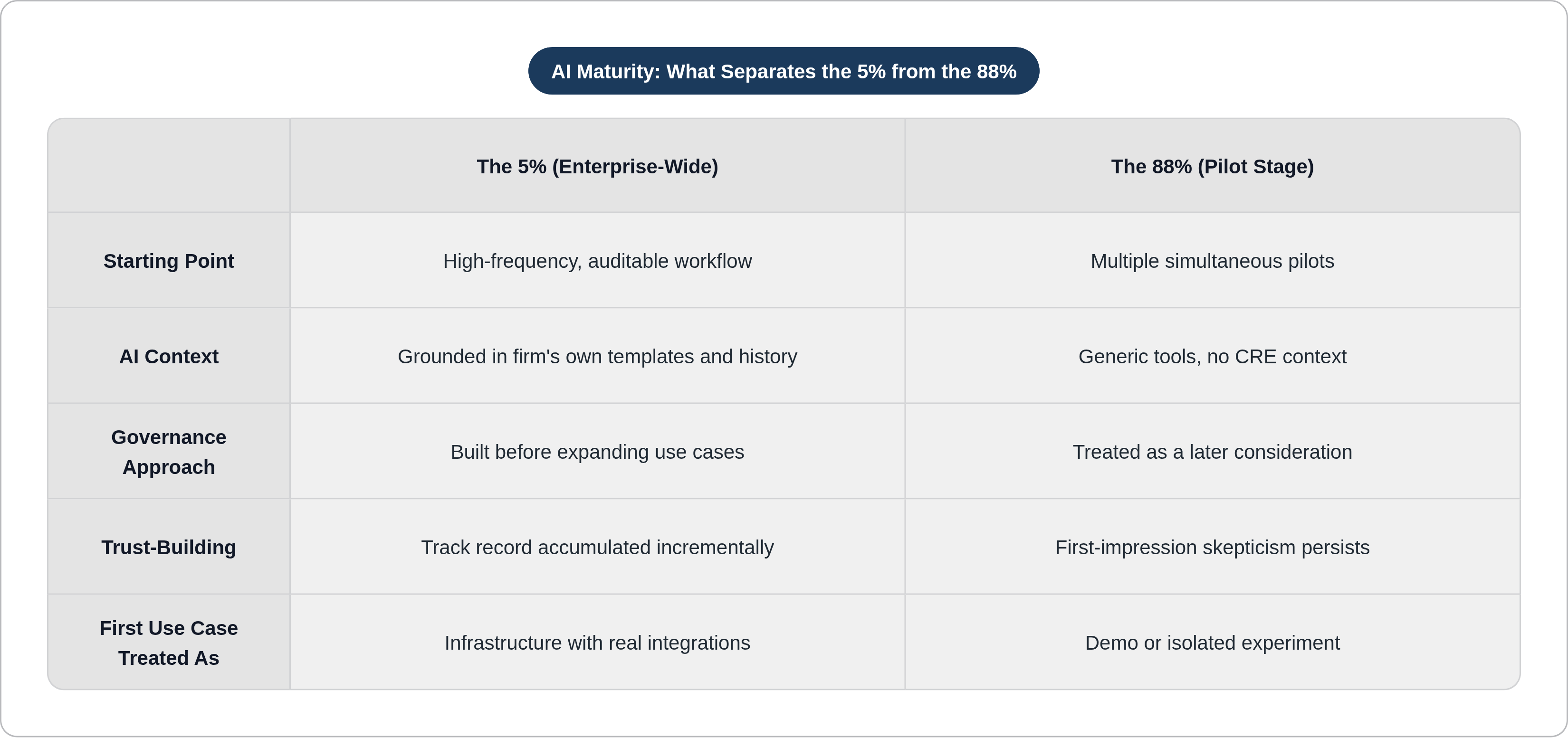
They started with a high-frequency, auditable workflow, typically financial spreading or lease abstraction, where AI output could be verified against known answers and trust built incrementally. They connected AI outputs to their own templates, historical decisions, and credit standards rather than generic benchmarks. They built internal governance around AI outputs before expanding use cases, so investment committees accumulated a track record rather than a first-impression skepticism. And they treated the first use case as infrastructure, which meant investing in integrations, not staging a demo.
Running multiple pilots simultaneously diffuses organizational attention and delays the trust-building any single use case needs to graduate into production. Breadth before depth is a maturity inhibitor. It is also the dominant pattern among the 88%.
Platform choice matters structurally here. Generic horizontal AI tools require firms to build CRE context themselves, on top of a tool not designed for it. Purpose-built platforms embed that context from the ground up, designed specifically for CRE underwriting workflows rather than adapted from generic AI tools. Automated financial spreading that extracts figures and tables with confidence scores tied to source documents, and generates credit memos from firm templates, addresses the explainability problem that stalls credit committee buy-in at the source rather than requiring a translation layer that reintroduces the manual effort you were trying to eliminate.
Security and data governance are prerequisites, not implementation details. Firms that reached production-grade deployment had enterprise-grade data handling in place before expanding AI to sensitive portfolio data. The ones that treated governance as something to sort out later are still sorting it out.
The agentic frontier is already under active discussion among institutional leaders furthest along the maturity curve: autonomous systems that monitor portfolios, surface exceptions, and escalate only when human judgment is actually required. That is the next threshold. It is closer than most of the 88% realize, and the firms that haven't finished their first use case are not positioned to reach it.
The Mortgage Bankers Association projects commercial mortgage origination to reach a new high in 2026. The structural gap between the 5% and the field is already open. At some point the question stops being whether AI will matter in this industry. It becomes a quieter, more specific question about your own organization: what exactly are you waiting for, and is that reason still good?