Debt Service Coverage Ratio Explained
Lenders use this formula to verify a property generates enough cash flow to cover its debt payments.

DSCR answers one question: can this property cover its own debt from the income it actually generates? Lenders check it before anything else, and if you touch CRE underwriting, covenant compliance, or portfolio risk in any capacity, you need this number cold. The formula is Net Operating Income divided by Total Debt Service, principal plus interest, nothing fancier than that. A property throwing off $450,000 in NOI against $250,000 in annual debt service lands at 1.8, or well over a dollar of income for every dollar owed, per JPMorgan's framing of the math. The formula is the easy part. What lenders do with it after closing, how they stress it, how they track it sliding or holding steady over years, is where people learn things the hard way.
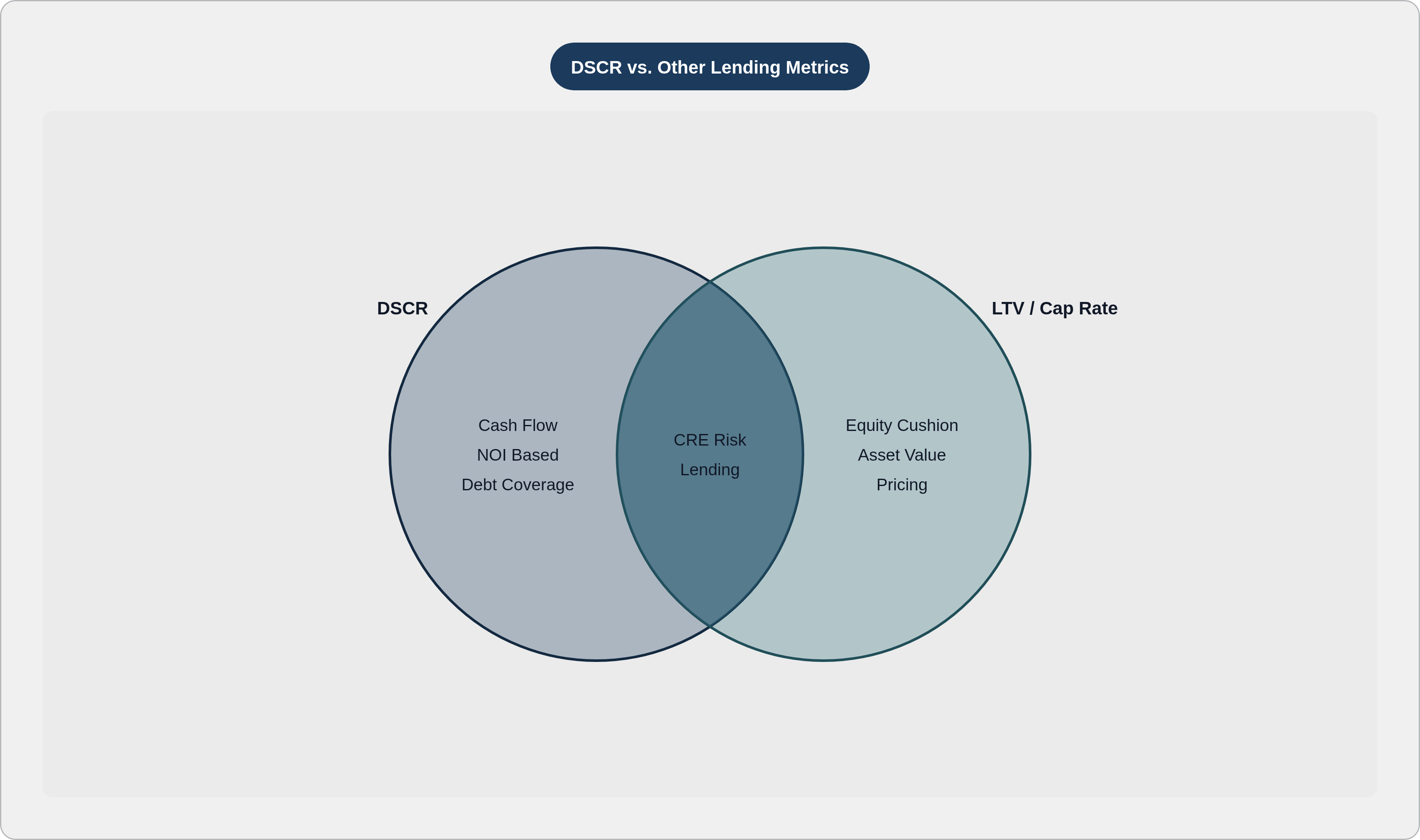
Why this number and not something else? Loan-to-value tells you what a lender recovers if a deal goes sideways; it's the equity cushion, not proof the borrower can make payments each month. Cap rate tells you what the asset is worth against its income, useful for pricing, silent on cash flow. DSCR asks, right now, whether the loan pays for itself. When a borrower holds several properties, some lenders widen the lens into a "global DSCR," pooling total NOI against total debt service across the whole portfolio rather than grading each asset alone. A weak property can hide behind a strong one, or get pulled under by it, depending which way you're looking.
NOI needs its own clean definition: gross rental income minus operating expenses, figured before debt service and capital spending touch it. It's what the property earns on its own, stripped of how it happens to be financed. DSCR didn't become the industry default by accident. The FDIC and OCC both require DSCR analysis as a cornerstone of CRE lending standards, and Basel III's capital treatment rewards loans carrying higher coverage. Regulators just wrote down what underwriters already felt in their gut: cash flow beats collateral when you're guessing who actually pays you back.
How lenders set the threshold: the 1.25x floor and where it bends by property type
Most conventional commercial lenders want a floor somewhere between 1.20 and 1.25, and 1.25x is the number everyone keeps citing for 2025 and 2026 underwriting. SBA 504 loans run looser, usually 1.15 to 1.25 depending on lender, because the program's risk-sharing structure carries some of the weight coverage would otherwise have to shoulder alone.
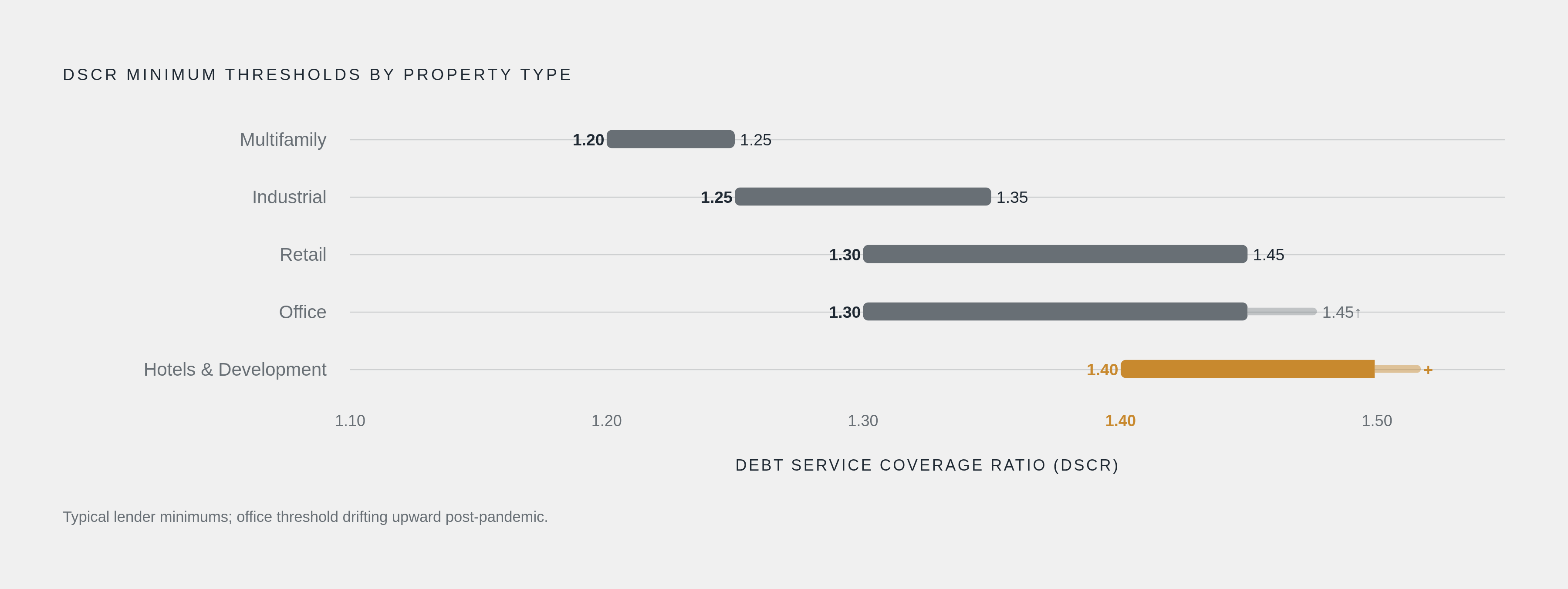
The floor swings hard by property type, and the gaps aren't small. Hotels, restaurants, and ground-up development sit at the tight end, often 1.40x or higher, since daily revenue swings and messy operations make cash flow a moving target. Retail and office land in the 1.30 to 1.45 range, with office drifting upward since the pandemic as vacancy and structural demand worries pile on. Industrial, oddly enough, has loosened, down to roughly 1.25 to 1.35, riding an e-commerce tailwind that refuses to quit. Multifamily gets the best treatment of the bunch, often clearing at 1.20x to 1.25x, thanks to diversified tenants and cash flows that don't jerk around quarter to quarter.
Rate cycles bend these numbers too. When rates climb, lenders push refinancing minimums up with them, often from 1.25x toward 1.35x or higher, because rising debt service eats straight into the cushion a borrower used to have. The same property, same tenants, same NOI, can pass underwriting in a low-rate year and fail two years later purely because the denominator grew. The building never changed; the math around it did.
The inputs that can make or break a DSCR calculation before anyone signs anything
NOI gets built from rent rolls, operating statements, and expense schedules, and these three documents have a habit of disagreeing with each other. The Urban Land Institute's 2024 Emerging Trends report flags mismatches between rent rolls, operating statements, and offering memorandums as among the most common issues turned up in early due diligence. This isn't a rare edge case; it earns its own line in an industry report for a reason.
Small errors compound fast. A 5% overstatement of NOI on a $2 million property shifts DSCR by roughly 0.06 to 0.10, which sounds minor until you realize that's the gap between a passing 1.25 and a failing 1.18 against a lender's floor. Rate exposure hits from a different angle entirely: a 1% bump on a $5 million variable-rate loan adds around $50,000 in annual debt service, compressing DSCR without the property doing a single thing differently. Occupancy is its own lever, and a 10% occupancy drop on a thin-margin property can push DSCR below 1.25 on its own, no other variable required.
Seasonality is a different kind of problem. It's less a data issue than a modeling choice somebody has to make on purpose. Student housing is the textbook case: a property might post 0.85x in summer with half the units empty between leases, then 1.65x during the academic year once everyone's back and paying rent. Judge it off one quarter and you get a wildly different picture depending purely on which quarter you picked. Most lenders use trailing twelve-month averages instead of quarterly snapshots to avoid punishing predictable dips, though that same averaging can bury real deterioration if a strong quarter happens to land in the wrong window.
The risk compounding underneath all this is quiet. Bad NOI inputs, miscategorized expenses, a stale rent roll: none of these produce an obviously wrong DSCR. Instead, they produce a number that looks entirely credible, sails through review, and only shows its true colors when a covenant test fails months or years down the road. A DSCR calculation is only as honest as the paperwork behind it.
Where the current market is stress-testing DSCR at scale
There's a $930 billion wall of CRE debt maturities working through the system right now, and banks are catching more scrutiny over their CRE exposure than they have in years. Office sits at the front of the line: delinquencies at 11.76% and vacancy near 19% in 2026, the exact sector where DSCR thresholds have climbed hardest and where lenders enforce them without much patience left.
The delinquency data backs this up without shouting about it. The 30-day delinquency rate for DSCR loans hit 1.5% in Q3 2024, not a number that screams crisis by itself, but telling because these are properties that looked fine at origination and still couldn't absorb ordinary volatility. DSCR at closing is a photograph, not a forecast. Conditions shift underneath a loan that cleared underwriting with room to spare, and sometimes that room disappears faster than anyone bothered to model.
Rising rates squeeze variable-rate borrowers hardest, who absorb higher debt service against flat or shrinking NOI in some sectors, exactly the combination that turns a comfortable 1.35x into covenant-breach territory over a handful of quarters. Yet DSCR-structured lending keeps growing anyway. RCN Capital points to expansion in DSCR loan products through 2025, as investors and lenders lean on the ratio's ability to communicate risk cleanly, even without traditional income verification behind it. The market leans on the metric harder now, using it as a stand-in for paperwork it used to demand elsewhere.
How covenant monitoring turns a static DSCR into an ongoing credit signal
DSCR doesn't get calculated once and filed away. Loan agreements bake it in as a recurring covenant: keep DSCR above 1.25x, keep LTV under 75%, deliver financials within 45 days of quarter end. Miss any one of those and a borrower can land in technical default without ever missing a payment. That catches people outside the industry off guard, and it catches a few people inside it off guard too.
What matters more than any single reading is the direction things are moving. A quarter sitting at 1.30x against a 1.25x covenant barely raises an eyebrow. Three straight quarters sliding from 1.45x to 1.32x to 1.28x tells a different story, one where the slope matters more than wherever the line currently sits. Good monitoring catches the slope, not just the latest dot on the chart.
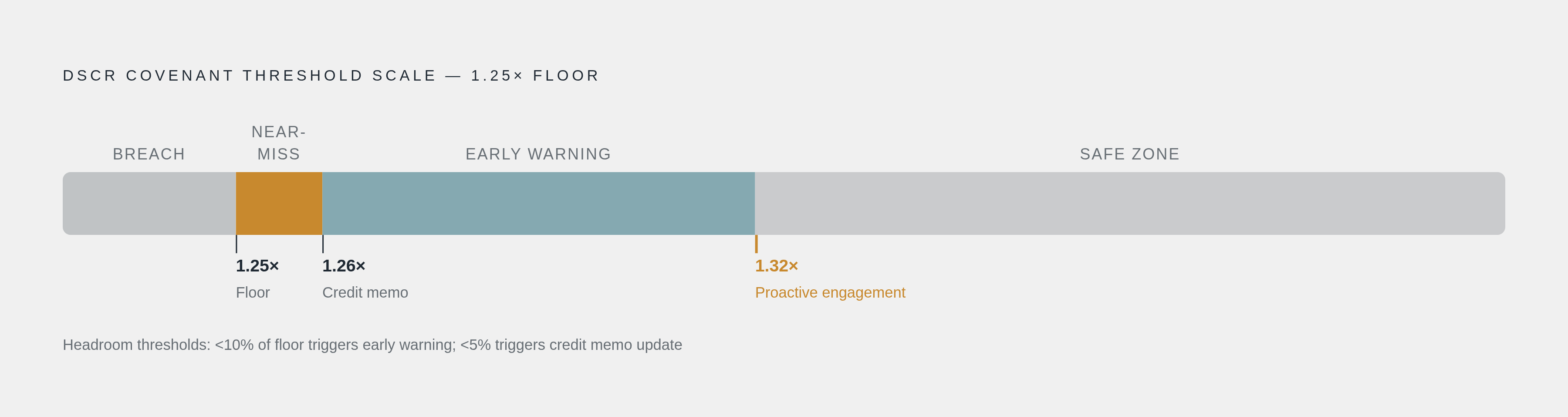
Credit policies generally build in early warning zones: closer scrutiny once DSCR headroom drops below roughly 10% of the covenant floor, near-miss classification inside 5%. Against a 1.25x covenant, that means proactive engagement kicks in around 1.32x, with a credit memo update triggered around 1.26x, well before an actual breach shows up on paper.
Getting this right takes a few specific pieces working together. Automated covenant testing against live financial data, not a spreadsheet an analyst refreshes once a quarter if they happen to remember. Portfolio-level exception reporting, so a deteriorating loan can't hide inside a stack of files nobody's cross-checking. Records that hold up under examiner review, particularly under the revised interagency guidance from April 2026 (SR 26-2 and OCC Bulletin 2026-13). The Commercial Real Estate Finance Council's research backs the payoff: lenders using risk-tiered monitoring post better loss rates and workout outcomes than peers running flatter, less differentiated review. Skip this and the failure mode is predictable: the breach surfaces at the scheduled test date, and by then the window for doing anything useful about it has already closed.
How AI-assisted underwriting and monitoring are changing the way DSCR gets calculated and tracked
Adoption here moved faster than most people guessed. JLL's 2025 Global Real Estate Technology Survey found 92% of CRE firms testing AI tools, up from just 5% three years earlier, with 85% planning to spend more on tech going forward. That's a fast, industry-wide shift in posture, not some slow incremental drift.
Inside the DSCR workflow, AI tools pull data automatically from rent rolls, T-12s, operating statements, and leases, build a first-pass NOI calculation, and flag where source documents disagree, going straight at the discrepancy problem ULI flagged in its 2024 report. Beyond extraction, these tools run scenario stress tests, rate shocks, occupancy drops, expense inflation, and quantify how fast a given DSCR would breach covenant under each condition. On raw speed, the gap is stark: document processing that eats up 30 to 40 minutes of a person's day runs in 1 to 3 minutes through an AI agent.
That speed compounds once it hits the decision stage. Research from V7 Labs found banks using AI-assisted underwriting reporting 50% to 75% reductions in time-to-decision on commercial loans, landing right as total commercial mortgage origination is projected to hit $806 billion in 2026, up from $633.7 billion in 2025. Volume climbs right as the tools built to process it get faster.
The analyst's job doesn't disappear, though. Someone still has to check the source inputs, own the financial model, run scenarios with judgment instead of rubber-stamping whatever the model spits out, and make the actual credit call. AI shortens the data prep cycle; the thinking still belongs to a person. The bigger snag right now is what the technology has to plug into: JLL's 2025 Global CRE Trends report found a majority of CRE teams cite legacy system compatibility as their top barrier to AI adoption. Most firms testing these tools haven't gotten anywhere near using them for portfolio-wide covenant monitoring yet. They're still wiring new software into systems built before anyone imagined a document could read itself.
This is where the choice of tool actually matters. A generic AI model can parse a PDF fine, but it has no idea what a hospitality DSCR covenant is supposed to look like next to a multifamily one, and it carries no memory of how a given firm has historically built its own underwriting templates. Tools purpose-built for CRE lending can ground DSCR extraction and covenant flagging in a firm's actual lending standards, rather than treating every document like it's the first one anyone's ever seen.
What a working DSCR practice looks like across the deal lifecycle
At origination, DSCR is the gatekeeper. It sets loan sizing, decides whether a deal clears the lender's minimum at all, and sets the covenant floor that governs the loan for years after everyone's forgotten the closing dinner. Get this wrong at the start and everything downstream inherits the mistake.
At closing, that threshold stops being a calculation and becomes a binding obligation. The DSCR underwriting produced is now the benchmark every future monitoring cycle gets measured against, whether the borrower remembers agreeing to it or not.
During the hold period, covenant monitoring is ongoing credit risk management, plain and simple. Quarterly or annual DSCR testing, trajectory tracking across multiple periods, early intervention before a breach instead of a scramble after one: that discipline is what actually plays out here, day by day, loan by loan.
Refinancing recalculates the whole equation against current market conditions, and this is where rising rates or sector stress in office and retail can flip a previously healthy loan into a real headache. A property that cleared 1.30x three years ago at a lower rate might not clear 1.35x today at a higher one. Same building, same tenants, worse math.
At the portfolio level, no lender or asset manager with a large book reviews every loan's DSCR trajectory by hand, not at any real scale. The edge goes to whoever can surface deteriorating coverage automatically across hundreds of loans instead of finding it deal by deal, months too late. DSCR is only as good as what feeds it, how often somebody actually looks, and whether a slipping trend triggers a phone call before it turns into a breach nobody saw coming.