AI Applications in CRE Underwriting Workflows

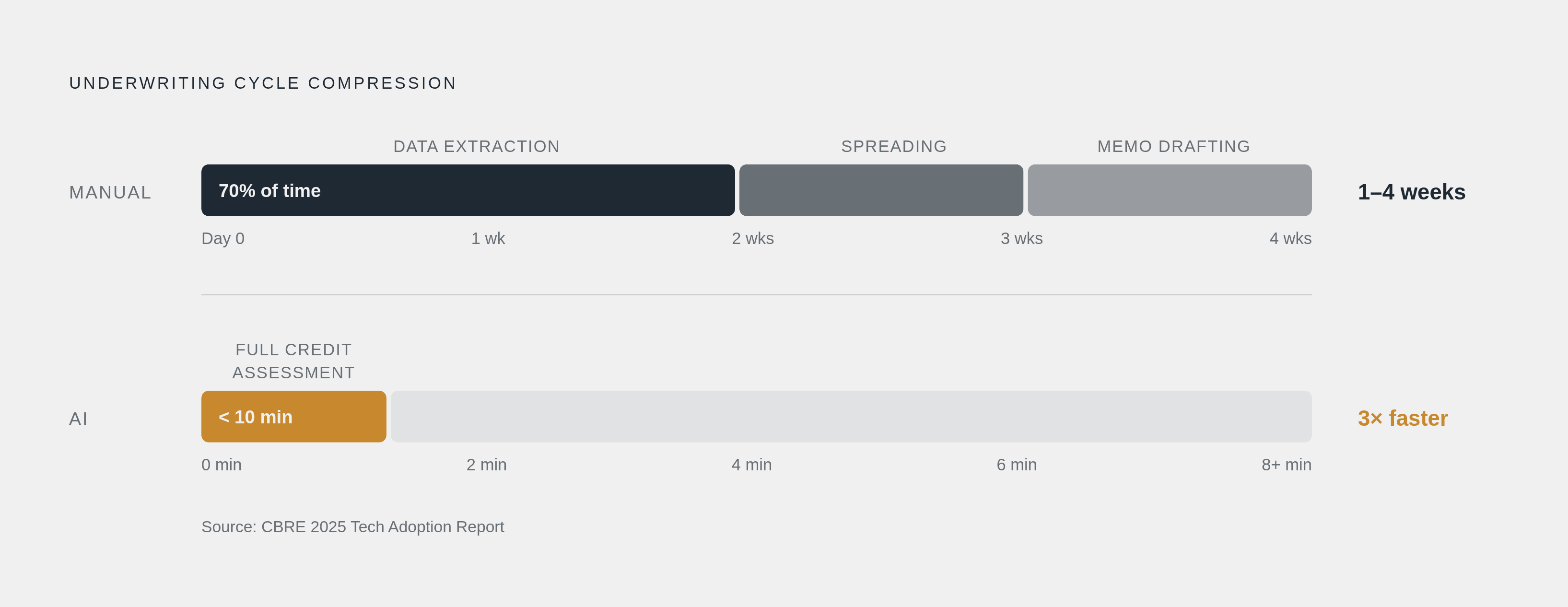
Start with what CRE underwriting analysts actually do with their days. The answer, for anyone who has sat at a deal desk long enough to develop strong opinions about PDF formatting, is simultaneously unsurprising and dispiriting: roughly 70% of analyst time goes to data extraction. Spreading tax returns. Tracing K-1 distributions across entity stacks. Reconciling rent roll totals against collection schedules. Re-keying operating statement line items into spreadsheets, then copying those outputs into Word memos or loan origination system fields.
A single deal can generate 500 to 1,000 pages of tax documents across entities and years. That is not borrower disorganization. It is a function of how these deals are structured: layered entities, co-sponsors, operating partnerships, holding companies stacked on holding companies. Every hand-off between a source document and a spreadsheet cell is both a latency event and an entry point for error, not because teams are undisciplined, but because the workflow was built around manual tools and then scaled without anyone seriously questioning the underlying architecture.
Here is the irony: the people hired for credit judgment are structurally occupied with transcription. A conventional CRE underwriting cycle runs one to four weeks per deal, and time kills deals. When a borrower has multiple term sheets in hand, the lender who can move from intake to preliminary credit in days wins the relationship. That competitive reality has existed for years. What has changed is whether there is a credible technical solution to it.
With commercial mortgage origination projected at $806 billion in 2026, up from $633.7 billion in 2025, the question is no longer theoretical. But adoption data tells a more complicated story. Per Altus Group's 2025 CRE Innovation Report, 71% of institutional CRE investors now have at least one production AI application live, up from 18% in 2023. JLL's 2025 Global Real Estate Technology Survey found that 88% of senior decision-makers had started piloting AI. That sounds like a revolution. McKinsey's July 2025 survey of North American banks found that only 12% have deployed any generative AI use cases at all. Piloting is near-universal. Execution is not. The gap between "we are exploring AI" and "AI is embedded in our underwriting workflow" is where the actual competitive asymmetry lives right now — and most firms are still standing in that gap like a runner who trained for a race but never crossed the starting line.
What Document Ingestion and Financial Spreading Look Like When AI Handles the Extraction Layer
"AI spreading" has started to mean everything and nothing at the same time, so precision matters here.
Basic optical character recognition reads characters off a page. It does not know whether a management fee line is above or below market. It cannot understand that a T-12 operating statement and a borrower-prepared income summary can represent the same period with materially different figures. It does not flag a one-time insurance recovery inflating net operating income in year two. OCR is, in that sense, a fancier version of the transcription problem — and calling it AI is a bit like calling a calculator a financial analyst.
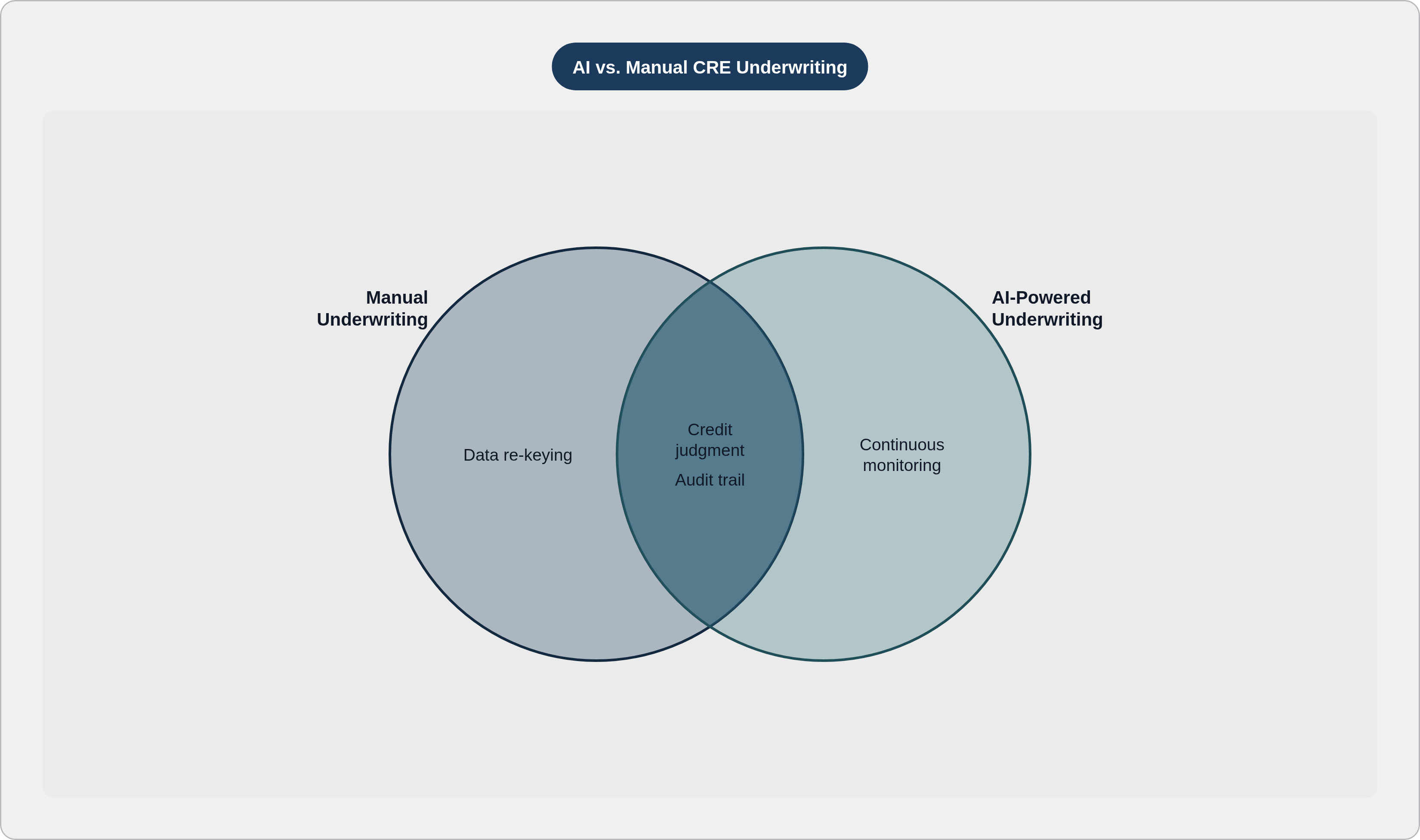
AI-powered financial spreading does those things. It classifies CRE-specific line items, aligns fiscal periods, reconciles totals, separates recurring from nonrecurring items, and flags a below-market management fee so the underwriter can apply a policy reserve. The normalization layer is where the substantive value sits. The output is structured data ready for credit analysis, not a pile of extracted text for an analyst to re-sort. Source citations link every extracted figure back to the document page it came from. Overrides are logged. That audit trail is not ancillary; it is the thing that makes the workflow defensible.
Speed matters here, but not for the reason usually cited. AI-powered spreading can move from raw documents to a full credit assessment in under ten minutes. CBRE's 2025 Tech Adoption Report found that development teams using AI for underwriting completed preliminary analysis three times faster than those without. Fine. But the more durable advantage is that once the baseline is structured, stress testing becomes repeatable. Rate shock, vacancy stress, rent step-downs, replacement reserve assumptions, TI/LC haircuts: all of these can run against the same documented baseline without rebuilding a spreadsheet from scratch. That repeatability is what scales deal capacity without scaling headcount proportionally. The analyst's role shifts from transcription to reviewing normalized output and applying judgment on anomalies. Which is, notably, what they were hired to do in the first place.
How AI Moves Through the Rest of the Underwriting Stack — From DSCR Analysis to Credit Memo Output
The workflow AI now touches is not a single function. It is the full sequence: intake, financial spreading, rent roll review, DSCR analysis, due diligence, credit memo generation, approval routing.
At the analysis layer, the system calculates debt service coverage ratios and benchmarks them against historical trends and peer groups. Anomalies are flagged automatically. Computer vision processes property photographs to verify physical condition against appraised value and extracts spatial data from floor plans to confirm property specifications. At the memo and output layer, AI drafts credit memos with structured narratives grounded in extracted data. A December 2024 analysis of multiagent AI systems applied to credit memo workflows in banking found analyst productivity gains of 20 to 60% and roughly 30% faster credit decision turnaround.
Goldman Sachs estimated in mid-2025 that AI tools could reduce CRE due diligence costs by 20 to 35% for large institutional portfolios. Banks using AI underwriting have reported 50 to 75% reductions in time-to-decision for commercial loans. Those numbers are striking, but they are also downstream of something more structural.
The real argument is not AI as a cost reduction exercise. It is AI as the mechanism by which a lending team participates competitively in an $806 billion origination market without proportional headcount growth. The analyst reviews and approves rather than composing from scratch. That is a different job. It is also, by most accounts from people who have done both, a better one.
Why Explainability and Audit Trails Are Not Optional Features — They Are What Makes AI Underwriting Defensible to Regulators
Here is where the pitch often glosses over something that will eventually matter a great deal.
CRE underwriting involves borrower financial data, material credit decisions, and regulatory examination. The OCC's 2025 model risk management guidance, Bulletin 2025-26, brought AI governance into explicit focus for community banks and mid-size institutions up to $30 billion in assets. Examiners now expect documentation, governance, and oversight proportionate to risk. Explainability is not a feature you add later; it is the price of admission.
What examiners actually care about is not whether a human typed every number into a spreadsheet. They care about governance, traceability, and evidence that human decision authority was exercised. A well-structured AI workflow provides all three: source citations linking every extracted data point to its originating document page, a preserved override trail logging every assumption an underwriter changed, and a documented record of how the system reached its output.
But what if the manual alternative is actually less traceable? That question gets skipped in conversations about regulatory risk and AI. Consider the baseline: inconsistent manual processes, where each analyst structures a credit memo differently, assumptions are embedded in unnamed spreadsheet cells, and source documents are filed separately from the analysis, are often harder to examine than a structured AI workflow with a complete audit trail. In many cases, the AI workflow is significantly easier to defend to regulators, not harder.
Generic AI tools built without CRE workflows in mind fail precisely here. Explainability requires that the system understands CRE-specific document structures, line items, and override logic. A general-purpose language model that processes PDFs does not meet that standard. Bolting an audit trail onto a tool not designed for it produces the appearance of compliance, not the substance. Examiners have been doing this long enough to know the difference.
What Covenant Monitoring Looks Like When It Runs Continuously Rather Than Quarterly
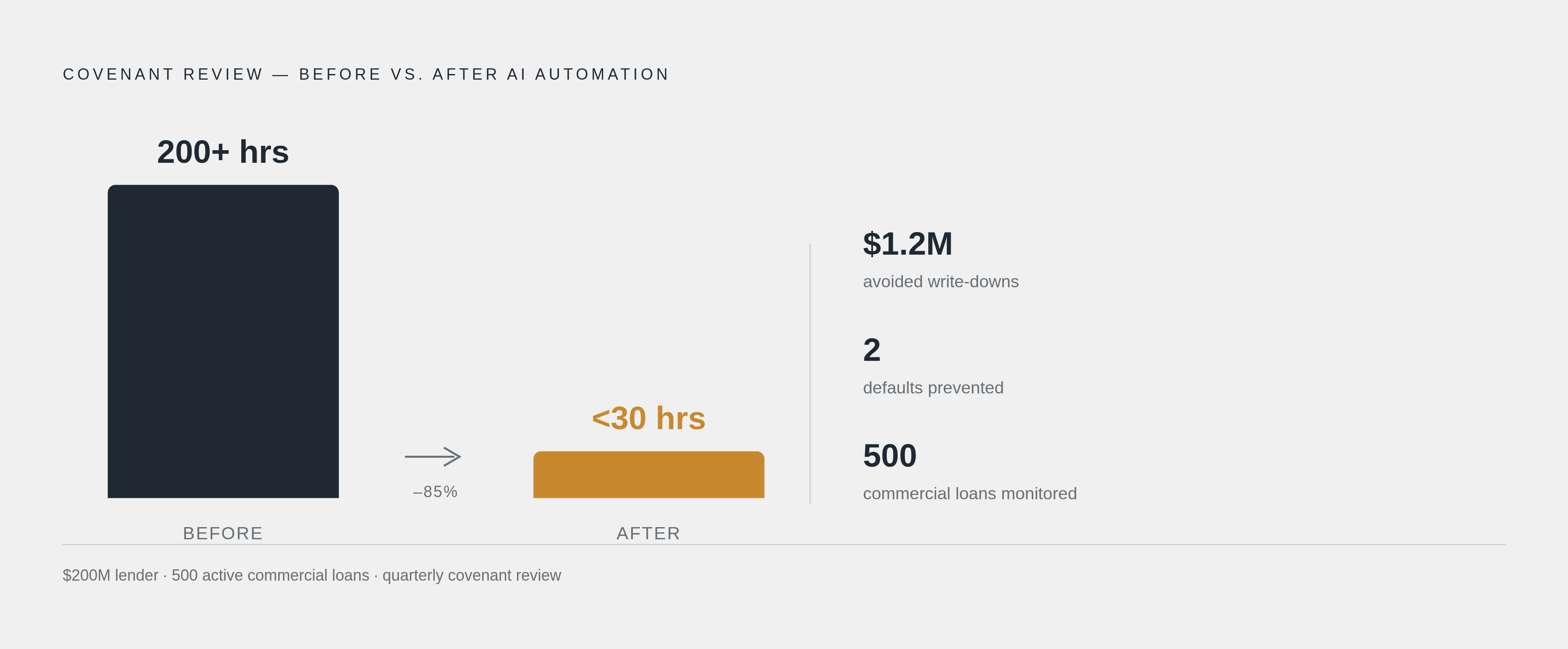
The manual covenant monitoring problem is structural, not a failure of effort. Understanding it requires looking at the raw operational math.
A mid-sized lender with 500 active commercial loans must track an estimated 1,500 to 2,500 covenant thresholds each quarter, roughly three to five covenants per loan, and approximately 70% of banks still manage this in spreadsheets. That is not a technology gap so much as a workflow design that creates inevitable blind spots. CRE loans rarely fail because of a missed payment. They fail because a borrower quietly breaches a DSCR, LTV, or debt yield covenant and the breach surfaces months later under quarterly manual review. By the time the lender acts, remediation options have narrowed considerably.
AI covenant monitoring addresses the failure mode directly. NLP extracts covenant terms from loan agreements and maps threshold conditions to borrowers' incoming financial data. Monitoring runs continuously. Composite loan health scores aggregate DSCR trends, vacancy movement, tenant credit signals, lease rollover concentration, and market changes into a single indicator per position. One $200 million CRE lender's operations team went from more than 200 hours monthly on covenant review and risk reporting to under 30 hours monthly after automation, with early alerts that helped prevent two potential defaults and an estimated $1.2 million in avoided write-downs. AI-powered early warning systems have reduced non-performing loan formation by 12 to 25% across documented implementations.
One thing vendors will not volunteer: continuous monitoring is only as current as the data feeding it. If the rent roll underlying a DSCR calculation reflects a tenancy structure that has since changed — a major tenant departure, an unreported lease modification — the AI alert is only as good as that stale input. "Continuous monitoring" means the system monitors what it receives, at the frequency it receives it. Lenders need to understand what that actually looks like in their specific data environment before treating the alert as ground truth.
The urgency behind all of this is not academic. S&P Global estimates the CRE maturity wall will peak at $1.26 trillion in 2027. The volume of loans requiring active surveillance is rising. Quarterly spreadsheet review was inadequate before that wall arrives. It will be untenable after.
How Portfolio-Level AI Surfaces Refi Windows, Concentration Risk, and Opportunity Signals That Deal-by-Deal Review Misses
That raises an important question: if every loan lives in its own spreadsheet or siloed system, what patterns surface at all?
Most of the interesting ones do not. Maturity clusters, geographic concentration, tenant credit exposure across the book, DSCR deterioration patterns that are invisible in individual positions but visible in aggregate: none of these surface under deal-by-deal review unless someone manually aggregates, which rarely happens proactively. Every lender with a $500 million book already possesses the information to identify concentration risk, optimize maturity distribution, and time refinancing conversations with borrowers. The insight is latent in the data. The operational path to it usually is not.
Connected portfolio intelligence changes the visibility layer. Refi windows and loan maturity clusters surface automatically across the book. Concentration risk by geography, property type, tenant, or sponsor is flagged at the portfolio level, not discovered in the moment a new deal tips an implicit limit. Performance benchmarking runs across assets against market comparables and internal peer groups without commissioning a one-off analysis. McKinsey has estimated that real estate organizations using machine learning have enhanced net operating income by up to 10%, with better-timed decisions rather than cost reduction as the primary mechanism. Accenture's 2025 CRE Investment Benchmarking found that institutional teams deploying predictive deal-sourcing roughly doubled their deals-screened-per-analyst metric, from 12 deals per quarter to 28.
It is also worth considering what the institutional knowledge argument implies, because it often gets buried under the throughput story. Structuring information so it flows between underwriting, servicing, asset management, and portfolio monitoring also preserves analytical continuity when team members leave. In a spreadsheet-based firm, institutional memory leaves with the person who built the model; in a connected system, it stays. For mid-sized lenders who have watched their best analysts recruited away by larger platforms, that is not a minor operational footnote. It is a meaningful structural advantage.
What Separates AI Tools That Work in CRE Underwriting from Those That Create New Risk
The proliferation of AI in CRE underwriting is itself a risk surface. Deploying tools with insufficient domain specificity introduces errors that propagate invisibly through the credit record. That framing, rather than the feature-comparison matrix, is the right one for evaluating any specific tool.
The core distinction is between character recognition and domain-aware classification. Basic OCR reads characters. AI-powered spreading classifies CRE-specific line items, understands document structure across T-12s, rent rolls, and K-1s, aligns fiscal periods, and reconciles totals. A general-purpose AI tool lacks the domain model to do those things reliably. That gap is not a minor technical detail; it is where errors enter quietly and travel far.
The failure modes of generic horizontal AI in CRE underwriting are specific and worth naming. Misclassified line items that look correct but map to the wrong account produce errors that propagate through downstream analysis without triggering any obvious flag. No source citations means overrides and assumptions cannot be traced, which fails examiner review. Stress testing that cannot run against the same documented baseline forces each scenario to rebuild from scratch, which eliminates the repeatability advantage entirely. Covenant extraction that does not understand CRE loan agreement language or deal-specific carve-outs misses precisely the terms that matter most.
Purpose-built, in this context, means something concrete: outputs that land in the format analysts actually use, built against a firm's own templates and chart of accounts; a system grounded in the firm's institutional knowledge rather than siloed from it; explainability and audit trail built into the extraction layer from the start, not retrofitted; and human override preserved and logged throughout. The AI assists the underwriter's judgment. It does not replace it, and any tool that obscures that boundary is creating risk, not reducing it.
One last signal, which I find more telling than most of the throughput metrics. One commercial bank reported a 45% reduction in turnover among credit analysts following AI deployment. That figure reflects something real: the analysts who stay are the ones whose judgment is being exercised rather than bypassed. When the work is credit analysis instead of transcription, the job becomes what people thought they were signing up for when they took it.
The evaluative frame for any CRE lender or asset manager is simpler than the vendor landscape suggests. Does the tool understand a T-12? Does it produce a defensible audit trail? Does it work inside existing templates without requiring a workflow overhaul to accommodate it? Those three criteria filter out the noise quickly. The tools that pass them are few. The ones that fail will tend to create precisely the problems they claimed to solve, just later, and at larger scale.