OCR Accuracy Benchmarks for Financial Documents
Fact-level tests, not character scores, show whether extracted financials can be trusted.

OCR accuracy benchmarks for financial documents should test whether extracted data can support a financial decision as well as whether most characters survived the scan. A high character score can coexist with a wrong balance, monetary unit, or reporting period. The standard should thus be fact preservation, tested on the documents that lenders and asset managers use.
Why standard OCR accuracy scores do not answer the question financial practitioners are actually asking
A lender reading “97–99% character accuracy on clean PDFs” still cannot answer the question that prompted the evaluation. Will the extracted figures support a dependable credit decision? The score describes text recognition, while the lender needs confidence in balances, dates, entities, and financial concepts. Those are related questions, but they are not interchangeable. A nearly perfect transcription can still contain a wrong total.
The broader benchmark ecosystem does not close that gap. OmniDocBench contains no invoices, receipts, or business forms in any version, while OCRBench v1 includes only 67 receipt questions out of 1,000 total. Widely used leaderboards, including olmOCR-Bench and OCRBench v2, were not designed around financial documents. Their results can help assess document recognition without establishing reliability for underwriting. The missing test is whether the system preserves the particular evidence on which a decision depends.
What character-level accuracy actually measures, and what it leaves out
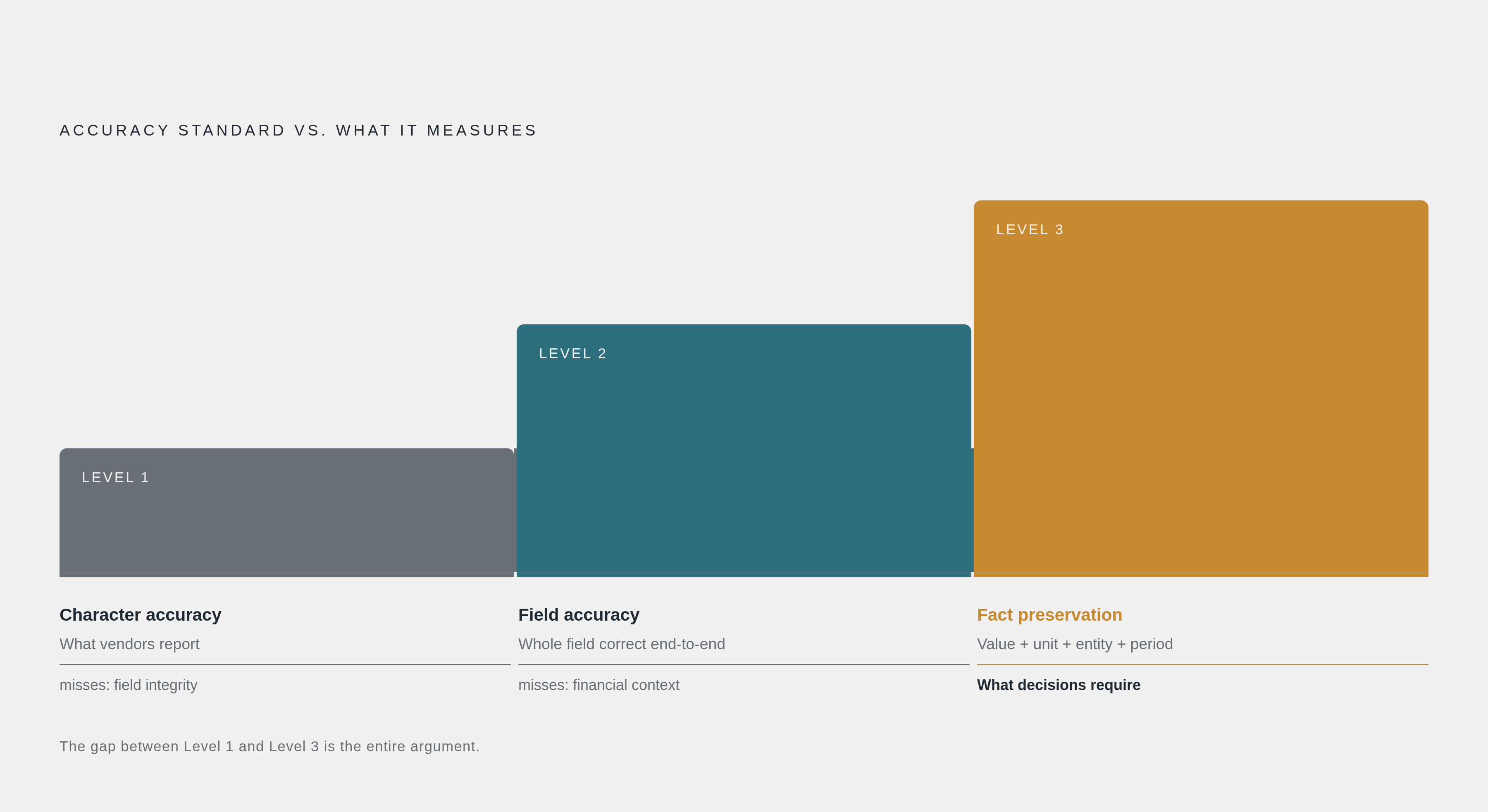
Character-level accuracy counts how many characters in the extracted text match the ground truth. Each character receives the same weight, regardless of its role in the document. A mistake in boilerplate thus counts as much as a mistake in a loan amount. The metric has no sense of financial consequence. This makes it useful for measuring transcription quality, but incomplete as a measure of usable financial data.
Field-level accuracy changes the unit being scored. Instead of asking whether individual characters match, it asks whether a named value, such as a total, date, or balance, is correct from beginning to end. One wrong character can fail the entire field. CC-OCR’s key-information track applies that strict rule, illustrating why field-level F1 and character-level accuracy can diverge sharply on the same document.
Fact preservation asks a further question about context. Is the extracted value still the right fact when read with its monetary unit, reporting entity, period, and financial concept? Correctly recognizing a number is necessary, but the number alone is not the whole assertion.
What FinCriticalED found when it measured fact-level accuracy on real financial documents
FinCriticalED, a fact-centric visual benchmark submitted November 2025 and last revised April 2026, tests whether OCR and vision-language systems preserve financially critical evidence beyond lexical similarity. It has 859 pages from real-world financial documents, with facts annotated by experts. Those annotations span five field types, namely numeric, temporal, monetary unit, reporting entity, and financial concept.
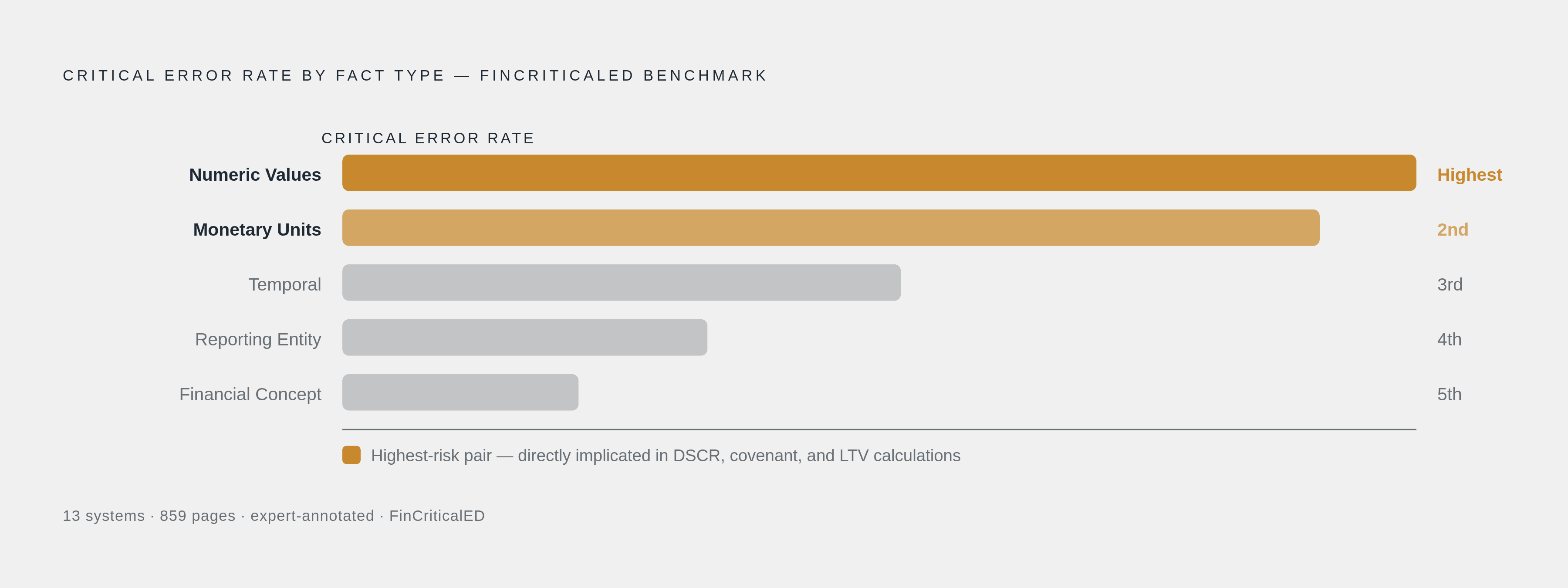
FinCriticalED tested 13 systems and found a clear gap between lexical accuracy and how often the facts were right. Numerical values and monetary units emerged as the most vulnerable fact types. Critical errors were most common in documents with complex visuals and mixed layouts. The pages span text-only, table-only, and mixed modalities at varying levels of complexity, making layout part of the evaluation.
The benchmark uses a deterministic-rule-guided language-model evaluation protocol to assess whether outputs preserve annotated facts in context. That method targets errors that surface metrics miss. Its findings do not supply one universal accuracy rate for all financial extraction. Instead, they establish why a text-recognition score cannot substitute for a financial-fact test. For commercial real estate practitioners, the next question is how that vulnerability intersects with their own document mix.
How accuracy degrades across the financial document types that drive CRE decisions
Reading clean printed documents is a different task from reading poor-quality scans, mobile photographs, or documents with non-standard layouts. In commercial lending, those harder inputs are routine. Treating their performance as interchangeable hides the conditions under which extraction becomes unreliable. Results must be broken down by both document type and document condition, since accuracy can vary even among bank statements or operating statements.
For bank statements, part of the challenge is reading transaction tables that run across pages. For operating statements and financial reports, dense tables and mixed layouts bring structure into the test. Rent rolls and loan agreements add CRE-specific document forms to the evaluation. The evidence so far does not give a single set of production ranges that can be compared across Google Cloud Document AI, Azure Form Recognizer, and Amazon Textract.
Six factors explain much of the degradation. They are scan resolution below 300 DPI, handwritten content, dense or nested tables, colored or patterned backgrounds, high layout variation across senders, and non-primary languages or mixed scripts. These conditions can compound when they appear together. Poor performance on such inputs is therefore not safely dismissed as an edge case, especially when the workflow routinely receives them.
Why multi-page table stitching is the dominant failure mode for bank statements and financial reports
For multi-page bank statements and financial reports, the dominant technical bottleneck is page-stitching. This means reconstructing one continuous transaction table from a table spread across several pages. Banking and lending underwriting needs a 12-page statement to yield that continuous table. The page boundary is a formatting choice.
The reported 97–99% scores on clean printed English illustrate why ordinary text recognition does little to distinguish performance on this harder task. High accuracy on individual pages can coexist with systematic row-level gaps in the assembled output. Those gaps leave out data used for cash-flow analysis and covenant review. The evaluation therefore has to inspect the reconstructed table.
Layout-aware OCR detects tables, columns, and field positions before reading text. It is a prerequisite for preserving this structure. Without it, transaction tables can collapse into scrambled text, limiting downstream accuracy regardless of the underlying recognition engine. Recognizing a table on each page is not the same test as joining the statement correctly.
What fact-level failure actually costs when it reaches a credit or underwriting decision
An extraction error that reaches a loan model has crossed a consequential boundary. It is now a credit risk. FinCriticalED’s vulnerable categories, numeric values and monetary units, map directly onto inputs used in DSCR calculations, covenant tests, and loan-to-value ratios. A one-digit error in such an input can change the conclusion even when the surrounding document is transcribed accurately.
The risk also extends beyond the first calculation. An error that escapes extraction review can enter the financial spread, set the covenant baseline, and anchor later monitoring comparisons. In that chain, a mistake at origination can persist through the life of a loan. Later steps may treat an accepted input as correct even though it was extracted wrongly.
Portfolio size and decision frequency increase the exposure to this kind of failure. Character accuracy alone does not show which errors reach those decision-critical inputs, so it tells only part of the story of the risk. Text recognition is the floor of a dependable workflow. The higher standard must test whether the extracted facts remain fit for the calculations and comparisons that follow.
What a benchmark standard fit for financial documents would actually require
Practitioners should ask vendors to show fact preservation by checking against expert-annotated ground truth on the financial documents they use. FinCriticalED provides a direction for that evaluation through structured OCR and fact-level verification. The requested results should distinguish numeric values, monetary units, reporting entities, temporal data, and financial concepts. Separate results make the vulnerable inputs visible.
Strict field-level accuracy provides a concrete companion measure. A field should fail if any character is wrong, rather than receive partial credit that obscures an unusable value. This is closer to the way a financial model consumes its inputs. A nearly correct balance is not a separately useful class of balance.
Vendors should demonstrate field-level confidence scores that route low-confidence extractions to human review. For documents with totals and running balances, they should also show validation against the document’s own arithmetic, including whether the sum of rows equals the stated total. These are distinct checks. One identifies uncertain extraction, while the other tests consistency within the financial document.
How purpose-built CRE document intelligence platforms address the gap generic OCR leaves open
Purpose-built financial document intelligence addresses the gap by combining recognition with the structure and logic of the documents being processed. Layout-aware extraction trained on rent rolls, operating statements, and loan agreements works with the forms used in CRE workflows. Multi-page table stitching preserves continuity, while field-level confidence scoring supports review. Financial validation rules test the extracted data as financial information.
Cross-document reasoning extends that approach beyond a single extraction. A platform capable of reconciling the same tenant’s data across a rent roll, a lease, and an estoppel can surface discrepancies between those records. Neither character-level nor field-level accuracy tests that relationship when each document is evaluated in isolation. Even when the transcription is correct, the information can still conflict. Resolving that distinction requires a broader view than OCR alone provides.
An AI-native asset intelligence platform built by CRE operators and grounded in a firm’s templates and institutional knowledge is better positioned to enforce this standard because its extraction logic is calibrated to the decisions the data will drive. That positioning is not itself proof of accuracy. The capabilities still need to be tested against actual documents and decision-critical fields.
How to evaluate an OCR or document intelligence tool against a fact-level standard for your specific document mix
Testing should start with the firm’s own production documents, including lower-quality scans, in place of clean samples chosen by the vendor. Bank statements, operating statements, rent rolls, and tax forms should be represented where they occur in the workflow. Field-level accuracy should be measured for each of those document types on its own. This keeps a strong result on easy inputs from obscuring a weak result on the documents that need the most review.
The multi-page test should check whether the output forms one continuous transaction table or treats each page separately. Errors in numeric and monetary fields should be reported separately because these fields were prone to errors in FinCriticalED. These tests answer different questions. One assesses structural integrity, while the other exposes mistakes in the values most directly connected to financial calculations.
Vendors should also demonstrate configurable field-level confidence thresholds and the review routing those thresholds control. Internal consistency validation should reconcile extracted totals against stated totals. Cross-document reconciliation should show whether discrepancies surface when the same fact appears in multiple records. Each capability should be assessed on the document mix being purchased for.
A confidence-based workflow can then send fields below the chosen threshold to people for review, keeping the amount of review manageable while making the data that enters downstream systems more reliable. That is the practical link between extraction performance and operational use. Demanding fact-level accuracy is a risk management decision about where uncertain text is allowed to become accepted financial evidence.