Structured Data Output Standards for Extracted Loan Documents
A framework for extracting loan data reliably across six document types and four validation layers.

Loan document extraction for commercial real estate is four separate requirements, stacked in sequence, where a failure at any level undoes the work of the levels above it. This piece walks through that stack: schema consistency, field validation, confidence scoring, and downstream integration, and shows where each one earns its keep and where its absence causes a specific, traceable failure in a CRE workflow.
The source document problem in loan extraction
Open a CRE loan file and little agreement exists about what a document is supposed to look like. None of it was built to a standard, because no standard exists that every counterparty in a CRE deal has agreed to follow.
This is not simply a matter of too many pages. A thousand clean, identical invoices are a volume problem, solvable with more compute. A CRE loan file is a variability problem: it includes lease agreements, rent rolls, property appraisals, environmental reports, title deeds, and loan documents, and each of those six document types arrives from a different counterparty, built in a different internal structure, requiring its own extraction logic. A rent roll from one property manager can look nothing like a rent roll from another, even though both are supposed to be the same kind of document.
The stakes attached to each document type are not interchangeable either. Loan documents carry LTV ratios, covenants, maturity dates, and interest rates, the figures a credit committee uses to price risk. If you pull the wrong number from the wrong field class, the error doesn't stay contained. It feeds into whatever decision depends on that specific field, whether that's a covenant test or an acquisition model, and nothing downstream has a way of knowing the input was bad.
Add to this that a single loan file can hold applications, income records, bank statements, credit reports, disclosures, and supporting documents, often arriving in a dozen different formats within the same file. What it would take for a system to treat this chaos as the normal condition of the work, rather than an exception to be cleaned up later, is what the rest of this piece tries to answer.
What "structured output" means: the four interlocking layers
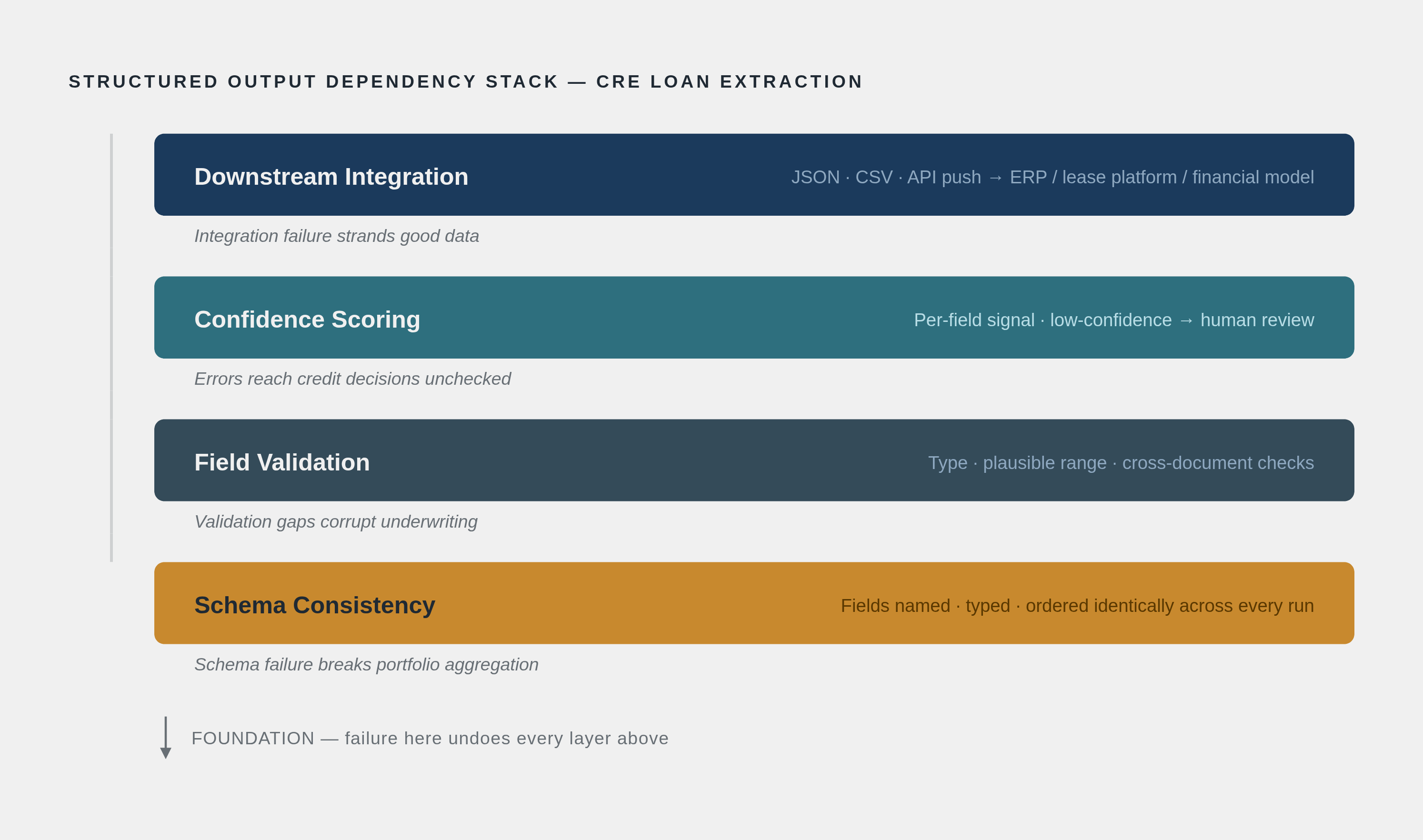
Structured data output doesn't just mean you pick a tidy CSV over a messy PDF. It means a set of four requirements that have to hold together, where getting one wrong undermines the other three regardless of how well they were built individually.
The first layer is schema consistency: fields named, typed, and ordered the same way across every document run, so that a downstream system doesn't have to remap its expectations every time a new document comes in. The second is field validation: checking extracted values against expected types, plausible ranges, and relationships across documents, before any of it leaves the extraction layer. The third is confidence scoring: a machine-generated signal attached to each extracted field, indicating how sure the system is that the value is correct; fields with low confidence are routed to a human reviewer, while others proceed straight to production. The fourth is downstream integration: delivering validated, scored data through structured JSON, CSV, or a direct API push, in the format and granularity the receiving system actually expects, so a lease management platform, an ERP system, or a financial model can consume it without manual rework.
These four layers depend on each other in one direction, and it matters which direction. And integration that assumes clean input amplifies every error that made it through the first three layers, because integration is where the data finally gets used for something.
The sections that follow take each layer in turn, in that order, because the order is the argument. None of them is optional, and none of them substitutes for the others.
Schema consistency: why field-level agreement across documents is the load-bearing requirement
Schema consistency is the foundation the rest of the stack rests on. Without a stable, shared field schema across document types, validation operates on a moving target, confidence scores can't be compared across runs, and integration has nothing fixed to map against. Every later step assumes the schema held, and when it doesn't, nothing built on top of it can be trusted either.
CRE loan files make this harder to achieve than it sounds. What looks, on paper, like a simple field-matching exercise turns out to require a different extraction approach for nearly every document that comes through the door.
The harder version of the problem appears when the same fact is described across multiple documents, not within one. When a rent roll, a lease, and an estoppel certificate all describe the same tenant, each source names its fields differently: one might call it "monthly rent," another "base rent," a third "current rent obligation." Extraction has to map all three onto the same canonical schema. Skipping that step leaves downstream systems holding three separate representations of a single fact, with no way to know they're supposed to agree.
CRE schemas also need fields that general commercial lending schemas were never built to hold. Cap rates, rent per square foot, DSCR, and escalation clauses don't show up in a generic lending template, so a schema borrowed from general commercial lending has to be extended, or replaced outright, before it can do useful work on a CRE file. Schema consistency, in the end, is the contract every other layer is written against. Get the contract wrong and nothing signed on top of it means what it's supposed to mean.
Field validation: catching extraction errors before they enter the decision workflow
A correct schema guarantees that a field exists, is named properly, and holds the right data type. But it guarantees nothing about whether the value inside that field is actually right. A field can be present, named correctly, typed correctly, and still hold a missed decimal, an income figure assigned to the wrong period, or a liability attributed to the wrong borrower. Each of those errors changes a qualification decision, a debt-to-income calculation, or how fast an approval moves, and none of them would be caught by schema checks alone.
The reason this matters as much as it does: everyone downstream treats extracted output as settled fact. A validation failure at the extraction stage doesn't stay localized to one team's work. It propagates into all four of those functions at once, because they're all drawing from the same extracted output.
Validation itself works at more than one level. Range validation catches values that are the right type but implausible on their face: a DSCR outside any reasonable range, a maturity date sitting in the past, an occupancy rate above 100%, each of which should get flagged as an extraction failure rather than waved through to the next stage. Cross-document validation goes further: it checks a flagged policy exception against two separate citations, one pointing to the data point that triggered it and one pointing to the policy clause it violated, so you validate against an external reference instead of just checking a field against itself.
The highest-value form of this, in CRE specifically, is reconciliation across sources. When the same tenant's rent shows one figure on the rent roll and a different figure on the lease abstract, the system's job is to surface that mismatch, not quietly pick one number and move on. Picking silently is a failure mode dressed up as a feature. Most extraction tools weren't built with this in mind. They were built for simpler document types, and when pointed at dense tabular data, like P&Ls and balance sheets full of subtotals, groupings, and tables that continue across page breaks, basic OCR and template-based validation logic break down fast. The fields that survive that kind of document are exactly the ones that need the most scrutiny before anyone treats them as settled, which is what confidence scoring is built to handle.
Confidence scoring: the mechanism that makes human review selective rather than universal
Validation catches values that are obviously wrong, outside a plausible range or inconsistent across documents. Confidence scoring is the layer built for that remaining uncertainty, and without it, a lender faces a binary choice: review every single extracted field by hand, or accept that some unknown fraction of extractions are wrong and let them through regardless.
The recommended practice for financial statement extraction tools in lending is to pick ones that include both confidence scoring and a review interface, on the reasoning that without them, low-quality extractions reach underwriting decisions unchecked. The same pattern is emerging across lenders, special servicers, and investors alike, because the economics of full manual review don't scale past a certain file volume.
Mercury, the business banking platform, went through exactly this kind of evaluation before settling on a vendor for its own extraction needs. The detail worth pulling from that example is that a well-resourced technical team ran a multi-way comparison specifically because confidence scoring and review tooling aren't a nice-to-have add-on; they're a baseline requirement a serious buyer tests for before committing.
Confidence attaches at the field level, not the document level. A document can average out to a high confidence score while individual fields inside it are flat wrong and unflagged, because the average hides exactly the outlier a reviewer needs to see. At the row counts typical of CRE financial packages, completeness isn't a nice property to have; you need it as a baseline.
None of this works without somewhere for the flagged items to go, since scoring without a review UI to act on the flags is pointless.
Downstream integration: where schema, validation, and scoring either pay off or break down
All three layers so far exist to produce one thing: data that's safe to act on. Integration is where that's tested against reality. Validated, correctly scored data delivered in the wrong format, at the wrong level of detail, or stripped of the citations an underwriter needs to trace a figure back to its source, makes everything built in the prior three layers operationally useless, no matter how well each of those layers performed on its own.
The format you choose has real consequences for how much work remains after extraction. Structured JSON, CSV, and a direct API push each assume something different about what the receiving system can do with the data when it arrives. The goal is formatting information for immediate use in lease management platforms, ERP systems, or financial models, but hitting that goal means matching the output format to how the consuming system actually takes in data, not just producing something technically structured and calling it done.
It helps to be precise about what CRE underwriting software actually is, because it's easy to conflate it with a loan origination system and the two do different jobs. CRE underwriting software works alongside that system as an intelligence layer, so extracted data has to integrate with both without forcing anyone to enter the same figures twice.
One test for whether a financial model is genuinely integrated, rather than just populated: does it contain live formulas referencing other cells, or does it contain hardcoded numbers sitting in place of them? Data that feeds a model with hardcoded outputs hasn't been integrated. It's been transcribed, and transcription carries the same error surface as typing the numbers in by hand, which defeats much of the point of automating extraction.
Then there's traceability, which in CRE lending isn't negotiable. Integration architecture has to account for deployment model as seriously as it accounts for file format, because if you get the format right but the deployment wrong, you just create a different compliance problem.
What breaks in CRE workflows without structured output
Calling these four layers "interlocking" is not a figure of speech. Each one's failure produces a specific, identifiable breakdown somewhere in a CRE lending workflow: schema inconsistency breaks portfolio aggregation, validation gaps corrupt underwriting, missing confidence scoring lets errors reach credit decisions unchecked, and integration failures leave good data stranded, disconnected from the systems meant to act on it.
Covenant monitoring is where these failures are most visible. Automated post-close monitoring is supposed to track DSCR, occupancy, and tenant credit health on an ongoing basis, generating alerts the moment a figure crosses a defined threshold, but that only works if the data feeding it is structured consistently and validated correctly every single reporting cycle. Manual tracking, the fallback when automation isn't trustworthy, usually means spreadsheets: slow, error-prone, and hard to scale once a lender is managing financial reports across multiple borrowers and reporting periods at once, which makes breaches, version discrepancies, and emerging trends genuinely difficult to catch in time.
The same spreading and reasoning engine that produced the original underwriting analysis should be the engine running covenant tests on every later reporting cycle. A unified engine produces numbers that reconcile by default, simply because there's only one calculation happening instead of two that are supposed to match but don't quite.
Financial spreading shows the same pattern from a different angle. Software that extracts thousands of data points, each citation-linked to its source page, and runs them through a lender's specific policies to flag exceptions, is only as good as the extraction layer feeding it. If you deliver inconsistently named or unvalidated fields into that process, the policy-checking logic will flag the wrong exceptions, or miss the ones that actually matter. These four layers depend on each other in sequence, and a single weak link anywhere in the chain eventually produces a number a credit committee trusted that it shouldn't have.
Sources
- Structured Data Extraction from Real Estate Documents using Clustering, Classification, and Large Language Models
- Mortgage Banking Document Automation: Common Workflow Gaps
- Loan Processing Workflow: Automate Document Extraction
- Loan Document Automation: Fix the Extraction Layer
- Valid Per-Field Selective Risk Control for Document Extraction: Three Failure Modes, a Validity Ladder, and When Conditioning Pays
- Mortgage Document Automation: Transforming Loan Processing
- Generating structured documents with traceable source lineage
- Automated Population-Level Audit Assurance via AI-Based Document Intelligence