Intelligent Document Processing for CRE and Lending Workflows
Purpose-built AI slashes the time lenders spend extracting data from hundreds of documents per deal.

Commercial mortgage originations are projected to hit $805.5 billion in 2026, up from $633.7 billion in 2025, an industry trade group reports. That's a 27% jump in volume landing on the same desks, the same analysts, the same intake queues that processed a third less paper the year before. This piece maps where that document load actually gets stuck, and what removes the jam.
What the document load looks like inside a CRE deal
A single CRE acquisition can throw off 800 to 1,200 pages of legal, financial, and operational paperwork, Deloitte's Commercial Real Estate Outlook reports. Loan agreements, rent rolls, T-12 financial statements, lease abstracts, insurance certificates, title reports, property records, appraisals, borrower and sponsor financials, compliance records: each one has its own structure, its own vocabulary, its own review logic baked in. A rent roll and a title report have about as much in common as a grocery list and a divorce filing. Both are documents. That's where the resemblance ends.
Think about how these files actually move through a shop today. PDFs get routed by email, sometimes forwarded three or four times before landing with the right analyst. T-12s get rekeyed into spreadsheets by hand, line by line, every single reporting cycle, as if the numbers might have changed shape since last quarter. Rent rolls get rebuilt from scratch instead of updated. Deloitte's 2026 outlook notes that document prep and review eat up a disproportionate chunk of analyst time at exactly the moments speed matters most: origination, credit approval, quarterly reporting.
Documents aren't just annoying to deal with, though they are. Document handling is the rate-limiting step on how many deals a team can chase and how fast it can put capital to work. Credit judgment, pricing, portfolio strategy: all of it waits on paper first, and paper doesn't move itself.
Why manual review breaks down structurally, not just operationally
Three problems stack on top of each other here, and none of them get better by adding more coffee to the analyst break room.
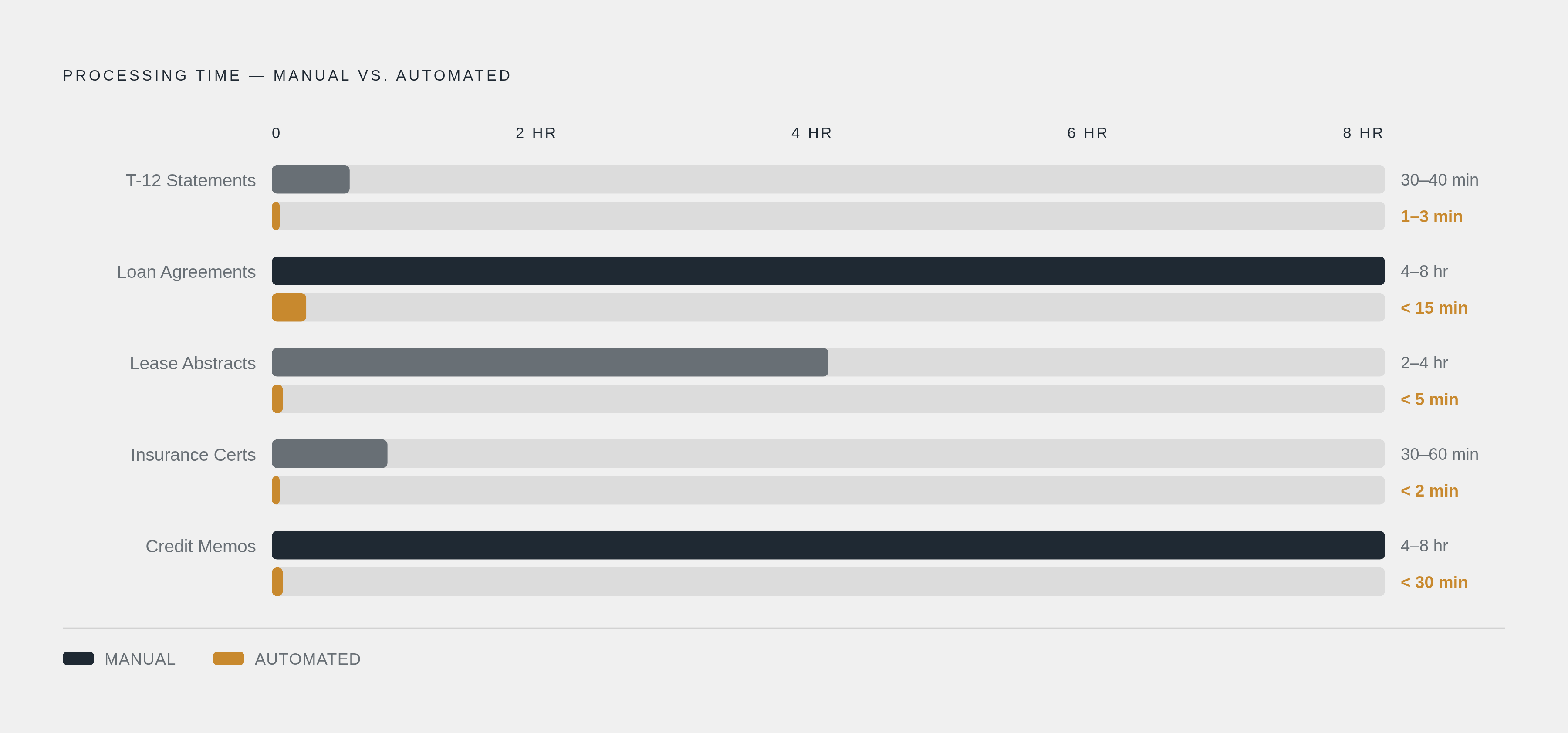
Start with time. A thorough manual review of a 300-page loan agreement runs 4 to 8 hours. A standard commercial lease takes 2 to 4 hours. A T-12 takes 30 to 40 minutes on its own. Running ten loans through that gauntlet in a month makes initial review alone eat more than 120 analyst hours, before anyone touches portfolio monitoring or compliance checks. That's three full work-weeks spent just reading, before a single underwriting decision gets made.
Then there's the error rate. Manual data entry carries a meaningful error rate per field. That sounds small until a loan file with hundreds of fields guarantees, statistically, that multiple mistakes exist before underwriting even starts. Errors don't spread evenly, either. They cluster in the clauses that matter most: covenants, contingent provisions, special conditions, exactly the fine print that decides who eats the loss when a deal goes sideways.
Manual review also scales in a straight line with headcount. A team handling 50 documents a month cannot suddenly handle 200 without hiring proportionally more people to read them. In a market where volume is projected to jump 27% in a single year, neither hiring at that pace nor turning away the extra deals protects margin.
Some shops treat this as a staffing problem, and that's the wrong diagnosis. Industry guidance is blunt about the actual failure mode: when content is ungoverned, inconsistently structured, or scattered across legacy systems, AI doesn't unlock value, it amplifies whatever mess was already there and creates new audit and security exposure on top of it. Deloitte's outlook found 27% of CRE firms running into real trouble implementing AI, largely because they tried to bolt automation onto a pipeline that was already broken. Hiring more analysts to read PDFs by hand just adds more people standing in the same broken pipeline. It just adds more people standing in the same traffic jam.
How intelligent document processing works
Intelligent document processing, IDP for short, pulls in, sorts, and extracts data from property-related files on its own. It goes past old-school OCR, which basically turns pixels into text, by using large language models and vision AI that understand context inside unstructured documents. OCR reads characters. IDP reads meaning, and that distinction is the whole ballgame.
On the ground, that looks like splitting a batch-scanned closing package into its individual component files without a human sorting the pile first. It looks like telling a co-tenancy clause apart from a subletting clause even when both show up in the same lease exhibit under nearly identical-looking language. It means pulling a number, say net operating income from a T-12, and linking that figure back to the exact line on the exact page it came from, so an auditor can trace it later without rereading the whole document. And it means formatting the output so it drops straight into the tools lenders already use: Excel underwriting models, agency workbooks, covenant tracking feeds.
A general-purpose AI tool won't do this job as well, and that's not a knock on general-purpose AI so much as a mismatch of training data. CRE lending runs on rent rolls, T-12s, operating statements, and agency workbooks, and none of those follow the conventions a horizontal OCR tool was built on. Purpose-built CRE systems learn from CRE-specific document structures and CRE-specific metrics: DSCR, LTV, NOI, cap rates. Pointing a generic tool at this work produces output that looks clean and structured on the surface, but it misreads domain-specific clause conventions, which introduces errors at the exact point where lenders most need a number they can trust.
That's why production-grade systems in this space get held to confidence thresholds above 95% for classification and extraction, a standard reflected in Built Technologies' and AWS's work here, before output gets anywhere near a financial or compliance-sensitive workflow. Built Technologies processes more than 250 document types across construction lending, real estate finance, asset management, compliance, and portfolio workflows, with individual documents sometimes running past 500 pages, built in partnership with the AWS Generative AI Innovation Center and AWS Partner and Digital. Extend, another platform in the space, has been noted among real estate document processing tools, built around agentic OCR with vision-language-model correction, layout-aware parsing for multi-column leases and dense purchase agreements, and source citations tied to every extracted field. More than 66% of CRE firms have already shifted toward automation for document processing and lease tracking, and 59% report a real drop in manual data entry time as a result.
The five document workflows that gate CRE decisions, where IDP removes the bottleneck
T-12 financial statements gate everything downstream, and they're also the clearest before-and-after case in the whole pipeline. Manual spreading runs 30 to 40 minutes per document: rekeying figures from PDFs, Excel interims, and scanned tax returns line by line before underwriting math can even start. Smart Capital Center and JLL data show that automated, that drops to 1 to 3 minutes. Smart Capital Center and JLL data point to roughly a 30x productivity gain on financial statement processing, and KeyBank cut loan model prep time by 40% as a result. None of that matters if the output doesn't land inside the lender's own template, ready for review. A pile of extracted numbers sitting in a CSV somewhere is just a different kind of homework. It's just a different kind of homework.
Loan agreements are where the highest-stakes clauses live, and where manual review is slowest by raw hour count. A 300-page agreement takes 4 to 8 hours to review by hand; Smart Capital Center's 2024 platform data puts the automated equivalent under 15 minutes. The clauses where manual errors concentrate, covenants, contingent provisions, special conditions, exception language, are precisely what clause-level semantic AI is built to flag. Source traceability matters most right here, since nobody wants to take an AI's word for what a covenant says. They want to click through to the original paragraph and read it themselves.
Lease abstracts are the workflow where scale breaks manual review hardest. Abstraction by hand runs 2 to 4 hours per lease; JLL's 2024 technology research puts the automated version under 5 minutes. Co-tenancy clauses, kick-out rights, and subletting provisions buried three exhibits deep carry direct cash flow consequences, and a keyword-matching tool will misclassify them without blinking. Abstract hundreds of leases across a maturing portfolio, and nobody has a small army's worth of spare hours lying around every quarter to do it by hand.
Insurance certificates look like the boring cousin of the group, but the review burden compounds because it never stops. Review runs 30 to 60 minutes per document by Smart Capital Center's estimate for CRE compliance workflows. Automated, that's under 2 minutes. Lender's loss payable endorsements carry specific compliance weight that generic extraction tools routinely miss or misfile, and insurance review isn't a one-and-done underwriting step. It recurs for the life of the loan, so the time saved compounds every cycle instead of paying out once.
Credit memo generation is where all the upstream extraction quality finally cashes out. Manual drafting takes 4 to 8 hours per deal; Smart Capital Center's data, including work with KeyBank, shows auto-generation under 30 minutes. An analysis of multiagent AI systems in banking found productivity gains of 20 to 60% on credit memo workflows and roughly 30% faster credit decision turnaround, with the analyst shifting from drafting to oversight and exception-handling. Get the T-12s, leases, and loan agreements right earlier in the chain, and the credit memo practically writes itself.
A live poll of institutional lenders and servicers at the MBA Finance Servicing and Technology Conference estimated up to 70% of current document review work could be automated. Seventy percent is most of the job, full stop. That's most of the job, full stop.
What IDP means for throughput, accuracy, and deal capacity
Commercial lenders using AI-powered underwriting report meaningful gains in deal capacity with the same team, according to industry analysis. Industry research has found banks using AI underwriting achieving substantial reductions in time-to-decision on commercial loans.
Speed alone doesn't win the argument, though. Accuracy has to hold too, or throughput just means making mistakes faster, and faster mistakes are worse than slow ones because they compound before anyone catches them. Does AI underwriting actually hold up on credit quality, or does it just move the same error rate through the pipeline faster? The data says it holds up. AI-powered underwriting has shown measurably higher accuracy in predicting defaults compared to manual-only processes. The speed gain isn't coming at the expense of the thing skeptics usually assume must be getting sacrificed somewhere.
Manual, document-heavy approaches leave many lending organizations facing 40 to 60% longer processing times, Klearstack's research shows. IDP doesn't paper over that drag. It removes the source of it. The competitive stakes are climbing too: Blooma's commercial lending trends piece notes that institutions taking days or weeks on initial reviews risk losing deals to faster-moving competitors, as borrower expectations for quick answers keep rising.
So what's left for the analyst once IDP handles extraction and classification? Exception handling. Sponsor quality assessment. Judgment calls on credit structure. In other words, the parts of the job that actually needed a human brain in the first place, rather than a human pair of eyes doing what a scanner could do better anyway.
Risk that surfaces late (covenant monitoring and portfolio surveillance after origination)
Everyone talks about the origination bottleneck. Fewer people talk about the monitoring bottleneck, and treating it as the lesser problem is the actual mistake here: covenant breaches can go undetected across a portfolio until a scheduled review cycle surfaces them. Risk doesn't wait politely for the next scheduled check-in.
The MBA's $875 billion maturity figure for 2026 means a wall of loans now needs workout analysis, extension underwriting, or refinancing review, and every one of those reopens the full document cycle on assets that already closed once. Refi windows, maturing loans, covenant exceptions across a portfolio: the system itself should flag that opportunity, and that risk, rather than leaving it to be discovered one deal at a time by whoever happens to pull the file next.
This is where IDP's job shifts from speed to surveillance. Automated covenant tracking checked against terms extracted at origination. Ongoing comparison of new rent rolls and operating statements against the assumptions the loan was actually underwritten on. Flags for insurance lapses, lease expirations, and compliance triggers otherwise wait for a scheduled review to get caught, sometimes long after they should have been. Portfolio-level dashboards that pull extracted data across the whole loan book, surfacing patterns that a deal-by-deal manual process never would, because no single analyst sits looking at the whole book at once.
Deloitte's Banking on Trust survey found that well-governed institutions run roughly 8 times as many fully implemented AI use cases as banks with ad hoc governance. That gap is a scaling advantage, plain and simple, and treating governance as a compliance afterthought misreads what it actually does for a portfolio. Risk caught six months too late is operationally no different from risk that was never managed. The value of IDP doesn't stop at closing; it just changes shape, from speed at the front end to vigilance for the life of the loan. It just changes shape, from speed at the front end to vigilance for the life of the loan.
The governance and data readiness requirements that make IDP work
JLL's research found 92% of CRE teams have piloted AI, but only 5% report hitting most of their program goals. That gap, between a pilot that looked good in a demo and a system that actually runs in production, is the real story of AI adoption in this industry right now. Everyone's testing the water. Almost nobody's swimming laps, and which vendor they picked usually has nothing to do with why.
Why does the gap stay so wide? Pilots run on curated data, cleaned up and hand-picked to make the demo look good. Production runs on whatever the shop actually has: scanned faxes from years back, inconsistent naming conventions, five different systems that don't talk to each other. IDP performs only as well as the documents and workflows feeding it, and an institution that hasn't sorted out where its data lives, who owns it, and how it's structured will watch even a well-built tool choke on the mess.
That's not a knock on the technology. A tool that reads a thousand messy files a minute just makes the mess impossible to ignore, the way turning on a bright light doesn't create the clutter on the floor, it just makes you finally deal with it. It just makes the mess impossible to ignore, the way turning on a bright light doesn't create the clutter on the floor, it just makes you finally deal with it.
Sources
- AI Document Analysis for CRE Lenders & Investors
- Real Estate Document Processing Tools (Jan 2026) | Extend
- Lending Document OCR: Don’t Let Paperwork Delay Good Borrowers
- CRE Due Diligence 2026: 5 Layers, Checklist & AI Guide
- Built Technologies builds an AI-powered document intelligence solution on AWS to power agents across real estate finance | Amazon Web Services