Integrating Extracted Data With Loan Origination Systems
Connecting AI extraction to an LOS works only if provenance survives.
Bringing extracted CRE data into a loan origination system takes work on how the system is built as well as how the applications connect. The integration works when document-derived data retains its meaning, source evidence, and calculation logic as it moves through underwriting, approval, and monitoring. Faster extraction helps, but the larger gain comes from removing the breaks that force people to reconstruct the same loan at each stage.
Why integrating extracted CRE data with a loan origination system is harder than it looks
CRE documents and loan origination systems speak different languages. Borrowers, brokers, and property managers produce rent rolls, T-12 statements, offering memoranda, loan agreements, and appraisals with no common schema. An LOS, on the other hand, sends structured credit data through the stages of approval. A document can have everything an underwriter needs but very little in the form the workflow needs. Technical connectivity does not resolve that mismatch.
The analyst usually acts as the translator. Reading a document, transcribing figures into a model, and entering those figures into the LOS creates a manual bridge between otherwise separate systems. Processing a single financial statement can consume thirty to forty minutes, while a full loan package can consume two to three analyst days before underwriting has technically begun. Much of the delay therefore precedes the credit judgment itself. The workflow is waiting for its inputs.
Two market tracks have emerged around this gap. Some institutions use purpose-built AI extraction alongside the LOS they already have, while legacy LOS vendors add AI features to their platforms. These approaches place the document-processing responsibility in different parts of the stack. That placement shapes the integration architecture, the scope of vendor dependence, and the work required to preserve existing processes.
What AI extraction actually does to the document side of the workflow
AI extraction creates a data layer. From T-12s, rent rolls, and operating statements, it produces fielded financial information including NOI, DSCR, vacancy, and per-lease terms, reducing processing time from hours to minutes. Every figure can be traced to its source document and page. That provenance distinguishes an auditable input from a number that merely looks ready for a model.
The output also extends beyond financial statements. Standardized lease abstractions capture base rent, escalations, free rent periods, TI allowances, expiration dates, and renewal options. They also capture non-standard provisions that manual abstraction frequently misses, including co-tenancy clauses, exclusives, and percentage rent triggers. Insurance summaries organize coverage limits by peril category, material exclusions, and gaps between required and actual coverage. Legal summaries point out the change-of-control triggers, cross-default provisions, lockout periods, and assignment restrictions.
These outputs have to travel with their supporting evidence. OCC Bulletin 2026-13 provides non-binding supervisory guidance on documentation, validation, and governance, rather than prescribing source-level traceability for every covenant calculation. Even so, evidence that can survive transfer into the LOS supports review of the extracted data. The reported 70–99% reduction in manual effort per lease in AI-assisted rent roll analysis depends on the data flowing straight into downstream models. Re-entry at the LOS boundary eliminates most of that gain and restores transcription risk.
The three integration patterns CRE lenders are actually using
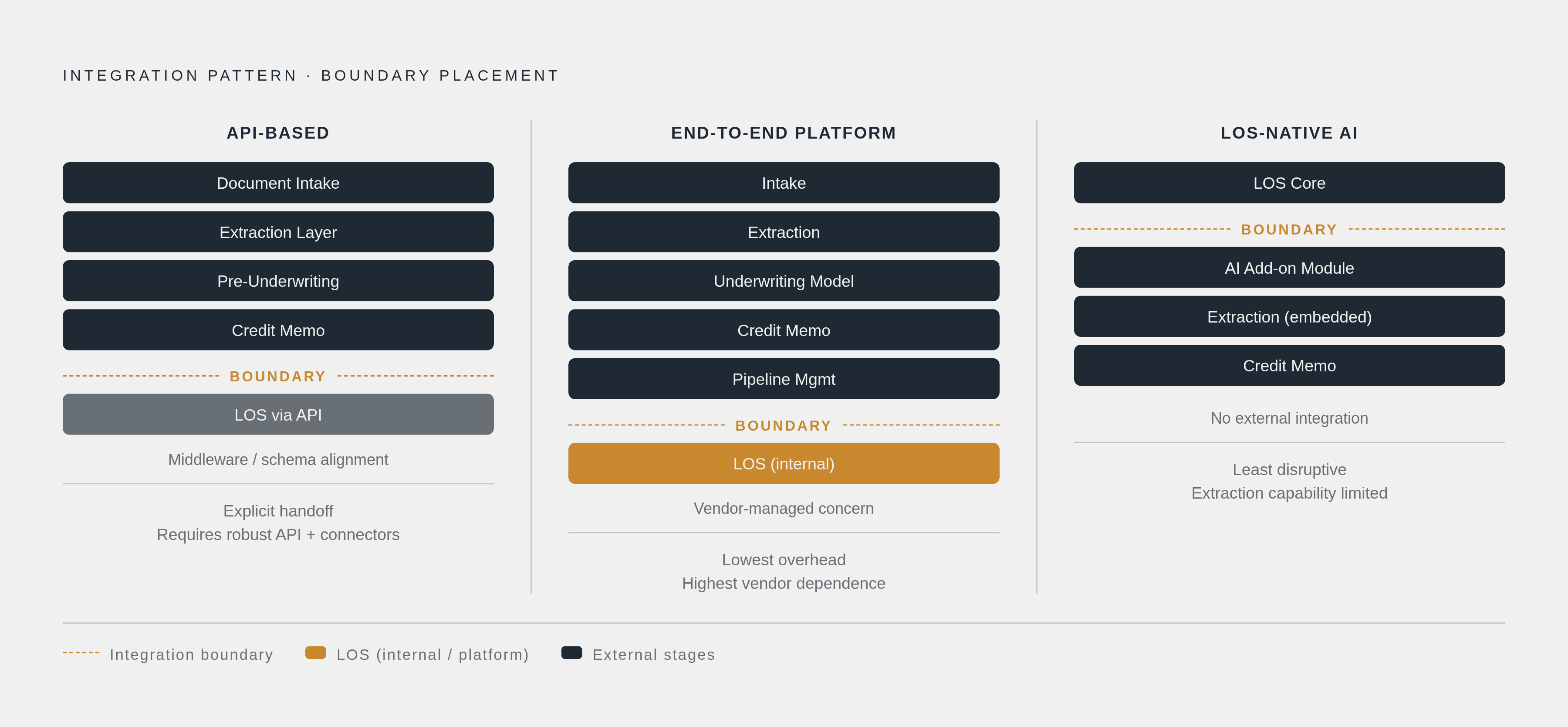
The architecture depends on the systems already in place. Relevant differences include the APIs the LOS exposes and whether extraction is a point solution or part of an end-to-end platform. Three patterns handle those differences by moving the integration work to different parts of the stack, and each has tradeoffs. The useful comparison is therefore between where each pattern puts the boundary and what the institution must manage there.
In the API-based pattern, the extraction layer pushes structured data into the LOS loan record at defined stages, including document intake, pre-underwriting, and credit memo generation. The boundary remains explicit. The LOS needs a robust API, and the extraction output needs a schema it can consume without elaborate field mapping. Many legacy platforms require middleware or custom connectors because they were not built with open APIs. Native connectors from purpose-built CRE AI platforms can reduce that burden.
An end-to-end platform instead handles document intake, extraction, underwriting model population, credit memo generation, and pipeline management within one system. The LOS boundary becomes an internal platform concern. This consolidation reduces integration overhead but can displace an incumbent LOS and require substantial change management. It also concentrates dependence on the vendor. A platform spanning origination through asset management requires confidence in its depth across that full lifecycle.
LOS-native AI brings extraction into the workflow platform already in use through embedded document AI modules or AI-native rewrites. This is the least disruptive path for institutions heavily invested in an existing LOS. Its tradeoff is a greater risk of limited extraction capability, because an add-on to a workflow tool is typically less capable than a purpose-built extraction layer. Across all three patterns, the decision is also about platform rationalization. Using several PropTech applications adds work to connect them, leaves data in silos, and means paying for overlapping licenses, so the extraction connection must be assessed alongside them.
Sequencing the integration: what has to work before what
For implementation teams, the sequence starts with the output schema. Before connecting systems, define the fields the LOS requires at intake, underwriting, credit committee, and booking, then map them to extraction outputs. Mapping first avoids the more expensive rework of discovering mismatches after deployment. Source citations belong in that schema too. If ingestion strips provenance metadata, the institution loses the traceability needed to support examiner review.
Next, validate extraction against the institution’s own document library. Vendor benchmarks do not predict performance on loan files with idiosyncratic formatting, scanning artifacts, or non-standard templates. The test set should include multi-tenant rent rolls with unusual lease structures, T-12s with non-standard charts of accounts, and insurance documents with manuscript endorsements. Source files that conflict, have missing information, or lack clear sources can make errors build up as they move through the pipeline.
Once the output is stable, stage the rollout by document type. Financial statement spreading and rent roll abstraction offer the most consistent extraction accuracy and the highest displacement of manual effort. They provide the starting point before legal and insurance outputs are integrated. This gives the team time to build trust in the output before extracted information is used to make LOS-level credit decisions.
Before data crosses that boundary, set the checkpoint for human review. Extraction accelerates the analyst’s work without replacing the review function. The checkpoint applies the institution’s credit judgment before extracted data becomes the official loan record. It also makes AI outputs human-reviewable before they influence decisions. The sequence thus moves from defining the data contract to testing its reliability, staging its use, and controlling its entry into the credit workflow.
Where the integration breaks down: the origination-to-monitoring handoff
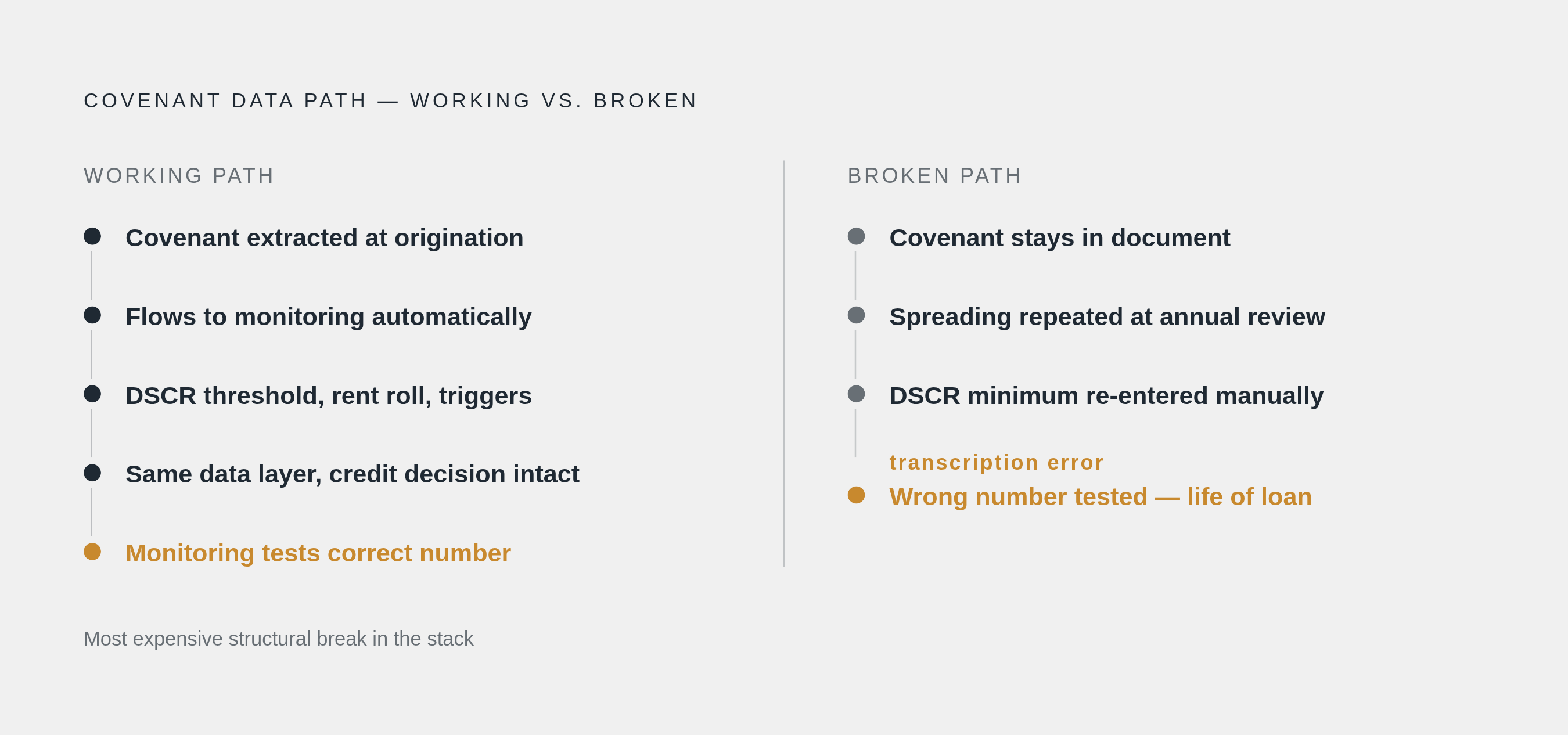
A DSCR minimum entered incorrectly into a monitoring spreadsheet can leave the system testing against the wrong number for the life of the loan. That is a different order of problem from slow document intake. It arises when covenant data extracted from a loan agreement is manually transcribed again after closing. The origination workflow may have worked correctly, yet its output fails to become a dependable monitoring input.
Most LOS integrations stop at precisely this boundary. Covenant terms stay in documents instead of feeding monitoring logic, and operational teams review information that was already checked earlier in the loan. A spreading completed at underwriting may be repeated at annual review because the data is not portable across systems. The isolation of existing information from operational workflows is a second structural break that can be more expensive than the first.
Monitoring also asks a different question of the architecture. Underwriting needs a DSCR calculation to make a credit decision, while covenant monitoring must run for the whole loan term and across the portfolio at the same time. An LOS is not built for that task, nor is an extraction layer unless it extends into ongoing surveillance. The required connection is native integration between the LOS and the covenant monitoring layer, using the same calculation logic that supported the credit decision. Origination AI followed by ticklers and spreadsheets leaves much of the regulatory exposure intact.
That exposure makes the handoff more than an efficiency concern. FDIC and interagency guidance subjects banks with significant CRE concentrations to heightened scrutiny. Systematic covenant monitoring therefore serves a regulatory purpose as well as an operational one. Faster approvals alone cannot answer that requirement.
The regulatory and security requirements that the integration must satisfy
Institutional deployment requires more than a functioning data connection. Using the architecture with confidential borrower information and relying on it in credit workflows requires model governance and security controls. The regulatory framework changed materially in 2026. The Federal Reserve’s SR 26-2 supersedes SR 11-7 and the 2021 interagency BSA/AML model statement, while placing generative and agentic AI outside its formal scope.
That exclusion leaves control decisions with the bank’s own governance program. It does not make extraction quality self-validating. Institutions need to validate AI extraction outputs as thoroughly as they validate traditional credit models, with training-data documentation, tests of accuracy on their own document libraries, and ongoing checks of performance. Human review is one part of that framework. A reviewer needs dependable evidence and a validated process.
Security sets a separate deployment threshold. The minimums are independently audited SOC 2 Type II compliance, private US-based servers rather than shared multi-tenant cloud infrastructure, and a contractual guarantee that loan data will never train underlying AI models. Self-reported assurances are not equivalent to an independent audit. The training restriction is especially important where files contain confidential borrower financials or proprietary underwriting templates.
Lenders that work across countries must also account for the EU AI Act because it lists credit scoring as a high-risk use case. That is a distinct consideration from US model risk governance. Within the US framework, OCC guidance supports documentation, validation, and governance but does not require the specific covenant-traceability mandate that some attribute to it. The practical distinction is important. An integration can preserve detailed provenance as a sound control without misrepresenting supervisory guidance as a prescriptive rule.
What a well-integrated stack looks like across the full loan lifecycle
At intake, a well-integrated stack processes offering memoranda, rent rolls, T-12s, appraisals, and leases in minutes, with each extracted field cited to its source. Structured output then reaches the LOS through an API or populates the origination workflow directly. The underwriting model uses those financials without manual re-entry. DSCR, NOI, LTV, and tenant-level analysis draw on the same extracted data, and the credit memo is drafted from the model with an audit trail.
Figures reach the credit committee with the evidence behind them, saving origination and credit teams another round of searching through documents. The resulting traceability supports the documentation and governance concerns addressed by OCC guidance. It also reduces back-and-forth that can add days to a deal timeline.
After closing, the covenant terms that were extracted feed the logic used for continuous monitoring. DSCR thresholds, rent roll changes, and covenant triggers remain connected to the same data layer without re-transcription. Alerts show when trailing twelve-month figures are drifting toward covenant thresholds before the test date. Across the full loan book, the monitoring layer surfaces concentration risk, maturing loans, and DSCR compression within a multifamily portfolio or construction loan cohort. Reviewing deals by hand, one at a time, cannot give that view of the portfolio all at once.
Data gathered for the credit decision makes monitoring better, and data from monitoring helps with the next origination decision. Maintaining that loop requires a shared calculation engine and a precise understanding of CRE documents, covenant structures, and portfolio risk patterns. Purpose-built platforms designed by practitioners with transaction experience are better positioned to preserve that continuity than horizontal AI tools repurposed for real estate.