Data Extraction Audit Trails and Compliance
Accurate extracted numbers still fail scrutiny without a traceable record of their source.

AI-driven data extraction in commercial real estate is only as defensible as the audit trail behind it. A number may be accurate yet unusable under scrutiny if no one can show where it came from, how it was interpreted, or whether its source is still current. Compliance therefore depends on more than extracting the right value. It depends on preserving the evidence that makes that value trustworthy.
Why audit trails have become non-negotiable in CRE data extraction
Extraction volume is rising as commercial mortgage originations expand, portfolios become more complex, and firms adopt AI. More documents are used to make more underwriting decisions, run more covenant tests, and write more investor reports. As the distance between a source document and a decision increases, the institution needs a reliable way to retrace the path.
Manual processing leaves whatever paper trail the analyst kept. Automated processing leaves whatever the system was designed to record. Automation does not, by itself, improve accountability. If the system retains extracted values but discards their origins and interpretation, it can process more information while leaving less evidence behind.
What does a lender or compliance reviewer actually need? Beyond the number, the reviewer needs the source document, the relevant clause or line item, the processing event, and its timestamp. Where approval or interpretation was involved, that history belongs in the record too. These connections establish provenance, the evidence chain through which a result becomes reviewable.
Institutional investors, commercial loan covenants, and regulatory programs impose documentation obligations that make this more than a preference for orderly files. The precise requirements vary by context. Yet an institution cannot defend a decision merely by pointing to a populated field in its system.
What a CRE document actually contains and why extraction errors carry disproportionate consequences
CRE source documents need to be handled in different ways because their layouts, labels, and legal purposes differ. Brokers use different formats for offering memoranda, operators label expenses in different ways, and leases put similar provisions in different sections. Property reports add further structural variation. The difficulty is determining what text means within the document that governs it.
A lease may contain tenant names, term dates, base rent, escalations, and TI allowances, while a rent roll records unit mix, occupancy, current rent, and lease expiry. An appraisal has valuation methods, cap rates, and comparable sales. Title documents set out legal descriptions, encumbrances, and ownership history, where a difference that seems small can change how an asset is understood.
Environmental reports bring site conditions, compliance flags, and remediation requirements into the record. Loan documents add LTV ratios, covenants, maturity dates, and interest rates. These are not interchangeable categories of information. Together, they shape the economic, legal, and operating picture on which a deal depends. A clean spreadsheet can conceal an untidy set of obligations.
A missed lease renewal costs negotiating leverage, an incorrect valuation distorts an acquisition model, and outdated figures in a regulatory filing create compliance exposure. An untraced error can also conceal a covenant breach. These are routine risks of document processing. Traceability must therefore follow the meaning of a field as well as its position on a page.
How a rigorous extraction workflow produces an audit trail — and where most systems fall short
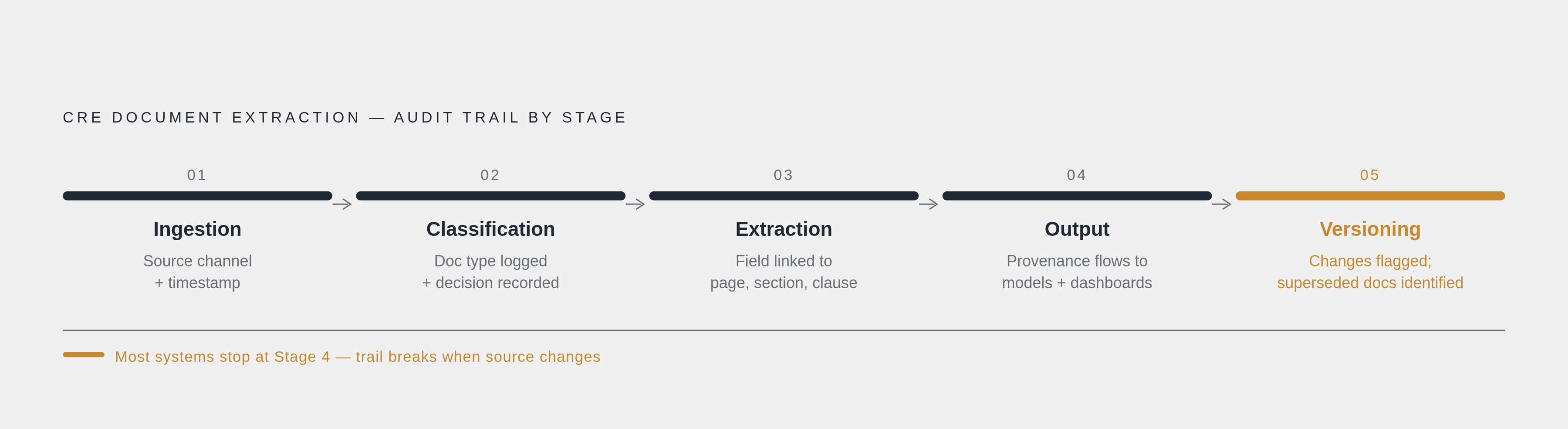
Provenance begins at ingestion, when documents arrive through email attachments, deal portals, or scanned mail. A rigorous workflow centralizes and indexes them on arrival to reduce document loss, duplication, and the processing of outdated versions. The source and ingestion timestamp form the first audit record. Without that starting point, later reviewers may know what was processed but not how it entered the workflow.
Classification then determines which extraction rules apply. A lease requires different treatment from a title policy or appraisal, so an incorrect classification can quietly produce incorrect fields. The decision itself needs to remain reviewable. Otherwise, a reviewer examining an implausible result has no way to distinguish a reading error from the application of the wrong rules.
Extraction uses OCR, rule-based logic, and large language models to pick out data points, while NLP helps make sense of clauses placed in different parts of a document and the legal terminology they use. Here, the record must connect each field to its specific page, section, or clause. At output, the same connection must continue beyond the extraction interface into underwriting models, compliance systems, and portfolio dashboards.
The common shortfall is an output record without a process record. A system stores the value but not the classification decision, extraction logic, or source location that produced it. Oleg Solozobov’s Governed Auditable Decisioning Under Uncertainty: Synthesis and Agentic Extension identifies related structural breaks in agentic systems, namely decision diffusion, evidence fragmentation, and responsibility ambiguity. There is no single audit point for decisions, the evidence is scattered, and it becomes unclear who is responsible for outputs.
What compliance actually requires from an extraction audit trail
Documentation requirements must be tied to the program or obligation involved. HUD Exchange’s Multifamily Housing Program Financial Management Toolkit requires supporting documentation for transactions and an adequate audit trail. It also requires source documentation showing that costs were approved by the appropriate officials within the organization. For extraction workflows supporting those records, a stored amount without its supporting evidence is insufficient.
LIHTC recordkeeping has a different emphasis. IRS Reg. §1.42-5(b) establishes requirements for tenant files, unit tracking, and project records. It should not be recast as a universal requirement to log who approved every accounting transaction, when, and what changed. The distinction is important for system evaluation. A platform’s “compliance” offering must support the applicable records beyond a generic activity log.
Each covenant test needs a timestamp, and each DSCR calculation needs a link to the specific T-12 lines that drove it. The complete record must be exportable for examination. Model risk management also requires that model outputs, including covenant calculations based on extracted data, can be traced to their inputs and reviewed whenever needed.
If the trail depends on one person remembering which email contains the right attachment, the institution has a single point of failure. Even teams that understand the documentation standard may struggle to meet it when their extraction system was built to deliver answers but not preserve the basis for them.
How a stale or incomplete audit trail turns a correct extraction into a liability
A correct extraction can become unreliable without any mistake in the original reading. Its source may have been superseded. If the audit trail captures the initial event but not subsequent document changes, reinterpretations, or updates, it cannot establish whether the result still represents the operative information.
Consider a DSCR covenant signal that uses income inputs from a rent roll. The original extraction may match that document, yet the tenancy structure may have changed because a major tenant left, rent abatement was granted, or a lease modification went unreported. The calculation can then signal on income that no longer represents current cash flow. A lender acting on it may miss genuine deterioration or initiate a false covenant review, with both operational and relationship consequences.
The gap is in the record’s failure to identify that its source has been superseded. A complete provenance record must therefore link data to a specific version of a document and show whether that version is still in force. A timestamp establishes when the reading occurred, but it does not establish that nothing relevant changed afterward.
The same problem appears when a spreadsheet cell is overwritten without a change log. The current value remains, while the history needed to interpret it disappears. Solozobov’s paper describes the broader problem as reconstruction failure, where formally compliant organizations cannot establish what happened or why an automated decision system failed. In a CRE workflow, preserving only the latest result can leave the institution unable to distinguish a valid update from an unexplained alteration.
What professionals should demand from any extraction system handling CRE compliance data
For professionals evaluating extraction systems, the lesson is to assess whether a reviewer can reconstruct a decision without improvising an investigation. Clause-level citation is the first requirement. Each extracted field should lead to the specific page, section, or clause supporting it. That precision lets a reviewer examine the evidence and the interpretation together.
The chronology must be equally dependable. Ingestion, classification, extraction, and subsequent modifications should each have system-generated timestamps. Document versioning must preserve what was extracted from each version and flag source updates. Together, these records distinguish when a value entered the system from whether the document supporting it remains current.
Reconstruction also requires an exportable process record. Examiners, lenders, and counsel should be able to review the source document, extraction event, classification decision, and output destination without assembling fragments from logs or email archives. Every extraction event and downstream use should show which system component or user action was responsible. Multiple AI agents do not remove that obligation. Their involvement makes the assignment of responsibility more important.
The evidence chain must also survive integration. Data moving into underwriting models, covenant monitoring, or reporting dashboards should retain its provenance, because those are the places where it informs consequential decisions. Professionals should treat these requirements as minimum standards. A generic horizontal AI tool repurposed for CRE is unlikely to have been engineered around all of them, while a purpose-built system must still demonstrate that it meets them. Platform choice is therefore a compliance decision, since an audit trail is an architectural commitment.
How audit trail quality connects to portfolio-level risk management, not just individual deal compliance
Continuous covenant monitoring needs T-12 lines that can be traced, rent roll occupancy figures that are up to date, and calculations that can be linked to their sources. An early DSCR warning is useful only if its inputs withstand review. Otherwise, the institution receives a signal without a defensible basis for acting on it.
Continuous AI monitoring can identify risks that traditional quarterly reporting misses, including covenant stress before technical default. A lender still needs to explain the signal to examiners or borrowers. If that explanation requires rebuilding the evidence from disconnected files, the apparent monitoring advantage may disappear at the moment action is needed.
Fragmented systems make this problem harder to contain. Shadow SaaS purchased outside procurement rarely receives a security review, while data scattered across disconnected tools undermines confidence in the portfolio view. An inadequate audit trail leaves those gaps difficult to reconstruct. The same weakness affects opportunity identification, because refinance windows, maturing loans, and early stress signals depend on information that is consistently structured, sourced, and auditable across assets.
Platforms connected to live operational data can detect mismatches, route reviews, block risky actions, and preserve evidence, moving compliance beyond the filing cabinet. That proactive posture depends on knowing both what the data says and why it deserves confidence. As the portfolio expands, each additional asset adds information that must remain defensible within the whole. The value of AI-driven extraction can scale with that growth, but only if its audit trail scales with it.