Automated Rent Roll Extraction and Validation
Validated rent roll data flows directly into underwriting models without manual re-entry.

Rent roll extraction pulls structured data (tenant names, square footage, base rent, lease dates) out of PDF documents so nobody has to retype them into a spreadsheet. Validation is the separate, harder step that checks the data against the lease, the estoppel, and the trailing financials. Most vendors sell the first one and call it the second, and that gap is the reason so many "AI-powered" underwriting pilots quietly stall out before anyone admits it.
Trace cap rate, cash flow projections, or debt-service coverage back far enough and each one comes from that document. Most teams still receive the rent roll as a PDF, sometimes scanned, sometimes exported straight from a property management system, and almost never in a format matching the last one they saw. A misread base rent figure doesn't stay in one cell. It runs through every formula downstream of it, the way a typo in cell A1 ruins a spreadsheet nobody thought to check twice. Reconciling the T-12, the current rent roll, and the OM pro forma by hand is a time-consuming manual exercise, for one deal, checked once, by someone who didn't get pulled into a call halfway through page 14.
What automated rent roll extraction does, step by step
Software claiming to "read" a PDF is not new; ten years of vendors have said as much. What's different now is that extraction produces structured data that flows directly into underwriting models, with no analyst sitting in the middle retyping numbers from one screen into another.
Three layers do the actual work, and skipping any one of them is where the cheaper tools cut corners. OCR turns scanned pages and photographed leases into machine-readable text. On top of that, an NLP layer figures out context: it finds a "commencement date" whether it sits in a table on page 2 or gets buried in a paragraph on page 47. Machine learning models recognize fields by context rather than fixed position, so the system generalizes across formats instead of breaking every time a property manager's export looks slightly different. An integration layer, built on APIs and native connectors, pushes the extracted data into Yardi, MRI, ARGUS, or whatever ERP the firm runs.
At the tenant level, the fields pulled out include name, leased square footage, base rent, rent escalations, commencement and expiration dates, renewal options, CAM obligations, and any free-rent or concession periods buried in the lease language. Format inconsistency is the specific headache machine learning solves and rigid, template-based tools don't. A rent roll from one property management platform can look nothing like one from another: same information, completely different layout. A tool built around a fixed template breaks the moment it hits something it hasn't seen. That's the whole case for ML-based extraction over template matching: it bends instead of snapping, and snapping is expensive when it happens on a live deal.
Why validation is the harder problem than extraction
Extraction answers one question: what does this document say? Validation asks a tougher one: is what it says true, complete, and something a lender would stake a loan decision on? Those are different tasks, and most automation projects that stall out do it by treating them as the same one. Vendors sell you the first and let you assume you bought the second. Vendors sell you the first and let you assume you bought the second, and that's the trap.
A handful of checks catch what manual review routinely misses. Does the occupied square footage on the rent roll match the gross leasable area on the lease or title document? Does the revenue implied by the rent roll at stated occupancy match the NOI on the T-12 for that period? Do the rent figures line up with the schedules in the executed leases, rather than whatever got typed into a spreadsheet last quarter? Are the expiration dates on the rent roll consistent with what the estoppels say? And the one that should make anyone's stomach drop a little: are there tenants listed as paying who occupy space nowhere reflected in the current rent roll, or whose lease already expired?
Source traceability is what separates real validation from a black box that spits out a number and asks to be trusted. A defensible system shows, for every extracted value, which page of which document it came from. That's what makes the output usable months later, in an audit or compliance review, when someone asks where a number came from and "the software said so" doesn't hold up.
Amendments are where this gets genuinely tricky. A lease sets a base rent per square foot, but an amendment executed eighteen months later bumps it up. A system that reads only the original lease returns a technically sourced, entirely wrong number. Generic document AI, built for contracts in general rather than commercial leases specifically, tends to trip on exactly this kind of layered, amended language. Real validation has to account for the operative figure living three documents deep.
Cross-document reconciliation: where automated systems catch what single-document extraction misses
Reading one document well is necessary. It's nowhere near sufficient. The rent roll, the executed lease, and the estoppel all describe the same tenant, and the real risk in a deal usually lives in the gaps between what those three documents each claim.
A few years back, reconciling a full data room against itself, in production, at scale, barely existed as a workflow. Somebody's associate did it by hand over a weekend, or it didn't get done. Now, firms with mature implementations ingest an entire data room and get back a variance report far faster than manual review allows, flagging where the seller's representations diverge from what the documents actually show.
What does that catch, specifically? The rent roll shows Tenant A paying $45 per square foot, but the lease shows a scheduled escalation to $48 that took effect two months earlier: the rent roll is stale and understates revenue. The rent roll, dated the same day, shows a vacancy nobody mentioned in the offering materials, while the OM pro forma assumes 95% occupancy. Or the T-12 NOI doesn't match what the rent roll implies at stated occupancy, meaning unreported vacancy somewhere, or a mistake in the operating statement. Or an estoppel contradicts the lease on a renewal option, and the tenant believes it holds a right the landlord's own paperwork doesn't reflect. Caught manually, each of these requires someone to notice a discrepancy across three PDFs open in three windows at once, and that gets missed at 6 p.m. on a Thursday. Caught automatically, the discrepancy appears as one line: document A says this, document B says that, with a page citation for both.
The output is a sourced variance report, the kind that goes in front of a credit committee without anyone asking how the number got there. That's the whole point of running it this way.
How extracted, validated rent roll data feeds underwriting models without manual re-entry
Extraction by itself is a party trick if the clean data just sits there afterward, admired like a nicely organized junk drawer nobody actually uses. Validated numbers flowing straight into the underwriting model are what produce the value, because skipping the re-entry step removes the point where most errors get introduced. Every time a person retypes a number from one system into another, there's a chance for a transposition, a rounding slip, a decimal in the wrong place. Cutting the retyping drops the error rate, because the software doesn't get tired on page 14 the way a person does after the third deal of the afternoon.
Automated underwriting engines take validated rent roll data and map tenant-level revenue straight into model rows. They pull trailing-12 actuals off the operating statement and check them against rent roll revenue automatically. DSCR, LTV, debt yield, and cap rate get calculated straight from source documents, with no manual formula-building. Rollover schedules and vacancy stress tests get built directly from the lease expiration dates the system already pulled out. The resulting pro forma traces back to actual documents, not to an analyst's memory of what those documents said three weeks earlier.
Automated underwriting on commercial loans has been associated with time-to-decision reductions in the range of 50 to 75%, with document-processing tasks that took 30 to 40 minutes by hand now done in 1 to 3 minutes by software. Reviewing five deals a week versus reviewing twenty comes down to that gap, and that math is the argument for doing this.
Validated rent roll data as the prerequisite for meaningful covenant monitoring
Commercial loans rarely blow up because a borrower misses a payment. They blow up because a covenant gets breached quietly, in the gap between quarterly reporting cycles, while the lender's spreadsheet sits there waiting on an update that hasn't come in yet.
Every covenant test depends on the same chain of data that rent roll extraction produces at the bottom. DSCR needs accurate NOI. Accurate NOI needs accurate tenant revenue, and accurate tenant revenue is what an accurate rent roll produces, full stop. A bad rent roll produces a bad covenant test no matter how sophisticated the monitoring layer sitting on top of it looks. No dashboard, however slick, fixes numbers that were wrong three steps upstream.
One large unplanned repair, or a tenant rolling down to a lower renewal rate, or an insurance premium spike, pulls trailing-12 NOI down just enough to push DSCR below the covenant threshold at the next test date. It rarely happens in one dramatic quarter. DSCR sliding from 1.31x to 1.28x to 1.26x across three quarters is a visible trend, but binary quarterly testing doesn't see trends. It sees pass or fail, on the one day it happens to check. By the time the spreadsheet gets updated and someone notices, the borrower may already be out of compliance, and the lender is holding the contractual right to sweep cash, charge default interest, or call the loan.
AI-based covenant monitoring changes that cadence. It reads the loan agreement, pulls current property financials, and tests every active covenant continuously instead of quarterly: DSCR, LTV, minimum debt yield, reporting deadlines, checked on an ongoing basis rather than four times a year. A slow decline gets flagged weeks before it crosses into technical default. Covenant monitoring stops behaving like a rearview mirror and starts behaving like a dashboard warning light, the kind that comes on before the engine actually seizes.
What the market's adoption gap reveals about where automated extraction delivers
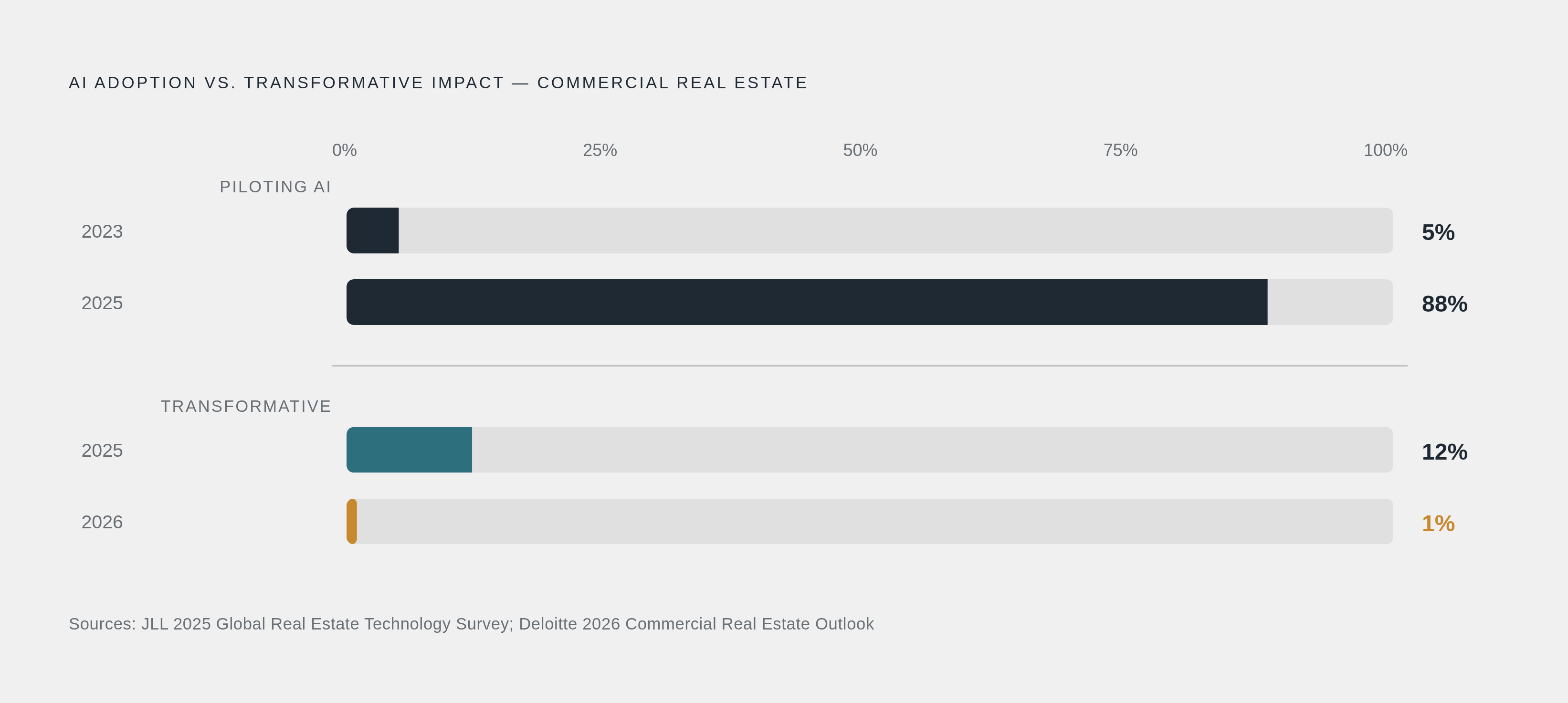
Among senior decision-makers surveyed, 88% of investors, owners, and landlords said they'd started piloting AI in some form. Just 5% had been piloting AI at all as recently as 2023, according to the JLL 2025 Global Real Estate Technology Survey. That gap is most of an industry running an experiment and watching it underdeliver, then wondering aloud why the technology didn't live up to the pitch deck.
Deloitte's 2026 Commercial Real Estate Outlook found something that lines up with it: the share of executives reporting transformative AI impact dropped from roughly 12% to 1% year over year. Is AI getting worse? Almost certainly not. What's more likely, and considerably more mundane, is that most firms pointed the technology at surface-layer work, chatbots, generic document summarization, instead of at the document- and model-intensive work that actually decides whether a deal performs or blows up.
That gap is diagnostic: firms running AI on top of manually assembled, unvalidated data are not modernizing anything. They're just inheriting the same errors at higher speed. Automating a broken pipeline just breaks faster, with better formatting. It just breaks faster, with better formatting. Separately, 76% of CRE organizations report relying on some form of smart automation for document processing, which sounds like broad adoption until you notice that adopting automation and adopting validated data infrastructure are two different things. One digitizes a bad process. The other replaces it, and conflating the two is why the transformative-impact number cratered to 1%.
Evaluating automated rent roll extraction tools: what the leading platforms cover
A few evaluation criteria fall out of everything above, and they hold up better than most vendor checklists. Source-document traceability comes first: can the tool show, for any extracted value, exactly which page of which document produced it? If the answer is a shrug, that disqualifies it from anything feeding a credit decision, no matter how clean its dashboard looks. A pretty dashboard sitting on top of untraceable numbers is decoration.
Cross-document reconciliation matters just as much. Does the platform actually compare the rent roll against the lease and the estoppel and flag disagreements, or does it process one document at a time and leave the cross-checking to whoever's stuck doing it manually afterward? A tool that reads beautifully but reconciles nothing has solved half the problem and called it finished.
Format generalization is the third test, and it's the one that separates machine-learning approaches from rigid template tools. Does the platform handle a rent roll from an unfamiliar property management system without breaking, or does every new format trigger a support ticket and a two-week wait for a custom build? That question gets skipped most often in a sales demo, because demos run on clean, familiar files rather than the scanned, slightly crooked PDF that appears at 4:45 on a Friday afternoon, the one nobody wants to open until Monday.