Document Classification and Routing in Loan Origination
AI prepares validated, routed loan files before underwriting starts.

Document classification and routing tackle the least glamorous source of delay in CRE loan origination, the work it takes to turn a document packet into a file that is ready to use. AI delivers its fastest, most measurable payback here by preparing validated, routed data before underwriting begins while preserving the lender's credit judgment. The investment becomes more valuable when that same data supports the loan after closing.
Why loan origination stalls before underwriting ever begins
Lenders often look to credit decisioning to explain why origination is slow, but most of the time is usually lost before that. Documents arrive incomplete, figures need re-keying, and errors send files backward. None of that requires a lending decision. Yet the analyst cannot begin useful analysis until someone has assembled the evidence, reconciled its formats, and found what is missing.
Uptiq's origination analysis describes analysts copying figures from PDFs into spreadsheets while relationship managers chase borrowers for the same missing document three times. Statements arrive in a different format for every entity, making preparation a recurring job. At lean institutions, one person may originate, spread, draft the memo, and manage the compliance file. That concentration makes the constraint especially sharp. Growth demands more headcount even when much of the additional work requires no lending judgment.
What document classification and routing actually do, and what they do not do
Optical character recognition, or OCR, converts printed or handwritten text into machine-readable text. Intelligent Document Processing, or IDP, goes further by identifying document types, extracting fields and tables, applying validation rules, and routing uncertain results for review. Readable text is only the starting point. Infrrd's IDP guide distinguishes the two by what they produce, with OCR creating text and IDP turning loan documents into usable lending data.
Classification establishes what the system is reading before extraction begins. It separates bundled packages, identifies document types, and organizes pages so that relevant values can be found without relying on page position. Routing then determines where those results belong. High-confidence results that pass the applicable rules can proceed to the LOS or underwriting queue, while missing pages, conflicting figures, and uncertain extractions go to reviewers.
This file-processing role is distinct from both workflow management and credit decisioning. Multimodal's loan origination agent guide separates the stack into a decision layer that approves, prices, and scores risk, an origination layer that manages applications and documents, and a file-processing layer that reads and verifies the packet. The distinction prevents a costly category mistake. An LOS can move a file without checking that it has everything it needs, while IDP can get the evidence ready without deciding whether to lend.
The CRE document set is specifically why generic lending automation falls short
CRE documents challenge more than a system's ability to recognize text. A file can contain leases, rent rolls, trailing financials, offering memoranda, appraisals, environmental reports, inspection summaries, tax returns, and multi-entity organizational charts. These records describe different parts of the same deal. When the system processes them, it needs to keep the links between them as well as put their contents into a common format.
There is no single dependable template underneath them. Non-standard rent rolls, inconsistent trailing-period formats, and multi-tenant lease structures defeat assumptions about where information will appear. Docsumo's AI in lending guide includes rent rolls and T-12s among documents from which AI can extract fields and tables with confidence scores for each value. That coverage is important because recognizing a familiar bank statement does not establish competence with the rest of a CRE packet.
A borrower entity, operating company, guarantors, and multiple property-owning LLCs may each bring financials requiring tracing through K-1s and schedules. Senior analysts can spend hours tracing these by hand for each file. Extraction and validation also need to reflect property type, tenancy structure, and loan purpose, while non-standard structures such as bank-statement, asset-depletion, and foreign-national loans leave cases where human judgment remains necessary. CRE intake is not consumer intake with a larger attachment limit.
The four-step automated intake sequence and what each step changes
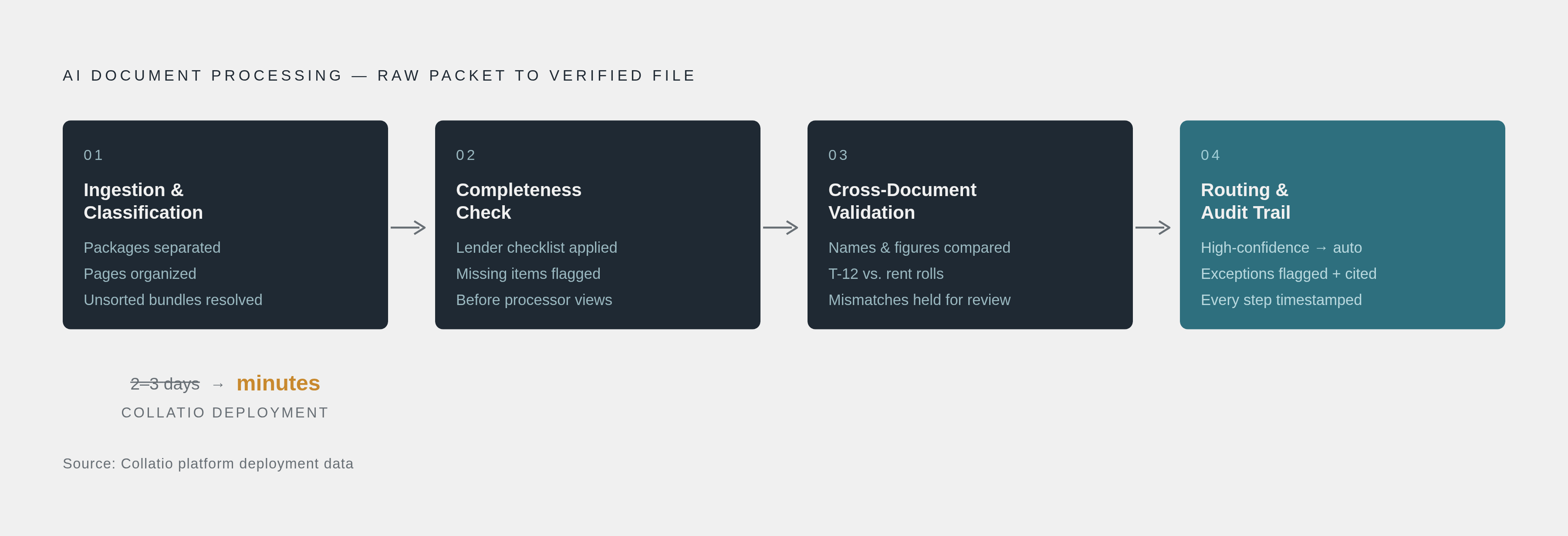
The first step is ingestion and classification. Documents enter through a portal, email, mobile upload, scanner, API, or LOS workflow, and the system separates packages and organizes pages into a consistent structure. Extraction no longer starts with an unsorted bundle. Scry AI's origination software review says that, in reported deployments, Collatio used intake and classification to cut the time it took to process applications from two to three days to a few minutes.
The second step checks whether the packet is complete. The agent compares its contents with a configurable checklist based on the lender's internal policies. The system flags what is missing before a processor touches the file. This changes the starting condition for underwriting from a partial packet requiring repeated borrower contact to a complete file ready for the next checks.
The third step validates values across documents. Names, amounts, employer details, and financial figures are compared, with mismatches and low-confidence results held for review. Docsumo's guide gives examples of checks that deposits fit the revenue reported on a tax return and that names match across the file. In CRE, validation includes checking T-12 income against rent rolls and calculating DSCR from extracted actuals.
The fourth step routes results and preserves the review trail. High-confidence, rule-passing outputs proceed automatically, while missing pages, conflicting figures, low-confidence extractions, and suspected alterations reach a reviewer with the flag and source citation attached. Every step is timestamped, and extracted values remain traceable to their source pages. Multimodal describes the output as a fund-ready summary or an exception list with citations.
Why fixing the document layer is what actually accelerates underwriting
Uptiq identifies assembly as the bottleneck. Using automation to make the judgment call raises governance problems and may be hard to trust, while using it to prepare the file cuts delays and leaves the decision with the lender.
Multimodal's Field Report 2026, based on talks with financial institutions, found that traditional automation can handle structured steps but breaks down on the long tail of hard cases. A decisioning model can score risk in milliseconds while a processor still reconciles pay stubs by hand. Financial spreading illustrates the upstream opportunity in CRE. Multi-entity files covering 1040, 1065, 1120, and 1120-S returns with K-1 tracing can move from several hours of senior analyst assembly to minutes of automated processing followed by review.
Uptiq describes six specialised agents that pass structured work from one stage to the next, including spreading, policy checks, and preparing the memo. Verified figures do not need to be re-entered. Credit memo sections covering the borrower, financial summary, ratios, risk findings, and recommendation can arrive pre-populated with cited content for the analyst to edit and approve. An existing AUS or LOS does not remove this opportunity, because scoring risk and managing workflow do not establish that the underlying file is complete, accurate, or fundable.
The auditability requirement that makes AI output usable in regulated CRE lending
Faster preparation is useful only if the lender can defend the result. An analyst needs to inspect the evidence behind a figure, and an examiner needs to reconstruct how it was handled. Auditability makes that possible without starting the assembly process again. A source-page citation should lead from a consolidated number to the tax return, K-1, or schedule that supports it.
The record also needs to preserve human intervention. When an analyst changes a value or treatment, the system should retain the AI output, the change, and the reason, together with confidence scores and review actions. Infrrd's guide describes recording extracted values, rule results, confidence scores, changes, and reviewer actions to support quality control and audits. A manual correction should not erase its history. With this record, analysts can let routine results through and focus on exceptions.
Docsumo's guide identifies written AI governance framework requirements for sellers and servicers at Freddie Mac from March 3, 2026, and Fannie Mae from August 2026 as contractual obligations. Regulation B still requires specific reasons for a credit denial. Human review therefore needs to be built into the system, so agents prepare the analyses and loan officers make the credit decisions. Sensitive borrower financials, entity structures, and property data also require enterprise security, including SOC 2 Type II as a baseline procurement requirement.
What to look for in a document classification and routing platform for CRE origination
For lenders evaluating platforms, the first test is coverage of the documents they actually receive. That means non-standard rent rolls, inconsistent T-12s, multi-entity tax returns with K-1 tracing, appraisals, environmental reports, and lease abstracts. Familiarity with pay stubs and W-2s is insufficient. Completeness checklists must also adapt to internal policy for each loan type rather than forcing the lender into a vendor's default rules.
The next test is whether the output fits the institution's work. Source-page citations and visible confidence scores let reviewers see what they are being asked to confirm. A summary alone does not provide that evidence. Spreading into the firm's templates and citing into its credit memo structure also avoids a parallel workflow in which staff must translate the automation's output. Integration with the LOS should remove a handoff.
Several platforms address parts of this requirement. Collatio combines extraction, validation, matching, review, and audit tracking, supporting scanned and digital formats including PDFs, Word, Excel, JSON, and XBRL. Multimodal covers intake, cross-document validation, income verification, and exception routing with audit trails. Infrrd IDP covers classification, extraction, validation, and exception routing across mortgage and commercial loan types, with integrations into LOS, core banking, and compliance systems. These candidates each require evaluation for fit with the institution's requirements.
CRE-specific asset intelligence platforms are a broader group to look at when automated spreading, covenant monitoring, source-cited extraction, and portfolio dashboards all need to use the firm's templates and intellectual property. Lenders should ask whether the system lets them keep monitoring the loan or adds another handoff after close, and they should require a current SOC 2 Type II report. Data must remain within the institution's control boundaries, without client documents being commingled or used to train shared models.
Where classification and routing fit in the broader CRE origination-to-monitoring lifecycle
When closing data is captured in structured form, covenant monitoring can use the same data model without manual re-entry into a separate system. Traceability can survive the transition after the loan closes. By contrast, returning to manual tickler systems and quarterly spreadsheets after automated origination gives up an advantage the document layer has already created.
With new data flowing into that foundation, portfolio monitoring can calculate DSCR, LTV, and occupancy in real time between quarterly reporting cycles. An updated rent roll can show when occupancy drift is getting close to a covenant trigger. The scope extends beyond individual deal reviews. Document intelligence can show which loans across the portfolio are maturing, which are nearing covenant thresholds, and where refinancing windows are opening, helping lenders track risk and spot opportunities.
Intake automation can cut the cost of preparing files, and it adds value to the system by linking origination evidence to continuous monitoring without having to put that evidence together again. The work of putting files together then need not grow at the same rate as the loan books. Lenders should evaluate whether the platform selected at the front door can automate document intake and support portfolio intelligence after the loan closes.