Automating CRE Loan Covenant Monitoring
Continuous monitoring detects covenant stress months before quarterly reports can surface it.

Automating CRE loan covenant monitoring is about closing the gap between when risk develops and when a lender can respond. At current portfolio volumes, it is no longer simply an efficiency upgrade. Continuous monitoring is the operationally sound response to a timing problem that quarterly spreadsheets cannot solve, however carefully their owners maintain them.
Why covenant breaches rarely announce themselves in advance
A property's debt service coverage ratio has a comfortable cushion at the start of a quarter. Then a tenant renews at a lower rent, an insurance bill rises, and a large repair reduces income available for debt service. Payments on the loan remain current throughout. Yet by month two, DSCR has slipped below the covenant threshold, and the compliance report will not arrive until month three. The borrower has lost time before the conversation starts.
This is the distinction between payment performance and covenant compliance. A technical default can occur even when every payment arrives on time, potentially triggering cash sweeps, default interest, or loan acceleration. Because covenants can measure trailing-twelve-month net operating income, a change in property performance can compress the cushion before the next formal test makes the breach visible. Reporting obligations can also lead to default, since a missing rent roll or operating statement can itself breach the agreement.
What quarterly spreadsheet workflows structurally cannot see
Quarterly review captures reported results rather than the operational changes that precede them. A tenant whose payments shift from day one to day twelve may be showing strain before that strain becomes visible in a financial statement. More frequent partial payments can deepen that warning. A spreadsheet built around periodic statements has no dependable way to recognize those developments as they happen.
Falling submarket rents can weaken the outlook for upcoming renewals before signed leases record the change, while insurance increases, utilities volatility, and urgent capital expenditure can accelerate DSCR compression. Lease-level revenue projections, tenant payment behavior, expense trends, and market rent reversion therefore operate on a different clock from quarterly accounting. Reviewing the latest statement more diligently does not make it forward-looking.
That limitation also shapes how staff allocate attention. Stable loans and deteriorating loans receive the same scheduled review until a formal trigger distinguishes them. As the book grows, concentration risk can build between those reviews, while maintaining the existing process requires proportional headcount growth.
The portfolio volume context that makes the monitoring gap urgent now
A substantial volume of approaching CRE maturities makes that design flaw more pressing. Office and some retail properties face NOI compression as leases reset below in-place rents, while floating-rate debt keeps debt service high. Reporting lag adds a third pressure, delaying recognition of the resulting covenant stress. These pressures come at the same time.
A weakening property approaching maturity needs attention both for its current loan terms and for the conditions under which it might refinance. Banks with CRE concentrations above regulatory thresholds also face heightened scrutiny under FDIC and interagency guidance. The monitoring gap is no longer just a problem inside an individual loan file. It affects how an institution handles the many risks on its calendar.
How automated covenant monitoring works across the loan lifecycle
Automation begins with the agreement. The system reads the document and extracts each covenant, its threshold, measurement period, test date, and cure rights. Work that previously occupied a junior analyst for an afternoon can be completed in minutes. The extracted terms also set what the system must measure as it monitors the loan. Speed is useful only if the system captures the obligation correctly.
Once those terms are structured, the system connects to accounting platforms such as Yardi or AppFolio to get rolling financial data. The system recomputes DSCR, LTV, debt yield, and occupancy as relevant inputs become available, while tracking reporting deadlines. Configurable thresholds reflect each loan's covenant structure. Springing cash sweep and lockbox triggers can also be modeled continuously. Borrowers and lenders can then see their proximity to a trigger before crossing it.
Projection extends that calculation beyond current compliance. AI models combine lease-level revenue projections, tenant behavior, expense trends, and market rent reversion to estimate where covenant metrics are heading. Those inputs can update daily or weekly. An alert can therefore respond to a cushion falling below a configured buffer before a formal test date. The forecast is an early-warning signal that complements the contractual calculation.
When a breach occurs, the workflow shifts from projection to response. The system tracks the document's cure window, drafts the lender notification, and monitors reporting deadlines to reduce the risk of a separate paperwork default. Automated escalation makes the response traceable. A complete audit trail for alerts and breaches is a designed output, supporting internal governance and regulatory examination rather than leaving staff to reconstruct events later.
What portfolio-level dashboards surface that loan-by-loan review cannot
A loan can remain compliant while belonging to a deteriorating cluster. That is the insight a portfolio view adds to individual monitoring. A dashboard that shows every covenant, color-coded by how much cushion is left, can show which loans are under shared pressure before any one position triggers a breach.
Continuous loan health scoring can bring together DSCR trends, vacancy, and other signals from across the book. Deteriorating loans then receive more scrutiny than stable ones. Credit-policy concentration limits can be tracked against the live book, including CRE as a percentage of capital for banks and sector or geography caps for private credit funds. This connects individual warning signals to institutional exposure.
The same connection reaches back into origination. A new deal can be scored for its concentration impact before it reaches credit committee, making portfolio policy part of the decision. Refinancing windows, prepayment options, and maturity dates can also surface across the book automatically. Monitoring becomes more than a collection of loan-level alarms. It provides a common view of developing risks and available options.
What the Blackstone portfolio case shows about early intervention timing
The Blackstone portfolio example needs an evidentiary qualification. The supplied material does not establish primary-source support for the attributed outcomes, and the executive quotation attached to the account is unsupported. The timing comparison is still useful as an illustration, provided it is not presented as a verified Blackstone result.
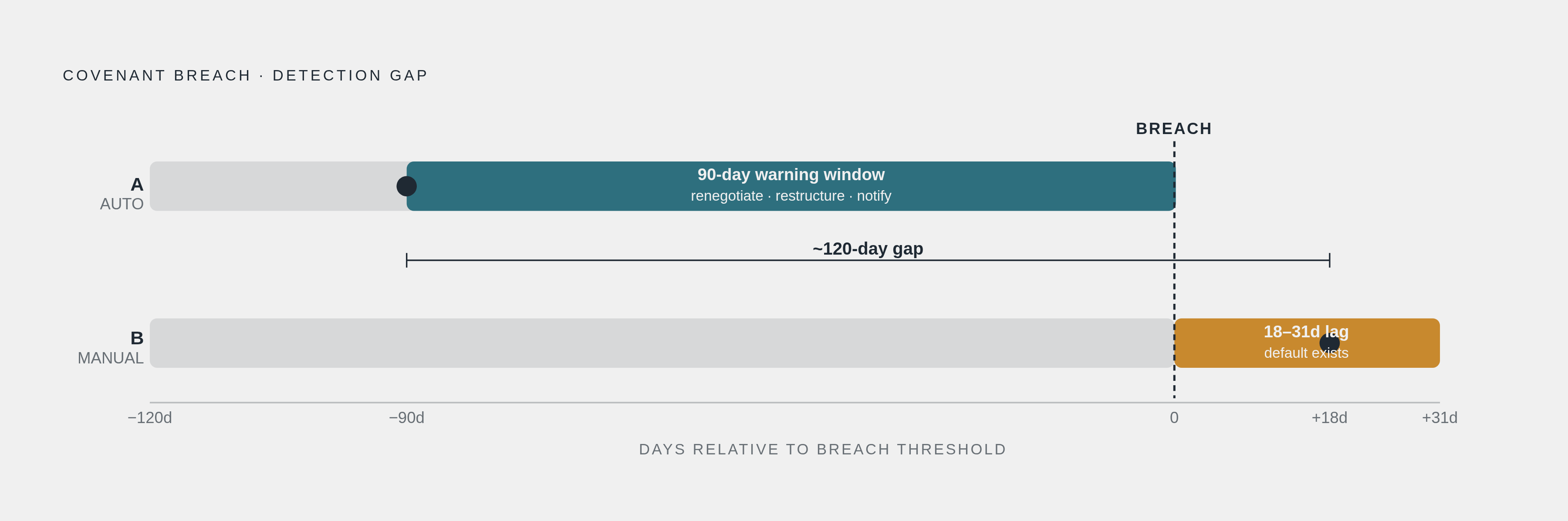
Consider the operational difference between a 90-day warning before a breach and an 18-to-31-day reporting lag after it. The first gives the borrower time to speed up lease renegotiations, set temporary rent structures, keep tighter controls on expenses, and speak to the lender early. The second begins after the contractual threshold has already been crossed.
Before a breach, the borrower can discuss steps to stay in compliance. Afterward, the lender may have contractual remedies available, and the conversation shifts toward curing or waiving an existing default. Even with early warning, a workout can fail. Its value is the opportunity to pursue measures before the timetable and negotiating leverage change, a mechanism that does not depend on overstating an uncorroborated case.
Where automated systems produce false positives and how that is addressed
Early automated covenant systems sometimes produced noise that undermined adoption. Models overweighted market rent declines while overlooking sponsor-level capital injections, creating alerts that asset managers learned to discount. That is a serious operational defect. Alerts become less useful when the people who get them no longer trust them to tell projected pressure from risk that calls for action.
The response integrated data on leasing performance at each asset, the history of sponsor behavior, and near real-time feeds with validation layers, giving models more to draw on for their projections. Data quality remained the governing constraint. Poor extraction from varied borrower documents can cause both false alerts and missed breaches, so more sophisticated forecasting cannot compensate for unreliable inputs.
Does that mean automation just trades one blind spot for another? It can, if calibration and validation are neglected. The practical standard is reliable document classification and extraction, thresholds tailored to covenant structures, and a complete record of alerts and overrides. Quarterly review avoids forecast noise by waiting for reported results, but that also forfeits the warning window. The choice is not between imperfect prediction and perfect foresight.
The regulatory compliance case for continuous monitoring infrastructure
The OCC's Comptroller's Handbook on Commercial Real Estate Lending includes covenant tracking among the credit administration activities examiners review. That supports a case for consistent monitoring, but not a claim that regulators prescribe a particular AI product or architecture. The distinction is important for internal justification. Continuous monitoring aligns with sound administration because it can make obligations, exceptions, and responses visible throughout the loan term.
The Federal Reserve, OCC, and FDIC issued revised model risk guidance on April 17, 2026. The OCC states that generative and agentic AI models fall outside that guidance's scope because they are novel and rapidly evolving. That exclusion is not a governance exemption. Institutions still need to manage the behavior and risks of tools entering their lending workflows.
The OCC issued the new Lending and Loan Portfolio Risk Management booklet on June 25, 2026, consolidating legacy guidance and bringing model risk and third-party risk into credit examination scope. For institutions deploying AI, the practical response includes a current inventory, risk-tiering, validation and challenge processes, and ongoing monitoring. Records of inputs, model versions, timestamps, and overrides support that governance. SOC 2 Type II certification does not cover model card completeness, training-data provenance, or fair-lending testing methodology, so institutions need to check each of these separately.
What to evaluate when selecting a covenant monitoring platform
For a lender choosing a platform, extraction accuracy should be the gating criterion. The system must reliably classify borrower documents and capture the covenant terms those documents contain. A polished dashboard cannot repair a misread agreement.
Configuration comes next because the platform must monitor the actual loan. That includes the relevant DSCR, LTV, debt yield, occupancy, reporting, and cash management provisions, rather than an approximation built around standard terms. Integration is equally practical. A system requiring double data entry, or unable to receive live accounting feeds and connect with origination and servicing systems, cannot deliver the continuous workflow described here.
The evaluation should also follow an alert through its audit record. Inputs, model versions, overrides, and escalations need to be available in a defensible form, while sensitive borrower financials require strong encryption, access controls, and audit logs. SOC 2 Type II is a baseline, but institutions should check whether it covers the lending workflows they plan to use. Institutions should give more weight to data models built for CRE because this market has its own covenant structures, document formats, and reporting practices. General document analysis is not the same capability as administering a loan.
Why the monitoring infrastructure decision is a portfolio risk posture decision
Keeping quarterly spreadsheet monitoring can look conservative because the process is familiar. But familiarity does not reduce exposure between reviews. The institution is choosing a timetable on which developing stress may remain unseen, and that timetable shapes when workout discussions can begin.
Automation makes earlier judgment operationally possible across a book that cannot receive continuous manual attention, while still requiring judgment, reliable data, and lender-borrower negotiation. Institutions are already starting to use agentic platforms that handle multi-step underwriting, covenant monitoring, and portfolio alerts, widening the gap between scheduled review and ongoing surveillance. Their value still depends on the controls described above.
Quarterly workflows organize attention around the calendar. Continuous, automated monitoring organizes it around changing risk, giving institutions a chance to act while compliance can still be preserved, before default has set the terms.