Interest Rate Swap Mechanics for CRE Borrowers
How a CRE swap's pricing, collateral, and exit costs add up.

An interest rate swap can fix a CRE borrower’s interest cost, but it also creates a bilateral financial position with its own pricing, exit exposure, and contractual obligations. Understanding those mechanics before signing an ISDA is what separates a managed obligation from a financing formality. The rate is only the beginning of the bargain.
What a swap actually does to a CRE borrower's cash flows
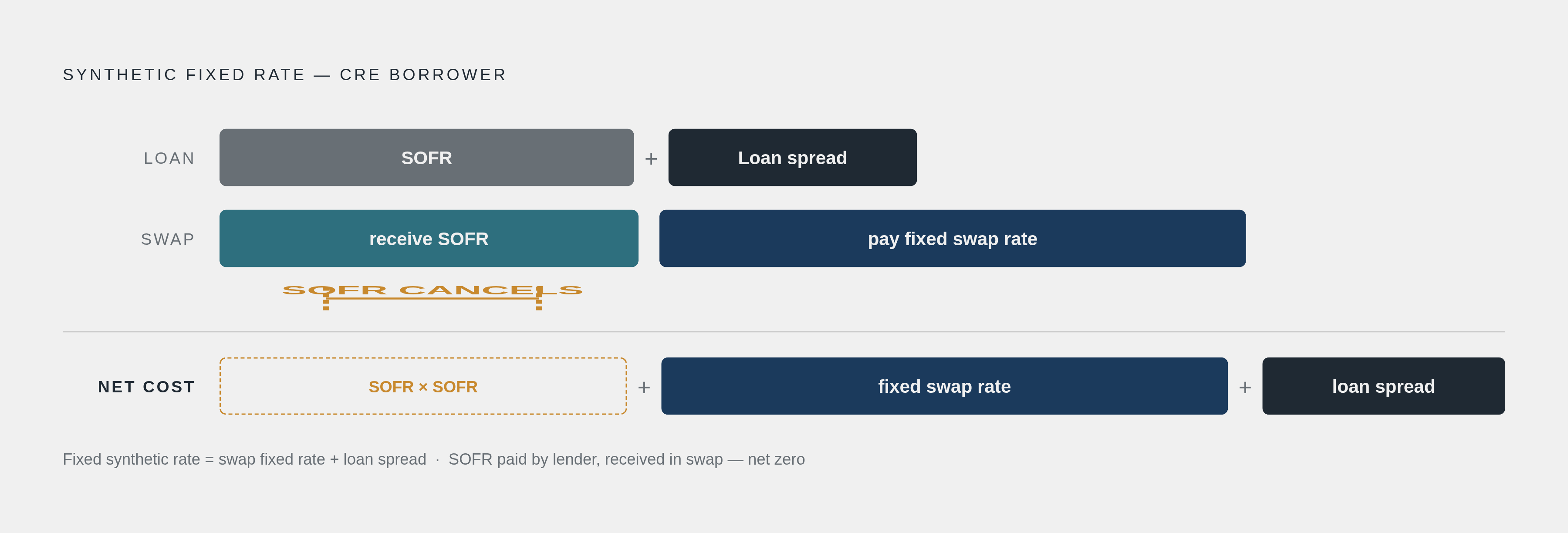
Consider a borrower whose loan charges SOFR plus a spread. Under a matching pay-fixed swap, the borrower pays a fixed rate to the counterparty bank and receives SOFR. The SOFR receipt offsets the SOFR component of the loan payment, leaving the swap’s fixed payment plus the loan spread. The loan itself still has a floating rate. The two contracts together produce a synthetic fixed rate.
Chatham Financial illustrates this offset in its explanation of swap cash flows. For pricing purposes, the fixed payment includes both the market swap rate and a credit charge, so the full net cost is the swap fixed rate plus the credit charge plus the loan spread. The headline market rate alone is incomplete. The notional amount, which is the amount used to calculate the swap payments, is not exchanged. Only the net interest differential moves between the parties at each payment date.
That clean offset depends on how closely the contracts match. The counterparty may differ from the lender, and the loan and swap may differ in term, notional, or payment date. A borrower therefore has two obligations to manage, even when the combined cash flow looks like one fixed-rate loan.
How the swap is priced at inception and what moves the rate after closing
The market component of the fixed rate reflects the pricing of SOFR over the swap’s term. Chatham notes that banks quoting the same structure at the same time should offer very similar mid-market rates. The credit charge is different. It compensates the provider for credit risk and gives its trading desk a return, with pricing that varies by sponsor and collateral.
Chatham notes that this charge can reach high single digits to teens in basis points or higher on longer-dated swaps. It is not a rounding error. A borrower can negotiate a lower loan spread and surrender that saving through an unnegotiated swap charge. Borrowers should lock in the credit charge at term sheet rather than leave it until closing, while recognizing that the mid-market rate can still move during that window.
The SOFR forward curve shapes the market rate, so an upward-sloping curve produces different pricing from a flat or inverted one. At the mid-market par rate, the present value of fixed payments equals that of expected floating receipts. A swap can therefore begin without an upfront payment, although that does not make the credit charge disappear. After execution, the agreed fixed rate stays fixed. What changes with the market is the value of having agreed to pay it.
What ISDA documentation actually governs and why the Schedule is not boilerplate
Those economics become enforceable through four documents working together. The ISDA Master Agreement supplies the contractual framework, while the Schedule contains the parties’ elections, amendments, and negotiated carve-outs. A trade-specific document records the individual trade. Where used, the Credit Support Annex, or CSA, governs collateral posting against mark-to-market exposure.
The Schedule is not administrative wrapping around the trade. Chatham flags termination events and cross-default language as heavily negotiated provisions, including terms that can allow a default on unrelated financing to trigger a swap default. It also flags language linking non-recourse carve-out guarantors to swap obligations. That link can extend liability beyond what a sponsor thought the financing structure allowed.
Chatham notes that a single-purpose entity borrower typically must secure the swap with the underlying asset pari passu to the loan, which in practice can limit the borrower to the lender. REITs and open-end fund vehicles with multiple unsecured lenders are more likely to have access to unsecured swaps with multiple counterparties. Shopping the hedge is not always an available option.
The pre-trade review also reaches the financial statements. The hedge-accounting election under the accounting standard that applies needs to be made before the trade is signed, because the accounting treatment affects profit and loss after the trade.
How mark-to-market moves after origination and when it creates a collateral obligation
Mark-to-market, or MTM, is the swap’s market value as it changes after the trade is signed. For a pay-fixed borrower, rising market rates make the existing fixed rate more valuable, putting the borrower in the money. Falling rates do the reverse. The borrower is committed to paying above the new market rate, creating a negative MTM position.
That valuation changes even when every payment is current. It is therefore distinct from payment performance and from the property’s ability to service its debt. Chatham notes that investment platforms using historical cost accounting may find that MTM swings affect fund returns even when cash flows are unaffected. The accounting result and the cash result need not move together.
A CSA can turn the valuation into an immediate funding requirement. Where its terms apply, a sufficiently large negative MTM can require the borrower to post cash or eligible securities against the exposure. This is a separate call on liquidity. Even small shifts in the index can put large dollar amounts at risk when applied to CRE loan notionals.
Without such a collateral call, negative MTM can still remain an obligation waiting for an exit. When the swap ends, its value at that time becomes a cash settlement, so a borrower needs to look beyond the next debt-service payment to judge swap risk.
What swap breakage actually costs and when it appears in a transaction
Rates fall, and the borrower can refinance at a lower cost. The borrower’s existing swap, however, now has negative MTM, so terminating it requires a payment that offsets part of the financing savings. The attractive new rate arrives with an old bill. This is the central breakage risk for a borrower expecting freedom to refinance.
Breakage is the prevailing MTM settled when the swap ends early. In a sale, proceeds must cover the loan payoff and any swap termination liability, so omitting the latter overstates net proceeds. A refinancing typically requires a decision about terminating the old swap as the loan structure changes. Prepayment likewise requires attention to both contracts, rather than treating the loan payoff as the entire exit cost.
Chatham explains that swap breakage is generally less punitive than fixed-rate loan yield maintenance or defeasance because it compares swap rate to swap rate, while those alternatives compare a full loan coupon to a Treasury yield. It also runs both ways. If rates rise, the borrower can get a termination payment that helps pay refinancing costs, while yield maintenance never pays the borrower.
That symmetry does not remove the need for planning. Barrow Street Advisors advise borrowers to model several exits, including a year-three exit on a five-year swap. For uncertain hold periods, a cap or a shorter-term swap with a cancellation option may be a better fit.
How the SOFR forward curve shapes the swap decision in a given rate environment
The forward curve expresses the market’s pricing of where SOFR is expected to go. Its shape affects the fixed rate available today and provides a reference for thinking about the swap’s value at a possible exit.
An upward-sloping curve shows that the market expects rates to rise, so the swap fixed rate is above current SOFR. Derivative Logic explains that this also makes cap protection look more valuable because there is more expected exposure above today’s index level. A flat or inverted curve presents a different trade-off, as the market anticipates stable or falling rates. Barrow Street observed that two-year and five-year swap rates were not dramatically different from current SOFR in the April 2026 environment.
Does that make a swap unattractive? Not automatically, because certainty still has value, but declining rates can leave the borrower paying a fixed rate that becomes unattractive. The curve is a starting point for exit scenarios.
Where swaps sit in loan covenants and what a breach can trigger
Market movements are only one route to a swap settlement. Contract terms can force an exit too. Cross-default provisions can tie a swap to unrelated financing, so trouble at another property may force a settlement even when the asset behind the swap is performing.
The interaction with loan covenants also runs in two directions. Depending on the definitions in the loan documents, a large negative MTM may be treated as a contingent liability affecting DSCR or LTV calculations. In the other direction, a DSCR decline or occupancy drop can trigger lender remedies, including cash sweeps, default interest, or acceleration. Remedies that force an early loan payoff can also force swap termination at the prevailing MTM.
A borrower whose property is performing poorly may have to settle a negative-value swap just when it has less room to manage its finances. Any guarantor linkage negotiated in the Schedule then becomes especially consequential. The scope of liability depends on those signed terms.
Tracking DSCR, LTV, and occupancy without MTM misses the potential cash consequence of a forced exit. Conversely, tracking MTM without covenant proximity misses the contractual pressure that could turn a valuation loss into a settlement requirement.
Caps versus swaps as a structural decision, not a rate bet
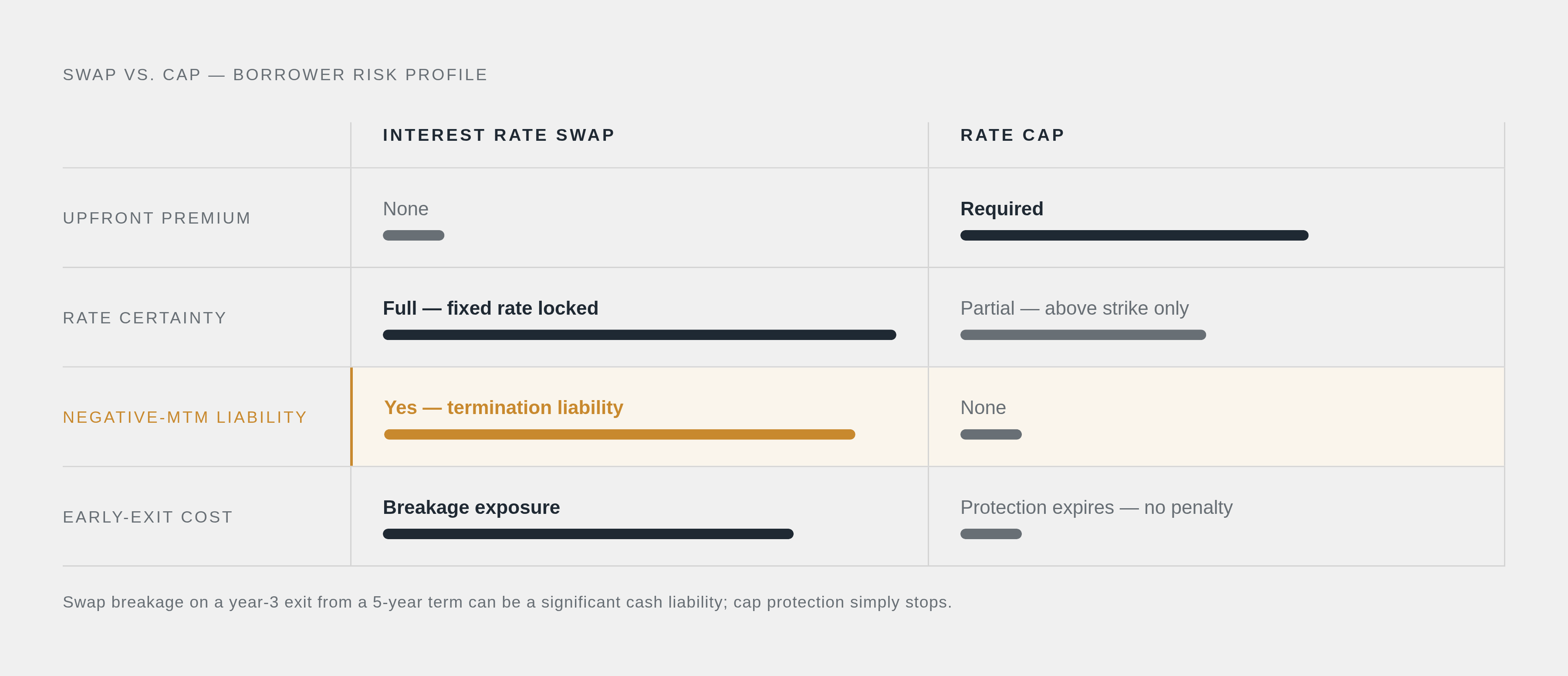
A swap gives the borrower a fixed-rate profile without an upfront premium, but both parties have MTM exposure and there may be breakage if the borrower exits early. A cap requires an upfront premium in exchange for protection above its strike, without the swap’s negative-MTM termination liability. Certainty and flexibility have different cost structures.
Swaps are a better fit for bank permanent term loans and longer-dated structures when the goal is full rate certainty. The choice follows the financing structure as much as the interest-rate outlook.
Hold period sharpens the comparison. A five-year swap can align with a five-year hold but create material breakage exposure if the asset exits in year three. A cap avoids that particular problem, yet its protection expires. A borrower who needs replacement protection must re-underwrite the premium under market conditions that may be much less favorable.
Neither instrument is cheaper in the abstract. The borrower needs to assess which obligations they can absorb, including an upfront premium, uncertain renewal cost, collateral demands, or an early termination payment. When the lender’s rules allow it, comparing hedge offers apart from the loan can help the borrower make that choice. An independent hedge advisor can help distinguish a structural requirement from the hedge that simply arrived with the term sheet.
What modeling swap exposure looks like in practice, and what most borrowers skip
Most borrowers model the swap’s effect on going-in debt service but omit its effect on exit proceeds and stressed covenant metrics. Rate scenarios need to show MTM across multiple outcomes, including a base case. Exit scenarios then need to show what those outcomes would mean at different sale or refinancing dates.
Property stress belongs in the same analysis. Modeling NOI deterioration together with rate movements makes the interaction between debt service, covenant metrics, and swap value visible. The contracts also need to match mechanically. Barrow Street flags differences between loan and hedge SOFR conventions as a source of basis risk.
Barrow Street also recommends starting hedge structuring well before the target closing date. Waiting until the final days leaves less room to negotiate the credit charge or respond to market conditions.
A portfolio of swapped loans requires ongoing visibility into MTM, covenant status, and their interaction. As a loan book grows, manual reports prepared from time to time fall short, while technology built for CRE debt can show breakage exposure, covenant proximity, and rate-scenario outputs across the book. The operational goal is an earlier warning. Swap exposure needs to be visible before a sale, refinancing, or covenant breach forces settlement, while the borrower still has choices.