Model Risk Management for AI Credit Models
SR 26-2 keeps the core disciplines, but accountability for AI stays with you.

Model risk management for AI credit models is now a test of institutional judgment. The April 2026 replacement of SR 11-7 with SR 26-2 preserved the core disciplines but sharpened the demand for proportionate, evidenced governance. For CRE lenders and asset managers, the central consequence is clear. The institution is still responsible for how an AI component shapes a credit decision, even if it falls outside formal scope or comes from a vendor.
Why SR 11-7 lasted fifteen years and why it finally broke
The Federal Reserve and OCC issued SR 11-7 in April 2011, and nearly every bank built its model risk program around it. Its three pillars of development, validation, and governance held up over time. They organized the discipline without depending on a particular modeling technique. The guidance also covered third-party models and called for rigorous validation even when banks could not see all of their code or data.
That tension was already there before AI made it harder to manage. By the mid-2020s, machine learning models were making credit, fraud, and AML decisions at scale, with behavior learned from data, changing over time, and dependent on components institutions had not built. Banks knew these decisions well, but knew less about the machinery making them. The replacement was therefore structural because the framework needed to describe how institutions would govern that machinery throughout its life.
What SR 26-2 actually changed on April 17, 2026
On April 17, 2026, the Federal Reserve, FDIC, and OCC replaced their earlier model risk guidance through separate agency issuances. SR 26-2 superseded SR 11-7 and SR 21-8, while the parallel agency actions rescinded OCC 2011-12 and FIL-22-2017. The rewrite kept governance, independent validation, and ongoing monitoring. The change was in their application. The new framework makes risk-based tailoring more explicit, with full lifecycle oversight for tier-1 material models and proportionate controls for lower tiers, provided the institution can defend the classification.
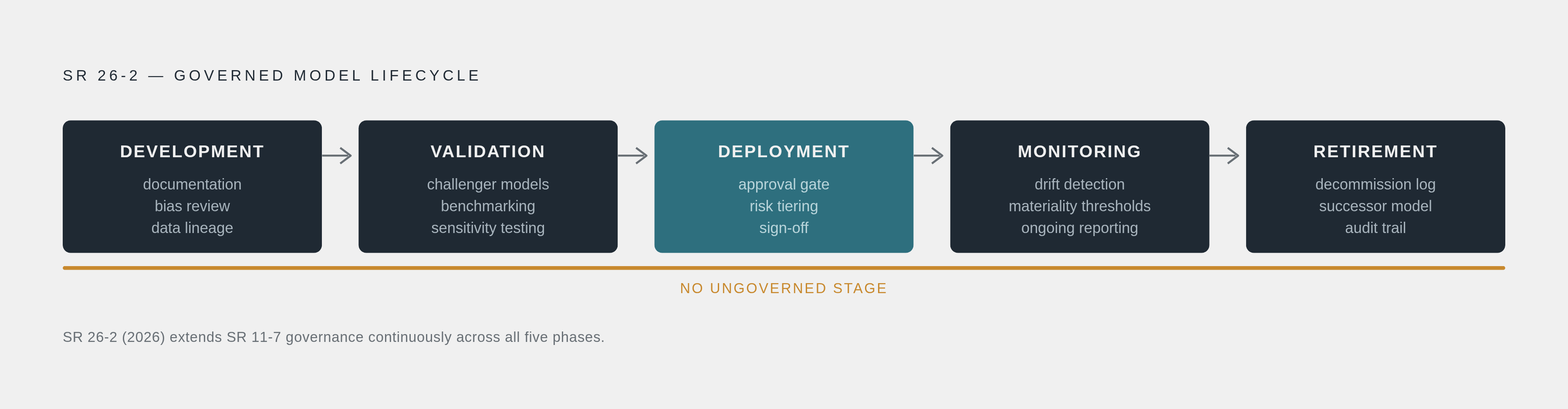
Lifecycle thinking also connects development, validation, deployment, monitoring, and retirement into one governed chain. Effective challenge must be reproducible through versioned challenger models, outcomes analysis, benchmarking, and sensitivity testing. Continuous monitoring tracks performance, data, and stability against thresholds linked to materiality. Evidence becomes part of normal work. Although the guidance is most directly relevant to institutions above $30 billion in assets, smaller firms often use it as a benchmark, making one conspicuous boundary especially consequential.
The deliberate gap: generative and agentic AI are outside SR 26-2's formal scope
SR 26-2 explicitly excludes generative and agentic AI models from its formal scope because they are novel and rapidly evolving. Footnote 3 states that exclusion in all three agencies’ versions. Traditional statistical models and non-generative, non-agentic AI models remain covered. An LLM that carries out a multi-step underwriting or document-extraction workflow thus falls outside the formal guidance that covers the credit scoring model its output may feed.
Does that make the LLM someone else’s governance problem? The exclusion provides no such safe harbor. Supervisors and internal audit are already applying MRM expectations by analogy to underwriting assistants, AML triage agents, and customer-facing copilots. Institutions must supply the governance scaffold themselves, rather than treating silence about formal scope as permission to dispense with controls.
For CRE institutions, the boundary runs through production workflows, including document extraction, rent roll analysis, and covenant parsing. Their outputs can become inputs to governed credit models. The practical response is to govern those inputs with prompt versioning, output monitoring, and audit trails for features influencing credit outcomes. The accountability gap is therefore inside the institution’s decision process, even when the underlying technology comes from outside it.
Why buying a model does not transfer the accountability for it
SR 26-2 continues to cover vendor and other third-party products, including their validation. Supervisors expect banks to get enough insight into models to validate them, monitor how well they work, and explain their outputs. With AI, however, transparency is harder to translate into assurance because a gradient-boosted model’s logic cannot simply be read line by line, and validation depends more heavily on testing outcomes.
The guidance does not solve the problem of validating models without direct access to training data. Institutions can nevertheless require documentation of design, assumptions, and intended use, together with performance data they can independently review. Contractual rights to audit, challenge, or retire a model provide another control when it moves beyond its validated envelope. Those requirements apply directly to platforms extracting covenant metrics, spreading financials, or scoring borrower risk.
The GLBA Safeguards Rule also requires firms to oversee vendors when those service providers handle customer financial data. A written information security program must cover those practices. Security oversight does not, however, answer why a model produced a particular result. Explainability sits precisely at that intersection between a vendor’s technology and the institution’s continuing duty to defend its use.
Explainability as a hard validation requirement, not a design preference
Regulation B under ECOA requires specific reasons for adverse action, whether a credit decision comes from a model or a person. The CFPB withdrew its AI adverse action circulars in May 2025, but the regulation itself did not change. Accuracy cannot substitute for an intelligible explanation. A score that predicts well still leaves the institution exposed if it cannot produce the required reasons.
Operationally, the 2026 pattern is hybrid, with AI widening the signal set while a governed model keeps the decision explainable and auditable. Human review addresses edge cases and overrides. Methods such as SHAP can help generate reason codes by estimating why a score occurred, but those estimates are distinct from the model’s actual logic. Validators must document that distinction instead of allowing an explanation method to become another unexamined assumption.
A defensible model file connects source data to the scored applicant without silent joins or undocumented overrides. It includes plain-language explanations, a risk register of known weaknesses and named owners, challenger models, and an audit trail of retrains, approvals, and testing samples. Uncertain cases need a human fallback. For CRE workflows, every covenant metric, DSCR calculation, and risk score must be traceable to its source document and inputs, making embedded source citations an evidentiary layer.
Drift and ongoing monitoring: where most institutions' controls are thinnest
Deployment evidence establishes what a model was fit to do, but it cannot establish that the model remains fit indefinitely. Continuous monitoring is where many existing MRM programs are least equipped to meet SR 26-2’s demands. Richer data can make models responsive and unstable. Monitoring intervals designed for bureau scorecards are too slow for models reacting to changes in transaction or open-banking data.
Validators must distinguish performance drift, where predictive accuracy degrades, from data drift, where input distributions change. Concept drift changes the relationship between inputs and the target itself, while population drift moves the borrower pool beyond the validated envelope. These are different routes to unreliable outputs. A single periodic accuracy check cannot describe all of them.
CRE covenant monitoring makes the exposure concrete because DSCR, LTV, occupancy, and debt yield move with market conditions. A model calibrated on pre-2024 data may misclassify risk in a materially different rate environment. Monitoring pipelines therefore need to surface drift automatically, with review thresholds proportionate to the model’s tier. Human judgment remains part of this architecture, since rent growth assumptions, exit cap rates, and renovation cost estimates remain human decisions even when AI benchmarks them against historical performance.
The four regulatory frameworks that now overlap on a single CRE credit model
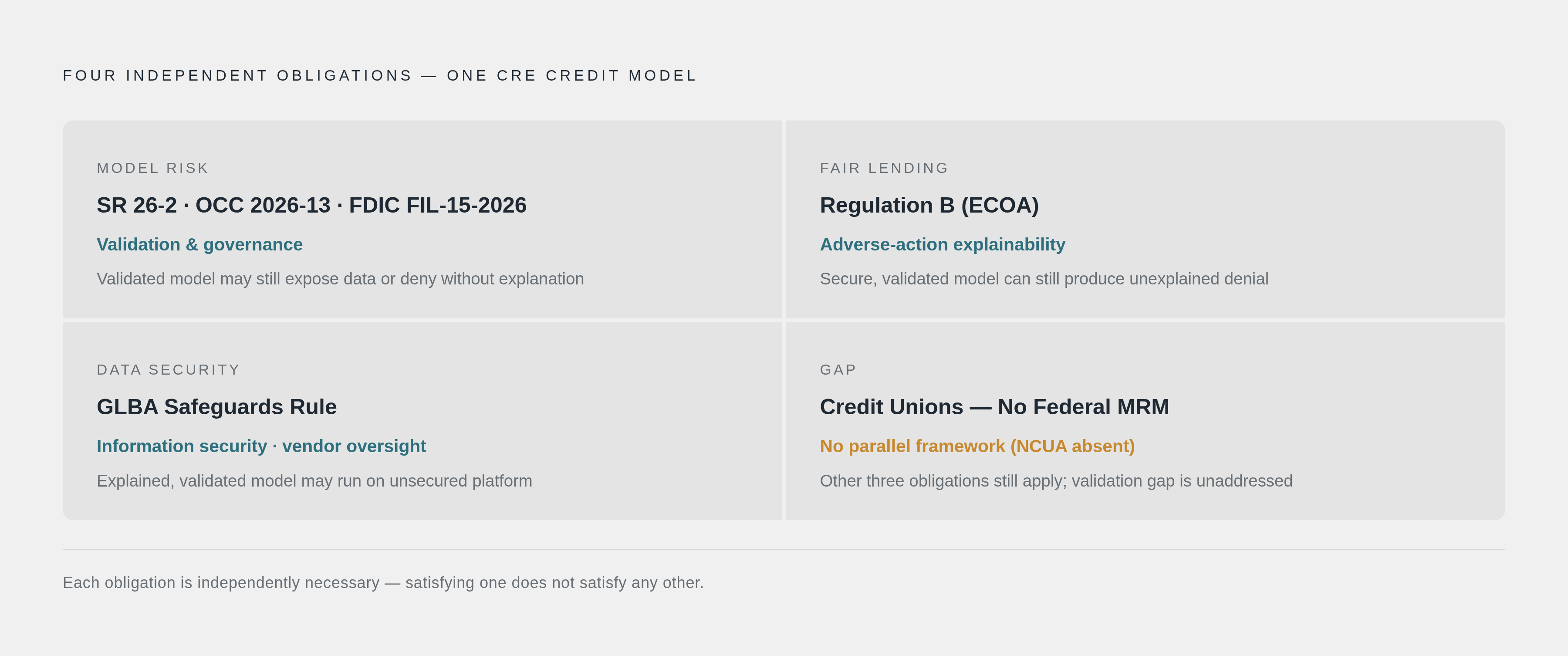
The overlapping obligations are easier to govern when their distinct purposes remain clear. SR 26-2, OCC Bulletin 2026-13, and FDIC FIL-15-2026 express a single interagency model risk framework. Regulation B also sets duties for adverse-action, while the Safeguards Rule covers information security and oversight of service providers. A model file may support validation without satisfying every security obligation, just as a secure platform may still produce an inadequately explained decision.
The operational opportunity is to build one internal framework around model identification and classification, governance and accountability, independent validation, and ongoing monitoring. A mapping layer can then connect that common control base to each regulator’s requirements. For example, pasting portfolio data into a non-approved AI tool can create an unmanaged, potentially unauthorized disclosure of nonpublic personal information, regardless of whether the tool produces accurate results.
The NCUA did not join SR 26-2, so credit unions have no parallel federal model risk framework. They still have duties for fairness, explainability, and adverse-action. One internal program that works as a whole can help institutions meet these different rules while keeping clear who is accountable.
What proportionality actually requires institutions to decide for themselves
For a risk executive, the practical lesson is to treat tiering as a governed decision. SR 26-2 requires controls calibrated to materiality and inherent risk but supplies no formula defining the tiers. Institutions must review each model’s inherent risk, the exposure it creates, and what it is for, including models they buy. Lighter controls have to be earned. Their justification must be documented and periodically reviewed, because an examiner may treat an unsupported low-tier classification of a material credit model as a control failure.
CRE document extraction exposes the difficulty of that judgment. Is the tool a model or merely a data-processing step? If its output becomes a feature in a tier-1 credit model, the classification has MRM consequences regardless of the internal label. Institutions should document the reasoning and the downstream use.
Proportionality also applies to how institutions organize independent validation. A smaller team need not create a separate department if a designated reviewer has genuine authority to send a model back for rework. Independence resides in the separation of responsibility. Turning that principle into systematic practice can still require multiple quarters of inventory migration, validation-template rewrites, monitoring pipelines, documentation refreshes, and vendor onboarding on a traditional infrastructure stack. Flexibility removes uniform prescriptions while preserving the work of making defensible choices.
Where purpose-built CRE AI platforms fit inside an MRM-compliant architecture
Document extraction, financial spreading, covenant monitoring, and portfolio analytics belong inside the governance perimeter, even where a generative component is formally excluded from SR 26-2. Upstream is not the same as outside. A platform that supplies credit inputs must support their review as well as their production.
Purpose-built CRE platforms can make that review part of everyday work with source-linked extraction, page-linked covenant evidence, automated financial spreading, and portfolio dashboards based on the firm’s templates. When generic horizontal tools lack citations, audit trails, and prompt-versioning infrastructure, institutions have to gather more evidence on their own. Familiarity with CRE decision workflows is valuable when it shapes which outputs are explainable and to whom.
Institutions that are weighing platforms should look for source-document and page links, immutable action and version logs, and tenant-scoped data stores that have no cross-training across clients. Human checkpoints need documented rationales for edge cases and overrides. Template grounding anchors outputs in the institution’s own underwriting assumptions. These capabilities support validation, monitoring, and vendor security oversight, but they do not transfer ownership of those duties to the platform.
Procurement therefore depends on the MRM team’s ability to validate the output, monitor it over time, and explain its contribution to a credit outcome. Usefulness alone is not enough for that task. The framework has made platform selection a governance decision, and CRE institutions that evaluate it on those terms are better positioned than those treating it as a purchase of faster workflow software.