API Integration Patterns for CRE Data Platforms
Matching integration patterns to data flow beats building point-to-point connections.

There is a specific kind of engineering pain that only reveals itself at 11 PM before a board presentation. The property data looks right in the CRM. The portfolio dashboard shows green. Then someone pulls the actuals from Yardi and discovers the two systems last agreed on anything three weeks ago. No alarm fired. No error log. The integration just quietly drifted.
This is not a data quality problem. It is an integration pattern problem, and the distinction matters enormously for how you fix it.
Commercial real estate organizations now pull simultaneously from property management, leasing, capital markets, valuation, and building operations platforms, each running its own data model, its own cadence, and its own opinions about what a "property ID" means. The typical response to this complexity is to build point-to-point connections one at a time, as fast as the business demands them. The result is a web of dependencies where any single system change can cascade into cascading failures. Migration statistics bear this out in uncomfortable detail: roughly 60% of real estate companies experience serious complications during platform migrations, and around 30% of properties require manual correction afterward, per Kolena (2026). These are not symptoms of bad source data. They are symptoms of integration debt accumulated by choosing patterns for speed rather than fit.
The PropTech market's rapid expansion, valued at $45.1 billion in 2025 and projected to more than double by the early 2030s across multiple forecasts, means more vendors, more APIs, and exponentially more surface area for brittle connections. The stakes are concrete: choose the wrong pattern and you get either stale data (polling where you needed events) or wasted API credits and engineering hours (webhooks where batch would have sufficed). Neither failure is dramatic. Both are expensive.
The protocol landscape CRE integrations actually run on
To understand why pattern selection matters, we must first understand what the actual integration surface looks like, because CRE is not one landscape. It is several, at different stages of maturity, coexisting uneasily.
The de facto standard for MLS and increasingly broader CRE data exchange is the RESO Web API: RESTful, OAuth 2.0 authenticated, OData query syntax, JSON payloads. Its Data Dictionary 2.0 defines common field names across compliant sources, which means a single well-built integration can theoretically work against any certified MLS. Roughly 93% of the approximately 500 U.S. MLSs are now certified on RESO standards, per Datafiniti (2025), and NAR-affiliated MLSs were required to certify against Data Dictionary 2.0 by April 2025. The RESO Common Format, launched in 2024, extends data portability beyond the Web API entirely; early adoption by Canada's Municipal Property Assessment Corporation signals that RESO is beginning to escape the MLS world and enter broader property data exchange.
RETS, the legacy protocol RESO replaced, reached end of support on December 31, 2024. Any team still running on RETS is operating on unsupported infrastructure. This is worth stating plainly, because inertia is a powerful force in enterprise software, and "it still works" is not the same as "it is not a liability."
What the RESO Web API spec makes easy to overlook: it supports webhooks and EntityEvent notifications natively. The standard was designed to anticipate event-driven use, not just polling. Teams building on RESO-compliant sources have REST and webhook options available within the same standard. Teams integrating RPR, which still exposes an RPC architecture over XML/SOAP, or legacy enterprise systems, are working against an older and considerably less accommodating surface. The protocol shapes the patterns available to you before you write a single line of code.
REST for synchronous, on-demand data retrieval
REST is the most widely used API style in CRE and adjacent sectors, including commercial lending and marketing technology, per Blooma.ai (2025). Familiarity makes it the default choice, which is simultaneously its greatest advantage and its most reliable trap.
The mechanics in a CRE context are straightforward: a CRM backend or underwriting tool calls an API endpoint on demand, triggered by a lead creation event, an analyst opening a property record, or a loan file being initiated. The request goes out; the response comes back; the page populates. It is debuggable, well-understood, and requires no standing infrastructure beyond the API client itself.
That simplicity has a well-defined operating envelope. REST fits when query volume is low, roughly under 500 daily enrichment requests per Homesage.ai (2026); when data freshness tolerance is measured in hours or days rather than minutes; when the team is building an MVP or a small brokerage tool where debuggability matters more than throughput; or when the CRM environment lacks native webhook support. A lender's origination platform calling a property data API to enrich a record at loan application is the canonical right-fit case: synchronous, user-triggered, low frequency per deal.
Where REST breaks down is more instructive. High-volume portfolios accumulate HTTP overhead per request; at scale, this compounds into both latency and cost. Real-time requirements expose REST polling as an engineering burden that events architectures eliminate. And REST endpoints return fixed response shapes, which means a field-heavy property record delivers its entire payload even when the caller needs two fields. That over-fetching problem is minor at low volume and quietly ruinous at high volume.
One implementation detail teams consistently underestimate: address standardization as the join key. USPS-standard address format, Street Number plus Name plus Suffix plus City plus State plus ZIP, is the most reliable mechanism for matching records across property data systems. Inconsistent address formats are the most common source of duplicate CRM records in property data pipelines, per Homesage.ai (2026). REST integrations often fail not at the protocol level but at the data normalization level, which is a less satisfying problem to diagnose at 11 PM.
GraphQL for flexible, field-precise queries across complex property data
REST's fixed response shape is a reasonable constraint when data models are simple. Property records are not simple. They are deeply nested: ownership entity trees sit above lien stacks, which sit above unit-level lease data within a building record. Different consumers need fundamentally different slices of the same object. An acquisitions analyst needs cap rate, rent roll, and ownership history. A lender needs lien position, assessed value, and tax status. REST would require multiple endpoints or force both consumers to absorb the full record and discard what they don't need.
GraphQL addresses this with a single endpoint where the client specifies exactly which fields it needs, shaped exactly as it needs them. No new endpoint required when product requirements change. A mobile leasing app can request a minimal property card while a desktop underwriting tool queries the full record against the same API, receiving appropriately sized payloads for each context. For platforms serving multiple consumer types against complex property data, this is not a marginal improvement. It is a structural one.
PropTech developers migrating off legacy RETS are encountering GraphQL as the modern replacement at several data providers. That migration is as much about query flexibility as protocol modernization. The two are connected: the teams that most struggled under RETS were the ones building products that needed different views of the same data for different users.
But what if the team is small and the queries are simple? GraphQL is less suited to simple, infrequent lookups where REST already works well; the added complexity isn't justified, especially if GraphQL expertise on the team is thin. Caching is also harder: POST-based GraphQL queries don't benefit from standard HTTP caching infrastructure the way REST GET requests do, which matters in high-read environments where cache hit rates translate directly to cost.
An emerging pattern worth tracking: GraphQL paired with streaming databases for querying real-time data. When property data changes continuously, live auction prices or intraday AVM updates, the combination allows clients to query current state using familiar GraphQL syntax while the underlying data is continuously refreshed. This is a more advanced architectural choice, and it connects directly to the streaming discussion below.
Webhooks for event-driven property data updates
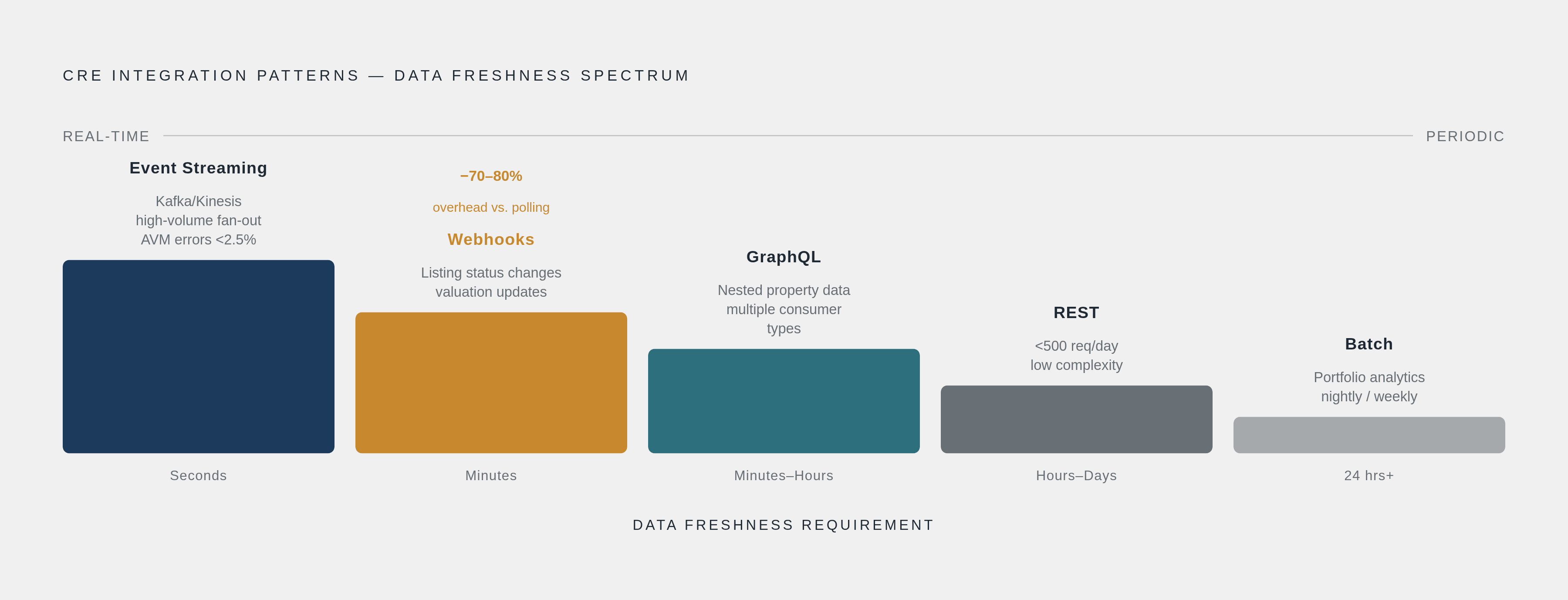
Polling is a reasonable fallback when nothing better exists. When something better exists, polling is waste: engineering hours building the loop, API credits burned on empty responses, and stale data in the window between cycles.
Event-driven webhook architectures reduce overhead by 70 to 80% compared to traditional polling patterns in real estate data integrations, per Homesage.ai (2026). The mechanic is straightforward: the integration subscribes to a data provider's event stream; when a listing status, valuation, or ownership record changes, the provider pushes the update directly. The RESO Web API supports this natively. MLSs can push updates the moment a listing changes rather than waiting for a scheduled pull.
The right-fit conditions are where the value becomes concrete. Listing status changes, active to pending to closed, carry competitive deal flow implications where latency matters. Valuation updates, AVM scores, tax assessments, feed downstream underwriting models that need current inputs to produce accurate outputs. Condition grade or risk score changes can trigger CRM workflow automations that only make sense if the trigger is timely.
That raises an important question about implementation that teams consistently underestimate. Three failure modes show up repeatedly. First: the receiving endpoint must be publicly reachable and must return a 200 acknowledgment quickly. Slow acknowledgment causes retries, retries cause duplicate events, and duplicate events cause data corruption in systems that don't expect them. Second: idempotency handling is non-negotiable. The same event will arrive more than once; the system must not double-write. Third: dead-letter queues for failed deliveries. A missed webhook is a silent data gap, which is the worst kind because it doesn't announce itself.
Webhooks are not universal. Providers that surface only SOAP/XML, like RPR, don't support them at all. And for batch-oriented use cases where real-time delivery adds complexity without proportional value, the engineering overhead of webhook infrastructure is simply unjustified.
Event streaming for high-throughput CRE data pipelines
Webhooks are point-to-point connections. That is fine at modest scale. It is a problem when the same event needs to reach an underwriting model, a CRM, a reporting layer, and a machine learning pipeline simultaneously. Building four separate webhook subscriptions for the same event creates fragile fan-out, where a single upstream change requires coordinating four downstream consumers. Event streaming, using platforms like Kafka or Kinesis, solves this with a durable log that multiple consumers read independently at their own pace.
The CRE use cases that require streaming rather than webhooks share a common characteristic: they involve continuous, high-volume data flows where the economics or architecture of point-to-point connections break down. Live AVM pipelines ingesting sales records, mortgage rates, and migration patterns continuously represent one example; some models now achieve error rates below 2.5% for on-market properties, per ORIL (2025), and that accuracy depends on fresh inputs, not batch feeds. Portfolio-level risk monitoring across thousands of assets is another: individual webhooks per property would create unmanageable fan-out at scale. Feeding machine learning models with economic indicators, rental demand signals, and appreciation forecasts in real time is the pattern used by institutional players at the scale of the largest asset managers, per ORIL (2025).
What streaming adds beyond webhooks is architectural. Replayability: if a downstream consumer fails, it can reprocess from a checkpoint without data loss. Fan-out: one event stream feeds multiple consumers simultaneously. Decoupling: producers and consumers evolve independently, which matters enormously in environments where vendor APIs change without notice.
The cost and complexity reality deserves equal weight. Streaming infrastructure carries the highest operational overhead of any pattern here. Kafka clusters require genuine expertise to operate. For teams not yet at portfolio scale, a webhook-first architecture with batch fallback is the pragmatic starting point. Streaming is not an aspiration to grow into. It is a pattern to adopt when the use case specifically requires it.
Batch processing for portfolio-scale data operations that don't need to be real-time
Not everything needs to be real-time. This is a point the industry underweights in its enthusiasm for event-driven architectures, and it costs teams money they don't need to spend.
Batch processing: a scheduled job pulls data for a defined set of properties in bulk, transforms the response, and writes to a database or data warehouse. Nightly or weekly cadence is typical. The right-fit conditions are where the majority of portfolio-scale operations actually live: lender platforms running nightly bulk underwriting cycles across a loan pipeline; portfolio management tools refreshing asset-level metrics for investor reporting; data warehouse loads where analytics teams query historical trends rather than current state. Any use case where 24-hour data freshness is acceptable is a candidate for batch, and batch is almost always more cost-efficient than continuous polling against the same data.
The economics are concrete. Pulling the same property record repeatedly via REST to check whether anything has changed burns API credits on empty responses. Batch jobs scoped against a well-defined address list retrieve only records that have been updated, or retrieve everything at once during off-peak hours when rate limits are less constrained. Datafiniti's pricing model distinction is instructive: per-request pricing bills for failed queries and empty results; per-record pricing charges only for data actually delivered. Batch jobs with well-scoped address lists minimize wasted spend under either model.
Where batch breaks down is equally clear. A listing that went pending at 9 AM won't appear in the nightly batch until the following morning. In competitive deal flow environments, that latency is the difference between a submitted offer and a missed opportunity. Compliance-sensitive workflows requiring audit trails of data at a specific point in time also need more granular event logs than a nightly batch provides.
The recommended hybrid is a webhook-first architecture for status changes and valuation updates, with batch fallback for bulk portfolio refreshes. This covers real-time operational needs and high-volume analytical ones without over-engineering either side. The goal is not elegance. It is fit.
The enterprise integration wall: Yardi, RealPage, and closed property management ecosystems
Everything discussed above assumes that pattern selection is the primary variable. For a substantial portion of CRE integration work, it is not. The primary variable is access, and the access path runs through Yardi and RealPage.
Yardi serves more than 13 million rental units; RealPage serves more than 24 million globally, per Truto (2026). Any platform integrating with property management at scale will encounter one or both. The integration surfaces are not what a team accustomed to modern API design expects to find.
Yardi's Voyager integration layer predates RESTful JSON APIs. The primary interface is SOAP web services described by WSDL files. Partners must join the Standard Interface Partnership Program with per-interface licensing fees, and programmatic access is gated behind a multi-step approval process that adds months to integration timelines before a single line of code is written.
RealPage's situation is different in character but similar in consequence. Its 2024 model introduced updated REST endpoints and an event-based framework, which looks like modernization until you examine the access terms: all third-party integrations are now routed exclusively through the RealPage Exchange program. Non-RPX applications are no longer permitted, per Truto (2026). The technical surface modernized; access tightened. This is a deliberate strategic choice about platform control, not a technical limitation, and treating it as a technical problem to solve will cost teams time they won't recover.
The practical consequence is that a team can architect a clean REST or webhook integration that is technically sound and architecturally correct and still find the integration stalled because vendor approval, partner fees, and certification cycles haven't cleared. The pattern is not the critical path. The partner program is.
Mitigation exists but requires planning from the start. Unified API abstraction layers that normalize SOAP endpoints into REST remove the need for each integration team to handle WSDL directly, which is worth more than it sounds because WSDL comprehension is a dying skill. Building to RPX certification requirements from the initial design rather than retrofitting matters because retrofitting a closed ecosystem's requirements onto an existing architecture is substantially more expensive than designing for them upfront. And treating vendor approval as a critical path dependency in project planning, rather than a detail to be resolved later, is the single most impactful process change a team can make before touching a line of integration code.
Custom API coding for non-standard CRE systems can take months and cost hundreds of thousands of dollars, per Synatic. The closed ecosystem doesn't penalize bad architecture. It penalizes the assumption that good architecture is sufficient.
The broader lesson is the one the whole integration pattern discussion points toward: the right pattern chosen for the wrong access surface produces the same failure mode as the wrong pattern chosen for the right surface. Both get you to the board presentation at 11 PM, staring at a dashboard that disagrees with reality, wondering where the drift started.