Early Warning Indicators for Loan Portfolio Stress
Four indicators of CRE stress appear before missed payments arrive.

Early warning indicators for loan portfolio stress reveal what delinquency reports cannot show about commercial real estate credit. The central distinction is between a borrower making payments and a property remaining able to support its debt. Tracking income, covenant headroom, reporting behavior, and refinancing exposure together gives lenders time to respond before deterioration becomes default. In the 2026 maturity environment, that time determines which options remain available.
Why delinquency reports are the wrong instrument for detecting CRE loan stress
A lender looking at a clean delinquency report in a stressed environment is not necessarily seeing safety. The report may simply be recording silence. It answers whether payments arrived, but not how the borrower funded them or what was sacrificed to keep them current. By the time a missed payment supplies confirmation, the lender’s available responses have already narrowed.
Forvis Mazars identifies several ways troubled borrowers preserve that appearance of health, including outside borrowing, depleted working capital, capital injections, shareholder loans, and asset sales. Borrowers can also delay taxes or vendor payments and defer property maintenance. These measures keep debt service current while weakening liquidity or the asset itself. Payment performance shows only part of a borrower’s repayment capacity. A lender monitoring only the former can systematically misread the latter.
Grant Thornton describes CRE debt reaching maturity while borrowing costs are still high and tenant demand has changed. Static valuation models built for a more stable environment can obscure the resulting pressure. The Federal Reserve’s proposed 2026 severely adverse scenario features a sharp decline in CRE prices and investor aversion to long-term assets, reinforcing the relevance of forward-looking analysis without predicting that outcome. If delinquency records the end of deterioration, what reveals its approach?
The maturity wall as the structural context for stress signals in 2026
Refinancing brings debt terms established in a low-rate era into collision with a capital environment that has repriced. Forvis Mazars notes that many CRE loans originated at historically low rates are approaching maturity and may require refinancing at significantly higher rates. The property may still be able to pay its current debt but lack the income to support the debt that would replace it.
That difference also affects the price of the property. Grant Thornton reports that buyers, appraisers, and auditors take refinancing risk into account in valuation, and prospective buyers adjust their bids when maturity is near. The borrower may consequently become a forced seller. Valuation now asks what the asset supports under current lender terms, a shift from asking what it supported at origination.
The answer varies across the loan book. Property type, geographic market, location quality, leverage, and sponsorship strength all shape exposure, making portfolio averages a poor substitute for loan-level analysis. CRE loans also represent a large multiple of common equity tier-one capital across mid-size U.S. banks, sharpening the consequences of concentration. For an approaching maturity, the measurable signal is the refinancing gap, which measures how far the debt the property can support at current rates falls short of the amount it owes.
The leading indicators that surface stress before a payment is missed
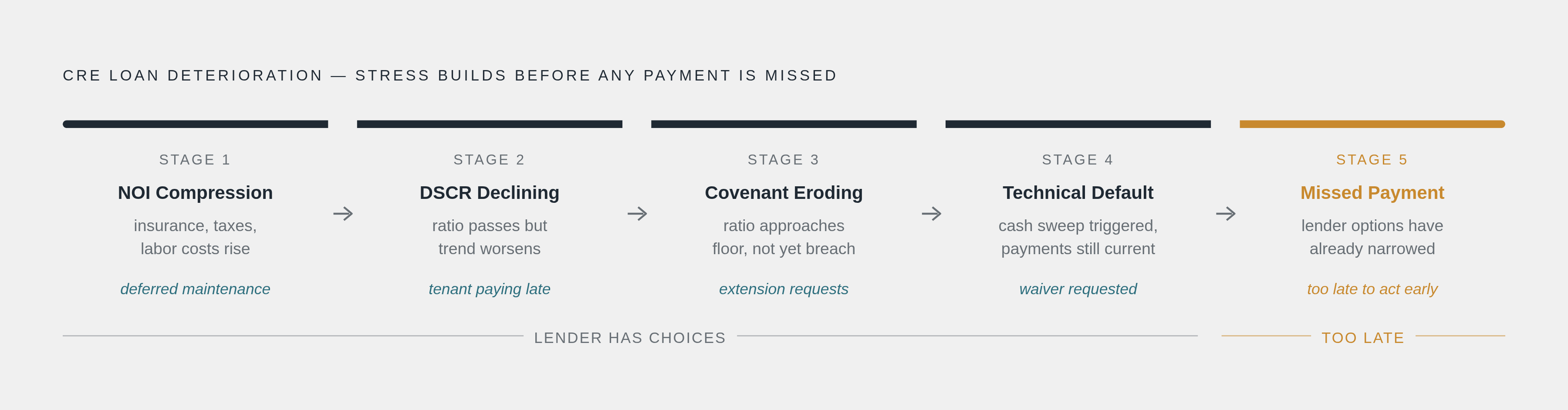
Forvis Mazars identifies actual net operating income below appraisal assumptions as a sign of emerging CRE risk. Higher insurance premiums, taxes, labor costs, maintenance expenses, and utilities can compress NOI, while weakened demand limits the ability to offset those costs through rent increases. Payments may remain unaffected for the moment. Yet the property is producing less income than the underwriting assumed.
That income change feeds into the debt service coverage ratio, or DSCR, but the ratio’s direction deserves as much attention as its current level. A passing DSCR that declines across consecutive periods presents a different risk from a stable one. Headroom is the cushion left above the covenant floor. Pass-or-fail testing discards that distance and waits for the boundary to be crossed, whereas trajectory monitoring exposes the approach.
Forvis Mazars names lease expirations as an early-warning indicator because the lease maturity profile belongs in an assessment of future income. A tenant who habitually paid on time beginning to pay a few days late is also a warning signal, especially when the pattern spreads. Tenant credit health and lease maturities need to be watched throughout the year, more often than once a year. They can show that income is at risk before the effect appears in a financial statement.
The firm also identifies deferred maintenance, underfunded reserves, and past-due property taxes as warning signs, with elevated expenses and depressed occupancy completing the picture. These signals show current payments being protected at the expense of asset value or future cash flow. Refinancing-gap analysis then tests whether current income can support the debt the property will need at maturity. Together, these layers cover operating deterioration, weakening income prospects, depleted resources, and refinancing exposure without pretending that any one indicator tells the whole story.
Financial reporting behavior as an early warning signal in its own right
Forvis Mazars identifies delayed statements, incomplete reporting packages, avoidance of lender communication, and repeated extension requests among the red flags found in loan reviews. This behavior may point to trouble with operations, cash flow stress, accounting problems, or managers whose attention is elsewhere. It is not proof of any one cause.
Reporting delays also obstruct the lender’s ability to distinguish those causes. Financial institutions are seeing increased tax return extensions, which often delay financial statement collection by six months and create annual-review bottlenecks. The practical response is a defined escalation and remediation approach when reporting requirements are consistently missed. Treating repeated delays as routine paperwork leaves both the information gap and its possible causes unresolved.
Once information arrives, comparisons across periods can expose liquidity concerns, capital erosion, greater reliance on revolving debt, and deteriorating collections. A single statement cannot establish that trajectory. Forvis Mazars puts the distinction plainly, saying, “Trends are important to track because they give a trajectory rather than a singular moment”. Reporting discipline supplies the evidence that makes this analysis possible and supports the contractual monitoring that follows.
How covenant drift and technical defaults surface risk that payment history conceals
A technical default is a covenant breach that can trigger cash sweeps, default interest, or loan acceleration even when every payment is current. This is why covenant monitoring cannot be replaced by delinquency monitoring. The two assess different obligations, and a clean record on one says little about compliance with the other.
Lenders have the most room to act in the window before a breach. A “pre-watch list” identifies loans needing closer attention because of tenant, property, or market signals, even though formal covenant triggers have not been reached. A ratio approaching its floor belongs in that window. Waivers, restructuring discussions, and collateral strengthening are more available while lenders can address an emerging weakness before it becomes an established default.
Risk grading gives that response institutional form. Forvis Mazars notes continued regulatory attention to prudent grading, timely rating adjustments, and the distinction between special mention and substandard credits. Special mention identifies potential weaknesses requiring management attention, while substandard identifies well-defined weaknesses that jeopardize repayment prospects. Lenders need to recognize the issue, identify its cause, adjust the rating promptly, develop a targeted action plan, and verify collateral values. Deferring the difficult credit decision does not preserve the options that delay consumes.
Why quarterly review cycles structurally miss what continuous monitoring catches
Even the right indicators fail when they arrive too late. Quarterly review cycles impose a delay between changes in borrower condition and the lender’s assessment of them. Analysts can compare successive statements, but they cannot review a new development through a process that waits for the next scheduled cycle. This is a structural constraint.
The distinction is between collecting snapshots and maintaining a trajectory. Forvis Mazars emphasizes evaluating operations and cash flow beyond a single period, which requires linking observations rather than treating each review as a self-contained compliance exercise. Continuous monitoring links those findings as new information comes in. Real-time DSCR, loan-to-value, and covenant tracking can surface stress weeks earlier than traditional reporting cycles. In a narrow refinancing window, the delay changes the responses still open to the lender.
More frequent review nevertheless needs discrimination. Severity scoring compares shortfalls with historical volatility to distinguish ordinary movement from genuine deterioration. Without that context, alert fatigue can lead analysts to discount useful warnings. Asking analysts to work harder inside the old timetable does not achieve that change.
How automated spreading and AI monitoring compress the detection timeline in practice
Agentic AI can extract and spread financial data from rent rolls and operating statements, monitor DSCR and LTV thresholds, and generate alerts for NOI compression, rising vacancy, or deteriorating cap rate trends relative to origination assumptions. The benefit is faster processing and earlier access to evidence that can change a credit decision.
Taktile Labs found that AI agents can achieve financial-spreading accuracy above the human baseline, with that threshold crossed in late 2025. This finding supports automation at scale for a task that previously consumed substantial analyst effort. Documented monitoring deployments flagged DSCR breaches 90 days before technical default. Documented 2026 deployments also materially reduced analyst time per commercial loan by automating spreading, covenant monitoring, and portfolio alerts.
Data ingestion and model population are increasingly automated, while market assessment, sponsor evaluation, structuring creativity, and investment committee advocacy remain judgment-intensive responsibilities. The time saved helps only if it supports those decisions. A faster populated model is an intermediate result.
Data integrity provides a second reason for automation. AI-fabricated rent rolls, operating statements, and manipulated loan-to-value calculations have made manual review unreliable as a detection control. Repeatable fraud patterns include phantom occupancy, WALT manipulation, revenue mismatch, short-term masking, and CapEx diversion, which AI detection can surface where manual review misses them. Speed without scrutiny would only move suspect inputs through the process faster. Automated detection supports the reliability of the information on which earlier intervention depends.
What a functional early warning system looks like at the portfolio level
Individual loan alerts do not show the whole exposure. Portfolio oversight must reveal which assets are approaching thresholds simultaneously and how those movements intersect with refinancing windows and concentrations. Credit stress differs by lending channel as well as by property and borrower. CMBS delinquency reached 8.02% in September 2026, materially above life companies, agency lenders, and banks. A single blended rate can hide the mix of loans that makes a portfolio vulnerable.
A functional system connects four layers of information and action. With continuous ingestion, rent rolls, operating statements, tax records, and covenant reporting go into financial models as they arrive. Trend-based alerts track DSCR, covenant headroom, and NOI against origination assumptions, while portfolio dashboards expose maturing loans, refinancing windows, and concentration risks. Audit-ready documentation makes each covenant calculation traceable to source data and each alert traceable to its reporting period. These layers connect the warning to both the underlying evidence and the wider book.
That connection holds when the software changes if the tools are integrated. Data normalized to models the institution owns preserves its knowledge base when an application is replaced. Tools that are disconnected force teams to enter the same data again, do more administrative and integration work, and have security teams watch more environments.
An AI-native asset intelligence platform built for CRE brings spreading, covenant monitoring, source-cited extraction, and portfolio dashboards into one connected system grounded in the firm’s templates and intellectual property. Forvis Mazars calls for increasingly proactive, data-driven oversight as economic conditions evolve. The platform decision turns that principle into a working capability, rather than an expectation that more analysts can compensate for fragmented information. As the 2026 maturity wall resolves, institutions that can act on developing trends will still have choices that are lost by the time breach-stage monitoring flags a problem.