Covenant Waiver and Amendment Workflow
Early detection and structured process reduce risk in covenant breach management.

A covenant waiver or amendment is a sequence of credit decisions. For CRE lenders and asset managers, protection comes from connecting breach detection, diagnosis, borrower communication, negotiation, documentation, and monitoring. Each stage must inform the next, or an accommodation intended to manage risk can compound it.
Why covenant waivers and amendments follow a defined sequence, not a case-by-case negotiation
A covenant breach has legal and credit consequences that commercial judgment alone cannot resolve. The governing agreement defines defaults and events of default, sets notice requirements, and specifies when cure periods apply. Potential cross-default triggers make that review more consequential than a discussion about one missed ratio. The sequence is therefore a form of risk control. It connects what happened to the rights available, the relief justified, and the record needed to defend the decision.
That structure gives the negotiation its boundaries while preserving the need to understand the borrower’s position. A lender cannot sensibly price relief before deciding whether the problem is temporary, nor document relief precisely before agreeing on its scope. A waiver without an expiry date or specified test period is, in practice, a covenant quietly deleted from the credit agreement. What appears to be flexibility can become a much broader concession than the lender intended.
Stage 1 — How a breach actually gets detected, and why timing determines every option that follows
Detection has two distinct modes, and they leave lenders with different options. In reactive detection, the borrower delivers financials, the lender calculates the covenant, and the failure emerges after the test date. The breach is already a dated fact. Forecast-based detection finds likely compression before the test, giving the parties time for a structured commercial discussion while the result is still a forecast. The most valuable interval is between those two states.
For CRE lenders, the tests also depend on how the loan is structured. Built’s CRE covenant monitoring guide distinguishes DSCR, which measures whether net operating income covers debt obligations, from LTV covenants, which limit the outstanding balance to a percentage of appraised value. Construction loans also have conditions for each draw that must be met before the funds are disbursed. These are not interchangeable checks on financial health. Their different inputs and timing determine when a warning can become actionable.
To preserve that warning window, the arrival of a financial statement should trigger the spread automatically, and the spread should trigger every covenant test that depends on it. Batch processing delays the signal. Batch processing can delay detection of a covenant that failed in February until May, after the borrower has already drawn again. Near-misses also need to be tracked, because a watch flag during compression has a different purpose from a breach notification. A system that records only pass or fail loses the distinction between comfortable compliance and narrowing room for error.
Stage 2 — Diagnosing the breach before any conversation with the borrower begins
Once a potential breach is identified, the lender’s first task is to review the loan documents. The guide calls for determining whether the failure constitutes a default or event of default, identifying notice and cure periods, and establishing the remedies available under the agreement. Timing cannot be treated as an administrative detail. Internal diagnosis must precede the borrower-facing discussion, but it cannot become a reason to delay required notice. The document review establishes the procedural boundaries within which the credit analysis must move.
Within those boundaries, the central question is whether the breach is isolated or systemic. The answer determines the instrument, its pricing, and the documentation to prepare. A waiver forgives a specific breach on a specific test date and leaves the covenant untouched thereafter. It does not solve a recurring mismatch between the covenant and the borrower’s expected performance.
A reset addresses a different problem by changing covenant levels for future periods, usually stepping back down to the original schedule over several quarters. An amend-and-extend moves the maturity date and reprices the facility, and may or may not accompany a waiver or reset. Those distinctions shape the entire credit decision. Treating a recurring problem as a one-time waiver invites another negotiation, while treating an isolated miss as grounds for a reset can expand the transaction unnecessarily. The borrower’s requested label is therefore less important than the lender’s diagnosis of the relief actually needed.
Stage 3 — Structuring the borrower communication and what must arrive with the request
The formal borrower-facing phase begins with written notice immediately upon discovery of the breach, referencing the specific covenant and governing agreement provisions. That communication needs precision as well as speed. Granting extensions, accepting late performance, or failing to enforce rights can inadvertently waive the breach or other contractual rights. A commercial discussion and a contractual concession are not the same thing.
To advance that discussion on defensible terms, the lender should require a thirteen-week cash flow forecast that reconciles to the model. It should also require the liquidity position, including undrawn revolver capacity and any springing trigger that capacity would touch. Availability needs to be understood in context. The amortization and interest calendar through the requested period then places the borrower’s payment obligations against its forecast liquidity. These materials let the lender judge the requested accommodation over the period it would cover, while a reassuring account from the borrower gives no such basis.
The request must also state clearly what relief is sought and for how long. Without that boundary, the lender cannot use its diagnosis to make a clear credit decision or leave an audit trail that others can use. Sponsor support requires equal discipline. Where a sponsor contribution is expected, the lender should require a commitment. An uncommitted sponsor line has little weight with a credit committee because it leaves a proposed source of relief unresolved.
Stage 4 — What the negotiation is actually pricing and where lenders hold firm
The accommodation compensates the lender for incremental credit risk through a waiver or amendment fee that addresses the increased risk of granting relief and a margin step-up that changes the return on outstanding debt. Price is only part of the bargain. More frequent financial statement delivery, more granular covenant testing, and enhanced information requirements give the lender closer visibility into the borrower’s condition. Permanent monitoring changes can also be part of the terms, rather than obligations that disappear when the waiver period ends.
The distinction becomes sharper when the borrower returns. A second or third waiver request should trigger a new credit review with a higher threshold for accommodation. Repeat events are themselves a deterioration signal. Pricing escalates materially with recurrence, but a higher charge does not answer whether the original diagnosis still holds. The lender must look again at whether what seemed to be a temporary exception has become an ongoing credit problem.
The Houlihan Lokey Q2 2026 Private Credit Survey shows a broader move toward stricter underwriting, with a large majority of lenders saying their standards have grown much tighter since the start of 2026. The share of lenders who expect looser documentation also fell sharply. That context helps explain a firmer negotiating posture. It does not determine the terms of an individual CRE accommodation, which still depend on the breach, the borrower’s position, and the incremental risk being accepted.
Syndicated facilities also need a consent process as part of that credit negotiation. The agent distributes the proposed amendment, consent solicitation, background information memorandum, and fee schedule to all lenders of record. This takes time beyond the borrower conversation. Solicitation runs over a number of business days, and the full process from first discussion to closing can take several weeks. That elapsed time reinforces the value of early detection, because commercial agreement is not the same as an executed amendment.
Stage 5 — Documenting the waiver or amendment so it holds up under review
An accommodation is not finished when its commercial terms are agreed. Loose documentation can turn limited relief into an apparent blanket waiver of broader lender rights, or leave an inconsistent practice exposed during examiner review. The document must define the exception precisely. A properly documented waiver is written, time-bound, and tied to the specific test period, with approval at the authority level required by the lender’s credit policy. The record must also preserve the discovery date, borrower communications, and internal decisions.
That record connects the legal instrument to the covenant that will actually be tested. Changes must cite the clause rather than rely on someone’s recollection of the negotiated outcome. The formula belongs with the loan record. Otherwise, the analyst who built the original spread becomes the unofficial custodian of the agreement’s meaning, a fragile arrangement even before the next amendment.
Syntiant Corp.’s First Amendment to the Loan and Security Agreement, effective February 3, 2026, illustrates the value of an explicit scope limitation. It addressed specified events of default, including failure to maintain minimum Adjusted EBITDA and late submission of financial statements. Under the waiver, the borrowers still had to meet their broader obligations under the existing loan documents. That boundary is the important mechanic.
Ribbon Communications’ First Amendment and Limited Waiver to Credit Agreement shows a similar difference between relief for one period and terms for later periods. Its structure separated a modified covenant level for one quarter from the level applicable to subsequent quarters. The periods therefore had distinct contractual treatment. These instruments are examples of how to write the documents, with no role as CRE pricing precedents, and show why a waiver must spell out what it covers and an amendment must spell out its future schedule. Neither can safely be reduced to a note saying that the covenant was “addressed.”
Stage 6 — Updating the monitoring system after a waiver closes, and what most lenders skip
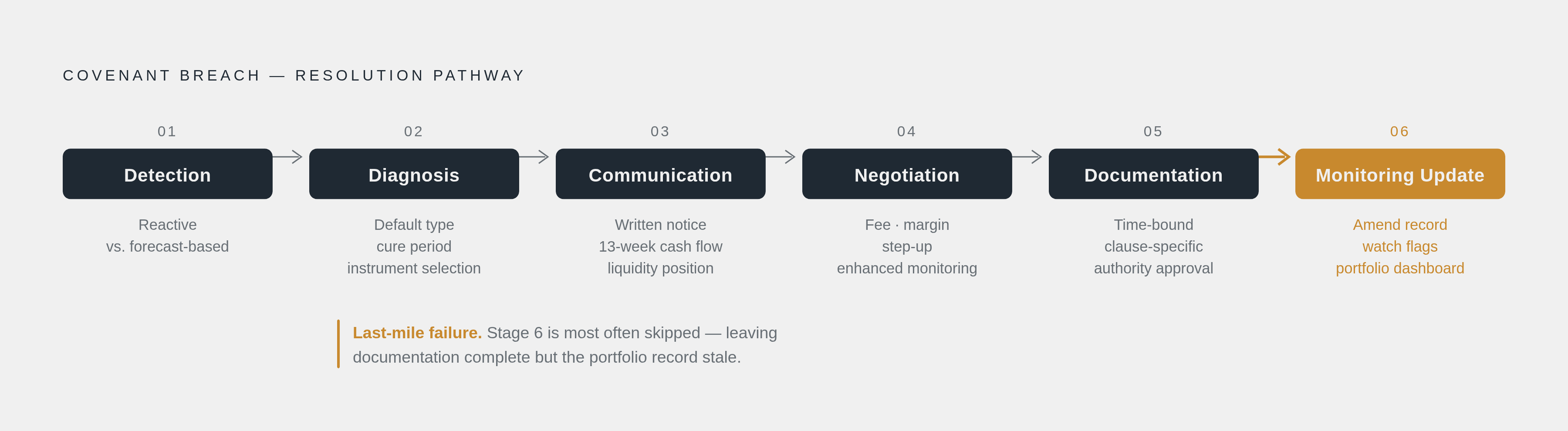
The most common failure after closing is to leave the monitoring record unchanged. The executed agreement then has one set of terms while the next covenant test uses another. Compliance results become misleading or meaningless. A correct legal document cannot rescue a test run against superseded terms, so the covenant record must reflect the amended structure.
For the lender, the next step is more intensive monitoring. The borrower has demonstrated covenant stress, and the monitoring approach should reflect that elevated risk. Cure periods need dated obligations and reminders. Near-misses after a waiver should be logged with a watch flag and a notice to the relationship manager. Repeat waivers on the same covenant or to the same borrower should also be visible in the portfolio dashboard as a portfolio-level signal.
The guide identifies the limits of managing covenants deal by deal. Repeated borrower waivers, concentrated DSCR compression within a property type, and clustered maturity exposure within a vintage can become visible through a portfolio dashboard. The purpose is not simply to count exceptions, but to recognize when separate accommodations point toward a shared source of pressure. That changes the meaning of the next waiver request before its negotiation begins.
AI-native platforms built for CRE are positioned to close this loop when they account for covenant structures, amendment sequencing, and examiner expectations. The platforms’ workflow requirements are to update the covenant record automatically after execution, flag compression after a waiver, and keep an audit trail that cites its sources so no one has to rebuild it by hand. The final test of an accommodation is therefore operational as well as legal. At the next test cycle, the lender must be measuring the borrower against the agreement it actually signed.