Borrower Reporting Compliance Management
Covenant breaches, not missed payments, trigger most commercial real estate defaults.

A borrower can be current on every single payment and still be in default. That sentence sounds like a contradiction, but it describes how commercial real estate lending works, and it is the reason borrower reporting compliance cannot be managed as a periodic checklist. Compliance here runs on documents, deadlines, and covenant tests at every stage of a loan's life, so you can't manage it as a box a credit officer checks once a quarter.
Why borrower reporting compliance fails as a periodic checklist
The loan lifecycle does not pause so a lender can catch up on paperwork. Origination sets reporting schedules and covenant thresholds. Post-close triggers its own document flow. Every quarterly or annual deadline means financials have to arrive, then get checked, then get tested. Extension options carry their own tests. Maturity brings a final set of conditions that either get satisfied or don't. None of these events wait for the next scheduled review, and that is the flaw baked into most lenders' current approach: spreadsheets, calendar reminders, and manual reviews that only look at the portfolio every so often.
That gap between when something goes wrong and when someone notices can be measured in actual dollars and actual defaults. Kelley Clarke PC's 2026 distress framework lays out the sequence: a rate reset pushes the debt service coverage ratio below the floor set in the loan documents, the covenant trips, cash management activates, and the borrower loses discretion over operating accounts. All of that can happen before the lender's next scheduled review even arrives on the calendar.
A covenant breach is a default regardless of whether the borrower has missed a payment. A tripped DSCR covenant can trigger a cash sweep, default interest, or even acceleration of the entire loan balance, independent of the payment history sitting in the servicing file. Once that covenant trips, it no longer matters how current the borrower's payments are.
The market and regulatory conditions that make continuous compliance non-negotiable in 2026
Two separate forces have landed on the commercial real estate market at the same time in 2026, and together they turn what was once a manageable administrative gap into a risk that touches a bank's capital position. One is a maturity wave bigger than anything the industry has recently faced. The other is a new federal transparency regime that now reaches into commercial property transactions.
Start with the maturity wall. Roughly $875 billion in commercial and multifamily mortgages come due in 2026, which works out to about 17% of all outstanding CRE debt. Much of that volume is in floating-rate bridge loans closed between 2019 and 2023, deals structured for a rate environment that no longer exists. Kelley Clarke PC points to this maturity wall as the single largest driver of current market distress, and the pressure doesn't come from rates alone: rate cap premiums, insurance costs that have spiked in many markets, and new supply softening rents are compounding against deals that underwrote correctly when they closed. Every loan in that maturity cohort is being tested against an active compliance window right now. Extension tests, DSCR floors, LTV thresholds, and reporting obligations are all live, and they're being tested against operating conditions that have deteriorated since underwriting.
Layer the regulatory side on top of that. The OCC's Comptroller's Handbook (Version 2.0, issued March 2022 and updated March 2025) tells banks they need documentation, approval, and reporting requirements so they can monitor compliance with the bank's own real estate lending policy. Separately, as part of credit administration for income-producing CRE loans, the Handbook requires banks to request, receive, verify, and maintain financial statements and other borrower and guarantor information, including covenant tracking. That takes borrower reporting compliance out of the category of internal best practice and puts it in the category of supervisory standard. Thousands of loans are testing at once this year, and regulators have made covenant tracking an explicit examination expectation in the same year, so the lag built into manual compliance processes is no longer a minor inefficiency. It is the thing an examiner will ask about directly.
What borrower reporting compliance covers across the loan lifecycle
Borrower reporting compliance breaks into at least four distinct categories of obligation, and each one runs on its own document flow and its own monitoring schedule.
Financial reporting obligations come first. Borrowers owe the lender operating statements, rent rolls, tax returns, and financial statements from both the borrower entity and any guarantors, typically on quarterly and annual schedules set at origination. The lender's job doesn't end at receiving these documents. The OCC Handbook states that a prudently run CRE lending operation establishes real processes for requesting, receiving, verifying, and maintaining this financial information as part of credit administration. Someone has to check the numbers, not just file them.
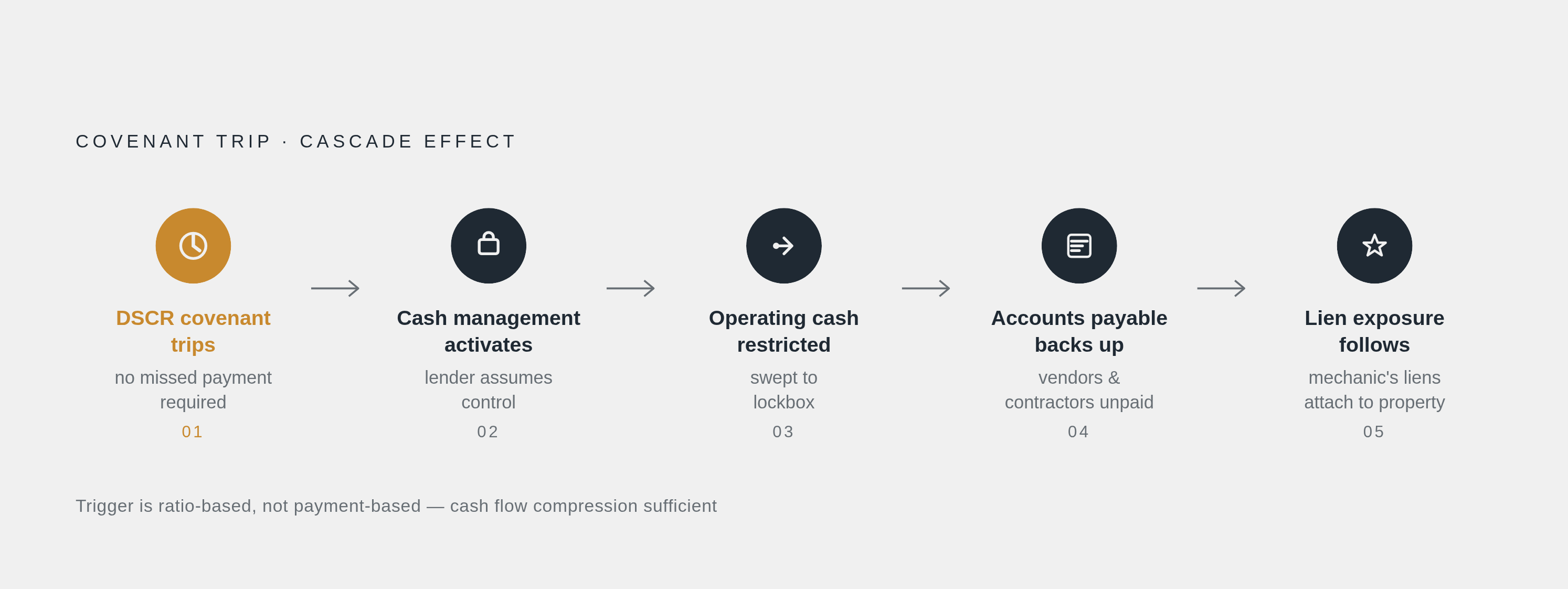
Covenant compliance obligations sit on top of the financial reporting layer. DSCR floors, LTV ceilings, debt yield minimums, and occupancy minimums all need testing on defined cycles, with the borrower delivering compliance certificates that the lender then verifies independently. The OCC Handbook treats covenants as a monitored condition of the credit under its underwriting guidance for income-producing CRE loans, so you can't check that box once at closing and forget it. Most sponsors who get caught by their lenders get caught here: non-monetary defaults from covenant breaches, not missed payments. The cascade that follows a tripped covenant runs in a predictable order: the covenant trips, cash management activates, operating cash gets restricted, accounts payable backs up, and lien exposure follows close behind.
Structural and ownership reporting obligations make up a third category, running parallel to the first two. Lender consent requirements cover transfers of ownership interest, subordinate debt, refinancings, and restructurings, and violating these can convert debt that was conditionally non-recourse into full recourse against the sponsor personally. Kelley Clarke PC names unauthorized transfers, subordinate debt taken on without consent, and violations of single-purpose-entity (SPE) requirements as recurring triggers for these bad-boy carve-outs. None of these appear on a payment ledger, so lenders need to track structural changes before they happen, not after a default notice forces the question.
The fourth category is regulatory disclosure: federal reporting and beneficial ownership filings, and keeping the two aligned with each other. Woods Rogers' analysis of FinCEN's rules notes that inconsistencies between a FinCEN filing and a CTA report can draw regulatory scrutiny on their own, even if nothing else about the deal is wrong. That makes centralized, accurate ownership records a lender responsibility, not a documentation afterthought left to outside counsel.
Four categories, four cadences, four document types: each one carries its own consequences for getting it wrong. You could argue that's simply the cost of doing business in CRE lending, and that's true as far as it goes. Compliance management was never going to be one workflow: it's several workflows, running at once, across every loan in a portfolio, all the time.
The limits of manual workflows at portfolio scale
Layering that four-part scope across a portfolio of any real size overwhelms spreadsheets and calendar reminders as a workable system. The volume, the variety of document types, and the differing cadences exceed what manual tracking can reliably hold together, and this happens even when nothing unusual is going on. It's a structural mismatch between the tool and the job, present on an ordinary Tuesday with nothing unusual happening.
Consider where the bottleneck actually starts. Financial spreading, the process of mapping a borrower's income statement, balance sheet, and cash flow data into a standardized credit template to calculate DSCR, debt yield, leverage, and liquidity, produces the data that every covenant test downstream depends on. Every compliance cycle begins with a spread. When that spread is built by hand, a delay opens up between the day the borrower delivers financials and the day the lender can actually test any covenant against them. That delay compounds across a portfolio of hundreds of loans, each on its own reporting schedule, each generating its own backlog in the queue.
There is also the quarterly refresh to account for. If a spreadsheet only gets updated once a quarter, a covenant problem becomes visible only when someone happens to notice it, sometime after the quarter closes. In a market where DSCR can deteriorate within a single operating quarter, as insurance premiums spike or a major tenant vacates, a lag of that length is functionally no different from not monitoring the loan.
Regulators have started to expect something spreadsheets were never built to do. The OCC's examination framework expects lenders to segment a portfolio on demand by common risk characteristics, including covenant status, and they need to produce that view reliably even under examination pressure. Ask a credit team to filter a shared spreadsheet maintained across dozens of loan officers for every loan currently close to its DSCR floor, and the honest answer is usually that it takes days, assumes nobody's version is out of date, and still might miss a loan where the latest financials haven't been spread yet.
You could argue, and reasonably, that lenders have run CRE portfolios on exactly these tools for decades without the industry collapsing. That's a fair point, and it was true for a long time. But what changed is timing: the maturity wall of 2026, the largest cohort of simultaneously stressed loans in recent memory, has arrived in the same year that regulatory expectations around covenant monitoring have tightened. A lag that was survivable when loan volumes were lower and rate environments were calmer now runs directly into examiner findings on one side and unmanaged credit losses on the other. The tools didn't get worse. The conditions they have to handle got harder, all at once, across the entire industry.
What systematic compliance management requires: the core capabilities
If manual workflows can't carry this scope, what does an approach that can actually look like? Four capabilities, working together rather than as separate projects, cover the gap: automated financial spreading, continuous covenant monitoring, portfolio-level exception surfacing, and outputs that trace back to their source documents well enough to survive an examiner's questions.
Automated financial spreading removes the first bottleneck identified above. Instead of a credit analyst spending hours mapping a borrower's financials into a template by hand, a system ingests the documents, extracts and normalizes the figures across different entity types and reporting periods, and produces the credit ratios, DSCR, debt yield, leverage, that every covenant test downstream depends on. Speed matters here beyond simple efficiency: a spread finished in minutes rather than days means covenant tests run against financials that are current, instead of financials that sat in a queue for three weeks while the market kept moving underneath them.
Continuous covenant monitoring replaces the quarterly cycle. Rather than waiting for a scheduled review, the system reads the executed credit agreement itself, pulls out each covenant along with its threshold, measurement period, test date, and any cure rights attached to it, and runs the test automatically whenever new financial data comes in. The practical effect: a DSCR slide, a drop in occupancy, or an expense spike gets flagged in the same cycle it happens, not in whatever review follows weeks or months later. That difference can give lenders weeks of lead time to work with a borrower before a covenant trips, where the quarterly cycle might leave only days or none. It also changes how lenders and borrowers interact day to day. A borrower whose financials get tested continuously should expect more frequent questions and sharper scrutiny of the numbers, and a sponsor whose own reporting can't keep pace with a lender's monitoring capability is negotiating from the weaker side of the table before the conversation even starts.
Portfolio-level exception surfacing takes the view beyond any single loan. Breaches, thresholds a loan is approaching, upcoming reporting deadlines, and loans nearing maturity all get flagged across the entire book at once, instead of waiting to be discovered one deal at a time by whoever happens to pull that file next. So a portfolio manager can spend time on the loans that need attention instead of chasing down documents on every loan equally.
Source-traceable outputs tie the whole system together: they let an examiner verify the calculation against its original documents. If an AI-calculated DSCR links every input figure back to the exact line on the exact financial statement that produced it, it holds up under examiner review. A DSCR figure presented without that trail, no matter how accurate, doesn't. For a supervisory standard built around documentation, verification, and maintenance of borrower information, traceability is what makes the calculation usable as evidence.
Building these capabilities into CRE institution workflows
Institutions are approaching this problem from different starting points, and which capability a lender reaches for first usually says something about where its own bottleneck sits. A credit team drowning in manual spreads looks for automation there first. But a team confident in its spreads and blind between review cycles looks for continuous monitoring instead.
Some platforms cover the compliance cycle end to end: they pair automated spreading with covenant extraction pulled directly from the executed credit agreement, so one system handles both the math and the monitoring against it. Moody's CreditLens approaches the problem from the credit lifecycle side: the spread, the risk rating, and the relationship hierarchy already live inside the platform, so testing a covenant means testing it against the exact same financial data that produced the risk rating in the first place, with nothing re-entered or re-keyed along the way. Built Technologies takes a narrower, construction-focused angle, monitoring DSCR, LTV, and draw covenants specifically for construction and CRE lenders managing active draw schedules alongside standard covenant tests.
Neither approach is the only valid one, and the right fit depends on where a given lender's portfolio sits: construction-heavy, stabilized income-producing, or some mix of both. What both have in common is the premise running through every section above. If compliance happens once a quarter, it catches problems only after they've already cost something. Compliance built to run continuously catches them while there's still time to do something about it.