Default and Recovery Analysis in Private Credit
Early intervention on distressed loans preserves recovery options that late action destroys.

Default and recovery analysis in private credit is about more than choosing between a 2.5% and 6% default rate. The gap reflects different definitions, but the practical problem is a workflow problem. Lenders who detect and act on distress early can manage recovery while options remain, while those who act late discover recovery prospects after those options have narrowed.
Why the gap between a 2.5% and 6% default rate is not a measurement problem
Proskauer’s Private Credit Default Index was 2.51% for Q2 2026, counting payment and financial-covenant defaults across 716 loans with $195.6 billion of original principal. Fitch’s US private credit default rate reached 6.0% on a trailing-twelve-month basis at the end of the same quarter, including distressed exchanges and maturity extensions. The first fell from 2.73%, while the second rose from 5.7% to a record. Fitch counted 32 default events in Q2 2026, with maturity extensions accounting for more than half and outnumbering missed payments and interest deferrals.
KBRA’s Middle Market Default Monitor occupied the space between them, reaching 3.3% by borrower count and 2.4% by debt for the twelve months to 30 June 2026. Its coverage included 2,785 sponsored middle-market borrowers and more than $1.2 trillion of direct lending debt, counting imminent defaults and interventions that prevented payment failure. Moody’s made the definitional choice explicit for 2025, putting the likely rate between 1.6% and 4.7%, depending on whether distressed exchanges were included. Distressed restructurings accounted for roughly 65% of defaults that year.
These figures are not interchangeable gauges of crisis. A narrow rate tracks breaches of the contract, while a broad rate also counts relief given to distressed borrowers. Understanding which number belongs in a decision therefore requires understanding what each definition was built to capture, and what it was never designed to catch.
What each definition was built to capture — and what it misses
The narrow definition answers a contractual question. Has the borrower broken a payment obligation or financial covenant? Lenders can use it to track formal defaults and for loss-given-default modeling on credits that are already impaired. Its weakness is timing, because a borrower may have been deteriorating for quarters before missing a payment.
How often has a creditor granted relief it would not have granted to a healthy borrower? Including distressed exchanges and maturity extensions captures impairment that a payment-only measure excludes. Yet this remains a record of outcomes.
KBRA’s approach asks how much distress is being absorbed before the formal threshold is crossed. Counting cases where a sponsor or lender steps in keeps the stress in the record even when a rescue succeeds. This is useful when comparing underlying pressure with recognized defaults. These definitions distinguish failure, accommodation and absorbed distress. Each category on its own leaves out how a borrower’s condition is changing.
How payment-in-kind interest obscures distress before it hardens into loss
PIK agreed at origination is a pricing choice with little default signal, whereas PIK introduced later on a cash-paying loan signals that the borrower can no longer pay that interest in cash. Lincoln International’s data for Q1 2026 showed that roughly one in ten direct-lending loans had PIK. Loans with no PIK at close but with PIK today reached 5.9% of all loans, against 2.5% at the end of 2021. Lincoln described this “bad PIK” measure as a shadow default rate.
Average loan-to-value in that cohort rose from 39.4% at inception to 76.1%, loading interest onto an already-leveraged capital structure. Elevated floating-rate coupons, 2021-vintage leverage and missed growth plans compress cash flow before covenant tests necessarily register a breach. A borrower electing bad PIK in Q1 may not breach a DSCR covenant until Q3 or Q4, depending on the test mechanics. Loans with bad PIK are also materially more likely to enter non-accrual in following quarters, when lenders stop recognizing interest income.
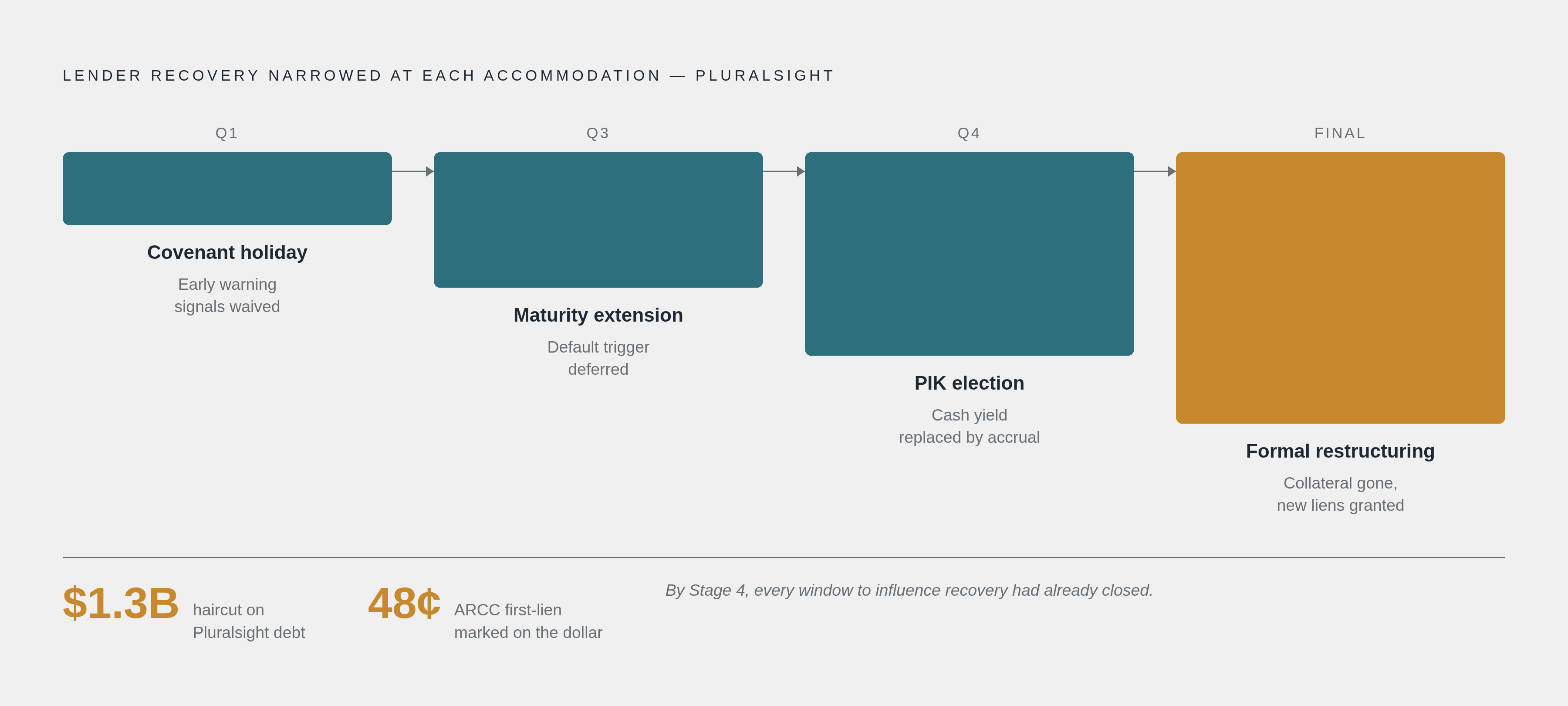
The Pluralsight restructuring gives the consequences a concrete scale. The Vista Equity Partners–backed company had $1.5 billion in total debt, with Blue Owl as agent, and underwent a debt-for-equity swap with a roughly $1.3 billion haircut. ARCC marked its first lien to 48 cents on the dollar. The case illustrates the danger of recognizing default only when deterioration has become a restructuring outcome and the opportunity to manage it has passed. The PIK dynamic is well documented; the operational question is whether lenders can act on it in time.
What recovery actually looks like when distress is discovered late
A 65% recovery assumption embedded in fund models is a useful benchmark, but it cannot substitute for following the borrower’s changing capital structure. Pluralsight’s first-lien mark was not a final realized recovery, yet it shows why modeled recovery and the value recognized during distress need careful separation. Recovery depends on what remains available when lenders negotiate, including collateral value, competing claims and their own bargaining position.
Consider the sequence described by repeated accommodations. A borrower receives a covenant holiday in Q1, a maturity extension in Q3 and a PIK election in Q4. By formal restructuring, collateral may have deteriorated, additional liens may have been granted and senior lenders’ negotiating position may have weakened. Each concession can buy time while leaving the borrower unable to repay. Direct-lending amendment activity rose materially quarter on quarter in Q4 2025, with extensions, covenant holidays and sponsor equity infusions all increasing.
That sequence shows why recovery analysis must track accommodations together and weigh whether each one has cured the distress. The consequences can also reach beyond individual loans. Blue Owl permanently ended redemptions on its $1.6 billion OBDC II non-traded BDC on 18 February 2026 and replaced quarterly withdrawal windows with quarterly return-of-capital distributions. The event illustrates the fund-level liquidity dimension of portfolio stress, distinct from the eventual loss on any particular credit.
Why periodic monitoring creates a structural lag that amendment activity cannot hide
Quarterly monitoring is structurally mismatched with deterioration that accumulates between reporting dates. A binary covenant test can record a pass while headroom has been shrinking for three or four quarters. A DSCR test against a single period’s financials does not capture the whole sequence of negative free cash flow, repeated PIK elections and growing exposure to EBITDA underperformance. The analyst may have run the test correctly.
Of roughly 5,000 companies held by business development companies at 31 March 2026, more than one in ten showed signs of credit pressure. Half of those companies had not used PIK in the preceding twelve months. Hamilton Lane’s 2026 Private Credit Focus described outcomes as likely to be company-specific rather than sector-wide, reinforcing the need to distinguish borrowers within the same sector. Rising amendment activity reveals the stress that has reached negotiation.
The Financial Stability Board’s May 2026 report identified valuation opacity, inconsistent definitions and data gaps as structural vulnerabilities. The OCC’s Spring 2026 Semiannual Risk Perspective gave private credit expanded attention within its credit risk section, including restructurings and PIK mechanisms that may mask deterioration. This raises expectations for systems that can track risk, but leaves lenders free to choose among monitoring techniques.
What continuous covenant monitoring requires in practice — and what it changes
AI reads loan documents and extracts covenant mechanics, while current financials supply the inputs for ongoing DSCR, LTV and debt-yield tests. The system flags possible breaches before they become technical defaults, giving lenders time to negotiate waivers before they are forced into workouts. In the 40-property portfolio example, continuous AI monitoring identified materially more assets at risk than traditional quarterly testing, with roughly 90 days of lead time.
Automated financial spreading extracts and normalizes rent rolls, T-12s and operating memoranda into a consistent data layer. Earlier rule-based extraction used fixed templates, while today’s systems can read financial terms in documents with different formats. Semantic normalization allows heterogeneous loan documents to feed comparable tests without manual reconciliation. Even so, continuous calculation cannot make stale financials current. The test is only as timely as its inputs.
Traceability is the other prerequisite for useful automation. A covenant result needs source citations so that its inputs and the basis of the test can be examined. OCC Bulletin 2026-13 on Model Risk Management sets principles that include adequate documentation and traceability of model inputs and outputs. It does not prescribe enforceable requirements and explicitly states that non-compliance will not result in supervisory criticism.
Portfolio-level opportunity surfacing as the other side of the same infrastructure
The same data layer can expose opportunities that manual, deal-by-deal review leaves scattered across a loan book. Lenders can assess refinance windows, maturity walls and concentration exposures across the portfolio without searching through documents one by one. This is the other use of timely visibility. A lender that can see extensions, approaching maturities with negative free cash flow and bad PIK elections in the last two quarters can prioritize engagement before a borrower exhausts its options. Earlier engagement may also create room to negotiate better terms.
The opportunity comes from reading the same financial condition and contractual timeline used in risk monitoring with a different decision in mind. A maturity extension is both evidence of accommodation and information about when the next negotiation may become urgent. Automatic surfacing makes that connection available across the portfolio, rather than dependent on someone assembling it manually. Institutions with this infrastructure can move faster on distressed opportunities, restructuring negotiations and refinance windows than competitors still working through quarterly spreadsheet cycles.
What the current cycle reveals about the minimum viable risk infrastructure for private credit lenders
A lender needs a workflow that follows the signals preceding formal default, creditor accommodation and intervention to improve its decisions. Distinguish PIK introduced mid-term from PIK agreed at origination, then track the bad PIK cohort’s LTV trajectory continuously, including between covenant-test dates. That makes the change in payment capacity visible. It also prevents a contractual election from disappearing into a general category of performing loans.
Amendments need the same continuity of analysis. Minimum viable infrastructure must show which credits have received one accommodation, which have received several and how the sequence changes the recovery outlook. Covenant headroom must then be tested against current financials, with source-cited outputs that make the calculation open to examination. Portfolio dashboards that use the lender’s own loan templates and what it knows about its loans help it act on those signals across the book.
The implementation is a connected data layer. Regulatory scrutiny strengthens the case for that transparency, while earlier negotiations supply its commercial purpose. This is a solvable workflow problem. The decisive capability is not producing a more reassuring default rate, but preserving the time in which a lender can still influence recovery.