Covenant Breach Early Warning Systems
Detecting covenant breaches early requires closing the gap between stress and lender response.

Covenant breach early warning systems turn borrower and property data into time for a lender to respond. Their value depends on closing the gap between emerging stress and credit action. For CRE lenders and asset managers, monitoring they can defend needs a workflow that covers every step, follows the loan’s actual terms, and puts a warning people can use in the right hands.
Why the gap between when stress appears and when lenders act determines workout outcomes
Consider a borrower’s October submission that shows a drop in debt service coverage ratio, or DSCR, but goes unread until January. The information has arrived, but the credit response has not. During that interval, the lender has neither tested the deterioration against the agreement nor decided whether it warrants action. The submission date disguises the delay.
That distinction explains why having covenants does not, by itself, protect a loan. Where the cure period starts from notice of breach, rather than from the breach itself, delayed detection postpones notice and leaves emerging stress unaddressed. It consumes time in which the lender could have assessed the problem and engaged the borrower. The clock and the property follow different calendars. Workout options depend on the property’s condition when the lender responds.
What CRE loan covenants actually require lenders to track, and why each type has a different failure mode
Financial covenants include minimum DSCR, maximum loan-to-value, minimum debt yield, and minimum net operating income, or NOI. Testing them depends on timely borrower financials and consistent extraction of the figures defined in the agreement. Their characteristic failure is calculation lag. Even a timely test can mislead if it uses the wrong income or expense treatment. The OCC Comptroller’s Handbook on Commercial Real Estate Lending identifies requirements for affirmative and negative loan covenants as an element banks should establish in their real estate lending policies.
Operational covenants instead concern occupancy, insurance coverage, property condition, lease approvals, and restrictions on additional debt. To test them, lenders need data on how each property operates and third-party sources, which financial statements alone cannot provide. Reporting covenants govern delivery of rent rolls, trailing statements, audited financials, and insurance documents on defined schedules. Here, absence is itself a signal. A borrower can remain financially compliant while breaching an obligation to submit information.
Construction lending adds draw-specific conditions before disbursement, requiring reconciliation of draw packages, inspection reports, and lien waivers against agreements and amendments. Built’s lender guide places construction draw compliance within a sequence that also includes stabilization and permanent-phase covenants. Unlike enterprise-level corporate leverage tests, CRE covenants follow the underlying property. No single submission stream covers every obligation.
How manual covenant tracking breaks down as portfolios grow past the point where spreadsheets can keep up
At quarter-end, teams must collect compliance certificates, annual budgets, rent-roll updates, and insurance renewals for many transactions at once. Teams spend that time gathering and entering information when they should be weighing risk. A spreadsheet may have the required dates and ratios but do little to help the team handle the surge in work they bring.
Each new loan also has its own definitions, testing dates, and reporting formats. As those differences accumulate, the tracking burden compounds faster than the loan count. When records sit in different inboxes and separate workbooks, version control gets harder, and gathering and entering data uses up the time for analysis. Delayed tests then narrow the time available for response. Fragmentation can leave a breach undetected altogether.
Calculation inconsistency adds a quieter failure mode. Analysts working from the same statement may use different income lines, normalize expenses in different ways, or disagree on how to treat concession periods when they calculate DSCR. One flags a breach that another does not. The portfolio therefore gains not only more work but more opportunities for inconsistent judgment to enter routine calculations. Collection delays, version conflicts, and interpretation differences reinforce one another.
The five-stage workflow an automated covenant monitoring system must complete end-to-end
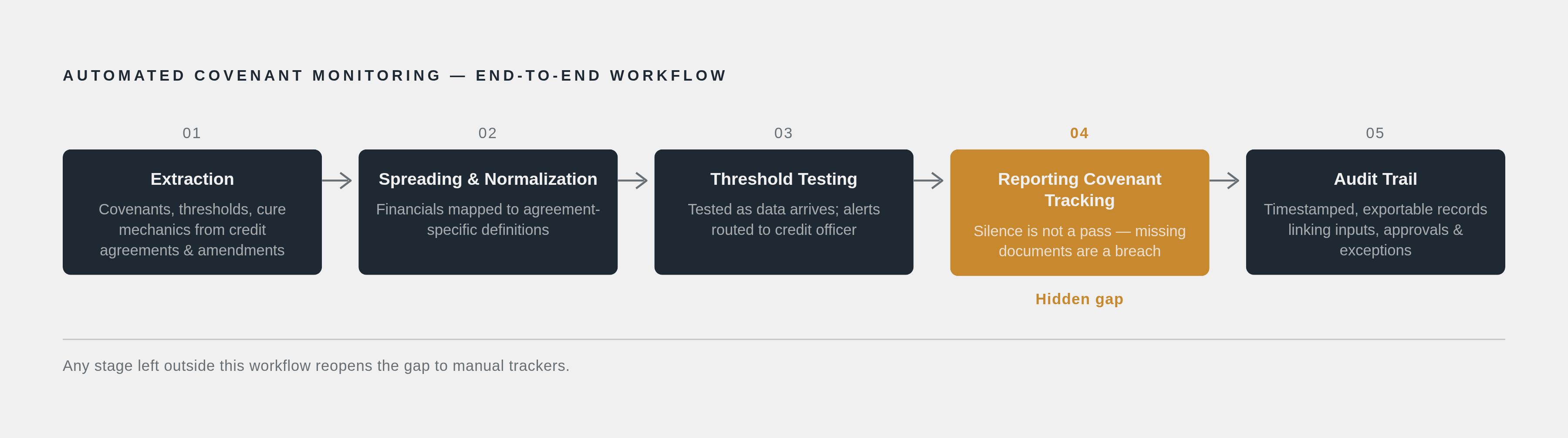
The first stage extracts covenants from executed credit agreements, amendments, and side letters into structured definitions, thresholds, testing frequencies, reporting deadlines, and cure mechanics. Contract review should examine these documents and connected project files together for gaps, conflicts, and completeness. A generic template is not enough. Mapping a negotiated EBITDA definition to a standard formula can produce the wrong numerator, while missing a side letter can leave the system testing a superseded threshold.
The second stage is spreading and normalization of incoming borrower financials. Extraction establishes what the agreement requires, and spreading supplies the financial inputs needed to test it. These stages must share the same definitions. Otherwise, automated calculation speeds up work that uses definitions that do not match.
The third stage tests those inputs against the thresholds as data arrives. Threshold-approach alerts distinguish early warning from breach notification by identifying a loan nearing its limit. Delivery is part of the mechanism, too. The alert must reach the responsible credit officer.
The fourth stage tracks reporting obligations and submission deadlines. A financial test cannot flag a missing rent roll if the system keeps waiting for the document before it does anything. Reporting compliance therefore needs a separate test to check whether the required information came in on time. Silence cannot be treated as a pass.
The fifth stage generates an audit trail of tests, inputs, approvals, and exceptions. Timestamped, exportable records connect the result to the evidence and decisions behind it. This completes the chain from agreement to accountable action. Leaving any stage outside the workflow pushes work back into manual trackers and reopens the gap.
How AI-driven monitoring uses leading indicators to flag stress before financial statements report it
Quarterly financial statements show what happened in a period that has already passed. AI-driven monitoring can move the warning earlier by using operational and market streams that update daily or weekly, before their effects appear in reported NOI. Lease expirations offer one such lead. Models can assign probabilities to renewal, rent resets, and downtime between tenants, then project the income effect before those expirations occur.
Payments shifting from day 1 to day 12, more frequent partial payments, and increased accounts receivable aging can indicate distress before an income line changes. Market data extends that forward view. Falling submarket rents can affect expected renewal income before new leases are signed, while insurance increases, utility volatility, and deferred maintenance becoming urgent capex expose expense and cash demands that historical statements do not yet capture.
Together, these inputs support a projected DSCR curve under multiple scenarios. The question changes from “Has this loan breached?” to “What path is it on?” As a structural illustration, several loans in a portfolio might still pass their current tests even as their projected coverage weakens at the same time. Its value lies in making the trajectory available for review before reported financials catch up.
Where AI prediction fails and how lenders should calibrate model outputs against asset-specific reality
A forward-looking model is only useful if its assumptions fit the asset. Assuming every expiring lease will reset to lower market rents can overstate NOI decline at a property with stronger leasing performance. A model that assumes owners are doing nothing can also miss capital injections or active leasing incentives that are already easing the pressure. The model sees an unmanaged problem where the borrower is taking action. Repeated false positives can then train analysts to discount genuine warnings.
Models should use actual lease terms, borrower capital plans, and property-level expense history. The same discipline applies to contractual inputs. A wrong EBITDA definition or superseded threshold contaminates the prediction even when the calculations run without error. A clean calculation is not necessarily a correct one.
Lenders should therefore treat AI outputs as a first-pass exception surface. AI can handle ingestion, normalization, modeling, and first-draft exception reporting, while people assess the exceptions and borrower relationships. Grounding the system in asset-specific data and the firm’s own credit methods makes the warning more relevant to the decision it supports.
What portfolio-level covenant monitoring surfaces that loan-by-loan review structurally cannot
An individual loan approaching a covenant limit presents a credit question. Several loans approaching their limits together present a concentration question, even before any has triggered a formal breach response. Sequential review does not show that pattern directly. A portfolio manager must assemble the separate findings into a common view, which is precisely the work fragmented systems leave unfinished.
Built Deal Management shows managers which loans across the portfolio are compliant, which are approaching limits, and which have active breaches, without making them piece together information from multiple systems. That common view moves concentration analysis earlier in the risk curve. It also raises a data-quality requirement. Patterns across the book are meaningful only if the underlying loan tests use accurate definitions and comparable methods.
Moody’s Lending Suite connects covenant management from initial request through ongoing monitoring with AI-enabled validation, linking monitoring to upstream origination and credit decisioning. This continuity helps prevent re-entry errors and methodology drift between underwriting and later tests. The data lineage supports the portfolio view. Purpose-built CRE systems grounded in a firm’s covenant definitions, spreading templates, and portfolio data can reveal patterns in the institution’s actual credit book.
What regulators and examiners now expect from covenant monitoring programs, and what an audit trail must demonstrate
The FDIC’s Risk Management Manual of Examination Policies lists adherence to loan covenants as a depth-of-review criterion. The FDIC’s C&I Lending Examination Module also lists tracking covenant compliance and covenant violations among the items to review in ongoing monitoring. These provisions put monitoring within credit administration scrutiny. They do not, however, establish that buying an automated audit trail automatically satisfies every examination requirement.
The operational implication is evidentiary. A lender needs records from which a reviewer can reconstruct the input, test, approval, and exception. Timestamps and exportable histories make that reconstruction easier. Scattered emails, manual logs, and inconsistent spreadsheet versions make it harder to establish what happened and when. A gap in monitoring can therefore show that a lender was slow to spot risk and kept weak records of credit administration.
AI adds a separate validation obligation. OCC Bulletin 2025-26 allows community banks to tailor AI model validation frequency and scope to risk exposure and complexity of use. That flexibility concerns model validation, so institutions must document their validation approach as well as monitoring outcomes. Before a system is used with sensitive borrower data, lenders also need to check its security, including SOC 2 Type II, encryption, and access controls. A continuous, automated audit trail is both an operational output and evidence supporting sound credit administration.
How to evaluate covenant monitoring platforms against the workflows they must replace
For lenders selecting a platform, the evaluation should begin with the workflow failures already present in the portfolio. The minimum scope covers extraction, spreading, threshold testing, reporting covenant tracking, and audit trail generation. Completeness comes before feature count. A platform that automates only calculations may leave document collection, reporting breaches, and exception records in the same fragmented processes it was meant to replace.
Extraction deserves scrutiny against borrower-specific definitions, amendments, and side letters, while alert evaluation needs to cover both threshold approach and routing to the responsible credit officer. Portfolio visibility should show compliance, approaching limits, and active breaches in one view as well as make individual loan records easier to open. Integration deserves equal weight. Aloan illustrates the continuity principle by extending the spreading and reasoning engine used at underwriting into covenant monitoring, without requiring the bank to re-enter definitions or re-implement spreading rules.
The final test is whether the platform fits the institution’s assets and credit methods, including the context needed to interpret a predicted breach. Human review must remain attached to the exceptions that require judgment. Otherwise, the lender sends warnings faster but is no better at acting on them. The monitoring gap closes only when the whole workflow is covered, the system is grounded in asset-specific data and firm IP, and warnings reach people who can act before the cure period clock runs out.