Risk Rating Systems for Private Credit Loans
Internal ratings must detect stress while lenders still have options to act.

Risk rating systems for private credit loans must do more than assign a grade at origination. Because borrowers typically lack public ratings and carry higher leverage, lenders need their own frameworks for detecting deterioration. With rigorous frameworks, stress appears while choices remain open, while with less rigorous frameworks it appears only when a workout becomes unavoidable.
Why private credit borrowers cannot rely on public ratings
Private credit borrowers usually have no public ratings, so lenders lack the public reference point they have for comparable rated debt. The FSB’s May 2026 report identifies this absence as a transparency challenge for market-wide monitoring. It also finds that private credit borrowers typically have lower credit quality and higher leverage than comparable public-market borrowers. Internal analysis has to account for both the missing assessment and the risk beneath it.
The Federal Reserve’s May 2026 Financial Stability Report places private credit at roughly one-third of below-investment-grade U.S. corporate debt, excluding bank loans. At that scale, unrated exposure is more than a portfolio quirk. Yet a higher yield does not by itself establish alpha, because the spread compensates for credit risk, illiquidity and complexity. Distinguishing those components requires an internal view of credit quality.
The FSB notes that information can take longer to arrive when the asset manager acts as an intermediary. It also identifies the growing use of private ratings from lesser-known providers as an area warranting monitoring. An external grade can inform the lender’s analysis, but it cannot do the lender’s thinking.
How internal risk rating systems are built and what regulators require of them
OSFI’s 2026 Capital Adequacy Requirements, Chapter 5, sets out an important distinction for qualifying internal ratings-based approaches. A rating system must have separate dimensions for borrower default risk and transaction-specific factors. These answer different questions, namely whether the borrower will default and how the particular transaction affects the risk. Collapsing them into one score conceals which dimension is changing. Keeping them separate preserves information needed to understand deterioration.
OSFI requires at least seven borrower grades for non-defaulted borrowers and one for defaulted borrowers. That granularity prevents a few broad buckets from swallowing meaningful differences in credit quality. For specialized commercial real estate lending, institutions that cannot estimate probability of default under the corporate foundation method must map internal grades to five supervisory categories, each with a set risk weight. These requirements apply only to qualifying regulatory approaches, so they cover less than the full range of private credit lenders. Their broader design lesson is that grades need enough resolution to distinguish risk and a clear basis for interpretation.
The Federal Reserve’s guidance on credit risk models says the obligor internal risk rating is the key cross-sectional input. It describes that rating as a holistic measure of hard and soft credit-relevant information. Qualitative judgment is therefore part of the architecture. A defensible internal system combines structured evidence with accountable judgment, while treating any private rating as an input to its own conclusion.
The signals that internal ratings are designed to catch: PIK elections, covenant drift, and rating migration
The first test of that architecture is whether it registers deterioration before a formal default. PIK elections, covenant resets and maturity extensions matter because they can postpone distress while leaving it unresolved. Moody’s October 2026 sector report found that the reported default rate among credit estimate issuers rose materially when PIK amendments and maturity extensions among distressed issuers were included. A system that notices only missed obligations is therefore looking through too narrow a window. It can remain administratively current while falling behind the borrower’s condition.
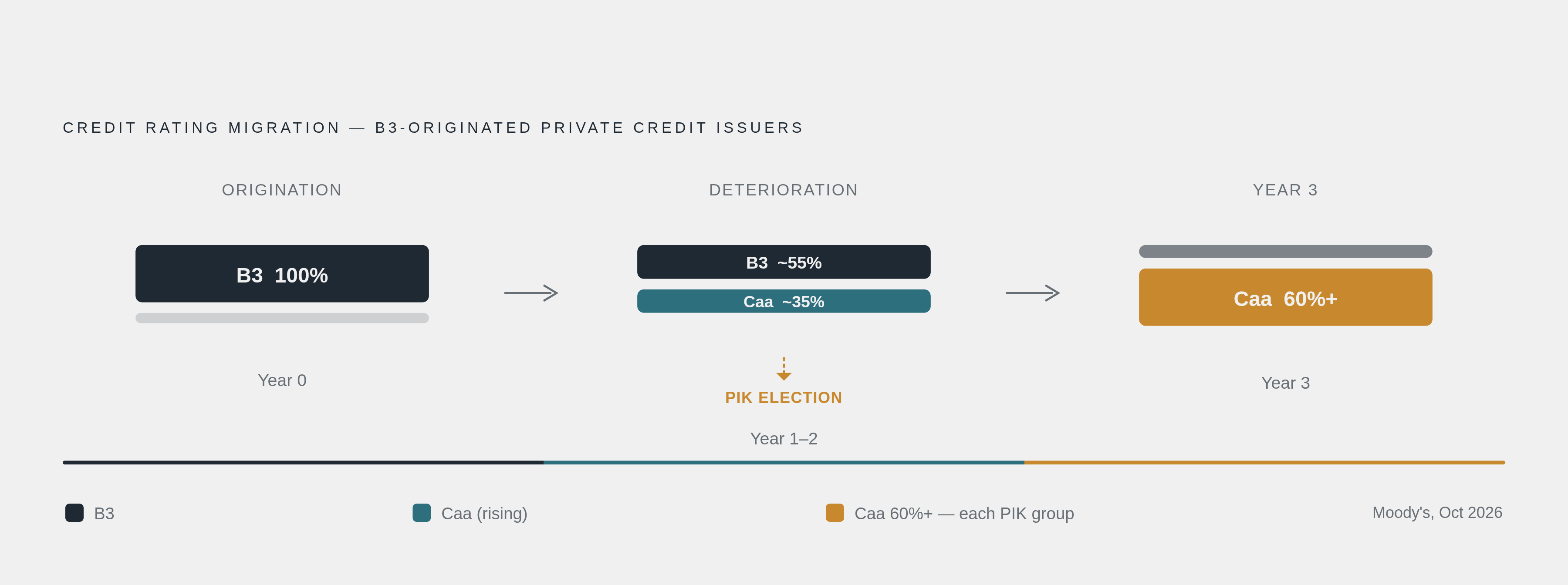
Moody’s also tracked downward migration among issuers first assessed at the B3 rating-equivalent level. Over approximately three years, the share carrying Caa rating-equivalents rose to over 60% for each PIK group. That trajectory makes PIK a leading indicator to examine. Information from covenant resets and waivers should also stay visible across relationships with the same sponsor. Treating an accommodation as paperwork strips it of its warning value.
KBRA’s 2026 private credit outlook reports that assessment downgrades outpaced upgrades for eight consecutive quarters, contributing to a record count of obligors assigned its highest risk score. That pattern gives lenders a reason to examine whether their own grade distributions reflect deterioration in comparable exposures. Federal Reserve research by Banegas et al., 2026, also finds substantially weaker interest-coverage ratios among private credit borrowers than leveraged-loan borrowers. Coverage deterioration and DSCR trends thus belong in the early-warning picture, where they can explain movement before defaults do.
What rising default rates reveal about systems that failed to catch stress early enough
Fitch Ratings recorded its largest sustained stress reading in U.S. private credit across a wide range of U.S. and Canadian issuers in middle-market CLOs and privately monitored ratings. A default does not, by itself, prove that a lender’s rating system failed. Diagnosing a system failure requires examining whether the system had registered the preceding deterioration while there was still room to act. Where it had not, the eventual default exposes a monitoring gap as well as a credit loss.
The IMF has warned that misclassification of private credit instruments could produce unexpectedly large losses under stress. Many of these instruments are held by insurers as investment grade, making the rating classification important to their regulatory capital treatment. An inaccurate grade can therefore affect more than the assessment of an individual loan. It can also distort how an institution understands the capital supporting its exposure.
The FSB notes that private credit remains untested in a prolonged economic downturn. Current stress should consequently be read as diagnostic evidence, with resilience under worse conditions still untested. The useful response is neither reassurance from a low reported default rate nor a declaration of market crisis. It is a closer examination of what the rating process recognized, when it recognized it, and whether that information reached the people responsible for decisions.
The exposure chain problem: why loan-level ratings are not enough when borrowers and sponsors overlap
Even timely loan ratings can leave an important gap if they remain isolated from one another. A lender can rate each loan correctly yet miss how exposure builds up through shared sponsors, overlapping collateral pools and co-borrowing structures. The unit being rated is then smaller than the relationship carrying the risk. Portfolio intelligence is the natural extension of loan analysis because it connects exposures that separate deal files cannot explain together.
That connected view has to cover direct fund financing, shared borrower risk, distribution and origination arrangements, and indirect exposure. Shared borrower risk includes a bank revolver to a company whose term debt sits in a private fund. Indirect exposure can run through insurers, sponsors, wealth clients, collateral values and synthetic risk transfer structures. A useful inventory therefore links the legal entity and ultimate sponsor with the fund, underlying borrower, collateral, guarantor, investor base and bank product. It records commitments as well as utilization, because a fund may draw precisely when portfolio liquidity weakens.
The FSB’s bank credit-line data shows how hard this is, with a wide gap between the figures its members report and commercial estimates. No single regulatory exposure field can be assumed to describe the whole relationship. The FSB’s May 2026 report also identifies services, technology and healthcare as the largest borrowing sectors, adding a sector dimension to sponsor concentration. Every material sponsor cluster consequently needs a named senior owner who can see direct, contingent and collateral-dependent exposure across product desks. Dividing the file is not the same as dividing the risk.
Where covenant monitoring and financial spreading fit into the rating maintenance cycle
The connected portfolio view still needs up-to-date information on borrowers. Financial spreading supplies the inputs to covenant testing, and covenant results help determine when a rating needs review. Under a traditional quarterly process, a breach may reach the scheduled review only after distress has developed. That delay can narrow the window for a waiver negotiation or proactive modification. An origination grade needs to be updated to take new financial information into account.
Smart Capital Center, whose platform is used by institutional lenders including KeyBank, reports a dramatic reduction in the time needed for AI-assisted DSCR calculation from a trailing-twelve-month document. The operational significance is the reduced burden of preparing a key monitoring input. It makes continuous monitoring more feasible, rather than proving that any resulting rating is correct. Faster spreading has credit value only when the resulting tests and threshold breaches feed a review process.
OCC Bulletin 2026-13 on Model Risk Management emphasizes risk-based model validation, documentation and ongoing monitoring. It is non-binding supervisory guidance. Its emphasis nevertheless gives a useful basis for assessing AI-assisted covenant work. Timestamped tests and calculations linked to the specific document lines that drove them make the process open to examination. The aim is not merely to produce a covenant result sooner, but to preserve enough evidence for an analyst to understand and challenge it.
What AI can and cannot do in a private credit rating workflow
Practitioners increasingly agree that AI is most useful for extraction, spreading, covenant checking and early-warning flagging, while analysts keep rating authority. Extracting a figure from a document produces an output a person can compare with its source. To judge what that figure means for a borrower, an analyst needs a wider view of the credit.
PwC’s 2026 Global Private Credit Survey finds that extracting, summarizing and monitoring are relatively mature AI applications because humans can source and check their outputs. It finds that cash flow forecasting and portfolio early-warning systems are also maturing. Autonomous pricing, covenant negotiation and deal structure recommendations are still at an earlier stage. Dealpath’s 2026 survey similarly identifies document analysis as the most common AI use case in CRE, with a strong majority of firms using it.
AI still introduces model risk, and an audit trail makes the output challengeable even if a calculation remains incorrect, which is a stronger position than a manual process with undocumented number lineage. Purpose-built support therefore means more than a tool that can read a financial statement. It means a workflow that fits credit analysis and preserves the boundary between preparing evidence and exercising authority. The analyst remains responsible for the conclusion, including when the machine’s output looks persuasive.
Building a rating system that surfaces stress before it becomes a workout
The practical design test is whether the framework turns new evidence into a timely, explainable decision. Separate borrower default risk from transaction-specific factors so that deterioration has a clear location. Preserve enough grade granularity to make movement visible rather than compressing weaker credits into a catch-all category. OSFI’s rules are the basis for both principles. The objective is not a more elaborate scorecard, but a more discriminating one.
The same discipline applies to maintenance and aggregation. Treat PIK elections, maturity extensions and covenant resets as rating triggers, as the Moody’s migration evidence supports. Connect those triggers to a portfolio dashboard that resolves individual credits to their ultimate sponsor and sector. The FSB’s concentration findings explain why this view matters beyond any single borrower. Covenant monitoring and financial spreading then give that view up-to-date evidence that can be traced to its source between formal reviews.
Finally, preserve underwriting independence from origination pressure. Incentives should reward durable risk-adjusted returns and data completeness rather than only origination volume or first-year fee income. That governance principle applies to internal rating committees as much as to underwriting. Ground the framework in the firm’s own templates, analytical standards, historical data and IP, so that it remains an institutional asset independent of a generic tool. A rigorous system earns confidence by making the evidence visible, the judgment accountable and the emerging stress difficult to overlook.