DSCR Loan Overview for Commercial Borrowers
Property cash flow, not personal finances, determines whether you qualify for the loan.

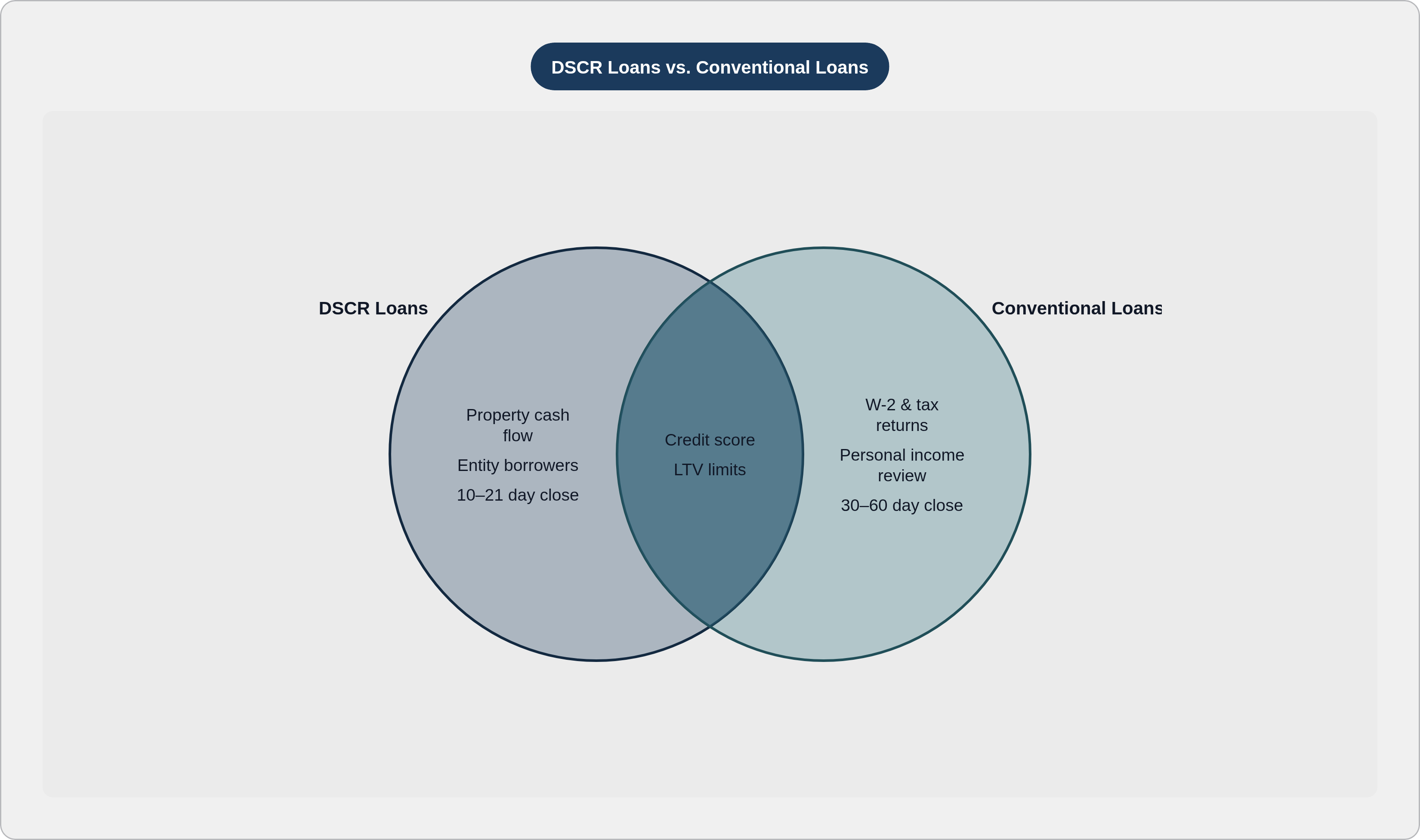
DSCR lending flips the underwriting script: the building qualifies for the loan rather than the person who owns it. The lender wants one number, and one number only, to tell them whether the property earns enough to cover its own mortgage payment, sidestepping the tax returns and W-2s that dominate conventional review. I've sat through underwriting calls where that single swap was the entire conversation, and it's still the thing new investors take the longest to actually absorb, not just repeat back.
The math itself takes about ten seconds. Net Operating Income divided by Annual Debt Service. A property netting $125,000 against a $100,000 mortgage payment lands at 1.25x, and that number is what everyone in the room is negotiating over even when the conversation sounds like it's about the cap rate, the exit strategy, whatever. The formula looks clean. The two inputs feeding it are loaded with judgment calls, and honestly, that's where this piece spends most of its time, because the formula was never the hard part. The hard part is what NOI actually means to the person underwriting it.
DSCR loans sit in the non-QM bucket, exempt from the qualified mortgage rules that govern most conventional financing. That exemption is why a lender can underwrite off property cash flow instead of tax returns. It's also why standards swing so hard shop to shop that two lenders can stare at the same rent roll and land on different numbers, sometimes significantly different. For self-employed investors, LLCs running multi-property portfolios, or operators scaling toward a dozen doors whose tax returns bear no resemblance to their actual bank balance, this is often the only door that opens. Put the loan on an entity, keep personal and business finances in separate lanes, and loan sizes up to $10 million are on the table, enough for a single acquisition or a ground-up multifamily build. The ratio measures whether there's room above the payment to survive a bad vacancy stretch, a jump in insurance, or a rate reset, functioning less as a yield number and more as a shock absorber rating; a good one tells you the car can hit a pothole without the axle snapping.
Why DSCR lending is growing and what market forces are behind it
DSCR volume is up roughly 35% year over year by most counts, a figure reflected in where the money is actually flowing. Non-QM securitization hit a record in 2025, with DSCR loans making up around 30% of that activity according to HousingWire. Wall Street is buying this structure in bulk.
Private money lending overall is on pace to hit $2 trillion in 2025, up from $1.75 trillion the year before. That's a 14% jump, driven mostly by institutional cash hunting for yield it can't find anywhere else. The Mortgage Bankers Association projects total commercial and multifamily mortgage borrowing climbing to $583 billion in 2025, up 16% from 2024, then to $806 billion in 2026. Somewhere in that stretch, DSCR lending stops looking like a niche product for self-employed borrowers and starts looking like infrastructure.
Why now, though? Part of it is just who's doing the borrowing these days. More investors operate through entities, more people work for themselves, and conventional underwriting was never built to flatter either group. A self-employed borrower running three LLCs and writing off every legal deduction can look terrible on paper to a bank underwriter while sitting on a portfolio throwing off steady cash flow every month. DSCR lending skips the deductions and looks at the rent roll instead.
Speed is the other half, and it gets underrated constantly. DSCR lenders typically close in 10 to 21 days against 30 to 60 days at a conventional bank. In a hot acquisition market where the seller takes whoever closes fastest, that gap decides who gets the property and who doesn't. Lighter paperwork does the rest: no W-2s, no reconciling three years of returns, just proof the building earns what it claims to earn.
How lenders calculate DSCR in practice and where the inputs get contested
Here's where the tidy formula gets messy. NOI is gross rental income minus operating expenses, insurance, taxes, management fees, and maintenance, and it deliberately leaves out principal and interest. Straightforward enough on paper. What counts as an operating expense, and at what level, is where lenders start disagreeing with each other, and every so often with reality itself.
Take vacancy. Some lenders normalize it at a flat rate, say 5%, no matter what the property has actually done, even if it's run 98% occupied for three straight years. Others use trailing actuals. That single assumption can swing NOI by tens of thousands of dollars on a mid-size multifamily deal, enough to flip DSCR from clearing 1.25x to falling short. Ask your lender which method they use before you build your own projections; if you're modeling off actuals and they're underwriting off a normalized floor, that mismatch shows up at term sheet time.
Debt service carries its own quirk. It's the full principal-and-interest payment at note rate, except during an interest-only period, when debt service runs lower and the calculated DSCR looks better than it will once amortization kicks in. More on that cliff later. It's one of the more common ways a DSCR loan looks healthy at closing and shaky three years out.
Stress-testing has become close to routine now, even on fixed-rate deals. After the rate whiplash from 2022 through 2025, lenders started modeling how a property holds up if rates climb further, not just whether it clears DSCR today. Reasonable habit, given how fast the rate environment reshuffled everyone's assumptions in the span of about eighteen months.
Then there's debt yield: NOI divided by loan amount, expressed as a percentage. Lenders typically want 8% to 10% on stabilized deals. Debt yield doesn't care about your amortization schedule, your rate, or your term. It's a blunt read on how much loan the income actually supports, which makes it a cleaner floor and a much harder one to game. You can restructure loan terms to improve DSCR. You cannot restructure debt yield without changing the loan amount or the NOI itself. A borrower who spends every ounce of effort optimizing DSCR can still get declined on debt yield, because both ratios have to clear at once, and neither one accounts for the other.
The thresholds lenders actually use by property type and program in 2025
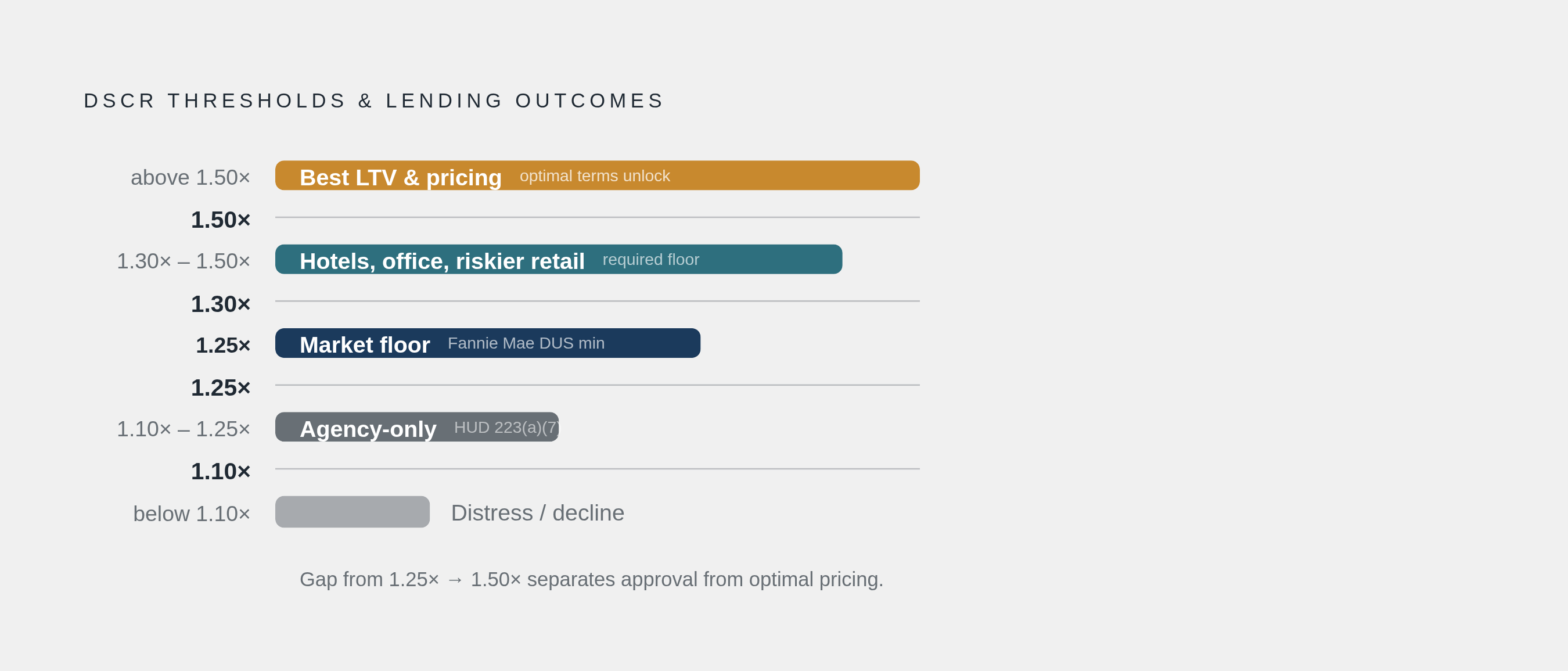
For stabilized, lower-risk types like multifamily and industrial, 1.25x is the market floor. Step into riskier categories, hotels, speculative office, certain retail formats, and lenders commonly want 1.30x to 1.50x or higher, since those asset types swing harder on income when things go sideways. Hotels in particular can go from full to empty in the time it takes a headline to break.
Agency programs run their own separate math. Fannie Mae's DUS program sets a 1.25x minimum with adjustments for property size, location, and risk profile. HUD's 223(a)(7) program actually caps DSCR instead of flooring it: 1.11x max for for-profit borrowers, 1.05x for nonprofits. That makes sense once you remember the program exists to refinance existing HUD debt, not underwrite something new. Some agency executions will accept DSCR closer to 1.10x under tight standards, which matters if you're sitting on a stabilized asset with thin margins chasing agency pricing over bridge or private-money terms.
DSCR doesn't just gate approval, it prices the loan. Clear 1.25x and you're generally in range for decent pricing. Push past 1.50x and the best LTV and terms a lender offers tend to open up. On leverage, CBRE reports average LTVs around 63.3%, up slightly from 62.2%, with most commercial lenders capping loans in the 60% to 70% range now, down meaningfully from the 75% to 80% range common in prior cycles. Some DSCR-specific lenders will still stretch toward 80% on stabilized deals, well above the roughly 70% ceiling typical at banks.
Lease rollover has worked its way directly into the threshold math instead of sitting off as a footnote somewhere in the appendix. A property staring down a wall of lease expirations in the next 12 to 24 months, especially in office or retail, faces higher DSCR requirements or gets its loan proceeds trimmed outright. Underwriting is pricing in the specific risk that a big chunk of income might walk out the door, deal by deal, rather than as a blanket haircut applied to everything equally.
What lenders look at beyond the ratio when underwriting DSCR loans
Clearing DSCR doesn't close the deal by itself, not even close. Credit score still matters, and most mainstream DSCR lenders want to see around 680, a real gate even if it's more forgiving than a lot of conventional commercial programs.
Rate premium is where the math quietly works against you if you're not paying attention. DSCR loans typically run 0.5% to 2% above conventional investment property rates, and conventional investment property rates already sit 0.5% to 0.75% above owner-occupied pricing. Stack those and you get a compounding effect on the very rate used to qualify DSCR: a higher note rate means higher debt service, which means more NOI is needed just to clear the same 1.25x. As of mid-2026, DSCR rates were starting around 5.375% for 1-year ARMs and 6.375% for 30-year fixed, 40-year fixed, and 5-year ARM structures, roughly in line with conventional investment loans once agency add-ons get factored in.
Reserves trip people up more than almost anything else in this process. Lenders commonly want six to twelve months of debt service held back, and older or transitional properties often carry an added capex reserve on top of that. That's real cash, sitting idle for the life of the loan, doing nothing but existing as insurance. I've watched a borrower plan an entire capital stack around the loan amount alone and only clock the reserve requirement staring at it across the closing table. Rough way to learn a lesson.
Property type and tenant concentration draw scrutiny no matter what the ratio says. A single-tenant industrial building at 1.40x DSCR still gets a harder look than a 40-unit apartment building at the same ratio, because one tenant leaving drops that single-tenant income to zero overnight, no gradual slide, just a cliff. Environmental risk has also folded into standard underwriting rather than living in its own separate diligence track somewhere off to the side. The SEC's Climate Disclosure Rule, adopted in 2024, pushed lenders to review climate and environmental exposure alongside the title and insurance checks they were already running.
Clearing 1.25x at note rate is necessary, but it's nowhere near sufficient on its own, and treating it like the finish line is how people end up surprised at the closing table.
Where DSCR loans concentrate risk for borrowers over the life of the loan
DSCR doesn't sit still once underwriting wraps up. It moves with occupancy, expense creep, lease expirations, and rate resets, so a loan that closed at a comfortable 1.35x can drift below covenant without a single missed payment anywhere in the file. DSCR trouble and default are separate events on separate timelines; the first one happens quietly, while the borrower is current on everything else, which is exactly why it sneaks past people watching the wrong indicator.
Commercial loan agreements build in ongoing DSCR floors, often 1.25x, alongside LTV ceilings, debt yield minimums, and reporting deadlines. Breach any single one and the lender has remedies available, even without a missed payment anywhere in sight. That's a different problem from default risk, even though the two get talked about as if they're the same thing among commercial brokers who should probably know better.
Traditional CRE debt management runs on a periodic clock: monthly reporting, quarterly reviews, annual appraisals. Risk doesn't respect that schedule, and it never has. A covenant breach can develop and fully compound in the gap between two review cycles, with nobody noticing until the quarterly report lands looking worse than anyone expected.
The most common trigger, by a wide margin, is lease rollover concentration. A major tenant doesn't renew, NOI drops hard, DSCR falls below the covenant floor, and the lender has options, sometimes before the borrower's had a real shot at backfilling the space. ARM structures carry a related but separate risk: a floating-rate loan built to clear covenant at origination can fall below the minimum purely because rates moved, with the property's actual performance unchanged.
Interest-only structures deserve their own callout because the mechanism is easy to miss if you're not looking for it. IO periods lower debt service, which inflates the qualifying DSCR during that window. The day amortization starts, the payment jumps, sometimes hard, and the borrowers who only ever modeled the IO-period ratio are the ones caught flat-footed. Model the fully amortizing DSCR before signing, not after the payment changes on you. Reserves matter here too, in a quieter way: a property can pass its DSCR test on paper while steadily draining its reserve account through capex overruns or a slow vacancy stretch, and the ratio alone won't show that erosion happening underneath, at least not until it's too late to do much about it.
How lenders and asset managers are using technology to track DSCR covenants across portfolios
Somebody has to watch all these covenants. For a long time that somebody was an analyst with a spreadsheet and a calendar reminder set for the fifteenth of the month, hoping nothing changed between reviews. That model scales badly. Manual covenant tracking eats real analyst hours per loan per month, and once a portfolio grows past a certain size, the review cycles themselves become the risk. The gap between reviews is exactly where DSCR drift hides until it turns into a real problem.
AI covenant monitoring tools have moved into that gap. The better ones pull covenant terms straight from loan documents, with citations tracing back to the specific clause and page, then track the relevant metrics continuously against those thresholds and flag exceptions before they become a technical default. That audit trail matters more than people give it credit for. Any monitoring system facing regulatory scrutiny needs every extracted number traceable back to the loan agreement it came from, full stop.
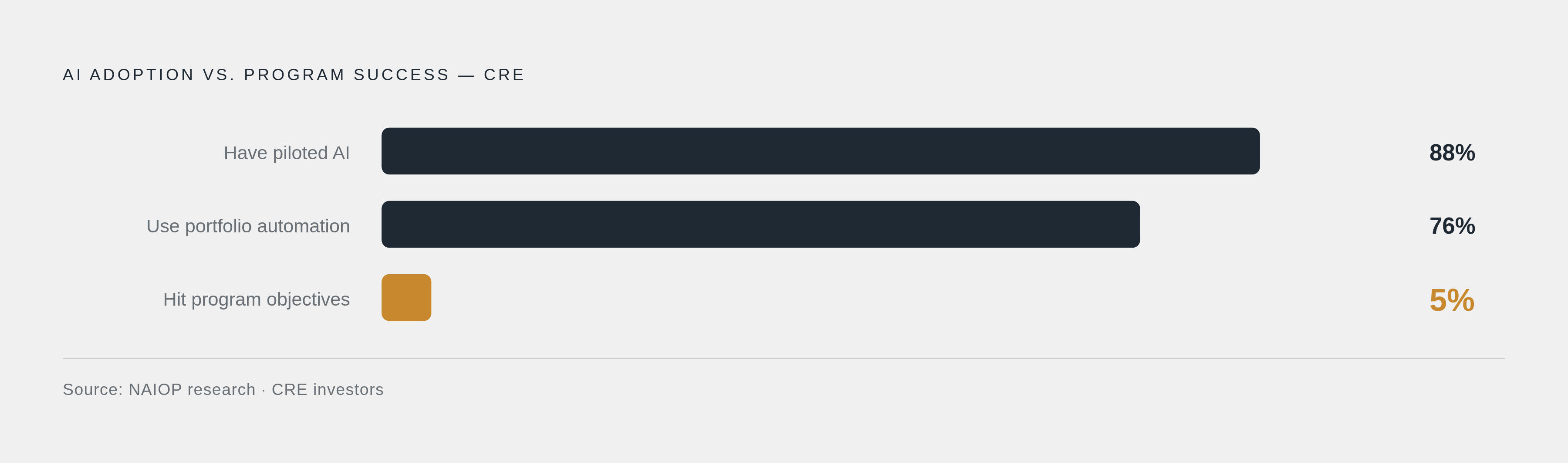
Adoption has clearly crossed some threshold. Roughly 76% of CRE organizations now use some form of automation to handle portfolio management, which makes manual-only shops the exception at this point rather than the rule. But sit with this gap for a second: about 88% of investors have piloted AI in some form, yet only around 5% report hitting their program objectives, per NAIOP research. That's not a rounding error. That's most of an industry buying a tool and not getting what it paid for. The gap almost always comes down to whether the platform was built for CRE workflows in the first place, or whether it's a general-purpose tool with real estate vocabulary bolted on afterward.
General-purpose tools tend to choke on the specifics: lease event tracking, outgoings calculations, multi-tier debt structures, covenant terms that vary by property type. Deloitte's 2026 CRE Outlook notes that firms which adopted CRE-specialized platforms back in 2022 and 2023 report meaningfully better outcomes now than firms still trying to bend generic enterprise AI into shape for this kind of work. Versatility helps at the margins; precision is what the job actually needs, and the sales deck rarely admits the difference.
Lenders running continuous monitoring catch covenant drift earlier and raise it sooner. Borrowers who understand that can get ahead of the conversation instead of waiting for a notice to land in their inbox on a Friday afternoon, which, in my experience, is when these notices always seem to land.
How borrowers can actively manage DSCR over the loan term rather than reacting to lender notices
None of this runs on autopilot. Signing a DSCR loan means committing to ongoing attention, not filing the paperwork away in a drawer and waiting to see what happens next. Borrowers who do well with this structure check DSCR monthly, not once a year when the lender happens to ask and everyone scrambles.
Start by modeling the ratio continuously, using your lender's exact NOI and debt service definitions, not your own internal shorthand. Most covenant surprises trace back to definitional drift: you excluded a cost the lender includes, or you used actual vacancy where they underwrite to a normalized rate. Map lease expiration concentration before it turns into a crisis instead of after. Know which tenants make up the biggest share of NOI and exactly when their leases roll, because one non-renewal from a big enough tenant can breach covenant on its own, nothing else about the property changing at all.
Read the loan agreement closely enough to know your DSCR floor and your debt yield minimum, not just the headline ratio everyone talks about at closing. Both apply at the same time, and either one can trigger remedies independently of the other. Watch reserves like they're a leading indicator, because they are one. A reserve balance dropping below the required minimum is often the first visible sign of stress, and it usually shows up well before DSCR itself shows any strain. Maintaining that balance is a reporting obligation written directly into the loan, no matter how many borrowers treat it like an optional cushion.
If you're in an ARM, model the amortizing DSCR under a few different rate scenarios before each reset date, not after it hits you in the mail. Catch a possible breach while there's still time to act on it. If you're in an IO period, build the future amortizing payment into your cash flow planning from day one, not month fifty-nine. The transition date is known years in advance and the payment jump is fully calculable, so treating it as a surprise later is avoidable, full stop.
And when something starts drifting, say so early. Lenders overwhelmingly prefer a borrower who shows up with a developing issue and a remediation plan already sketched out over one who goes quiet until a technical default notice forces the conversation anyway. A DSCR loan runs on the idea that a property's own economics drive the financing, separate from the owner's personal financial history. Track those economics with the same discipline the lender applies on their end, and access to this kind of capital tends to stick around, whatever the next rate cycle decides to throw at everyone this time.