Debt Service Coverage Ratio Stress Testing
Single-point ratios mask loan fragility; stress testing reveals true coverage resilience.

DSCR stress testing means running a loan's coverage ratio through a set of deliberate bad scenarios rather than calculating it once at closing and calling it a day. The single-point DSCR you see on an underwriting memo is a snapshot; stress testing is the film reel that shows what happens when rates rise, tenants leave, or expenses spike faster than rent growth can keep up.
Why a single underwritten DSCR is not a reliable measure of loan resilience
Look at the delinquency tape from early 2026 and you start to notice a pattern that should make any underwriter a little queasy. CMBS office delinquency hit an all-time high of 12.34% in January 2026. Lodging delinquency jumped 137 basis points in a single month, landing at 7.31% in March. Multifamily CMBS delinquency set a fresh peak at 7.15%, and CRED iQ put the distress rate across all CMBS sectors at 11.98% in January 2026, a jump of 148% over the prior 43 months. None of these loans got approved with a DSCR of 0.75×. They cleared 1.25×, maybe 1.30×, and the underwriter moved on to the next deal.
So what happened? Three things, really, and they all point the same direction.
First, fixed costs don't scale down when revenue does. Debt service doesn't care that your occupancy dropped three points; it's due on the first regardless. So a modest revenue decline doesn't produce an equivalent NOI decline; it produces something worse, because the expense side barely moves while the top line erodes. Second, the inputs you're modeling aren't independent of each other, no matter how convenient it would be if they were. Rate shocks and cap rate shocks tend to travel together. Revenue and expense pressure both track inflation, so when one moves, the other tends to follow within a quarter or two. Third, and this is the one that trips up otherwise careful analysts: the tails are fatter than a normal distribution assumes. The 2022 vintage, unemployment spike, insurance repricing in Florida and the Gulf Coast: these have become common enough in commercial real estate that pretending they're three-sigma events is its own kind of error.
The 2022 conduit vintage makes the point concretely. Fourteen percent of that vintage's balance now sits below 1.0× DSCR, and the serious delinquency rate on that book runs more than triple the overall average, at 1.33%. These loans were underwritten with positive coverage ratios. Somebody signed off on them believing the number told the whole story.
Part of this is structural, and not merely cyclical bad luck. KBRA's Global Head of CMBS noted in MBA NewsLink that average loan coupons over the last two years ran around 6.8%, against a historical average closer to 4.3%. That's a meaningful drift in the debt service math. Meanwhile KBRA's loan-to-value figure sat at 89% in 2024, the lowest reading since 2014, which tells you the cushion in these deals has been leaning on asset value rather than cash flow. Value cushions evaporate the moment cap rates move against you; cash flow cushions don't, or at least they're supposed to hold up better. A lot of loans that cleared the 1.25× or 1.30× screen were closer to the edge than the single number let on. The point estimate hid the fragility, and that's the entire reason stress testing exists.
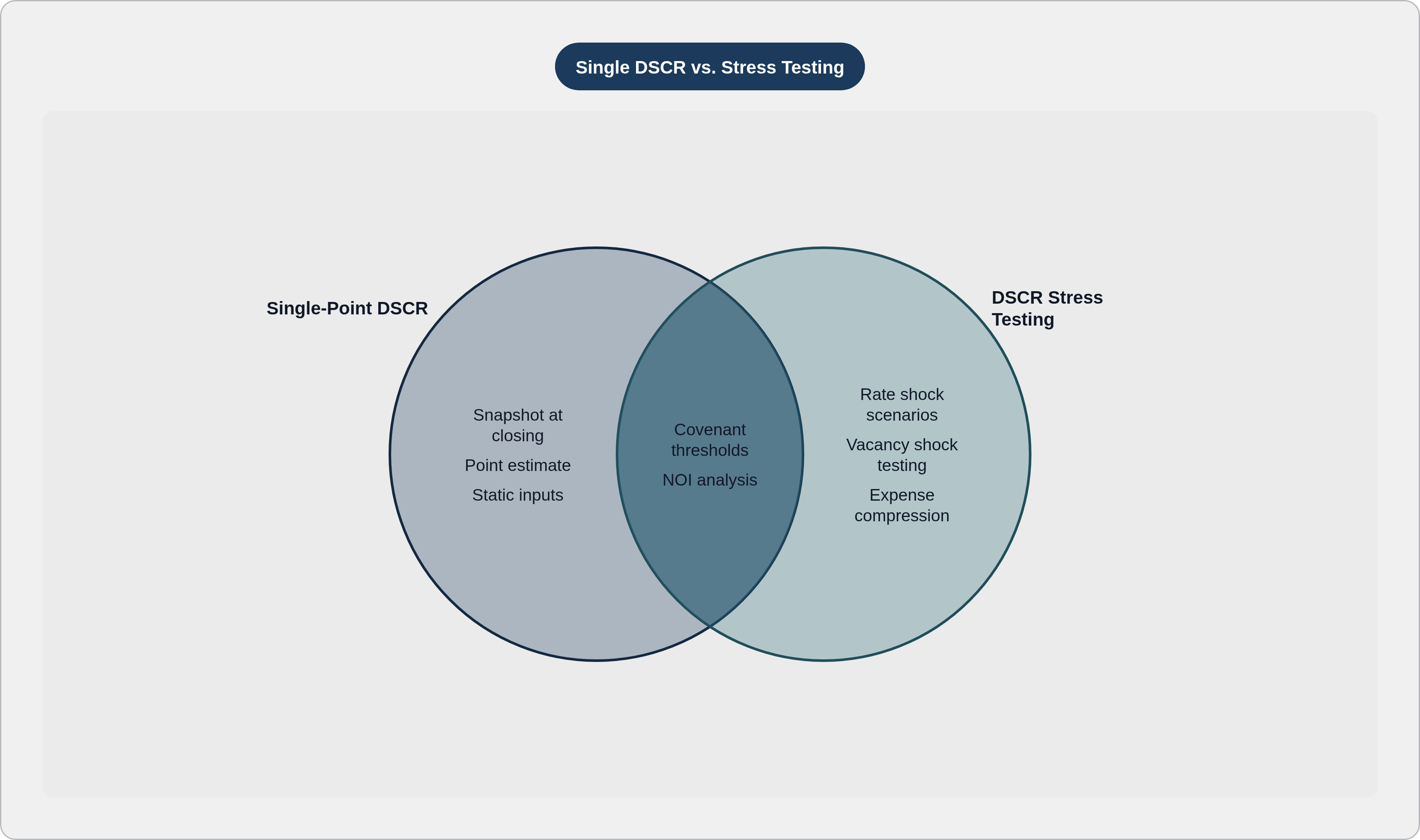
The three scenario families that constitute a complete DSCR stress test
Stress testing runs a structured set of scenarios, each one isolating a specific lever, and then combines them to find the actual breaking point, the place where coverage stops covering.
There are three families worth knowing by name, because each tests a different assumption buried in the original underwriting.
Rate shock scenarios ask what happens to debt service, and to refinancing math, if interest rates move against you. Vacancy and revenue shock scenarios ask what happens to NOI if occupancy falls or rents come in soft. Expense and NOI compression scenarios isolate the cost side entirely: taxes, insurance, capex, all the line items that can rise with no change in occupancy whatsoever. Run all three, then layer them together, and you get something close to a coverage surface: a map of how DSCR behaves across a reasonable range of futures rather than one photograph of a single future that may or may not arrive.
Institutional lenders use this framework for more than approve-or-decline decisions. It shapes covenant thresholds, tells them how big an operating reserve needs to be, and flags where the loan structure itself needs to change before closing, not after a workout call two years later.
There's also a calendar problem making all this more urgent than it would otherwise be. An estimated $1.5 to $1.7 trillion of U.S. commercial real estate debt was scheduled to mature between 2024 and 2026. A huge share of that debt was underwritten in a rate environment that no longer exists. Every one of those loans is facing a refinancing stress test whether the borrower wants one or not, so the market is running this exercise at scale right now, ready or not.
Rate shock testing: how rising or sustained high rates erode coverage and refinancing assumptions
Rate shock testing covers ground in a few different places, depending on how the loan is structured. For floating-rate debt, a 100 to 200 basis point move in the index hits debt service immediately, no lag, no grace period. For fixed-rate loans approaching maturity, the shock shows up at refinancing: NOI can stay flat and the deal still gets squeezed because the new loan carries a different coupon than the old one. There's a third angle worth testing too, and it's the one people forget: what if the refi window itself slides a year or two later than planned? Markets close sometimes. Modeling only the on-time exit is optimism dressed up as analysis.
Building the test is mechanically simple, even if the implications aren't. Hold NOI constant, vary the rate assumption across a band that brackets where the market actually sits, and calculate DSCR at each point along that band. Find the rate where coverage drops below the covenant floor. Then ask the harder question: given where forward curves sit today, how likely is that rate environment, really?
Circle back to that 6.8% average coupon figure from KBRA. Loans originated at that level are already carrying compressed coverage relative to the 4.3% historical baseline; stack a further rate shock on top, whether through a floating-rate reset or a refinancing event, and the compounding happens fast. S&P Global Market Intelligence data shows U.S. CRE debt maturities rising roughly 18.8% in 2026 compared to 2025. This has moved past hypothetical stress case territory. It's the maturity schedule.
When the rate stress scenario shows coverage dropping below covenant at a rate increase that's well within recent memory, lenders typically respond with a bigger operating reserve requirement, a rate cap covenant, or both. The most common underwriting mistake worth flagging here: assuming the exit rate at hold-period end equals today's rate. Rate shock testing exists specifically to break that assumption, forcing a look at refi economics across a range rather than at the single most flattering point on the curve.
Vacancy and revenue shock testing: finding the occupancy level where cash flow stops covering debt
The core mechanics here are straightforward. Hold expenses and debt service steady, walk occupancy down in increments, and find the point where DSCR crosses below the covenant. That point is the break-even occupancy, and it tells you, in one number, exactly how much vacancy cushion the deal actually carries.
Asset type changes how you should build this test, and treating every property type the same way is where a lot of stress models go wrong. Office needs vacancy assumptions that would have looked absurd five years ago; that 12.34% CMBS delinquency figure reflects, in large part, pro forma vacancy assumptions that simply didn't survive contact with a changed demand picture. Multifamily needs occupancy decline and rent-per-unit compression tested separately, because concessions can prop up a reported occupancy number while effective revenue quietly falls underneath it. Retail needs anchor tenant departure modeled on its own; lose one anchor and the vacancy profile can shift in a way that's nowhere close to linear. Hospitality needs a RevPAR floor tested directly, because revenue per available room can move faster than occupancy itself, and an occupancy-only stress test will miss that entirely.
The record backs up why this matters. A substantial share of GSE multifamily balances now sit below 1.4× DSCR, in a range where vacancy assumptions baked into original underwriting simply didn't hold up against the post-2022 operating environment.
Vacancy stress also needs to touch the rent roll directly. If a meaningful share of leases expire inside the stress horizon, model re-leasing at current market rents, not the contractual rents sitting in the existing lease. In markets where effective rents have slipped below in-place rents, using contractual figures amounts to underwriting a fiction. The 30-day delinquency rate for DSCR loans rose measurably in the third quarter of 2024, a reminder that plenty of loans clear an initial coverage screen and still can't absorb ordinary occupancy swings.
The practical output of all this is a covenant-setting input, not just an academic exercise. If a deal breaks at 82% occupancy and the submarket has been trading between 85% and 90% for the past several cycles, there's cushion there, but it's thinner than the headline DSCR would suggest, and that's usually the signal to attach a DSCR maintenance covenant rather than relying on a one-time test at closing.
NOI compression testing: isolating the expense side and modeling combined shocks
NOI compression doesn't need a single empty unit to happen. Property taxes get reassessed after a sale, insurance premiums spike in a coastal market, deferred maintenance finally comes due, or capex shows up two years earlier than the budget assumed. Occupancy can hold at 95% the entire time and NOI still shrinks.
Building an expense shock test means picking a range grounded in actual submarket expense trends, not a round number pulled out of thin air. It means modeling tax reassessment explicitly wherever a sale or a jurisdictional trigger makes reassessment likely. And it means treating insurance as its own line item worth stressing on its own terms; insurance costs have climbed sharply in coastal and wildfire-exposed markets, to the point where it's no longer safe to treat that number as stable year over year in a pro forma.
This is where the fixed-cost amplification effect from earlier in this piece shows up most clearly. Debt service is fixed. A meaningful chunk of operating expenses is fixed too. So when revenue softens even a little, those fixed costs eat a bigger share of what's left, and coverage erodes faster than a simple percentage decline would lead you to expect.
The most honest version of this test doesn't isolate one variable at a time; it runs vacancy compression, expense inflation, and rate pressure all at once, because that's how a real downturn actually behaves. Nobody gets the courtesy of one problem showing up before the next one starts. A workable build looks like this: drop vacancy to the break-even level identified in the occupancy test, layer in the expense increase, and if the loan is floating-rate or close to maturity, apply the rate shock on top of both. The output is a correlated-stress scenario grounded in how cycles actually unfold, more useful than a manufactured worst case designed simply to scare a credit committee.
Here's the part single-variable tests can't show you: because the inputs are correlated, the combined DSCR often comes in meaningfully lower than the sum of the individual stresses would suggest. A multifamily asset that comfortably clears 1.25× on a rate-only test, and clears it again on a vacancy-only test, can slip below 1.0× when both hit at the same time. That's exactly the situation the worked example in the final section walks through.
How covenant structures should reflect stress test findings rather than precede them
A covenant that gets set before the stress test runs is really just a guess wearing a suit. If the threshold wasn't drawn with knowledge of where coverage actually breaks, the monitoring program built around it will catch problems late, basically every time.
DSCR maintenance covenants should sit above the base-case ratio by a margin that reflects the deal's actual sensitivity to its worst-case scenario, not a generic industry rule of thumb. A deal where coverage falls off a cliff after a small occupancy dip needs a higher floor and more frequent testing. A deal that's more exposed to rate movement might need a rate cap covenant sitting alongside the DSCR floor, doing a different job.
Cash trap and cash sweep triggers add another layer. Plenty of loan agreements set a second threshold, lower than the covenant floor, where cash flow gets trapped rather than distributed to the borrower. The stress test should identify the gap between that cash trap level and an actual covenant breach, because that gap is the lender's intervention window, the space where a problem can still be managed before it becomes a default conversation.
Reserve sizing follows straight from the stress output. If a rate or vacancy scenario shows coverage dipping below covenant, that finding should set the operating reserve requirement directly: big enough to carry debt service through however long the expected recovery period runs.
There's a trajectory question that matters more than any single reading. A DSCR of 1.30× against a 1.25× covenant, read once in isolation, tells you almost nothing. Three consecutive quarters sliding from 1.45× to 1.32× to 1.28× tells you a breach is already in motion, well before it technically happens. Covenant monitoring built around point-in-time compliance checks misses this completely; it needs to track the trend.
Regulators have started saying this out loud too. The revised interagency guidance issued in April 2026, through SR 26-2 and OCC Bulletin 2026-13, reinforces the expectation that lenders keep covenant monitoring active and current, rather than dependent on borrower-reported updates every quarter. A 2025 Federal Reserve working paper backs this up with data: banks that lean on borrower-reported figures for risk ratings update those ratings more slowly as the information goes stale, and borrowers with stale financials default more often. The lag isn't an accident of process. It's structural, built into how the monitoring gets done, and fixing it means changing the monitoring rather than simply working harder within the old system.
A worked example: tracking DSCR through combined stress on a multifamily asset
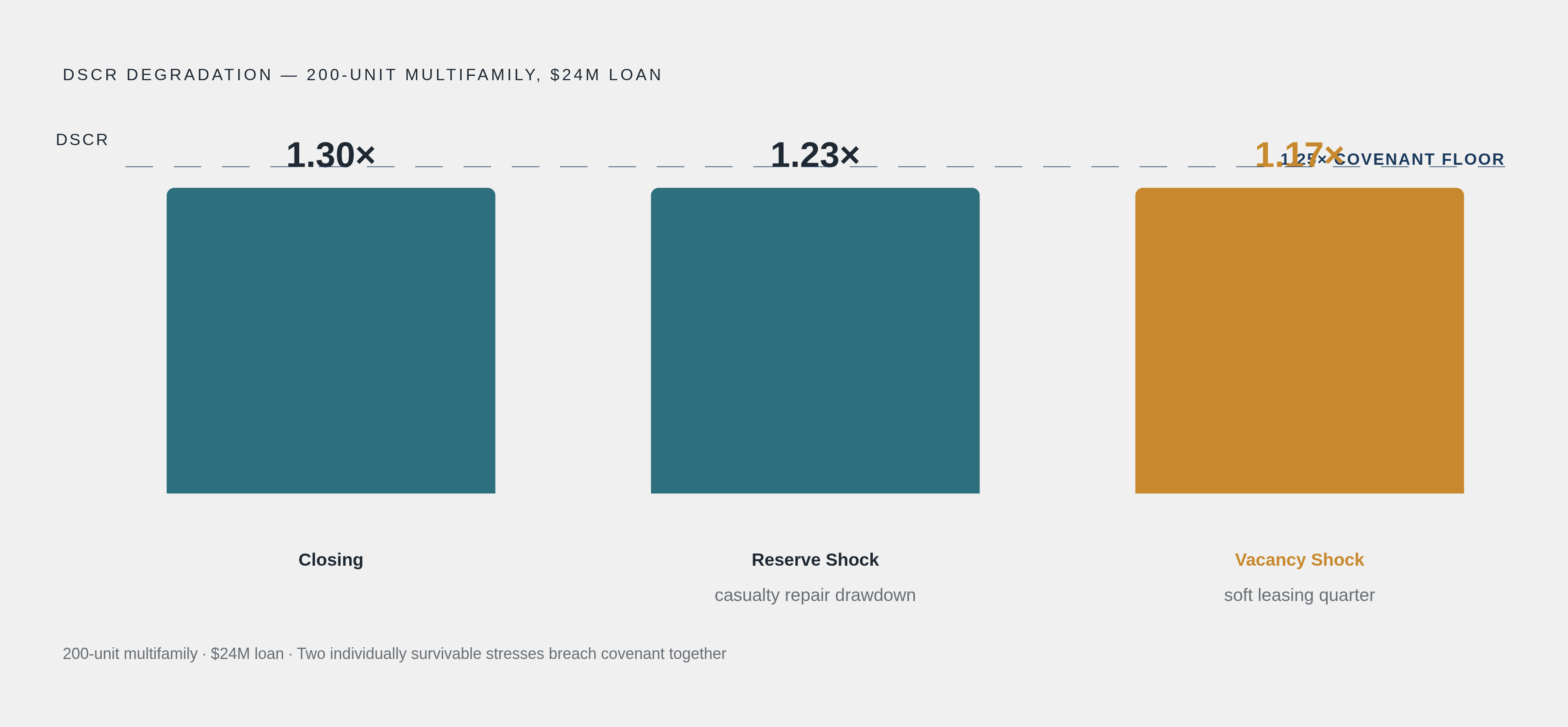
Take a 200-unit multifamily property carrying a $24 million loan with a 1.25× DSCR covenant. At closing, NOI runs well above annual debt service, putting DSCR at 1.30×. That clears the covenant with room to spare. Looks fine. Nobody's worried.
Then the stress events show up, and true to form, they don't wait their turn.
A casualty repair draws down the reserve account faster than budgeted. In the same stretch, a soft leasing quarter knocks occupancy down and effective revenue with it. Trailing NOI slides noticeably, a drop that doesn't sound dramatic on its own until you run it through the debt service math. DSCR falls from 1.30× to 1.17×. That's a covenant breach, and it happened without a single dramatic headline event, just two ordinary problems arriving close together.
This is exactly the scenario combined stress testing is built to catch ahead of time. A monitoring setup tracking trailing NOI and the DSCR trajectory month over month would have flagged the trend roughly two months before the formal test date, back when DSCR was still sitting comfortably above the covenant floor and the leasing softness hadn't fully worked its way into the trailing twelve-month number yet. That gap between first warning sign and covenant breach is the entire value of stress testing done right. Nobody can predict the future with precision. What stress testing offers instead is enough lead time to act before the number on the covenant report forces the conversation for you.