AI Adoption Stages in CRE Lending
Lenders face a capacity crunch that only AI at scale can solve, but most remain stuck in pilots.

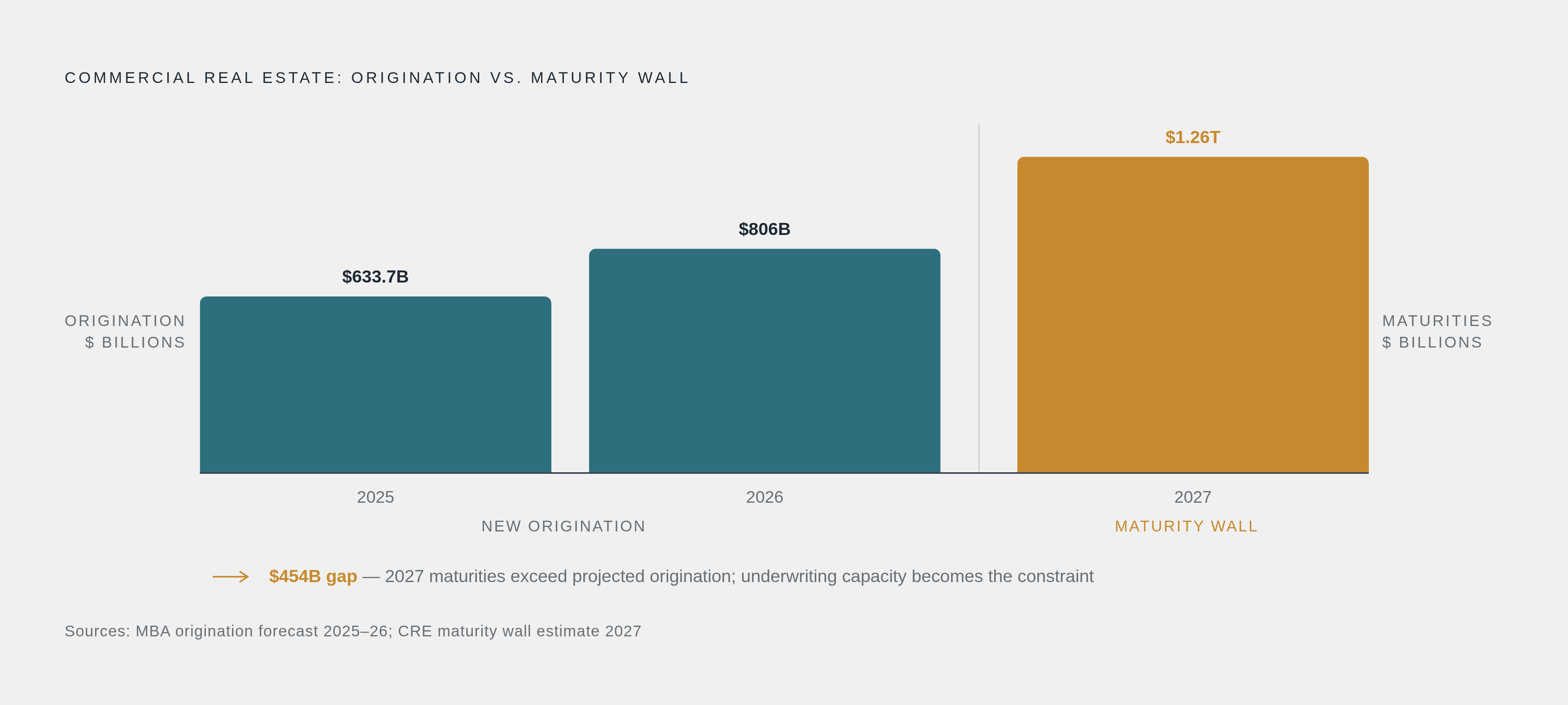
The numbers aren't subtle. The Mortgage Bankers Association projects $806 billion in commercial mortgage origination in 2026, up from $633.7 billion in 2025. S&P Global estimates the CRE maturity wall peaks at $1.26 trillion in 2027. Put those two figures side by side and you get a market accelerating on the front end while compressing on the back end, with refinancing pressure shortening deal timelines at exactly the moment deal volume is climbing.
The uncomfortable implication: underwriting capacity is now a direct constraint on revenue. Firms that can process more deals per analyst hour will capture disproportionate market share. Firms that can't will leave volume on the table, not because they lack origination appetite, but because they run out of analyst bandwidth before they run out of opportunities.
That is the actual context for evaluating AI adoption in CRE lending. Not as an innovation agenda. Not as a technology modernization initiative. As a capacity and risk-management response to a specific market moment with a known timeline.
So here is the most clarifying data point available: JLL's 2025 Global Real Estate Technology Survey found 88% of real estate investors and owners are piloting AI. Only 5% said they have achieved all their AI program goals. This is not a story about early adoption; it is a story about something breaking down between experimentation and production, and the industry has been conspicuously reluctant to diagnose it plainly.
The pattern holds across adjacent research. McKinsey's July 2025 survey of North American banks found only 12% have deployed any generative AI use cases, despite 78% of organizations globally using AI in at least one function. Eighty-nine percent of financial institutions identify AI as critical to the lending lifecycle in 2026, yet commercial lending still runs heavily on manual input, spreadsheet-based covenant tracking, and hand-assembled credit memos. One explanation is that the industry is simply early in its maturation arc, and the gap will close naturally as tools improve. But that explanation loses credibility when the same pattern persists across multiple survey cycles. The gap between piloting and scaling is not a technology problem. It is a structural one, rooted in data fragmentation, governance deficits, and a specific sequence of prerequisites a lender must satisfy before the next capability becomes accessible.
How to read the four-stage progression and what movement between stages actually requires
The four-stage progression, from Exploration and Piloting through Process Automation and AI-Augmented Underwriting to Agentic and Continuous Intelligence, is not a ranking of ambition. It describes what AI is actually doing in production workflows, as opposed to what a firm has purchased, piloted, or announced at an industry conference.
That distinction matters considerably more than most firms acknowledge. A lender can have a sophisticated AI vendor relationship and still be at Stage 1 if the tool has never touched a live deal workflow. A lender can be at Stage 3 for document processing and Stage 1 for portfolio monitoring simultaneously, which is, in fact, the most common configuration among mid-market institutional lenders right now. The stages describe capability areas, not firm-level maturity as a single dimension.
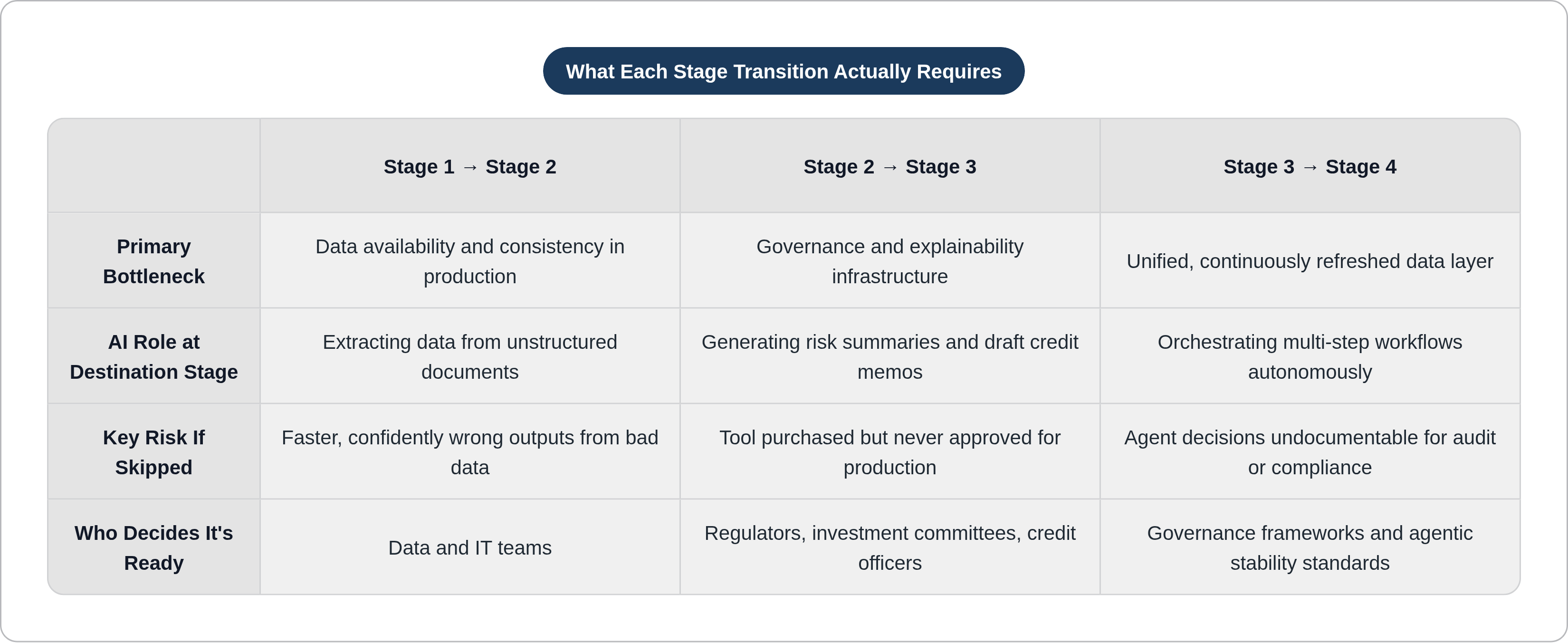
Movement between stages is not automatic. Each transition requires resolving a specific bottleneck, and two appear at nearly every transition: data quality and availability in production systems, and governance infrastructure sufficient to satisfy regulators, investment committees, and credit officers. Build those capabilities and the next stage becomes accessible. Skip them and the tools purchased for the next stage will either fail in production or never receive approval for use.
It is also worth considering how asset class shapes the picture. The 2025 Keyway State of AI Adoption survey found student housing leads in enterprise-wide AI deployment, while multifamily, the largest asset class by volume, shows the lowest rate of enterprise-wide adoption despite high levels of experimentation. Multifamily's operational complexity, combined with sheer scale, makes data fragmentation harder to resolve, which keeps more firms at Stage 1 longer. That should inform how a lender sequences investment, because sequencing is, in the end, most of the strategy.
Stage 1 — Piloting: what it looks like and why most pilots don't advance
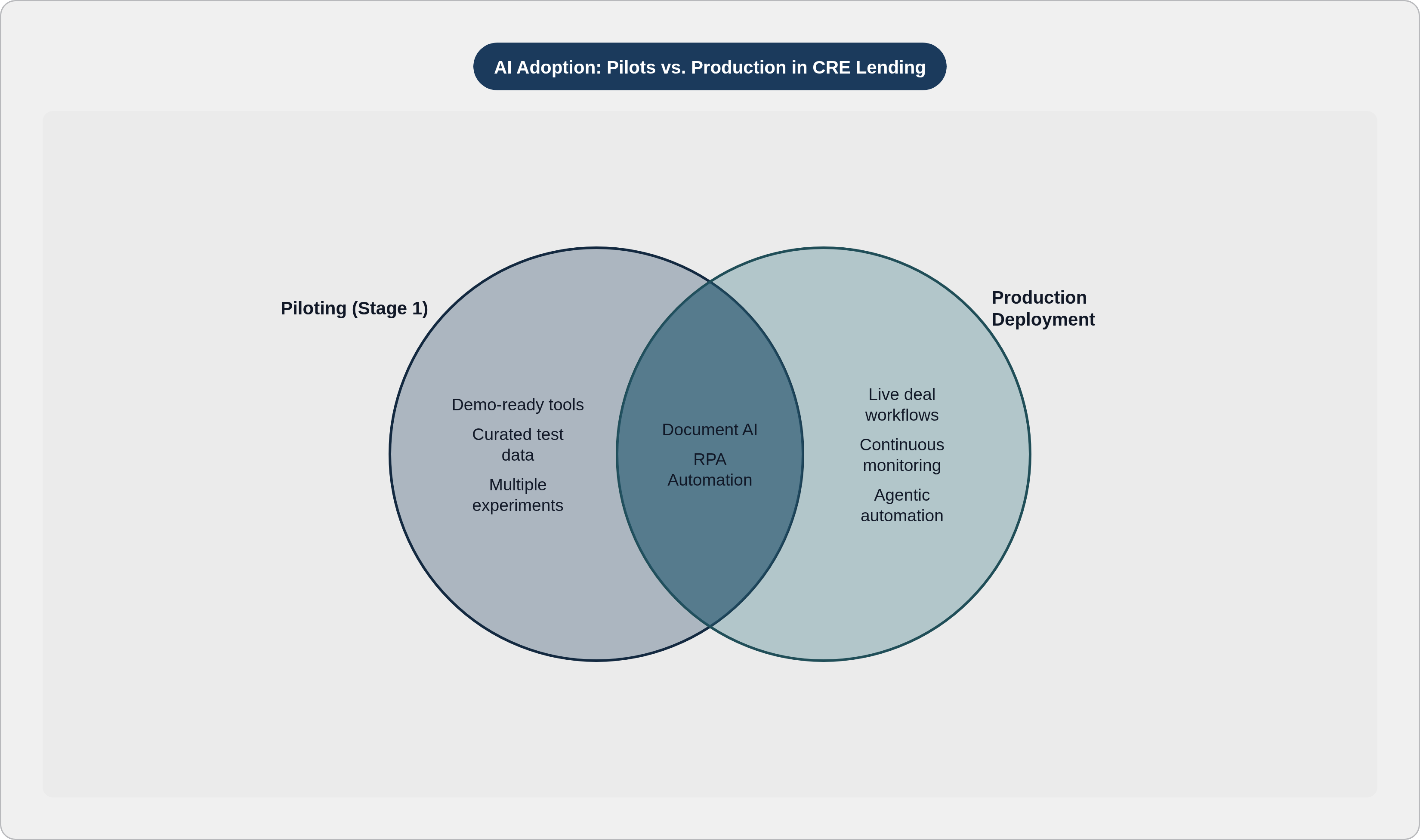
A Stage 1 lender looks, from the outside, like an AI-forward organization. Tools have been purchased. Pilots are running. Analysts are experimenting with prompts they found on LinkedIn. In the 2025 Keyway survey, nearly half of firms were in exactly this condition: running AI pilots without enterprise-wide deployment.
The same survey found firms average five AI use cases in experimentation simultaneously. That number is more damning than it sounds. Scattering effort across five disconnected pilots typically means none of them reaches the data volume or workflow integration required to demonstrate reliable production results. Each pilot succeeds in its controlled environment, then quietly fails to replicate at scale, for reasons that are entirely predictable once you understand the mechanism.
Why does this happen so consistently? Pilots use clean, curated data. Production environments don't. Deloitte's 2026 Commercial Real Estate Outlook found more than 60% of CRE finance organizations cite data fragmentation and manual reconciliation as their primary barriers to operational efficiency. Those conditions exist in the production environment every pilot eventually has to enter. The pilot never encountered them. The AI wasn't trained on them, the workflows weren't designed around them, and the governance approvals weren't obtained for them.
The question firms ask at Stage 1 is usually "Does this tool work?" rather than "Does this tool work on our actual data, in our actual systems, under our actual compliance requirements?" The former question gets answered in a demo. The latter requires solving the data infrastructure problem first, which is less exciting than the demo and considerably more expensive. Vendors, understandably, prefer to schedule demos.
The diagnostic question at Stage 1 is not about the tool at all. It is: Is the data this tool needs structured, accessible, and consistently formatted in production systems? If the answer is no, that problem must be solved before moving forward. A better AI model will not fix fragmented data; it will produce faster, more confidently wrong outputs from it.
Stage 2 — Process automation: document AI and RPA as the first durable foothold
Rule-based automation has existed in mortgage lending since the 1990s. What changed with modern document AI is the ability to handle the unstructured, format-variable documents that define CRE: rent rolls, trailing twelve-month operating statements, lease abstracts, offering memoranda. These documents arrive in dozens of formats from hundreds of sources, and until recently, extracting financial data from them was almost entirely a manual exercise performed by people with graduate degrees and the typing speed of administrative assistants.
This is the stage where high-paid analysts have historically spent the most hours on the least value-added work. Retyping numbers from a rent roll into Excel is not what someone with a finance degree is being compensated to do. It is, however, what the workflow required. That friction is expensive and scales badly as deal volume increases.
RPA adoption among mortgage lenders reached 48% in 2024, up from 30% in 2020, according to Stratmor Group's 2025 survey. Lenders deploying AI-powered document processing report 40 to 60% reductions in analyst time per deal, not as projections but as documented production outcomes.
But why does Stage 2 hold where Stage 1 doesn't? Three reasons, and they are worth naming precisely. First, it is narrow enough to succeed with imperfect underlying data, because extracting numbers from documents makes fewer demands on data infrastructure than drawing inferences across datasets. Second, it does not require model explainability to regulators, because a human analyst is still making the credit decision with the extracted data. Third, it produces measurable time savings that justify continued investment without requiring organization-wide transformation to demonstrate value. Each of those reasons, notably, is an absence of a requirement rather than a new capability. Stage 2 works partly because it avoids the hard problems.
The ceiling is equally clear. Automating extraction doesn't automate judgment. A Stage 2 lender still has analysts building models, flagging risks, and writing credit memos by hand. The output of Stage 2 is better raw material for the same human process. That is valuable, and it is not Stage 3.
Stage 3 — AI-augmented underwriting: where the analysis itself changes
At Stage 3, the AI isn't just extracting data. It's working on it. Large language models and machine learning models operate on extracted financial data to generate risk summaries, flag anomalies, model scenarios, and draft credit memos. The analyst reviews, challenges, and approves rather than builds from scratch. The cognitive labor shifts from construction to evaluation, which sounds like a subtle distinction until you realize it determines how many deals one analyst can actually process in a week.
The performance data here is difficult to dismiss. Research published in Management Science in 2024 found automated underwriting produces up to 10.2% higher loan profits and 6.8% lower default rates than manual underwriting, primarily through better deal selection and earlier risk detection. Banks using AI underwriting report 50 to 75% reductions in time-to-decision for commercial loans. Commercial lenders using AI-powered underwriting software report the capacity to underwrite three to four times more deals with the same team.
That last figure connects directly to the market context. If $806 billion in origination volume is arriving in 2026 and the maturity wall peaks in 2027, a 3-to-4x capacity multiplier is not an efficiency story. It is a competitive positioning story, and the lenders who have built to Stage 3 before the volume arrives will have a structural advantage over those still working through Stage 1 pilots.
That raises an important question: if the performance outcomes are this concrete, why are so many lenders still at Stage 2? The answer is governance, and it is less glamorous than the AI itself. At Stage 3, AI outputs directly influence credit decisions. Regulators, investment committees, and credit officers need to understand how conclusions were reached, and explainability is not optional; it is a precondition for production deployment. Deloitte's 2025 Model Risk Management Survey found more than 53% of banks cite transparency and explainability as a primary hurdle at this stage.
Firms that haven't built model governance infrastructure before reaching Stage 3 stall at the threshold. They have the tool, but lack approval to use it on anything that matters. Fannie Mae and Freddie Mac have incorporated automated valuation into their underwriting protocols, a signal that the regulatory environment is moving toward accepting AI-assisted decisions when documentation and traceability standards are met. Those standards have to be built before the AI goes into production, not as an afterthought once the first examiner asks about it.
Stage 4 — Agentic AI: from deal-level assistance to continuous portfolio intelligence
Stage 4 is architecturally different from what precedes it. Earlier stages improve discrete workflows: document extraction, credit memo drafting, risk flagging on individual deals. Agentic AI orchestrates multi-step workflows autonomously, pulling data, running risk models, flagging anomalies, routing exceptions to humans, without manual handoffs at each step. It is the difference between a tool that answers questions and a system that knows which questions to ask, and knows to ask them at 2 a.m. on a Tuesday when no one is watching the portfolio.
In CRE lending, this means automated financial spreading with continuous refresh as new data arrives; real-time covenant monitoring against DSCR and LTV thresholds rather than once-a-quarter spreadsheet reviews; early-warning alerts when portfolio properties show NOI compression, rising vacancy, or deteriorating cap rate trends relative to the origination model; and predictive signals 30 to 90 days before a missed payment. Automated DSCR reporting has reduced compliance preparation time by 70 to 85% in documented implementations. AI-powered early warning systems have reduced non-performing loan formation by 12 to 25% across documented cases.
With $1.26 trillion in maturities approaching their 2027 peak, portfolio surveillance at this granularity carries direct balance-sheet implications. A lender who discovers a DSCR covenant breach in a quarterly spreadsheet review is already behind. A lender whose system flags NOI compression sixty days before a payment is due has options; the other lender has a problem.
Stage 4 requires capabilities that earlier stages don't: a unified, continuously refreshed data layer across origination, servicing, and market data; agentic frameworks stable enough for regulated production environments; and governance infrastructure that can document agent decisions for audit and compliance review. Autonomous agents that cannot explain their decisions are not deployable in regulated lending environments, regardless of their accuracy. Gartner placed agentic AI at the Peak of Inflated Expectations in 2026, with over 60% of organizations planning deployment within two years but only 17% having done so. The gap between intention and production at Stage 4 is, for now, even wider than at the stages below it.
The barriers that keep lenders from advancing stages, and what they actually are
Banks spent over $73 billion on AI in 2025, a 17% year-on-year increase, yet only 25% of institutions have woven AI into their strategic operations. If spending were the bottleneck, the gap wouldn't exist. It does, which means the barriers are something else entirely, and the industry would benefit from naming them more precisely than "we're still learning."
Data fragmentation is the structural root cause. More than 90% of banking data users report that the data they need is often unavailable or takes too long to retrieve, per Deloitte's 2024 Banking and Capital Markets Data and Analytics Survey, with 81% citing data quality as a top challenge. Layering AI on fragmented data doesn't resolve the fragmentation. It automates around it, which is different, and eventually a more expensive version of the same problem.
Governance deficits compound it. Forty-six percent of banks cite unresolved AI risks as a deployment barrier. The approval frameworks, model documentation, and audit trails that regulators and investment committees require are often built after the AI goes into production rather than before. That sequencing is almost always fatal to the deployment, and it is the kind of mistake you only make once before you start building governance first.
Trust is a gating condition that often goes unacknowledged in vendor conversations. Investment committees and credit officers have spent careers making multi-million-dollar decisions based on human-sourced analysis. Delegating preparatory work to an AI system requires demonstrated accuracy and consistency across enough production decisions to build institutional confidence. A persuasive demo does not shorten that process.
Legacy system architecture compounds all of the above. RPA and workflow tools layered on top of legacy origination systems delivered incremental gains without addressing the structural fragmentation underneath.
And then there is a risk worth naming explicitly because it often gets omitted from AI adoption conversations: AI-generated fraud. Tools can now fabricate a complete, internally consistent loan package, trailing 12-month operating statements, rent rolls, leases, borrower financials, using widely available generation capabilities. The FBI logged over 12,000 real estate fraud complaints in 2025, with losses topping $275 million. A lender deploying AI in underwriting without also upgrading document authentication is solving one problem while creating a different one, and it is not obvious which one is more expensive until it's too late.
How a lender uses the stage map to determine what the next step actually requires
The diagnostic question is not "which AI tools do we have?" It is: What is the AI we have deployed actually doing in production, and where does it hand off back to manual work? That question, asked without flattering the answer, reveals more about a firm's actual position than any vendor assessment or capability survey.
Each stage transition has a characteristic bottleneck. Pilot to Stage 2 requires data availability and consistency in production systems. Stage 2 to Stage 3 requires governance and explainability infrastructure sufficient for credit-influencing outputs. Stage 3 to Stage 4 requires a unified, continuously refreshed data layer and agentic frameworks stable enough for regulated environments. None of those bottlenecks are fundamentally about the AI tool itself.
A lender who maps their current capabilities to specific workflow areas, rather than treating "AI adoption" as a single enterprise-level program, can identify which bottleneck they are actually facing. That is a tractable problem. Buying a more sophisticated AI tool to solve an unresolved data quality problem is not; it is just a more expensive way to produce the same wrong outputs, with better branding.
The lenders gaining durable advantage are not those who piloted the most tools or issued the most press releases about their AI strategy. They are those who resolved the data and governance constraints that prevented production deployment, then advanced stage by stage from there. The sequence isn't incidental to the strategy. For most firms, it is the strategy.