Natural Language Processing for Lease Abstraction

There is something quietly absurd about the fact that one of the most consequential analytical tasks in commercial real estate (the one that determines whether a cash flow projection is defensible, whether a covenant is being tracked, whether an acquisition is priced correctly) is still, in many shops, performed by a person manually reading a fifty-page legal document and typing what they find into a spreadsheet. It is, in a sense, like using a sundial to time a rocket launch — the instrument and the problem belong to different eras. Not because technology hasn't arrived. Because the industry hasn't fully decided what to do with it.
That is changing. Natural language processing has matured to the point where lease abstraction, once a labor-intensive bottleneck requiring trained paralegals and significant calendar time, can be executed in minutes with accuracy that meets or exceeds manual review on standard document types. Understanding how that works, and why it matters beyond the surface-level efficiency pitch, is what separates practitioners who deploy these tools intelligently from those who either over-trust them or dismiss them without basis.
Lease abstraction, to orient the uninitiated, is the process of extracting structured, decision-critical data from dense legal documents into a usable summary format. What gets pulled: rent commencement and expiration dates, base rent and escalation schedules, common area maintenance obligations, renewal and termination options, assignment restrictions, use clauses, tenant improvement allowances. These are not administrative curiosities. They are the inputs that determine cash flow projections, covenant calculations, portfolio valuations, and acquisition pricing. Get them wrong, and everything downstream is wrong too.
The volume context matters here. Total U.S. commercial and multifamily mortgage borrowing reached $498 billion in 2024, up 16 percent from the prior year according to the Mortgage Bankers Association. That is a deal flow environment in which lease data must move fast and move accurately. A single portfolio of modest size can contain dozens to hundreds of leases, each a 30 to 50 page legal document with amendments. The math is not forgiving.
The real cost of doing this by hand
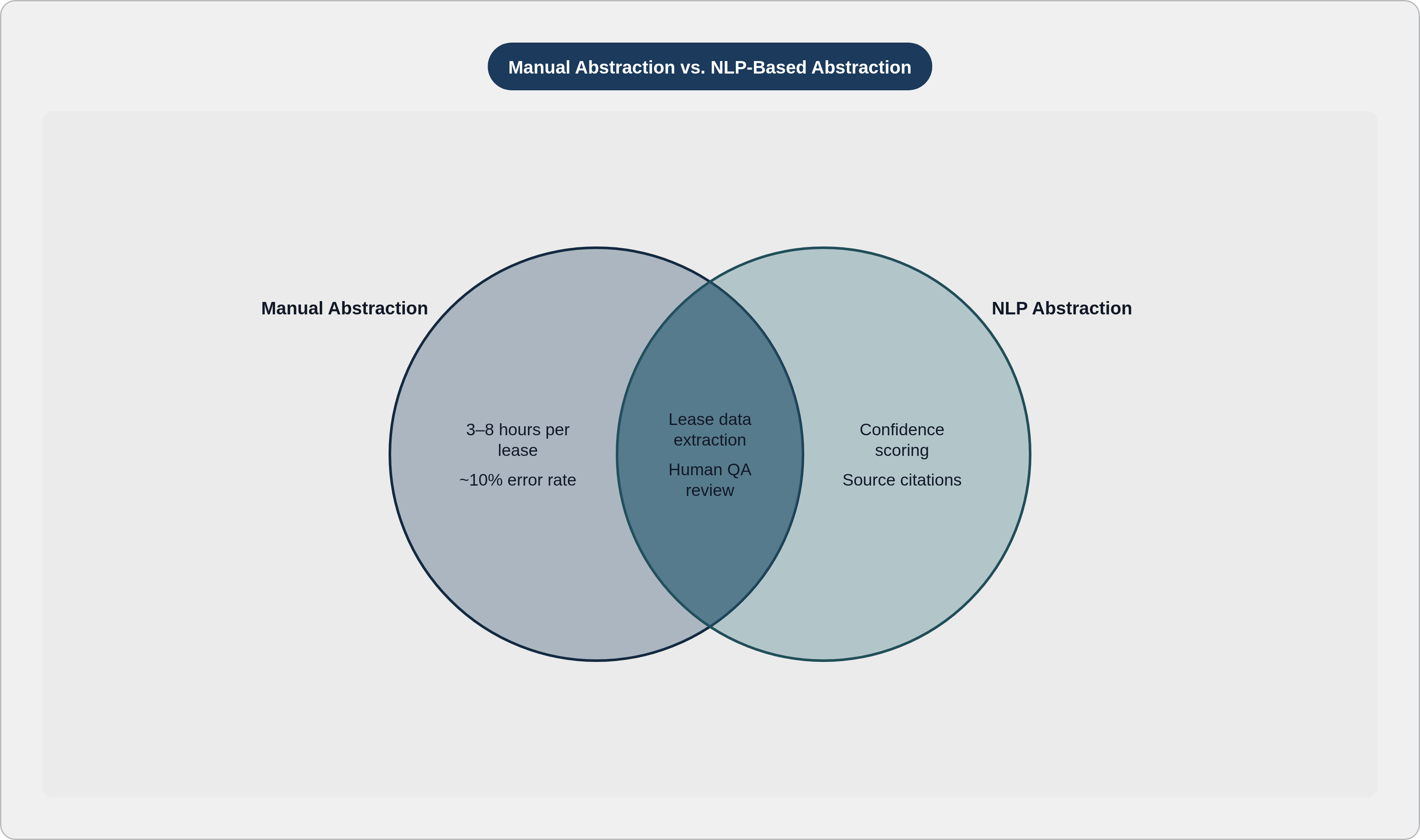
An experienced abstractor typically spends three to eight hours per lease on a standard commercial document. Apply that to a 100-lease acquisition portfolio at even the conservative end of that range, and you have consumed roughly 400 analyst-hours, approximately ten full working weeks of one dedicated reviewer. At outsourced rates, which run somewhere between $200 and $600 per lease depending on complexity and vendor, the cost compounds quickly, and that figure typically excludes the internal QA pass that variable-quality outsourcing almost always requires.
The accuracy picture is worse than most practitioners want to admit. Manual abstraction processes produce material errors in roughly 10 percent of abstracts. Manual data entry error rates run one to four percent per field. A document with hundreds of extractable fields statistically contains multiple errors before anyone has acted on it. That is not a condemnation of the analysts doing the work; it is a structural property of cognitive labor applied to high-volume, high-density document review. Fatigue, inconsistency, and deadline pressure are not personal failures. They are predictable features of the task design.
The timeline problem compounds everything else. Acquisition due diligence windows have compressed to 30 to 45 days in competitive markets. Manual abstraction simply cannot keep pace on portfolios above a certain size without adding headcount in ways that create their own coordination overhead. And the errors don't stay in the abstraction layer. They travel downstream into rent rolls, debt service coverage ratio calculations, and covenant monitoring inputs. A missed renewal option, a misread rent escalation, or an untracked co-tenancy clause can cascade into mispriced assets, faulty DSCR inputs, or blown deal timelines.
That raises an important question: if human review at scale is structurally error-prone, what does a better-designed alternative actually look like?
How a machine reads a lease
To understand why NLP works well for this task, it helps to walk through what actually happens between ingesting a raw PDF and producing a structured data record. The sequence is more deliberate than most marketing materials suggest.
The first step is ingestion and optical character recognition. Raw PDFs and scanned documents are converted to machine-readable text. OCR handles degraded scans, handwritten annotations, and varied formatting, with varying degrees of success depending on document quality. This is worth noting because OCR performance is often the rate-limiting factor for poorly maintained document libraries, a point we will return to in the implementation section.
The second step is entity recognition. NLP models identify and categorize CRE-specific entities trained on actual lease structures, not generic legal text. This distinction matters considerably. The model is looking for property identifiers like legal descriptions and suite designations; temporal entities like commencement dates, expiration dates, and option exercise deadlines; financial terms including base rent, percentage rent, escalation formulas, and CAM charges; and rights and obligations including assignment provisions, subletting rights, use restrictions, and co-tenancy clauses.
The third step is where NLP parts ways with keyword search, and this is the intellectually interesting part. Contextual interpretation means the model reads meaning, not just pattern. Terms like "net," "base," and "minimum" describe different rent calculation methods depending on lease structure. A model trained on a large corpus of commercial lease documents learns to distinguish base rent clauses, percentage rent provisions, and rent abatement periods that appear in similar document positions but require entirely different extraction logic. The same words mean different things in different contexts, and the model has to know that. Models trained specifically on commercial lease documents achieve clause-type identification accuracy in the mid-90s across office, retail, industrial, and mixed-use formats in vendor benchmarks, which is a different performance profile than a general legal NLP model applied to the same task.
The fourth step addresses one of the more persistent practical headaches in real estate: amendment reconciliation. Leases don't stay static. They accumulate amendments, riders, and side letters that modify original provisions, sometimes multiple times over a ten-year lease term. Large language models can reason about how provisions interact across the base lease and subsequent amendments, producing a single effective data record rather than conflicting parallel entries. Anyone who has ever tried to manually reconcile a third amendment against a restated base lease knows exactly why this capability is valuable.
The fifth step is structuring and confidence scoring. Extracted data is mapped to standardized fields, and low-confidence items are flagged for human review before being written to the lease management system. The output is not a summary of text; it is normalized, structured data, directly usable in rent rolls, financial models, and covenant monitoring systems.
The clauses where accuracy actually matters
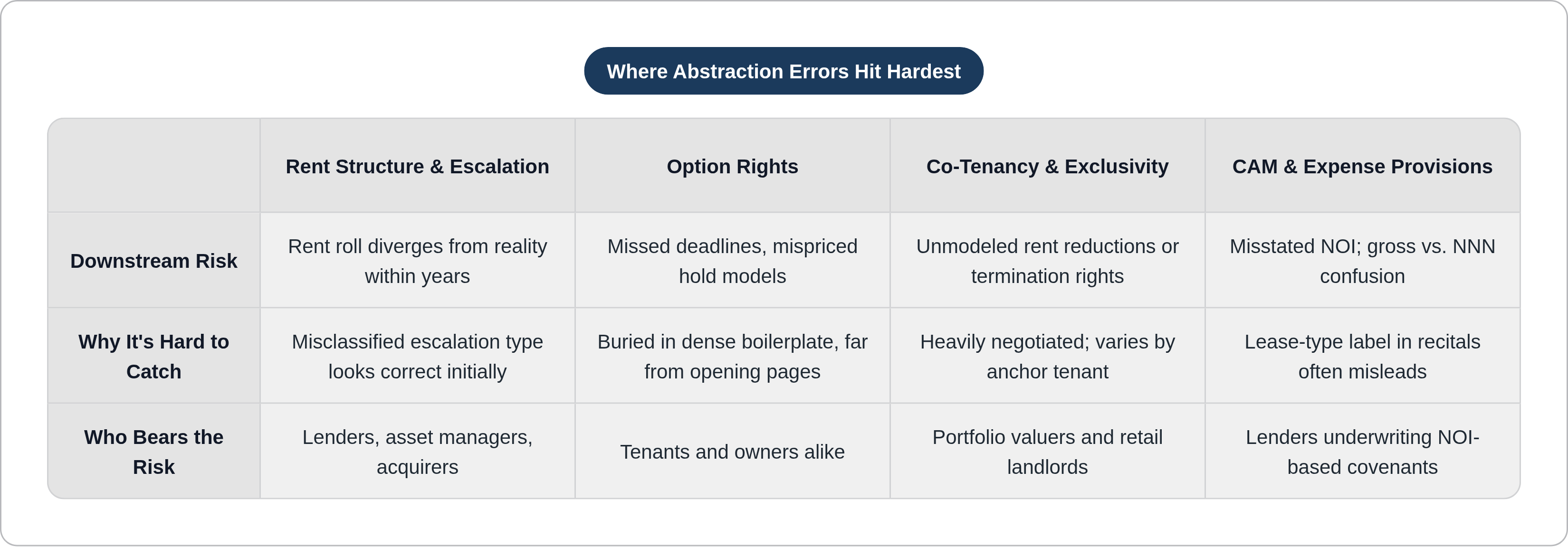
Not all extracted fields carry equal downstream risk. Some are important for completeness; others are the specific clauses whose misreading or omission can be genuinely costly. It is worth being direct about where the stakes are highest.
Rent structure and escalation is the obvious starting point. Base rent is rarely static. CPI adjustments, fixed step-ups, and percentage rent structures each require different extraction logic and different downstream modeling treatment. A model that correctly identifies the base rent figure but misclassifies a CPI escalation as a fixed step-up will produce a rent roll that diverges from reality within a few years. The error is invisible until it materializes.
Option rights, covering renewal, termination, and expansion, are time-sensitive and historically easy to miss in dense boilerplate. A missed renewal option exercise deadline can cost a tenant their space. For owners, missed options misrepresent occupancy assumptions in hold-period models. The option provision is rarely in the first few pages of the lease; it is buried in dense language alongside other administrative provisions, which is precisely where manual fatigue concentrates.
Co-tenancy and exclusivity clauses are common in retail leases and can trigger significant rent reductions or even termination rights if anchor tenants vacate. These provisions are material to portfolio valuation and risk modeling, and they are among the most heavily-negotiated clause types in retail real estate. A portfolio-level model that ignores co-tenancy exposure is not a portfolio-level model; it is an optimistic projection wearing one.
CAM and operating expense provisions determine the difference between a gross lease and a triple-net lease, which has significant net operating income implications. The label is not always reliable. The underlying expense allocation structure is what matters, and NLP must read that structure rather than rely on how a tenant's attorney characterized the lease type in the recitals.
Assignment and subletting restrictions matter to lenders, who need to understand whether collateral cash flows can be transferred, and to asset managers, who need to understand portfolio flexibility. Notice periods and default cure windows are operational triggers with legal consequences when missed. At portfolio scale, tracking these manually is structurally untenable.
The specific advantage NLP offers across all of these is consistency. Human abstractors are skilled but inconsistent, particularly across high-volume engagements where document fatigue is a real variable. NLP applies the same logic to the hundredth lease as it does to the first, and it flags the unusual or heavily-negotiated provisions that warrant closer human attention rather than passing them through silently.
What the numbers actually mean
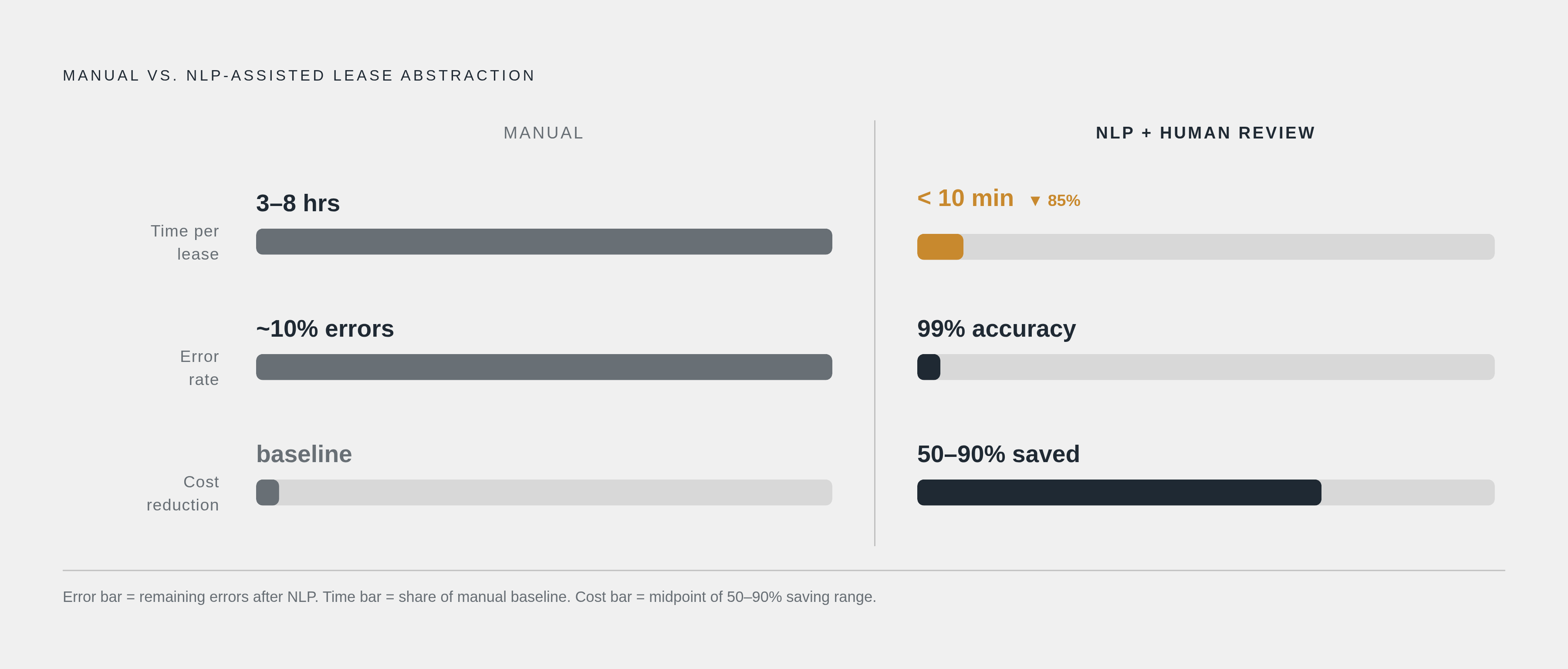
Speed benchmarks vary by vendor and document type, but real-world deployments have demonstrated per-lease review time reductions of around 85 percent, compressing what was a multi-hour task into a review cycle measured in minutes. Some platforms process a standard lease in under ten minutes.
The accuracy comparison deserves more careful treatment than it typically receives. A tool achieving accuracy above 95 percent on standard fields, measured against a baseline manual error rate of roughly 10 percent on abstracts and one to four percent per field on data entry, is not producing an incremental improvement. It is changing the risk profile of the abstracted data as an input to financial decisions. That distinction is not semantic.
But what does 95-plus percent accuracy actually mean in context? Modern tools hit this threshold reliably on standard fields: parties, dates, base rent, standard provisions. Accuracy is more variable for unusual or heavily-negotiated clauses, which is precisely why the best-practice deployment model does not use AI accuracy as a reason to eliminate human review. It uses AI accuracy as a mechanism for redirecting human attention. Analysts verify flagged items rather than re-reading every document. That is a fundamentally different use of analyst time.
One well-documented deployment involving a large commercial real estate firm onboarding a portfolio of more than 73 assets processed over 100,000 documents representing more than one billion square feet of commercial space. The human-in-the-loop approach achieved 99 percent accuracy at due diligence-compatible turnaround times. Those two numbers together (99 percent accuracy and due diligence-compatible speed) define the practical ceiling for what best-practice deployment looks like today.
Deployments have cut outsourced abstraction spend by 50 to 90 percent while improving consistency. That cost reduction does not mean the QA layer disappears. It funds the escalation workflow that handles edge cases, which is where the remaining error risk concentrates.
There is also an auditability point that tends to get underemphasized. AI extraction produces source citations and confidence scores, meaning every extracted data point can be traced back to the specific clause in the source document. Manual abstraction produces a summary with no traceable reasoning. When an abstract is contested in due diligence or litigation, that difference is not trivial.
From abstraction to portfolio risk: the downstream connection
It is also worth considering that the value of accurate lease abstraction does not terminate at the rent roll. The data flows further, into covenant monitoring, lender reporting, and portfolio risk assessment, and the quality of those downstream outputs is fully dependent on the quality of the abstracted inputs.
DSCR, LTV, and debt yield covenants are only as reliable as the rent roll inputs that underlie them. Rent rolls are only as current as the lease data that feeds them. If the rent roll underlying a DSCR calculation reflects a tenancy structure that has since changed (whether due to a major tenant departure, a rent abatement period, or an unreported lease modification) a lender acting on that signal will miss genuine deterioration or trigger a false covenant review.
The scale problem for lenders is significant. A mid-sized lender with a substantial commercial loan portfolio must track hundreds or thousands of covenant thresholds each quarter. Approximately 70 percent of banks still rely on spreadsheets and manual processes for covenant tracking, per available industry data. The same structural vulnerability that exists in lease abstraction exists one step downstream, in exactly the system where errors carry the most consequential implications.
What current, accurate lease data enables is early warning. Automated covenant monitoring systems can flag stress weeks before formal breach, but only if the underlying lease data is complete and current. One documented deployment involving a commercial real estate lender reduced covenant review time from more than 200 hours monthly to under 30 hours after implementing automated tracking. Early alerts from that system helped prevent two potential defaults, saving an estimated $1.2 million in projected write-downs. The abstraction accuracy was a precondition for that outcome.
The concept of the "living abstract" (an abstract that updates automatically as amendments are executed) transforms lease abstraction from a one-time extraction event into a continuous data feed. That framing redefines what the product is. It is not a report; it is infrastructure.
Why adoption stalls, despite all of the above
Given the accuracy and efficiency case, one would expect adoption to be further along. Per JLL's 2025 Global Real Estate Technology Survey of more than 1,500 senior decision-makers, 88 percent of investors, owners, and landlords had started piloting AI, up from roughly 5 percent in 2023. But only a small fraction report having achieved most of their AI goals. The gap between piloting and deploying at scale is where the implementation challenges live.
Document quality is the most underestimated constraint. OCR performance degrades on poor-quality scans, handwritten annotations, and non-standard formats. Teams that have not inventoried their document library before selecting a tool often discover partway through implementation that a meaningful portion of their documents require remediation before they can be processed reliably. Assessing document quality is not glamorous work, but it is determinative.
Non-standard clauses present a second structural challenge. Heavily-negotiated provisions, unusual lease structures, and portfolio-specific templates require either model fine-tuning or reliable human escalation workflows. A generic model applied without customization to a portfolio with distinctive lease templates will produce outputs that are accurate on standard provisions and unreliable on the specific clauses that actually differentiate that portfolio. That is a meaningful limitation.
Data destination is where many pilots stall definitionally. Abstracted data is only useful if it connects to the systems analysts actually use. Integration with lease management platforms, financial models, and covenant monitoring systems is the difference between a productivity tool and a workflow transformation. A tool that exports to a spreadsheet solves a different, and substantially smaller, problem than a platform that feeds directly into downstream systems.
The implementation pattern that works is incremental. Teams that start with high-volume, well-defined, lower-stakes extraction tasks typically see meaningful reductions in time-on-task within the first 60 days, building confidence before extending to more complex document types. That sequencing is not timidity; it is how you build institutional trust in a new data source.
Human-in-the-loop is the point I want to be explicit about, because it is frequently misunderstood. Confidence scoring and flagged review are not signs of AI limitation. They are the design mechanism by which 95 percent accuracy becomes 99 percent accuracy at scale. The goal was never to eliminate human judgment; it was to concentrate it on the items that require it. The best AI tools don't replace the expert in the room — they just make sure the expert is looking at the right page.
Evaluating the tools: what to actually ask
The evaluation questions that matter most are not the ones vendors volunteer.
CRE-specific training is foundational. Models trained on general legal documents perform differently than models trained on millions of commercial lease documents. Ask vendors about their training corpus, the lease types represented, and their accuracy benchmarks by document type. "We use NLP" is not an answer; it is an abstraction. The relevant question is what the model was trained on.
Clause coverage depth separates commodity extraction from genuinely useful tooling. Can the tool extract not just standard fields but the decision-critical provisions that matter for risk: co-tenancy, percentage rent, cure windows, assignment restrictions? Standard fields are table stakes. The unusual clauses are where abstraction errors have historically concentrated and where the financial exposure is highest.
Amendment handling is among the most revealing test cases for any tool. How does it reconcile the base lease against subsequent amendments? A tool that extracts from each document in isolation produces conflicting records. One that reasons across the full document set produces an effective-terms summary that is actually actionable. Ask vendors to demonstrate amendment reconciliation on a real document set, not a showcase example.
Confidence scoring and review workflow determine whether the system is honest about its limitations. What happens to low-confidence extractions? A well-designed system flags them for human review with source citations. A poorly-designed one passes them through silently, which is the worst of both worlds: you think you have accuracy and you don't.
Auditability and source citations matter for due diligence, audit, and dispute resolution. Can analysts trace every extracted data point back to the specific clause in the source document? If not, the tool has a limited shelf life in any institutional context where abstract accuracy is subject to scrutiny.
Integration with downstream systems is the evaluation criterion most often treated as an afterthought and most responsible for failed implementations. Where does the abstracted data go? The answer should be: wherever the analysts who act on it actually work.
Security and data handling are non-negotiable for institutional users. Commercial lease documents contain sensitive financial and operational information. SOC 2 certification, data isolation, and clear policies on whether client documents are used for model training are the minimum requirements. Ask explicitly.
Finally, the build-versus-buy question deserves honest treatment. Generic horizontal AI tools applied to lease abstraction without CRE-specific training are a different product than purpose-built platforms. They look similar in a demo environment with clean, standard documents. They diverge considerably when applied to real portfolios with their attendant complexity, amendment histories, and non-standard provisions. The evaluation criteria above are designed to surface that difference before the contract is signed.
The underlying thesis here is not that NLP eliminates the need for expert judgment in lease review. It is that the current design of manual abstraction processes is structurally incompatible with the volume, speed, and accuracy requirements of modern commercial real estate practice, and that NLP-based workflows, properly configured, resolve that incompatibility in ways that make the expert judgment already present in the organization meaningfully more valuable. That is a different claim, and it is worth holding the distinction carefully.