Generative AI for CRE Investment Memo Drafting
AI automates CRE memo research, freeing analysts for judgment calls.

There is a document that determines whether a commercial real estate deal gets done. Not the purchase and sale agreement, not the loan commitment, not the letter of intent. The investment committee memo. It is the formal decision artifact: recommendation, supporting evidence, deal terms, risk case, all synthesized into something a room full of skeptical people will read, challenge, and either approve or kill. Every upstream workflow feeds into it. And for most firms, producing it consumes one to two weeks of analyst time.
That baseline is what generative AI is beginning to restructure.
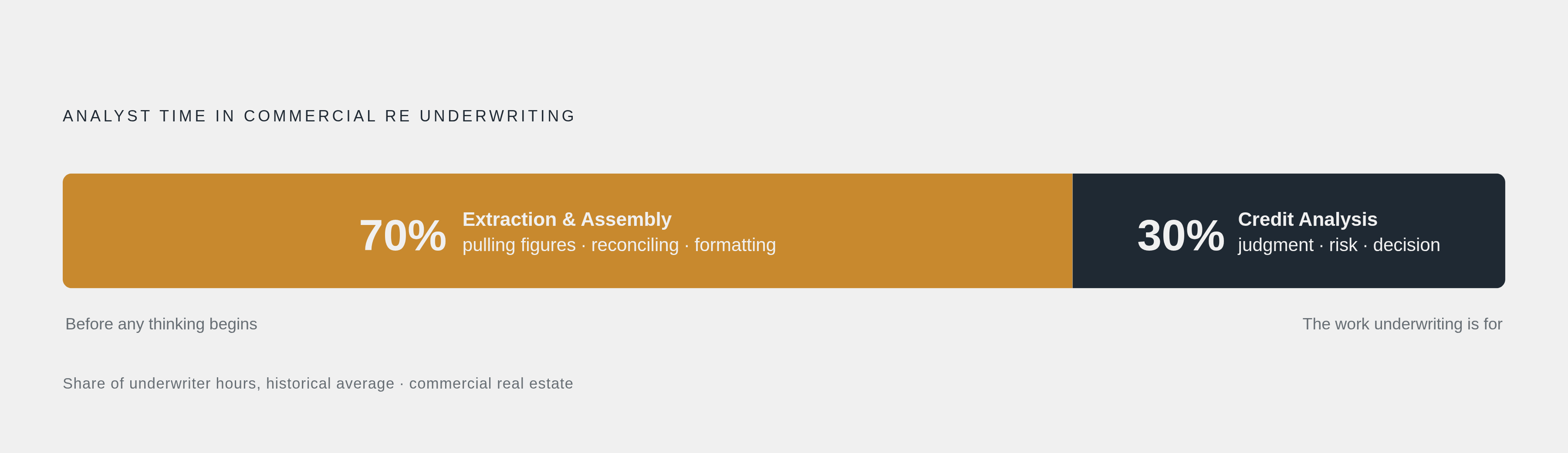
To understand where the time actually goes, consider what a memo contains: executive summary, market overview, property description, financial analysis, risk factors, comparable transactions, business plan, key terms. Each section draws on different source documents, frequently prepared by different parties, formatted inconsistently, delivered on unpredictable timelines. Before any writing begins, the analyst gathers all of it, extracts the relevant figures, reconciles the inconsistencies, and assembles a coherent narrative. Roughly 70% of commercial underwriting time has historically gone to that extraction layer rather than actual credit analysis. The analyst spends most of the week before the memo becoming the memo, rather than thinking about the deal.
Investment committees run on schedules. A memo that arrives late does not pause the committee; it misses the window, or forces a rushed read that compresses deliberation.
That pressure compounds at scale. Commercial mortgage origination is projected at roughly $806 billion in 2026, per MBA estimates. At that volume, underwriting throughput determines how many deals a team can compete for, not just how quickly they close the ones they win. A firm that produces a credible memo in three days instead of ten is not just faster; it is present in conversations where slower competitors simply are absent.
That raises an important question: if the efficiency case is this legible, why aren't more firms capturing it? JLL's 2025 global survey found that the overwhelming majority of commercial real estate teams have started piloting AI, but only a small fraction report having achieved most of their goals. The bottleneck is not adoption. It is scaling, and the distance between those two things is where the interesting problems actually live.
What scaling looks like in practice is instructive. Teams that begin with high-volume, low-stakes extraction tasks, pulling figures from rent rolls and trailing twelve-month operating statements rather than attempting full memo generation on day one, typically see time-on-task reductions of 30 to 50 percent within 60 days, according to Build.inc's 2026 findings. The firms that stall are usually the ones that tried to automate the judgment layer before they automated the assembly layer. That sequencing mistake is more common than it should be.
The memo is the pressure point precisely because it is the terminal output. Delays in market research, financial modeling, and due diligence all compound there. You cannot draft the financial summary if the spreading is not done. You cannot draft the risk section if the lease review is incomplete. The memo absorbs every upstream inefficiency and delivers it directly to the committee's calendar.
How AI Actually Ingests and Organizes the Raw Material a Memo Requires
One deal can produce hundreds of pages, sometimes more than a thousand, spanning multiple entities and multiple years. Rent rolls, trailing twelve-month operating statements, appraisals, sponsor financials, guarantor tax returns, third-party environmental and engineering reports, lease abstracts: the document layer a CRE memo draws on is voluminous, and no two deals format it the same way.
What AI does at ingestion is extract structured data from those unstructured documents. It pulls figures, dates, terms, and conditions rather than requiring an analyst to re-enter them manually. It tags and organizes extracted content against deal-specific categories. It flags missing documents or data gaps for analyst follow-up. The shift in analyst work is subtle but significant: instead of entering data, the analyst validates what the system surfaced. That is a fundamentally different cognitive task, and a considerably more defensible one.
Why does source citation matter here? Because a memo grounded in AI extraction is only trustworthy if every figure can be traced back to its source document. An AI that produces a confident net operating income figure with no citation is worse than no AI at all; it moves the analytical error downstream into the committee room, dressed up as a verified number. I have seen what happens when a committee member cannot source a figure mid-presentation. It is not a good room to be in.
The architectural reason this can work in a finance context is retrieval-augmented generation, or RAG. The system generates text grounded in the actual documents in the data room, not in general model knowledge. "Sounds plausible" is not a sufficient standard when the output is going to an investment committee. Plausible and accurate are not synonyms, and in credit analysis the gap between them is where losses originate.
What the AI-Assisted Drafting Step Produces and Where Human Judgment Takes Over
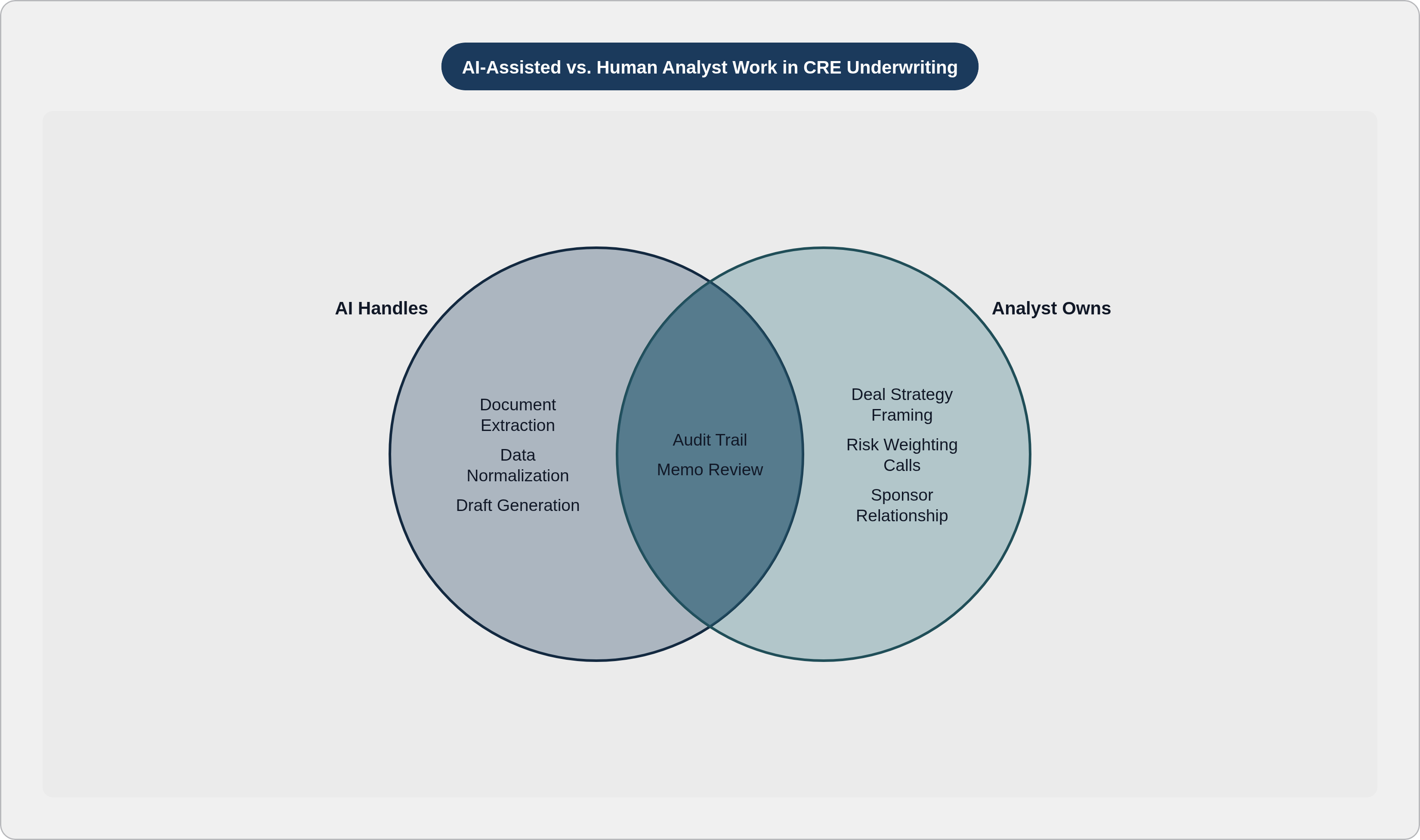
Given organized inputs, what does AI actually draft? Quite a bit. The market overview and submarket narrative, pulling from aggregated market research. The financial summary sections, drawn from spreading output. The comparable transaction analysis, assembled from prior deal data. Risk factor summaries, structured against the deal's specific characteristics.
Critically, the system drafts in the firm's own memo template and format, not a generic structure. The output lands closer to reviewable than to raw material. Visual citations on every fact and figure mean that committee members can trace any data point back to its source document, which changes how review works: from re-checking everything to spot-verifying the parts that warrant scrutiny.
But what does the analyst still own? Everything that actually moves investment decisions. The investment recommendation itself; AI does not advocate. The deal strategy framing: how this asset fits the portfolio thesis, what the sponsor relationship context is, what the negotiation posture should be. Judgment calls on risk weighting, specifically which risks are manageable and why. Any override of AI-flagged normalizations, a management fee below market, a nonrecurring item in the income statement, with the override preserved in the audit trail.
One illustration of what compression looks like in practice: an office building acquisition that would typically require roughly twelve hours of analyst time was completed in roughly three hours of review and refinement. The AI handled comp data, cash flow structure, and market narrative. The analyst handled deal strategy and client-specific judgment. BCG's research on AI-assisted professional work found that practitioners using AI assistance completed tasks faster and produced outputs rated meaningfully higher in quality compared to those working without it. The quality lift matters as much as the time savings when the output is going to a committee.
It is also worth considering what this implies about the analyst role itself. The work that remains is harder, not easier. There is nowhere to hide behind the rent roll anymore.
Financial Spreading as the Upstream Bottleneck That AI Eliminates First
Spreading is where most of the pre-memo time disappears. Parsing operating statements, tax returns, rent rolls, and guarantor financials. Normalizing recurring items from nonrecurring ones. Mapping every line to a standard template. The problem is not complexity; any trained analyst can do it. The problem is that no two borrowers format financials the same way, normalization requires judgment, and errors at this stage propagate through everything downstream.
Purpose-built AI applied to this workflow ingests the document types CRE lending requires, extracts every figure with a source citation, automatically checks the deal against credit policy, and generates a first-draft credit memo with examiner-grade audit trails. Lenders deploying AI-powered document processing report 40 to 60 percent reductions in analyst time per deal. Some implementations show time-to-decision compressing from multi-day baselines to 24 to 48 hours.
One benefit that rarely makes it into pitch decks is consistency. AI applies the same normalization logic to every deal. Management fees flagged against market benchmarks. Nonrecurring items separated. Policy reserves documented. The analyst-to-analyst variance that creates audit exposure, and occasionally generates credit losses, disappears. Financial institutions that have scaled AI underwriting report handling significantly more loan applications with the same staff, with documented throughput increases in the range of three to four times without proportional headcount growth.
One might argue that experienced analysts already apply consistent logic. That is true of experienced analysts on good days with adequate time. The entire premise of a deal clock is that adequate time is not always available. Anyone who has watched a good analyst burn a Sunday on a rent roll that arrived Friday afternoon already knows this. The consistency argument is not about competence; it is about conditions.
Why Generic AI Tools Underperform Purpose-Built Platforms in This Workflow
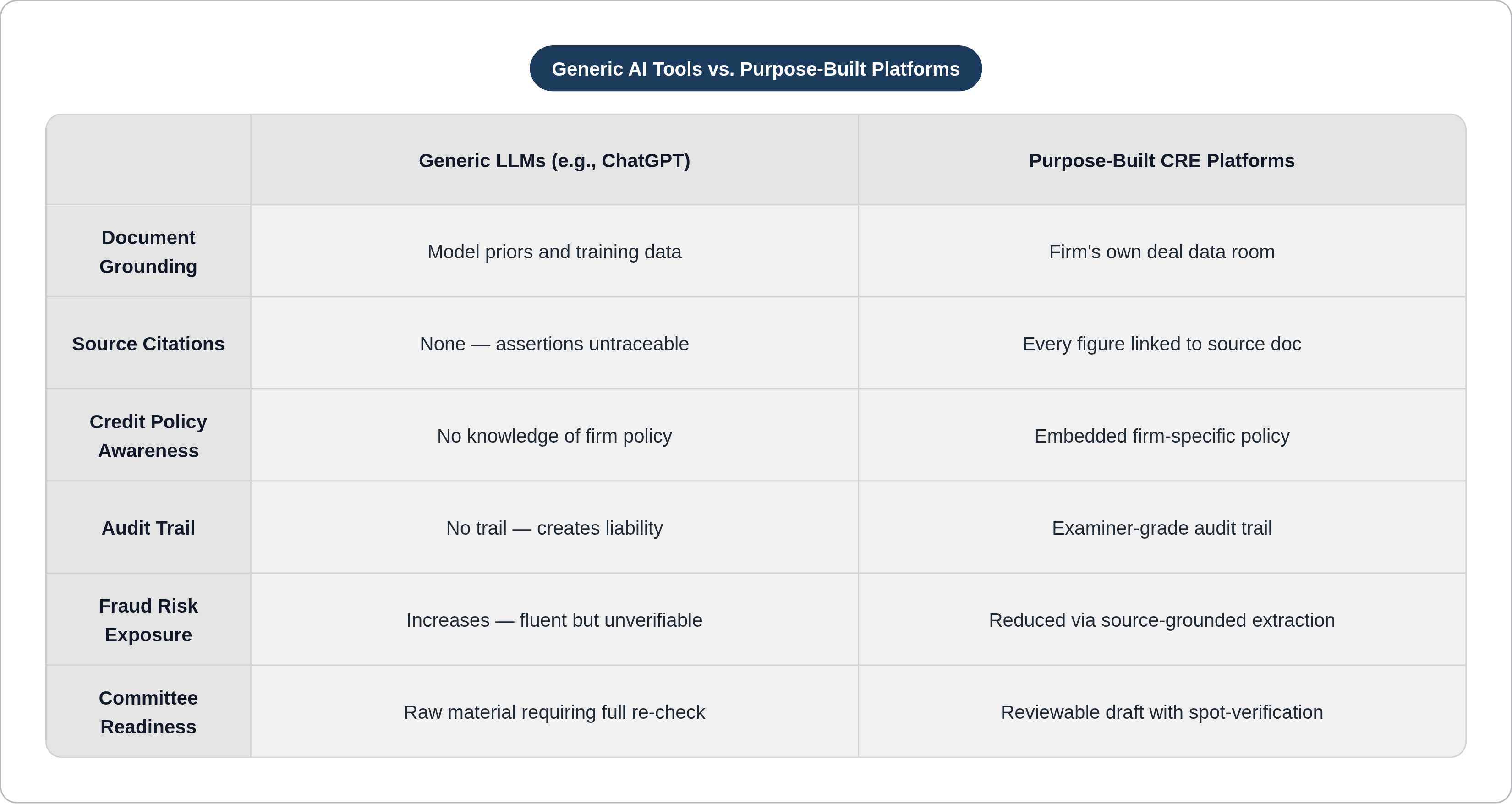
Asking ChatGPT to draft your investment committee memo is not AI-assisted underwriting. It is an experiment that will produce fluent, structured text with no source citations, no grounding in the deal's actual documents, and no knowledge of your firm's credit policy, template, or prior deal history. A fabricated-looking statistic in an IC memo is not just embarrassing; it is worse than no statistic at all, because it reads as verifiable and cannot be sourced.
The architectural difference is fundamental. Purpose-built platforms are grounded in the firm's own document corpus; the memo is generated from this deal's data room, not from general training data, and every assertion is traceable. General-purpose LLMs generate based on model priors. The former produces an audit trail. The latter produces liability.
There is a fraud risk dimension here that is easy to underestimate. FTI Consulting noted in May 2026 that the same reduction in friction that accelerates legitimate memo production also makes it easier to manufacture convincing deal narratives. Distinguishing authentic borrower performance from manufactured documentation requires source-grounded extraction, not generative fluency alone. A system that cannot produce citations does not just fail to prevent that problem; it actively creates conditions for it.
But how does this affect the committee's ability to do its job? The ability to spot-verify any figure is what makes the memo trustworthy in the first place. Tools that lack a citation layer create more review burden than they eliminate. They shift the problem rather than solving it.
What This Shift Means for How Analysts Spend Their Time and What Firms Can Expect from the Transition
The redistribution of analyst work is the most consequential consequence of this technology, and also the least dramatic-sounding. Extraction and assembly compress. Strategy, judgment, and committee preparation expand. The analyst's value shifts toward the parts that actually move investment decisions.
That is a good outcome for talented analysts. It is also, for the portions of the role that were comfortable precisely because they were procedural, a disorienting one. Structured busy work has its uses. It fills hours, produces a tangible artifact, and requires nothing genuinely uncertain of you. Losing that is not always experienced as a promotion.
What firms see in early implementation cycles follows a recognizable pattern. Meaningful time-on-task reductions appear within the first two months when teams begin with high-volume extraction workflows before moving to full memo drafting. The sequencing matters more than most firms expect going in.
The institutional readiness question is where most firms actually stall. Templates and credit policy need to be codified before they can be embedded in a system; firms with inconsistent internal standards hit this wall first and hit it hard. Audit trail requirements vary by institution and regulator. The first draft the AI produces is a starting point, not a deliverable; the review workflow needs to be designed, not assumed.
The monitoring extension changes the return-on-investment calculus in ways that are not always obvious at the outset. The same document intelligence that builds the origination memo can track covenant compliance, surface DSCR drift, and flag refinancing windows across the portfolio after close. The memo is not the end of the workflow; it is the front end of something longer.
The implementation gap from JLL's survey, most firms piloting and few scaling, reflects this readiness requirement. It is not a failure of the technology. The firms that close that gap fastest treat AI as infrastructure for their existing intellectual property rather than a substitute for it. They are codifying what their best analysts already do, embedding it in a system that can do it at volume, and then asking those analysts to focus on the part the system cannot: deciding whether the deal is actually worth doing.
That judgment has always been the job. It just used to arrive exhausted.