Computer Vision for CRE Property Inspection and Condition Scoring
AI-powered drone inspection replaces subjective property assessments with repeatable numeric scores.

There is something odd about the fact that a multimillion-dollar commercial real estate transaction can hinge, in part, on one inspector's opinion of a roof. Not a measurement. Not a model. An opinion, delivered in a PDF, drafted days after the fact, written in language no algorithm can parse and no two readers will interpret identically. The industry has accepted this for so long that calling it out feels almost impolite.
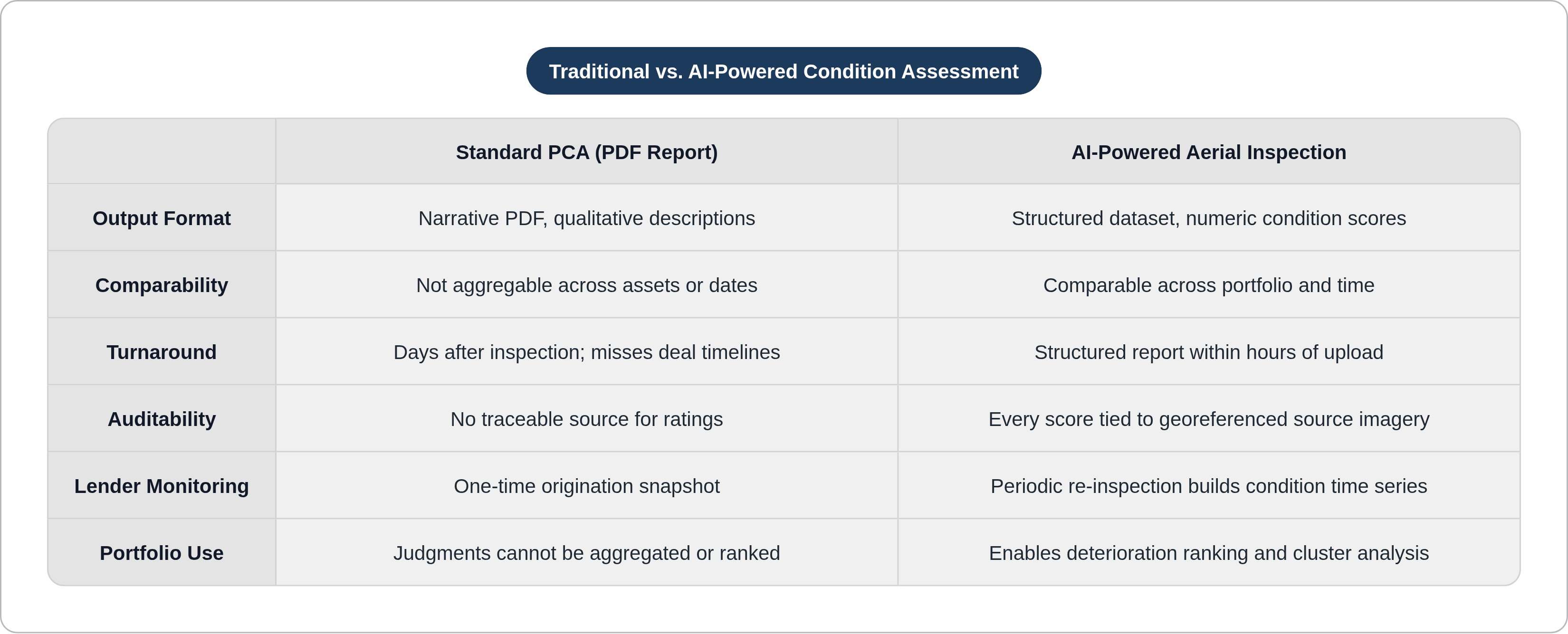
So what does a standard property condition assessment actually produce? An inspector arrives on site, uses a ladder or occasionally a drone, takes photographs, and writes notes into a tablet form. They compose a narrative report with qualitative condition descriptions: "moderate wear," "signs of prior repair," "recommend further evaluation." The report arrives as a PDF, often after the deal timeline has already moved on without it.
Who is this report actually written for? The narrative format serves a human reader reviewing a single asset. It serves that reader poorly, but it serves them. It serves nobody trying to compare condition across twenty assets, ingest findings into an underwriting model, or establish a monitoring baseline over a five-year loan term. The output is, by design, a terminal document. Nothing flows downstream from it in any structured way.
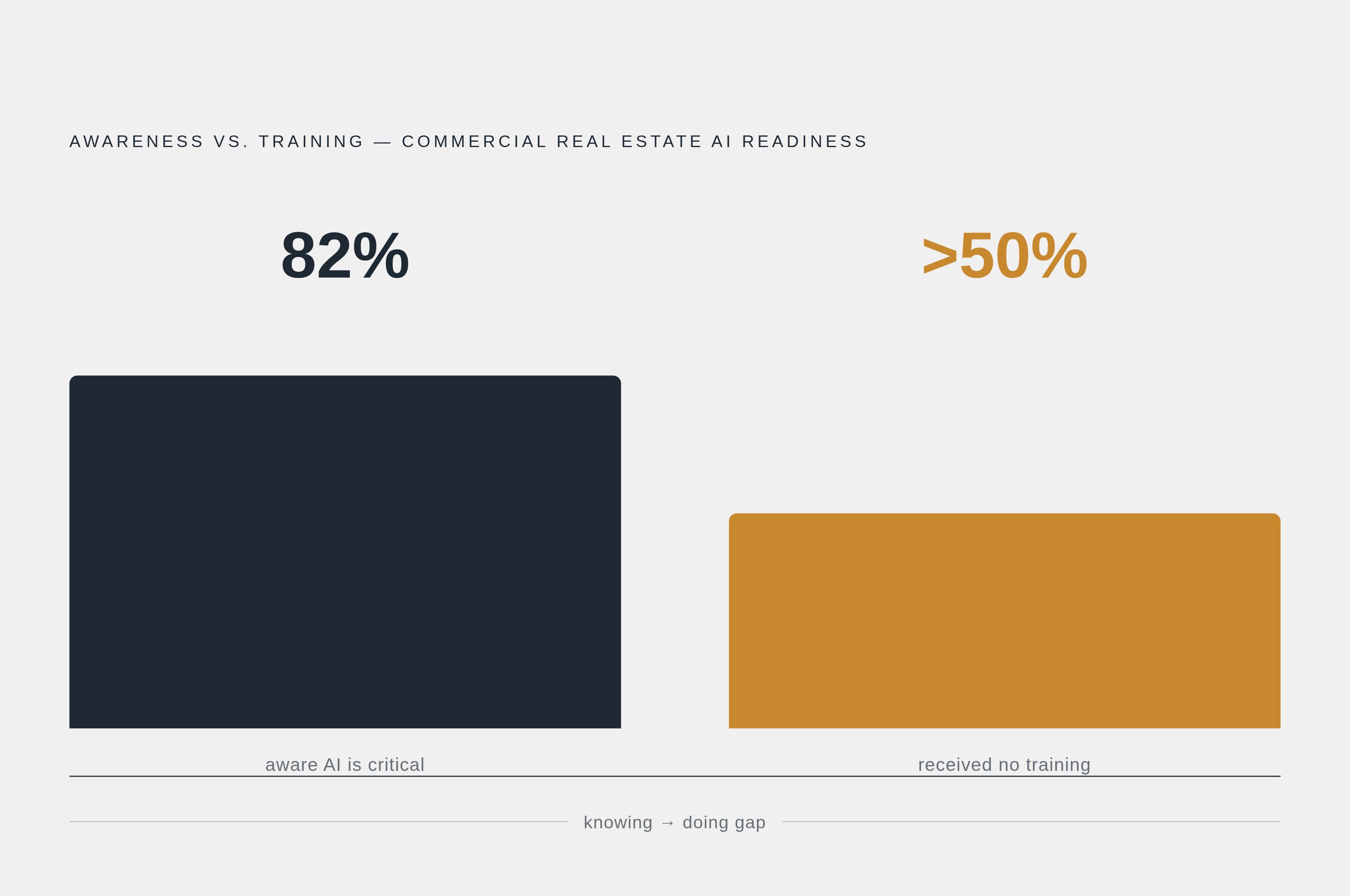
The subjectivity problem then compounds the format problem. Two qualified inspectors reviewing the same roof will produce different condition narratives. Neither is wrong, and neither produces something a machine can read or a portfolio manager can aggregate. The industry has roughly 82% awareness that AI is critical to commercial real estate, yet over half of commercial professionals report no training in the relevant tools, according to Propmodo. Awareness is running well ahead of implementation. The bottleneck is not ignorance of the problem; it is inertia in replacing the process that produces it.
The scale mismatch is the starkest dimension of all this. A portfolio manager overseeing dozens of assets cannot commission full manual inspections at every decision point. Transaction timelines already run one to four weeks per deal; a slow or incomplete physical inspection adds drag at precisely the moment when drag is most costly.
Modern aerial inspection platforms deploy drones carrying RGB cameras, thermal sensors, and LiDAR across roofs, facades, HVAC units, and parking structures, converting that data into georeferenced 3D models shareable the same day. AI layers atop this hardware flag defects during flights rather than in post-processing and run thermal analysis that catches moisture intrusion, insulation failures, and electrical hotspots invisible to the naked eye. Vendor studies report detection accuracy above 95%, with AI-powered thermal analysis reducing missed hazards by 65% compared to visual-only inspection. A photograph records reflected light and nothing else. It cannot detect subsurface moisture accumulation or early-stage structural deflection in a parking deck. The gap is real, and it is not marginal.
How condition scoring converts visual data into a repeatable, comparable metric
The core transformation is this: raw sensor output, processed through computer vision models, produces numeric condition scores rather than qualitative descriptions. A condition score represents defect type, severity, and location mapped to a defined scoring framework, aggregated from component-level assessments of the roof membrane, HVAC systems, facade, and structural elements into an asset-level summary. Every score is tied to georeferenced imagery, so any rating can be traced back to the specific frame that generated it.
Repeatability is what makes this useful in practice. The same algorithm applied to the same asset at two different points in time produces comparable outputs. Deterioration becomes measurable rather than impressionistic. That sounds like a modest improvement; it is actually a categorical one.
DroneDeploy's Progress AI is a working example: vision-language models analyze drone and 360-camera imagery, producing structured reports within two hours of upload and tracking more than 80 trade types without requiring BIM models or existing schedules to anchor the analysis. The output can be queried and compared across assets and inspection dates. It is not a narrative.
But what if the score is excellent and the asset is still declining? A numeric score can substitute a number for the nuanced professional judgment a seasoned inspector brings, creating a different kind of false precision. That concern is legitimate. Consider the alternative, though. Narrative reports that cannot be compared, aggregated, or audited create their own false precision, the illusion that a qualitative description constitutes rigorous assessment. At least a scored framework is explicit about its criteria. Applied uniformly across a portfolio, it makes cross-asset comparison structurally possible in a way that narrative-per-asset reporting simply cannot.
Where condition intelligence enters the underwriting and due diligence workflow
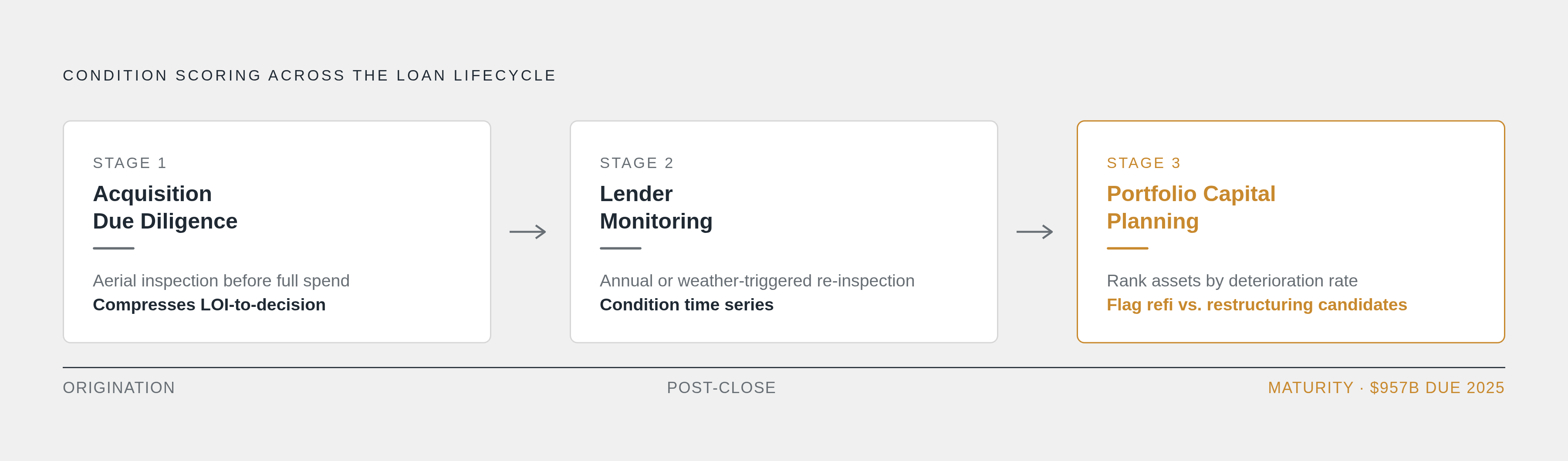
The acquisition due diligence use case is the most legible entry point. Aerial inspection gives buyers an early, high-level view of site condition before committing to the full physical due diligence spend. That sequencing matters more than it sounds. A quantified roof condition score produces a more defensible capital expenditure reserve assumption than a surveyor's qualitative note. Documented defects with severity scores provide specific grounds for purchase price negotiation, not just a general sense that the roof looked rough. Material condition issues surfaced in hours rather than weeks compress the time between letter of intent and informed decision.
CoStar's acquisition of Matterport in early 2025 for approximately $1.6 billion is worth reading as a market signal. The largest property data platform in the industry paid that price to join property data with 3D digital-twin technology. The inference is not subtle: spatial and condition intelligence are being repositioned as core underwriting inputs. When the dominant infrastructure player makes that bet at that scale, the direction of travel is reasonably clear.
The transparency dimension follows from this. Condition scores tied to source imagery give lenders and buyers an auditable record; every rating traces to the specific frame that produced it. A standard property condition assessment delivers a PDF narrative. Computer vision delivers a structured dataset that can be ingested, queried, and compared against prior assessments. Those are not equivalent instruments, and the market appears to be working that out in real time.
How ongoing condition monitoring feeds lender risk assessment after closing
A commercial real estate loan is a multi-year relationship. Physical condition of the collateral is typically assessed once, at origination, and then monitored primarily through borrower-submitted reports. Consider what that means in practice: a lender holds a seven-year senior loan on an office building and has, as its primary source of ongoing collateral condition data, documents prepared by the party most motivated to present that collateral favorably. Nobody says this out loud at origination, but the dynamic is universally understood.
CRE loans carry financial covenants: debt service coverage ratios, loan-to-value thresholds, debt yield floors, monitored at least nominally on a recurring basis. Physical condition covenants, maintenance standards and required inspection schedules, are often the first obligations to go unmonitored in practice. That asymmetry is a quiet credit risk embedded in most institutional loan books.
Deferred maintenance is a leading indicator of cash flow stress. Capex avoidance precedes NOI decline, not the reverse. A property scoring poorly on physical condition at loan maturity faces a constrained refinancing market precisely when the borrower needs maximum optionality. Periodic aerial re-inspection, applying the same scoring framework annually or after significant weather events, produces a condition time series. A lender can observe whether a borrower is maintaining collateral or deferring it, rather than inferring this from financial statements where the signal is lagged and obscured.
IoT-integrated building management systems from platforms like Siemens and Johnson Controls add a continuous monitoring layer alongside periodic inspection: sensors detecting HVAC degradation and water intrusion in real time. Water damage incidents alone can exceed $50,000 per event; early detection is a direct loss-mitigation input, not a facilities management nicety. It is also worth noting the stale-data risk that applies regardless of methodology: a condition score from two years prior tells a lender nothing about a roof that failed last winter.
Condition data as an input to portfolio-level capital planning and opportunity surfacing
Without standardized condition data, capital planning across a portfolio relies on age-based depreciation schedules and borrower self-reporting. Age-based depreciation tells you how long something has existed, not how it has been maintained. Borrower self-reporting reflects the borrower's incentive structure. Neither reflects actual asset condition, and both get used anyway, which is its own kind of institutional absurdity.
A scored, standardized condition dataset across a portfolio enables something qualitatively different: ranking assets by deterioration rate rather than age, identifying clusters of assets with similar condition profiles to coordinate vendor contracts at scale, and flagging assets whose condition trajectory suggests refinancing difficulty before the maturity date creates urgency. The opportunity-surfacing dimension is equally significant. Assets in strong condition at loan maturity are refinancing candidates. Assets on a declining trajectory are restructuring candidates. The condition score shapes which conversation happens, and whether it happens before or after a problem becomes undeniable.
With roughly $957 billion in commercial real estate and multifamily mortgages maturing in 2025, the ability to distinguish well-maintained collateral from deteriorating collateral at scale is a direct credit risk management tool, not a data science research project. Altus Group's integration of ARGUS for investment modeling with Reonomy for property intelligence reflects the same underlying logic: vertically integrated stacks connecting physical and financial data are where the institutionally sophisticated segment of the market is heading.
The manual alternative, individual judgments that cannot be aggregated, compared, or audited, is structurally unable to surface portfolio-level patterns. That is not an efficiency critique; it is an architecture critique.
What the downstream value of condition intelligence requires to actually work
Condition intelligence is only as valuable as the systems it connects to. A condition score that lives in a drone vendor's portal and never reaches the underwriting model, the lender's risk dashboard, or the asset management platform has produced a report. It has not produced a decision. That distinction sounds obvious until you examine how most inspection workflows actually terminate: the report is produced, reviewed perhaps, stored somewhere, and then it does not flow.
What integration actually requires is more specific than "better technology." It requires structured, machine-readable output from the inspection platform; a receiving system capable of ingesting condition data alongside financial data, rent rolls, and covenant metrics; and standardized scoring frameworks so that condition data from different assets and different inspection dates is genuinely comparable rather than nominally so. Each of these is a real dependency. None is a footnote.
The documentation risk dimension is worth raising here. AI has made it substantially easier to fabricate high-quality, internally consistent loan packages, including property condition narratives that reconcile convincingly across pages, as FTI Consulting has observed. Independently sourced, algorithmically generated condition scores tied to source imagery function as a verification tool as much as an assessment tool. The score is harder to fabricate because the imagery that generated it is part of the audit trail.
The training gap is a real operational barrier. With a majority of commercial professionals reporting no AI training, condition scoring tools will underperform not because the methodology is inadequate but because the professionals receiving outputs do not know how to interrogate them. A score without interpretive context is just a number; it can be misread in either direction.
Hypha is built around this integration problem specifically, connecting physical condition data to financial spreading, covenant monitoring, and portfolio dashboards within a purpose-built CRE asset intelligence platform. A declining condition score read alongside a DSCR trend and a lease rollover schedule is a materially different input than that same score sitting in isolation in an inspection portal. The surrounding context is where decisions actually happen.
Underwriters are sophisticated enough to seek out and synthesize condition data regardless of platform integration. That is probably true on any individual deal. It breaks down across a portfolio of fifty assets with varying inspection dates, different scoring vendors, and an underwriter who has fifteen other things open on their screen. The question is not whether good judgment can compensate for fragmented data. It is whether it consistently does, and experience suggests it does not.