Machine Learning for CRE Property Valuation

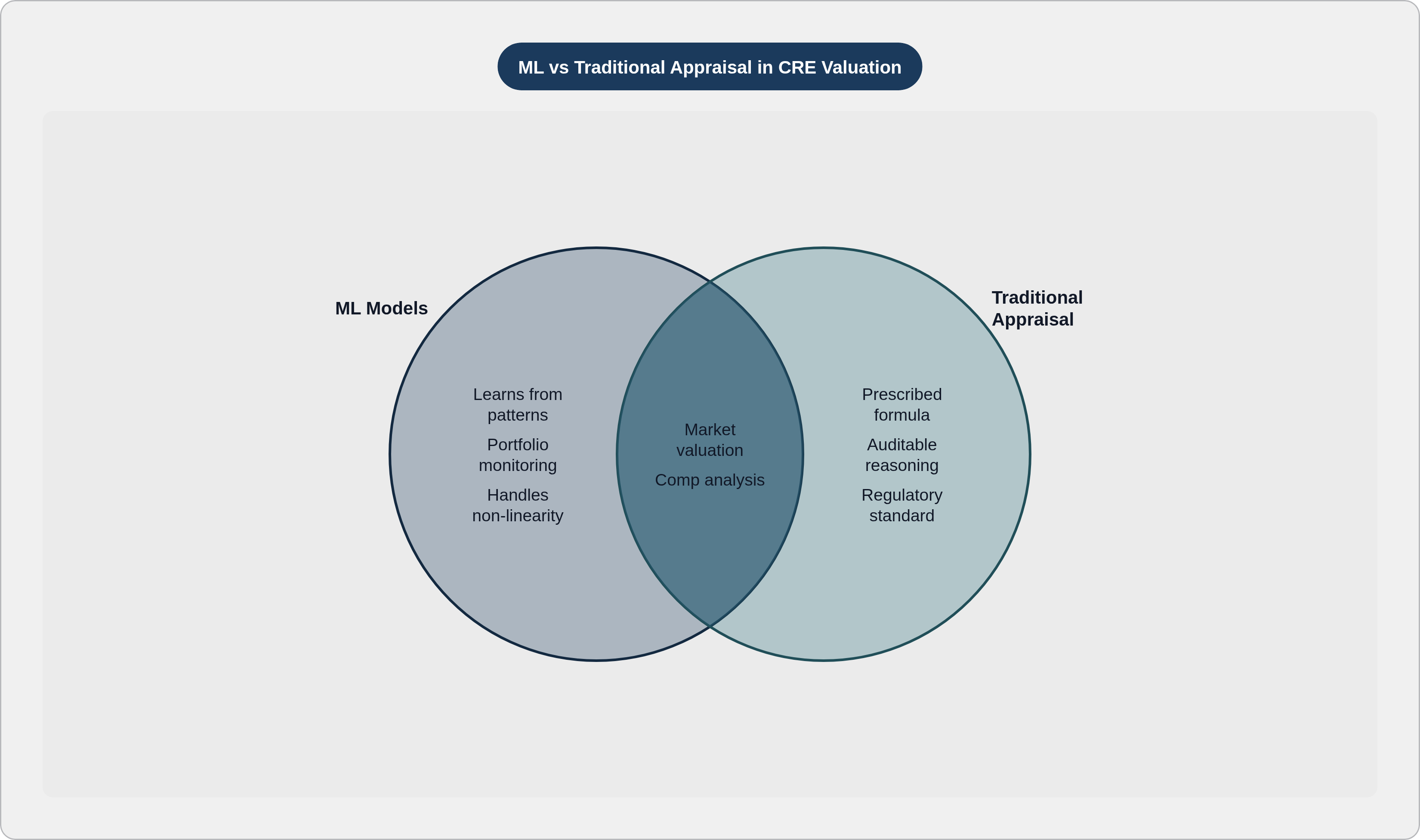
The core distinction between ML and traditional appraisal is not sophistication. It is architecture. A traditional model follows a prescribed formula. An ML model learns patterns from historical transaction data and applies those patterns to new inputs. Think of it like the difference between following a recipe and learning to cook by eating thousands of meals — one gives you a fixed output, the other builds intuition from experience.
Simple enough in theory. Considerably messier in practice, and the messiness is where the interesting stuff lives.
The model families most relevant to CRE valuation fall into two broad categories. Tree-based ensembles, including random forest, gradient boosting, and XGBoost, dominate real estate pricing applications according to a 2025 systematic review in Computational Economics. They handle non-linear relationships and feature interactions that regression models miss, and they are relatively robust to outliers and missing data. Those are real advantages in thin CRE transaction markets where you are often working with whatever comps you can actually find. Deep learning architectures, including recurrent and convolutional networks, capture temporal trends from sequential transaction records and can process geospatial imagery to encode location quality at granular scale. Their data requirements are substantially higher, which limits their utility in secondary and tertiary markets where transaction density is low and, frankly, everyone already knows everyone else's deal.
Automated valuation models implement supervised and unsupervised algorithms to enable mass appraisal: consistent valuation across hundreds or thousands of assets simultaneously, updated as market inputs change. For portfolio monitoring purposes, that capability alone is transformative, even if the underlying math would make most loan committee members reach for aspirin.
What goes into these models matters as much as the architecture. A well-specified CRE ML model ingests structural and physical attributes, location and spatial data, income-side variables like net operating income and occupancy, market-level indicators like vacancy rates and absorption, and macroeconomic variables including interest rates and credit spreads. University of Florida Warrington research drew on a dataset of over 5,000 variables spanning 1978 through mid-2024 to assess ML's ability to forecast returns in private CRE. That input dimensionality illustrates why ML produces outputs that traditional regression simply cannot.
But that raises an uncomfortable question: does more inputs in a more complex model automatically mean better predictions? It can mean overfit, noise amplification, and false precision. The architecture is necessary but not sufficient. Anyone who has watched a beautifully specified model confidently blow a valuation on a transitional asset understands the difference viscerally.
What the Research Actually Shows, Asset Class by Asset Class
Most ML valuation research has been conducted on residential and multifamily properties, where transaction volume is high and physical attributes are relatively standardized. The extension to office, retail, and industrial is newer and considerably less settled than the vendor decks would have you believe. That gap matters more than people acknowledge.
The most relevant study in the commercial literature is a 2024 paper in the Journal of Real Estate Finance and Economics, which applied ML methods to properties from the NCREIF Property Index spanning 1997 to 2021. It examined deviations between appraised market values and subsequent transaction prices and found that those deviations exhibit structured variation rather than random noise, a pattern that boosting tree models can learn. The result was improved appraisal accuracy and, notably, elimination of structural bias present in traditional appraisals. That last finding deserves emphasis. The problem with traditional CRE appraisals is not just that they are slow. They are also systematically biased in ways that compound over time, and ML can partially correct for that. Which is either encouraging or humbling, depending on how long you have been signing off on those appraisals.
Interpretability tools are narrowing the gap between research and practice. SHAP values and partial dependence plots allow practitioners to see which features drove a given valuation output, turning something that once resembled a black box into something closer to an auditable process. That matters for lenders, regulators, and any investment committee that has to defend a number to a credit officer who remains skeptical of anything a computer produced, which, in my experience, is most of them.
It is also worth considering the data quality problem that sits upstream of model accuracy. Automated financial data extraction achieves field-level accuracy in the low-to-mid nineties in vendor studies; manual data entry performs slightly lower. The implication is that the financial data being fed into valuation models is already imperfect, and imperfect inputs constrain model outputs regardless of algorithmic sophistication. Garbage in, garbage out is not a cliché here. It is a load-bearing constraint, and treating it otherwise is how people get surprised.
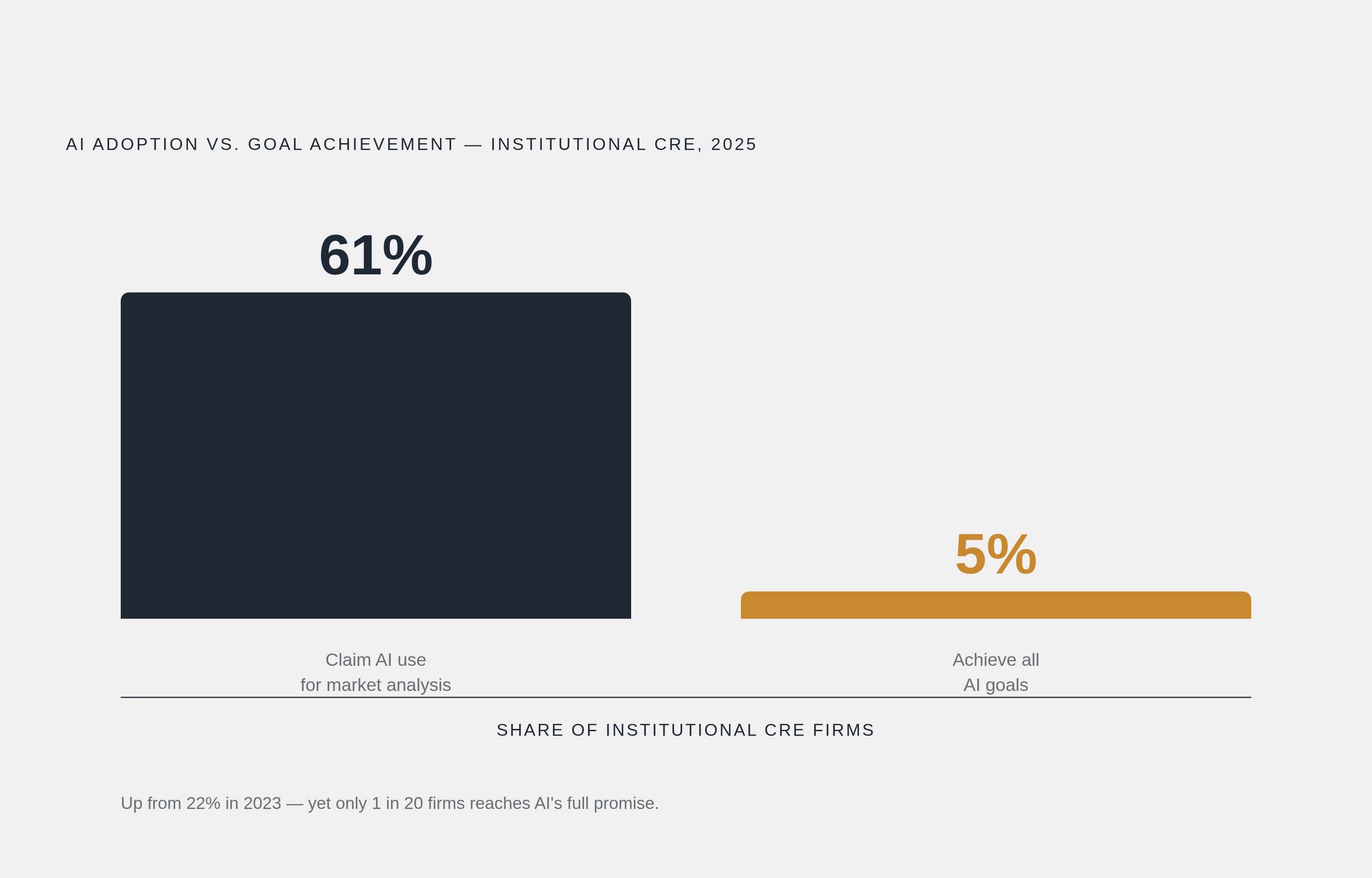
Asset class adoption patterns reveal an uneven track record. JLL's 2025 Global Real Estate Technology Survey found that 61% of institutional investors reported using AI for market analysis in 2025, up from 22% in 2023. But only 5% of CRE firms report achieving all of their AI goals. Office shows high experimentation with limited conversion to scale. Multifamily has the lowest enterprise-wide AI adoption despite being the largest asset class by transaction volume. One interpretation is that this is just laggard behavior. Another interpretation, which I find more credible, is that practitioners are rationally cautious about deploying tools validated on assets that look nothing like their own book. A model validated on stabilized multifamily in primary markets does not transfer automatically to transitional retail in secondary ones. The research evidence should be weighted by how closely the study's asset class and market characteristics match your actual portfolio, and that step gets skipped more often than it should.
Where ML Models Reliably Add Value in Valuation Workflows
Portfolio-level monitoring is the clearest and most defensible application. AVMs can update estimated values across a large loan book simultaneously as market inputs change, replacing the cycle of periodic, bespoke appraisals with a continuous signal. For lenders tracking LTV covenants across hundreds of positions, that is not a marginal improvement; it is a different operating model. Operators managing substantial CRE portfolios report that automation reduces missed covenant breaches by over 90% and cuts review time by 60%. The more important point, though, is that catching a covenant breach six weeks earlier is not a rounding error in a deteriorating credit environment. It can be the difference between a negotiated resolution and a forced one.
Comparable selection and initial market analysis are strong secondary applications. ML can surface statistically relevant comps from far larger transaction sets than any analyst could manually review. More importantly, it reduces the anchoring bias that creeps into manual comp selection when an underwriter starts with the deal already in their head and works backward to the comps that support it. That bias is real, prevalent, and rarely discussed openly in the industry, which is probably why it persists.
Return forecasting and scenario modeling benefit from ML's ability to run stress tests against interest rate shocks, occupancy deterioration, and expense inflation faster than spreadsheet-based pro formas allow. Commercial lenders using AI-powered underwriting report the ability to underwrite three to four times more deals with the same team. That throughput gain has portfolio-level implications well beyond analyst convenience. It also raises a question worth sitting with: whether the marginal deals being added to the pipeline at that volume are getting the scrutiny they actually warrant, just faster.
Early signal detection for at-risk assets is perhaps the least glamorous but most consequential application. Models integrating vacancy trends, lease rollover concentration, and tenant credit signals can flag deterioration before it surfaces in net operating income, giving lenders and asset managers lead time to act. An LTV covenant breach does not announce itself. It emerges from a value decline that a continuously updated AVM can flag weeks before a quarterly appraisal would surface it, and in a workout negotiation, weeks matter considerably.
Where ML Valuation Models Fall Short and Why
The black-box problem is real, not rhetorical. Despite strong predictive performance in research settings, implementation of advanced ML for property valuation remains limited in practice, precisely because models do not explain their reasoning in terms that appraisers, lenders, or regulators can audit. SHAP values help, but they add an interpretation layer that most CRE workflows do not yet support operationally. Telling a credit committee that the model identifies cap rate compression as the key driver is a different thing from explaining why, in terms they can actually challenge. The gap between those two things is where deals stall.
Data sparsity is a structural constraint in commercial transaction markets, not a temporary problem awaiting a better dataset. ML models learn from transaction volume, and office, retail, and specialty assets trade infrequently, particularly in secondary and tertiary markets. Thin datasets produce wide confidence intervals. The model's apparent precision is false precision, and false precision in a credit decision is worse than acknowledged uncertainty. Acknowledged uncertainty at least prompts a conversation. A model projecting false precision is like a compass that points confidently in the wrong direction: the problem is not that you have no guidance, it is that you trust the guidance too much, and too completely.
Some of the most important factors in CRE valuation simply do not encode well as model inputs: anchor tenant quality, ground lease structures, deferred maintenance, owner-operator relationships, management competence. Experienced underwriters weight these factors heavily and often struggle to articulate precisely why. They are difficult to represent in training data at the granularity needed, and models trained without them will consistently underweight them. The model has no way of knowing that the sponsor has a habit of deferring capital expenditures until they become someone else's problem.
Market discontinuities break historically trained models in ways that matter enormously in CRE credit. Models trained on data from 2010 through 2019 did not anticipate post-pandemic office demand destruction. Moody's reported that U.S. office real estate values were likely to decrease by over 25% through 2025, a regime shift that backward-looking models struggle to price in real time. This is not a solvable problem through better architecture. It is an epistemological constraint: a model can only learn from what has happened, and CRE markets occasionally do things that have not happened before. That is not a criticism of ML specifically. It is just a description of reality, and conflating the two is a category error.
The most underappreciated risk, though, has emerged only recently. Per FTI Consulting research published in May 2026, a complete set of trailing twelve-month operating statements, rent rolls, tenant leases, and borrower financials with figures that reconcile across every document can now be generated using widely available AI tools. A valuation model is only as reliable as the financial data it ingests. Manufactured inputs produce confident but wrong outputs. The ability to distinguish authentic borrower performance from a manufactured narrative is becoming a critical edge in CRE credit, and no ML valuation model has a built-in solution for it. The irony of AI-powered underwriting being undermined by AI-powered document fabrication is not lost on anyone paying close attention.
How CRE Professionals Should Actually Integrate ML Outputs into Underwriting and Asset Management
The right frame is this: ML output is a structured input to judgment, not a replacement for it. That framing is not a hedge designed to make the argument more palatable. It reflects the actual state of what these models can and cannot do, and it determines where implementation succeeds or fails.
Trust the model for portfolio-wide trend signals, comp screening, and initial range estimates on stabilized assets in liquid markets. Interrogate it on distressed, transitional, or idiosyncratic assets; on outputs that deviate sharply from appraiser judgment; and on any model output that will anchor a covenant threshold or an underwriting decision. The question is not whether to use ML. The question is knowing precisely where its confidence is earned, and being honest when the answer is: not here, not on this one.
Generic models trained on public transaction data do not know a firm's underwriting standards, portfolio concentration, or deal history. Deloitte's 2026 CRE Outlook found that firms that selected CRE-specialized platforms in 2022 and 2023 are reporting materially better outcomes than those that adapted general-purpose enterprise AI. Calibration to a firm's own transaction record and covenant definitions is not optional for serious implementation; it is what separates actionable outputs from expensive noise.
For lenders and asset managers building toward operational integration, a few principles hold consistently across use cases. Define which valuation applications justify ML, such as portfolio monitoring and comp screening, versus which require a full appraisal, such as origination and regulatory reporting. Establish data quality controls before automated spreading; document authentication and reconciliation should precede any model ingestion of borrower financials, particularly now. Require interpretability outputs, SHAP or equivalent, for any ML valuation used in credit decisions. Treat ML valuation ranges as a starting point for underwriter review, not a terminal figure. Build feedback loops that track where model estimates diverged from transaction outcomes and use those divergences to recalibrate continuously. A model that is never wrong is a model that is never being seriously tested.
BCG and Harvard research found that professionals using AI assistance completed 12% more tasks, finished 25% faster, and produced outputs rated 40% higher in quality. In CRE lending, those gains translate to portfolio capacity and risk coverage. Why exactly does this matter? Because the analytic question was never whether the technology is impressive. It is whether the workflow around it is clear about what the model knows, what it does not, and who is still responsible when the number turns out to be wrong. Someone always is, and that part has not changed.