CapEx Underwriting and Reserve Analysis in CRE Lending

There is a version of CapEx underwriting that looks completely fine on paper and is, in fact, quietly wrong in ways that won't surface until the loan is two years into its term and the roof needs replacing. Most lenders have seen this movie. The frustrating part is that the errors are rarely exotic. They are classification errors, sourcing failures, and process shortcuts that compound in predictable ways into mispriced credit. The mechanics are not the mystery. The discipline to apply them correctly, at volume, under time pressure, with a sponsor's pro forma already sitting in front of you, formatted to tell a particular story: that is where the actual underwriting happens.
Where CapEx and Reserves Sit in the Pro Forma, and Why Asset Class Changes the Answer
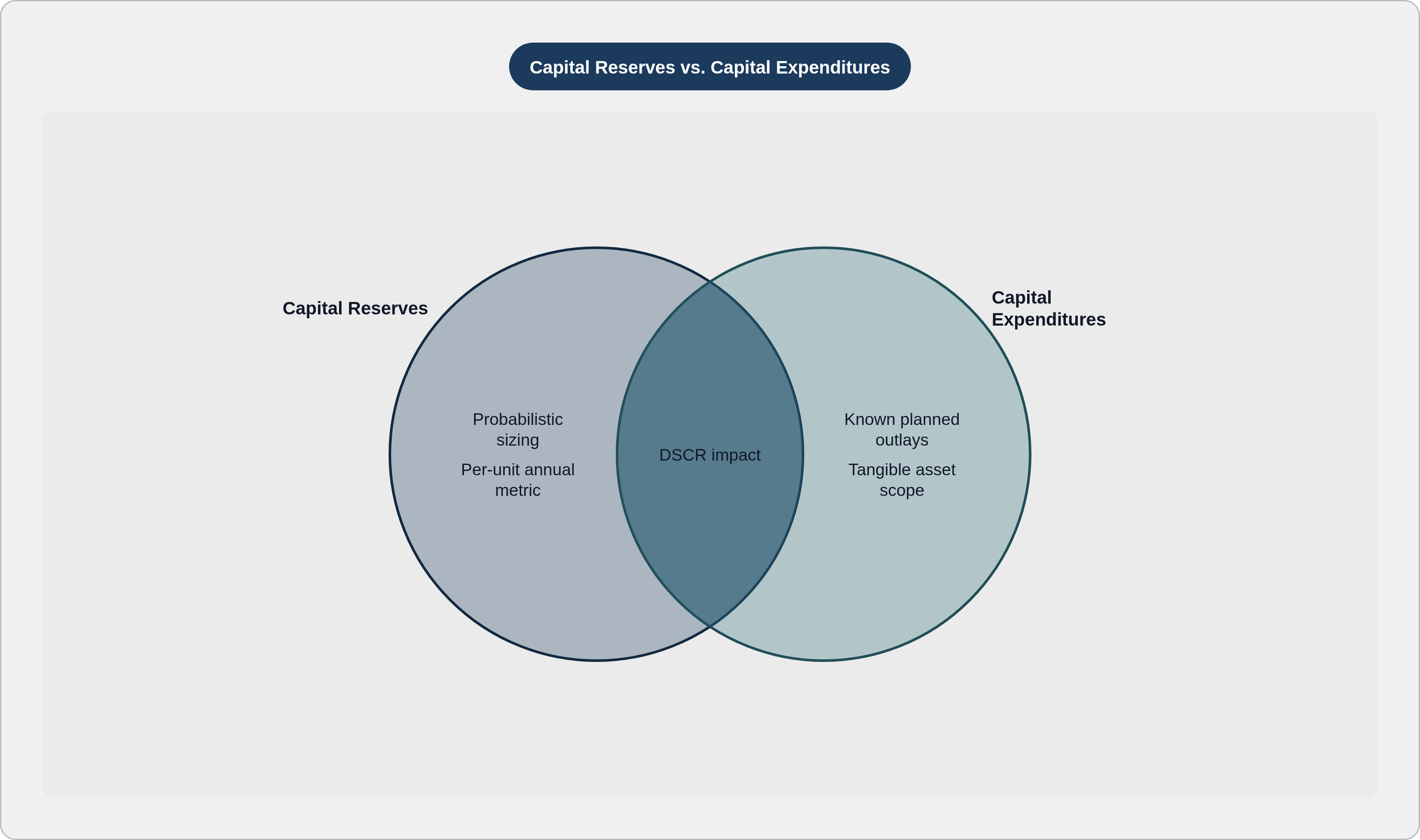
The first thing to get straight is that capital reserves and capital expenditures are not synonymous, and treating them as interchangeable is a semantic error, not just a quibble. It changes how the cash flow model behaves.
Capital reserves are placeholders. They represent unknown future needs, a contingency provision sized to what experience suggests a property of a given type, age, and condition will require, even if no specific need is identified today. Capital expenditures are known, planned outlays for tangible assets with useful lives extending beyond one year: a roof replacement, elevator modernization, a major renovation on a tenant space. One is probabilistic; the other is a line item with a scope and a number attached.
Why does the distinction matter? Because where an item is placed in the pro forma determines whether it flows through net operating income or sits below it, and that single decision propagates through every coverage ratio the lender is relying on.
In multifamily, capital reserves are modeled above the NOI line. This is not a choice; agency debt underwriting mandates it, and for good reason. Short lease terms mean unit-turn costs and capital needs are continuous, not episodic, so the above-the-line treatment reflects the actual character of the exposure. The standard sizing metric is a per-unit annual figure, typically something in the range of $250 to $350 per unit per year in agency underwriting, though asset condition and vintage should drive the real number. A 150-unit property at $300 per unit produces a $45,000 annual reserve. That figure reduces NOI directly, which means it flows into the appraised value, the supportable loan amount, and every coverage test the lender runs. Below that line, planned and known CapEx items are modeled separately, with their own scope and cost estimate.
In retail, office, and industrial, both capital reserves and capital expenditures typically sit below the NOI line. Longer lease terms shift the timing and character of capital needs; the lender is underwriting to cash available for debt service, and these items reduce that figure without touching NOI itself. That is a meaningful structural difference from multifamily, not a formatting preference.
That raises an important question. If no universal standard exists across asset classes, what does it mean when a lender applies a single pro forma template to every deal? It means the errors are silent. A retail property modeled like multifamily, or vice versa, does not produce an obvious red flag in the output. The numbers look coherent. The problem is that they are coherent around the wrong analytical premise, and the lender has no way to know that unless someone confirms that the placement matches both regulatory convention and the actual asset class.
How Errors in Reserve Sizing Compound into Mispriced Credit
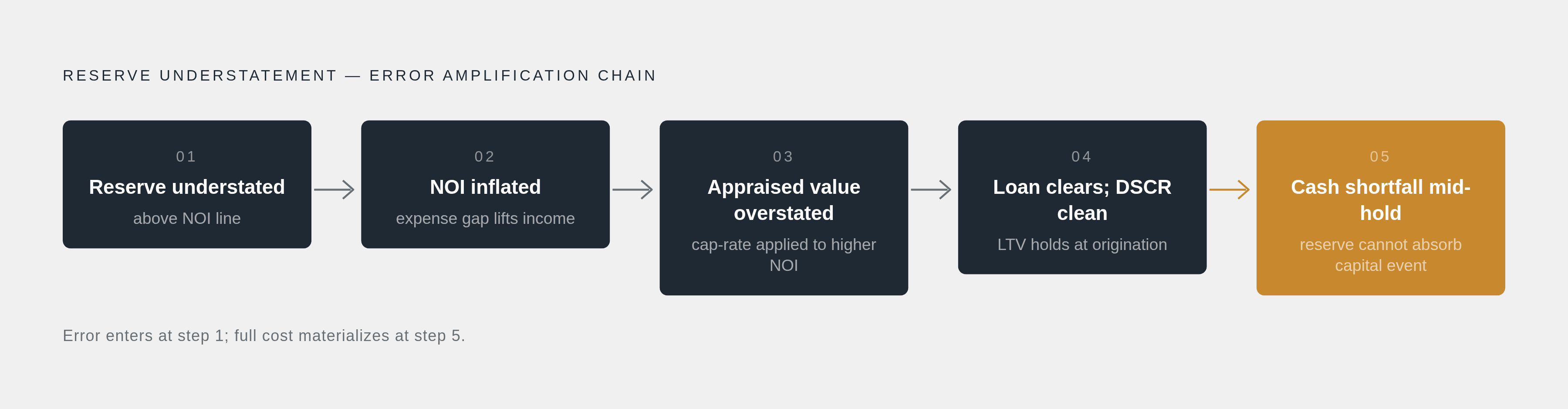
Here is the compounding logic, stated plainly. An understated reserve inflates NOI if it sits above the line, or overstates cash available for debt service if it sits below it. Inflated NOI, run through a cap rate, produces a higher appraised value. A higher appraised value supports a larger loan at the same LTV. The DSCR looks clean at origination. The cash shortfall appears mid-hold, when the capital event materializes and the reserve that was supposed to absorb it turns out to have been sized for a different, less expensive version of the property's future.
This is not a hypothetical risk. Consider the maturity context: roughly $2.1 trillion in U.S. CRE debt was slated to mature between 2025 and 2027 per Trepp data, much of it originated at lower rates and higher valuations. Loans being re-underwritten today carry embedded CapEx gaps from the original underwrite, assumptions set under materially different market conditions that were not stress-tested and not corrected. The refinancing math is already harder. A misidentified or understated reserve makes it harder still.
The OCC Comptroller's Handbook explicitly frames sensitivity analysis as a standard underwriting pillar: income declines, expense increases, rate changes. CapEx acceleration scenarios belong in that framework. What does DSCR look like if the major capital event occurs 18 months earlier than projected? That is not an unusual scenario; it is one of the most common sources of mid-hold deterioration. Yet it is routinely absent from the sensitivity section of credit memos, acknowledged in the narrative, perhaps, but not actually modeled.
One argument holds that reserves are inherently uncertain, so requiring precise stress scenarios is asking for false precision. That is a reasonable counterargument. But the response is not to omit the scenario; it is to frame it transparently: here is our base case timing, here is what coverage looks like if that timing is wrong by 18 months, and here is our rationale for accepting or hedging that risk. That is defensible underwriting. A memo that simply omits the scenario is not.
Asset-Class Variation in CapEx Underwriting That Lenders Must Account For
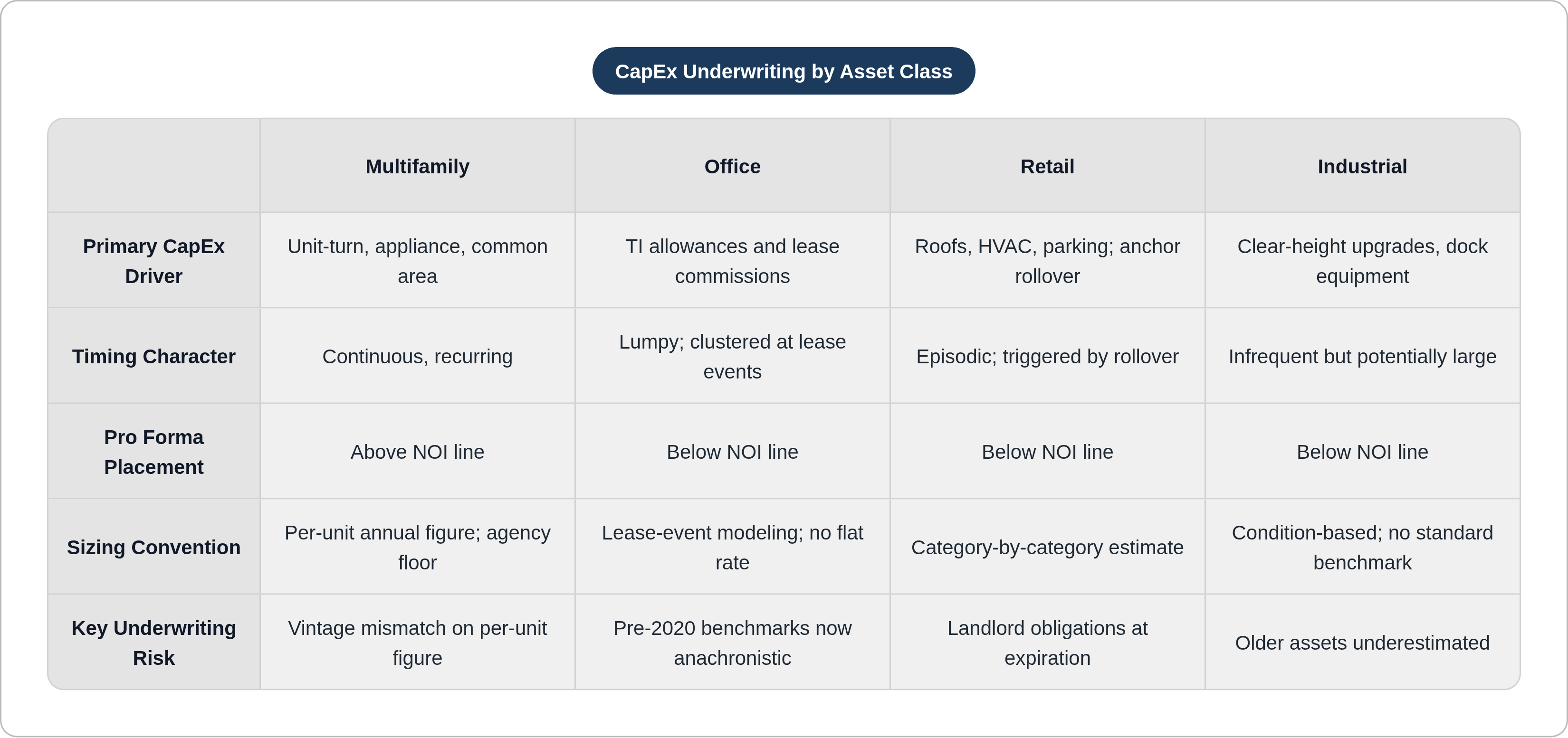
It is also worth considering how differently CapEx actually behaves across property types, because the variation is material, and applying a multifamily per-unit convention to an office or mixed-use asset produces a number with no real analytical foundation.
In multifamily, the cadence is continuous. Unit-turn costs, appliance replacement, common-area capital: these cycle constantly, which is precisely why the per-unit annual reserve construct exists. The formula is well-established, agency mandates create a floor, and lenders underwriting to those programs have limited discretion here. The question is whether the assumed per-unit figure reflects the actual condition and vintage of the asset, not whether to use the construct at all.
Office is structurally different. Tenant improvement allowances and lease commissions are the dominant CapEx driver, not building systems alone. Lease terms are long, which means CapEx is lumpy: minimal in the middle years of a lease, then a large renewal event. A flat annual reserve misrepresents that timing in both directions. It overstates near-term cost and understates the eventual outlay. And in the current office market, lenders should be cautious about applying pre-2020 benchmarks. Elevated vacancy, shorter renewal cycles, and tenant flight to quality have accelerated the CapEx cycle. An office underwrite in 2025 or 2026 that relies on vintage reserve assumptions is not being conservative; it is being anachronistic.
Retail's primary CapEx categories are roofs, HVAC systems, and parking structures, but anchor tenant rollover can trigger landlord obligations that appear nowhere in a stabilized pro forma. That is the kind of event that should be surfaced during underwriting, not discovered at lease expiration.
Industrial generally carries lower CapEx intensity, but clear-height upgrades and dock equipment replacement can be material for older-vintage assets. The asset class is not immune; it just presents differently.
The common thread across all of these is that the reserve assumption needs to be sourced, not assumed. A property condition assessment, an engineering report, or an appraisal addendum represents actual evidence about the asset's capital needs. A per-unit figure copied from a prior deal or a template represents a prior deal's assumptions. Those are not the same thing, and treating them as equivalent is precisely where the compounding begins.
What the OCC Framework Requires Lenders to Document, and Where Most Fall Short
The OCC Comptroller's Handbook treats reserves and CapEx as components of loan structure analysis, not as ancillary details. Reserve and CapEx assumptions that are unsourced to third-party evidence are vulnerable in examination. Sensitivity analysis that omits CapEx acceleration scenarios is incomplete by the standard the Handbook describes. Reserve adequacy is assessed relative to asset condition and lease structure, not just relative to what other lenders in the comp set are using.
Under the April 2026 revised interagency guidance, the documentation standard has become more explicit: examiners expect source-page traceability on every extracted figure. The CapEx and reserve assumptions in a credit memo must trace back to a specific document and page. Not to a general underwriting convention, not to prior-deal precedent, but to a named source with a page reference. That is the current examination standard.
Where do most lenders fall short? The patterns are consistent. Reserve assumptions are carried from a prior deal or a template without adjustment for the asset at hand. Planned CapEx is acknowledged in the narrative section of the credit memo but not modeled in the cash flow, existing as a note rather than a number. Sensitivity analysis excludes CapEx acceleration scenarios, despite those scenarios being among the most empirically common sources of mid-hold DSCR erosion. And sourcing is generic, where it exists at all.
The stakes at the community and regional bank level are particularly acute. CRE holdings comprise 44% of regional banks' balance sheets, and as of Q4 2025, the median bank holding company carries CRE loans at 47.8% of total loans per the New York Federal Reserve. At that concentration, examination findings on reserve underwriting carry direct capital adequacy implications. This is not an abstract compliance concern.
How Manual CapEx Underwriting Workflows Introduce the Errors Lenders Are Trying to Prevent
Here is the irony that is worth sitting with. Lenders understand the mechanics of CapEx underwriting well enough to have standards. They undermine those standards through the manual process of applying them.
The data ingestion bottleneck is structural. Underwriters spend the majority of their analytical time extracting and normalizing data from unstructured documents: offering memoranda, trailing twelve-month income statements, rent rolls, PCAs. Per V7 Labs (2025), this data extraction work consumes a disproportionate share of underwriting time before any analytical judgment is applied. That is not where underwriting judgment should live.
The specific failure modes in CapEx underwriting are predictable. Manual re-keying of a sponsor's pro forma imports the sponsor's classification errors without correction. The catch-all CapEx line in the borrower's deck becomes the underwriter's line, intact, unchallenged. Reserve assumptions are transcribed rather than interrogated. Planned CapEx buried in a PCA appendix is missed when document review is time-compressed. And cross-document inconsistencies — a PCA showing three years of remaining useful life on a roof while the pro forma assumes no near-term capital outlay — go undetected because the documents are reviewed sequentially rather than simultaneously. No single reviewer catches the contradiction because no single reviewer holds both documents in their analytical field of view at the same moment.
The volume problem makes this structural rather than occasional. A lender underwriting materially more deals with the same team, which AI-assisted underwriting has made operationally achievable per Multimodal.dev (2025), cannot manually reconcile CapEx across documents at that throughput without systematic error introduction. Throughput and manual accuracy are in tension; at scale, manual accuracy loses. Covenant tracking has the same leak. A mid-sized lender with several hundred active commercial loans is tracking thousands of covenant thresholds each quarter, and approximately 70% of banks still rely on spreadsheets for this work per Multimodal.dev (2025). CapEx reserve covenants are among the thresholds most likely to slip in that environment.
What Rigorous CapEx Underwriting Looks Like When the Process Supports the Analysis
Rigorous CapEx underwriting is not more conservative assumptions. It is better-sourced, more precisely classified, and properly stress-tested assumptions. The distinction matters because conservatism without precision is just a different kind of wrong.
The structural discipline starts before the model is built. Separate known items from unknown items at the line-item level. Do not let the sponsor's catch-all survive into the credit memo. Confirm that above-the-line versus below-the-line placement matches the asset class and any applicable agency or regulatory convention. Source the reserve figure to a named third-party document: a PCA, an engineering report, an appraisal addendum. A number without provenance is an assumption dressed as underwriting.
Model at least one CapEx acceleration scenario in the sensitivity analysis. If the major capital event occurs 18 months earlier than projected, what does coverage look like? That question should have an answer in the credit memo, not a silent absence. For term loans, build reserve adequacy into covenant structure. A minimum reserve balance covenant ensures that the capital set aside at origination is not depleted before the need materializes, which is the scenario the reserve was created to prevent.
The documentation standard is both the OCC examination expectation under current interagency guidance and the internal standard that makes credits defensible at workout. Every CapEx and reserve assumption should trace to a source document and page. Without that traceability, it is approximation, not underwriting.
AI-assisted underwriting changes the process ceiling without changing the analytical standard. Automated extraction across offering memoranda, PCAs, rent rolls, and income statements eliminates the transcription errors and missed cross-document inconsistencies that manual review introduces. The underwriter's judgment on reserve adequacy is unchanged. The quality of inputs to that judgment improves materially, and the time available for that judgment increases. That is the right division of labor.
But what if the process improves while the analytical standard stays vague? The tools solve a real problem; they do not solve the problem of an underwriter who never interrogated the per-unit reserve figure in the first place. The point is that better process clears the path for better analysis. It does not substitute for it.
U.S. CRE debt maturities are expected to increase by 18.8% in 2026 compared to 2025 per S&P Global Market Intelligence. Lenders re-underwriting assets in this cycle are making credit decisions on properties whose original CapEx assumptions were set under materially different conditions, at different interest rates, different vacancy levels, different construction costs, different market conventions. The discipline to build a fresh, sourced reserve analysis rather than carry the prior underwrite forward is not a technical refinement. It is where credit quality is actually defended.