NAV and Fair Value Reporting for Private Credit Funds
How funds determine fair value for illiquid private credit assets when market prices don't exist.

NAV is arithmetic: total assets at fair value, minus liabilities and accrued expenses, equals the number on an investor's statement. That formula hasn't changed in decades, and it won't. What's hard, and what this piece is actually about, is the left side of the equation: what "fair value" means when the asset is a unitranche loan with a PIK toggle, a leverage covenant, and no market liquid enough to spit out a price on demand. Let's walk through what happens between the moment a valuation cycle opens and the moment a number gets published, and where that process tends to snap.
How reporting cadence is determined and why it varies across fund structures
There's no universal clock here. Anyone looking for one will be disappointed. The right valuation frequency depends on how often investors can get in or out, which is why two funds holding nearly identical CRE credit portfolios can run on completely different schedules and both be doing it correctly.
An interval fund with frequent redemption windows might need monthly valuations, with something close to continuous monitoring running quietly in the background so nothing sneaks up on the team between cycles. A listed BDC settles into quarterly, because that's the rhythm its investors and the market have already priced in and nobody's asking for more. Then there's the diversified mutual fund with a small private credit sleeve tucked into a much larger, more liquid book, where oversight intensity gets dialed down because that sleeve doesn't move total NAV enough to matter on its own.
Underneath all of it sits one rule: more liquidity for investors means more rigor in valuation. Simple rule, messy execution. A fund that treats quarterly valuation as a once-a-quarter event will have a rough time the moment its cadence tightens. Cadences do tighten, too: fund structures shift, investor bases change, redemption terms get renegotiated over a weekend, and suddenly nobody's ready. The real question is what cadence a fund might get asked to run eighteen months from now, and whether anyone's built for that yet.
What the NAV practical expedient actually permits — and what it demands in return
ASC 820 and FASB ASC 946 hand investors in non-publicly-traded funds a shortcut: use the fund's own reported NAV as a stand-in for fair value, instead of independently pricing every underlying position. Fair enough, on its face. If the fund's already measuring at fair value under ASC 946, why pay someone to redo that work from scratch?
Here's the part accounting textbooks tend to gloss over. The NAV has to be calculated consistent with ASC 946 as of the investor's own measurement date, or adjusted for whatever's happened since the fund's last reported figure. In practice, a fund's most recent NAV is almost never sitting there ready for the exact date an investor needs. So adjustments happen: for market movement, for changes in underlying performance, for cash flows in and out, for anything material that occurred in the gap.
One line nobody gets to cross: if a decision's already been made to sell the fund interest and the expected sale proceeds don't line up with NAV, the practical expedient disappears entirely. Fair value gets estimated directly, per ASC 820-10-35-62, no exceptions carved out for anyone. On disclosure, using the expedient excuses a fund from slotting the investment into the Level 1, 2, or 3 hierarchy, but a reconciliation back to the balance sheet is still owed, in full. The expedient trims paperwork, but the obligation to actually understand what the NAV is built on underneath remains fully intact.
Where private credit investments sit in the fair value hierarchy and why Level 3 dominates
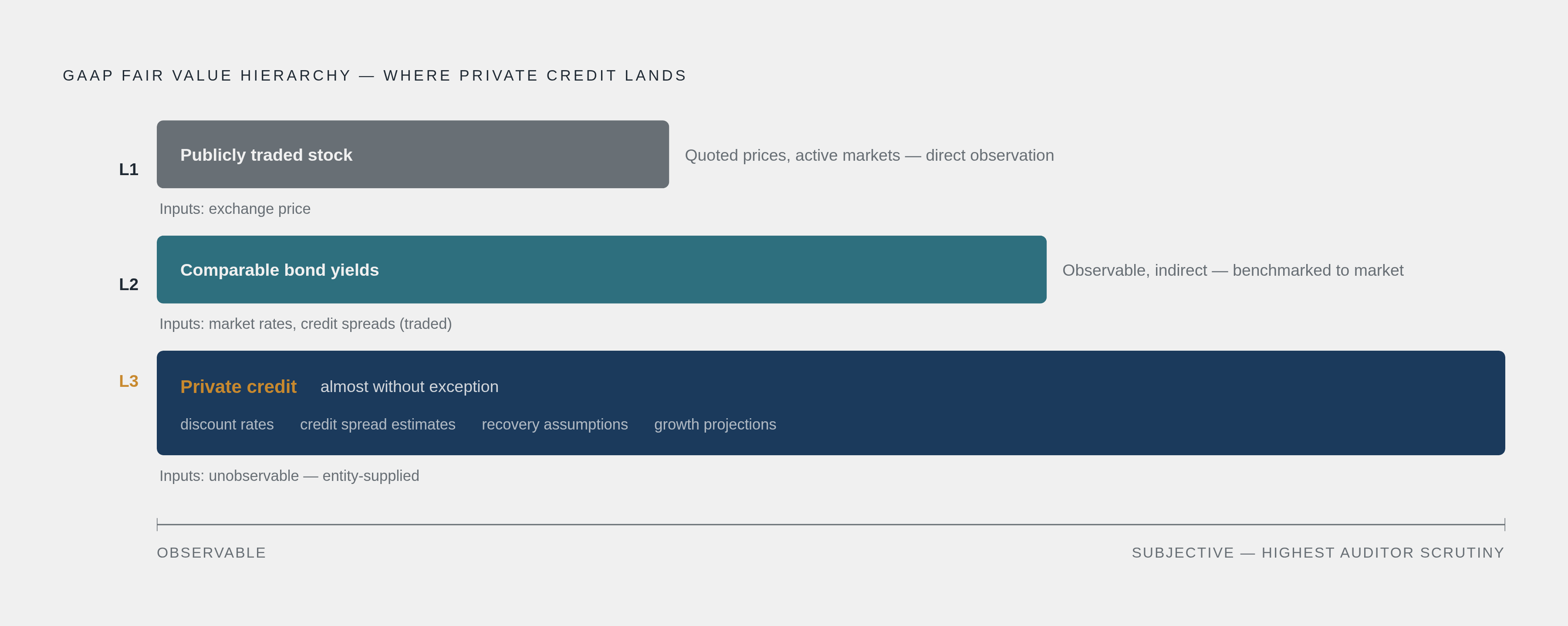
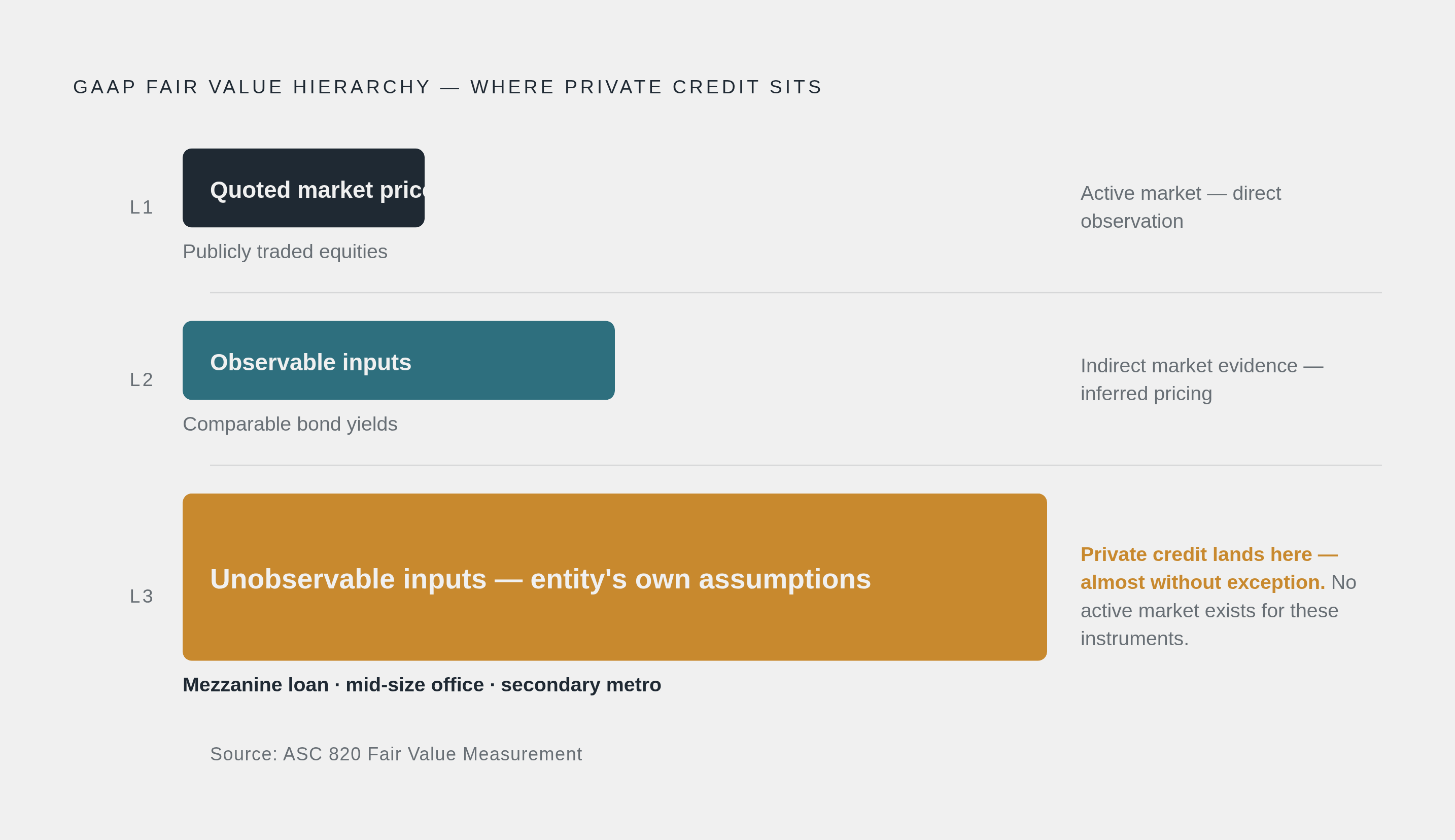
GAAP splits fair value inputs into three buckets. Level 1 is quoted prices in active markets, the tidy world of publicly traded stock where anyone can check the ticker and move on. Level 2 is observable inputs that aren't quite quoted prices but are close, comparable bond yields and things in that neighborhood. Level 3 is unobservable inputs, meaning the entity's own assumptions, because nothing better exists to lean on.
Private credit lives in that third bucket, almost without exception. There's no active market for a mezzanine loan against a mid-size office building in a secondary metro, and clean comparable transactions are scarce enough that you can't count on one showing up right when you need it. The fund supplies its own discount rates, its own credit spread estimates, its own recovery assumptions, its own growth projections, and every input has to hold up as something a reasonable market participant would actually use, tested against the standard of market plausibility rather than convenience for the position on paper.
Auditors set up camp for weeks in this territory. Methodology selection, input calibration, documentation quality, all of it gets taken apart piece by piece. The gap between a fund running a disciplined Level 3 process and one that isn't becomes obvious during market stress, right when the comparable data that used to exist quietly disappears. For CRE credit specifically, this isn't theoretical. One quarter of declining NOI, a covenant breach, a vacancy spike at the property level: any one of these can shift fair value meaningfully before the next scheduled valuation date arrives. The Level 3 process has to track that as it happens, close to real time, rather than being reconstructed weeks later from memory and a half-finished spreadsheet.
The three valuation approaches under ASC 820 and how CRE credit instruments are typically measured
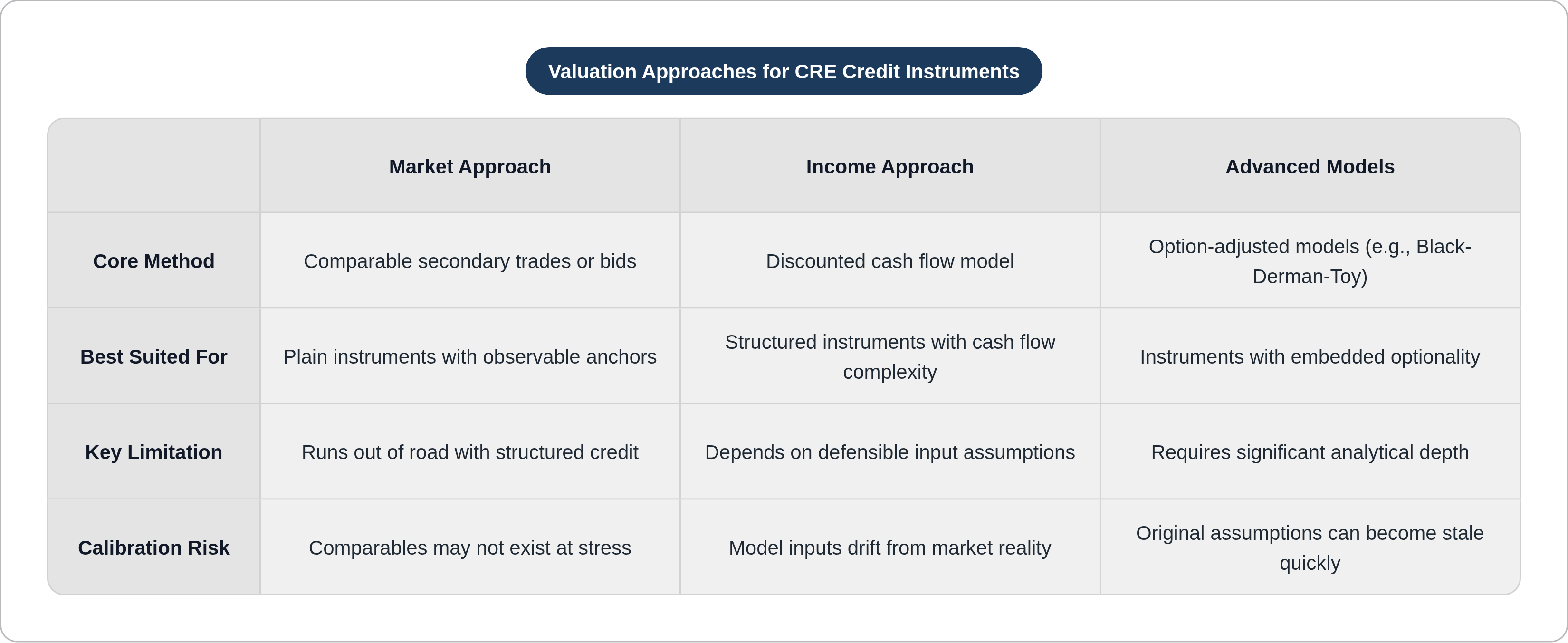
ASC 820 offers three approaches: market, income, and cost or replacement. For CRE credit, the market approach, using comparable secondary trades or bids from qualified buyers, is usually where a manager starts, especially when sizing an unrealized gain. It's the closest thing to an observable anchor this asset class ever gets.
The market approach runs out of road fast, though, once structured credit gets involved. A comparable trade doesn't capture a prepayment option, an extension right, a PIK toggle, or the way a covenant might redirect cash flow the second things get stressed. The income approach, a discounted cash flow model, picks up that slack, and for instruments with real embedded optionality, something more involved like a Black-Derman-Toy model earns its keep. Which approach fits comes down to what the instrument actually is and what inputs are realistically available, weighed against the analyst's own comfort level running it.
Then there's calibration, which is easy to skip and expensive to skip badly. A manager needs to check, periodically, whether a model's original inputs still track what the market believes today versus what it believed at deal close. That means anchoring back to original transaction pricing, then asking honestly whether conditions have moved far enough to drag the model along with them. In CRE credit, this matters most when the collateral market itself is repricing: cap rates widen, occupancy softens, rates move, and a loan's fair value can drift a long way without ever tripping a formal covenant test. Skip live calibration, and that drift just sits there, unnoticed, until it's suddenly everyone's problem at once.
The governance architecture that sits behind every fair value determination
For regulated funds, the SEC's valuation rule spells out who does what, and it doesn't leave much room for improvisation. The investment adviser handles day-to-day valuation; the board oversees it. A board can formally designate the adviser, or someone else, as fair value designee, but designation carries an ongoing weight of its own. It keeps oversight responsibility and is supposed to get regular reporting on what's actually happening inside that process, not a summary slide once a year.
The entire point of board oversight is friction against adviser discretion, particularly for Level 3 assets where the adviser has real room to maneuver. Third-party pricing agents and independent valuation specialists fill in around the edges, especially useful for complex or distressed positions where an internal number benefits from an outside check that isn't grading its own homework. Add valuation committee review, documented methodology changes, and clear escalation paths for positions that have moved materially, and there's a governance skeleton that can bear weight when something goes wrong.
Annual independent audits and SEC exams sit on top as external accountability, and enforcement action for weak fair value practices isn't a hypothetical line item buried in a compliance memo. It happens, with some regularity, and it's rarely quiet when it does. The operational squeeze is real too: regulated funds often get very little runway between a valuation cycle closing and NAV publishing. Firms that treat governance as paperwork assembled after the decision's already made tend to find out, usually at the worst possible moment, that the calendar doesn't allow for that approach anymore.
What a real valuation cycle looks like when a borrower's position deteriorates
At origination, the adviser builds a cash flow model, works through the risk profile, and lands on a baseline valuation anchored to the actual transaction price. Fine, nothing dramatic yet. At the next cycle, assuming nothing's changed much, the methodology holds and the valuation rolls forward with minor tweaks. This is the routine part of the job, and most cycles go exactly this way, without incident, quarter after quarter.
Then a borrower reports a revenue shortfall that trips a covenant, and the routine breaks. The valuation team flags it, pulls updated financials, and brings in third-party pricing agents to gauge whether the market would reprice something comparable. The loan gets marked down, the reasoning gets written up in detail, and the whole thing gets escalated through the valuation committee and folded into board reporting. Whoever transacts in the fund's next liquidity window does so at that new, lower number, whether they're happy about it or not.
Notice what that entire sequence depends on: the underlying data being available, accurate, and current the moment the cycle opens. If the borrower's financials are three weeks stale, if the covenant calculation is running off an outdated add-back schedule, if the property-level operating data hasn't been refreshed since last quarter, the valuation team's grip on real-time risk starts to slip. What comes out the other end is a careful, well-documented account of a situation that no longer exists, a bit like a weather report for yesterday. Nine times out of ten, the failure traces back to the plumbing, not the analysis.
How NAV finance facilities add a second layer of valuation scrutiny to portfolio assets
NAV finance facilities use the portfolio's own net asset value as collateral for a loan to the fund, borrowing against portfolio value rather than against LP commitments the way a subscription line does. This market has grown considerably in recent years and shows no sign of slowing, which says something about how central this financing tool has become to daily operations at private credit funds.
Put Level 3 assets up as collateral, though, and they get scrutinized twice as hard: once by the fund's own auditors, and again by a lender who now has real money riding on that valuation being right. Covenant calculations tied to NAV only become trustworthy on autopilot if the underlying administration platform is capturing and categorizing transactions as they happen, continuously. Skip that step, and covenant monitoring turns into a quarterly fire drill, everyone scrambling to reconstruct what should have been tracked all along.
There's a reporting wrinkle worth flagging here too. LPs need to see performance both gross and net of the facility's impact, because leverage boosting returns carries a very different meaning than leverage masking a problem underneath, and LPs deserve to know which one they're actually looking at. For CRE credit managers, the practical upshot is that NAV calculation quality quietly stopped being just a reporting matter somewhere along the way. It's a credit facility covenant matter now, and errors surface faster than they used to.
Where the process breaks down without reliable underlying data
Every piece of the valuation cycle, calibration, methodology, covenant checks, governance escalation, rests on one thing underneath it all: current, accurate data about the underlying positions. Pull that out and none of the sophistication described above matters much. For CRE credit, that data means borrower financials, property-level operating statements, rent rolls, occupancy figures, covenant compliance certificates, and in most shops it still arrives roughly the way it did a decade ago: PDFs, email attachments, borrower portals, then someone extracting and normalizing it by hand before anything resembling analysis can even begin.
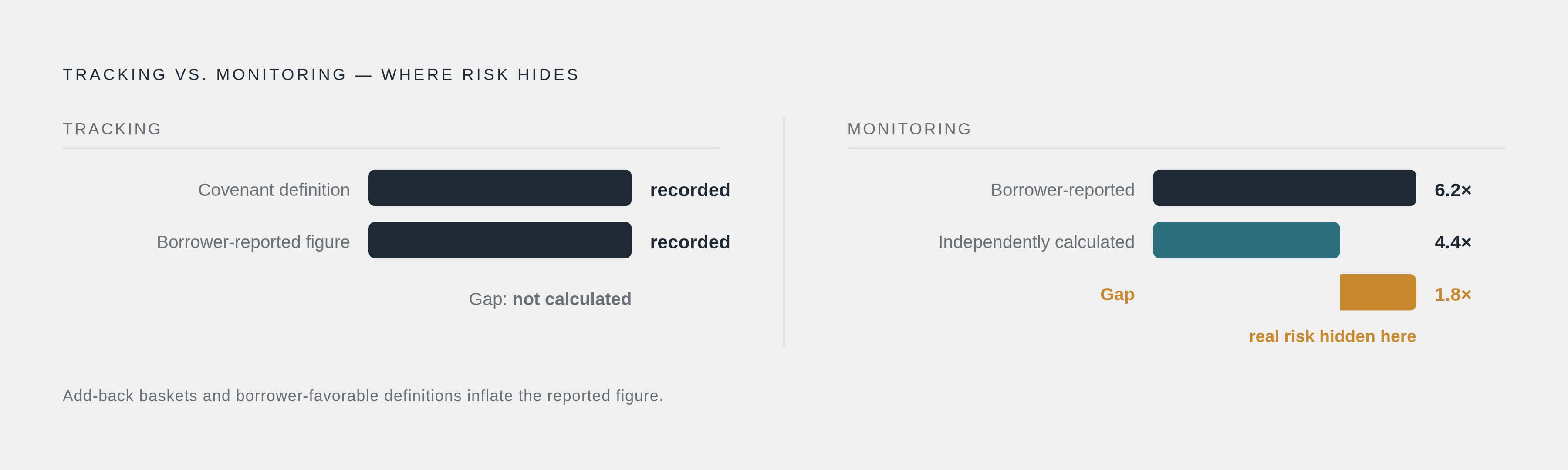
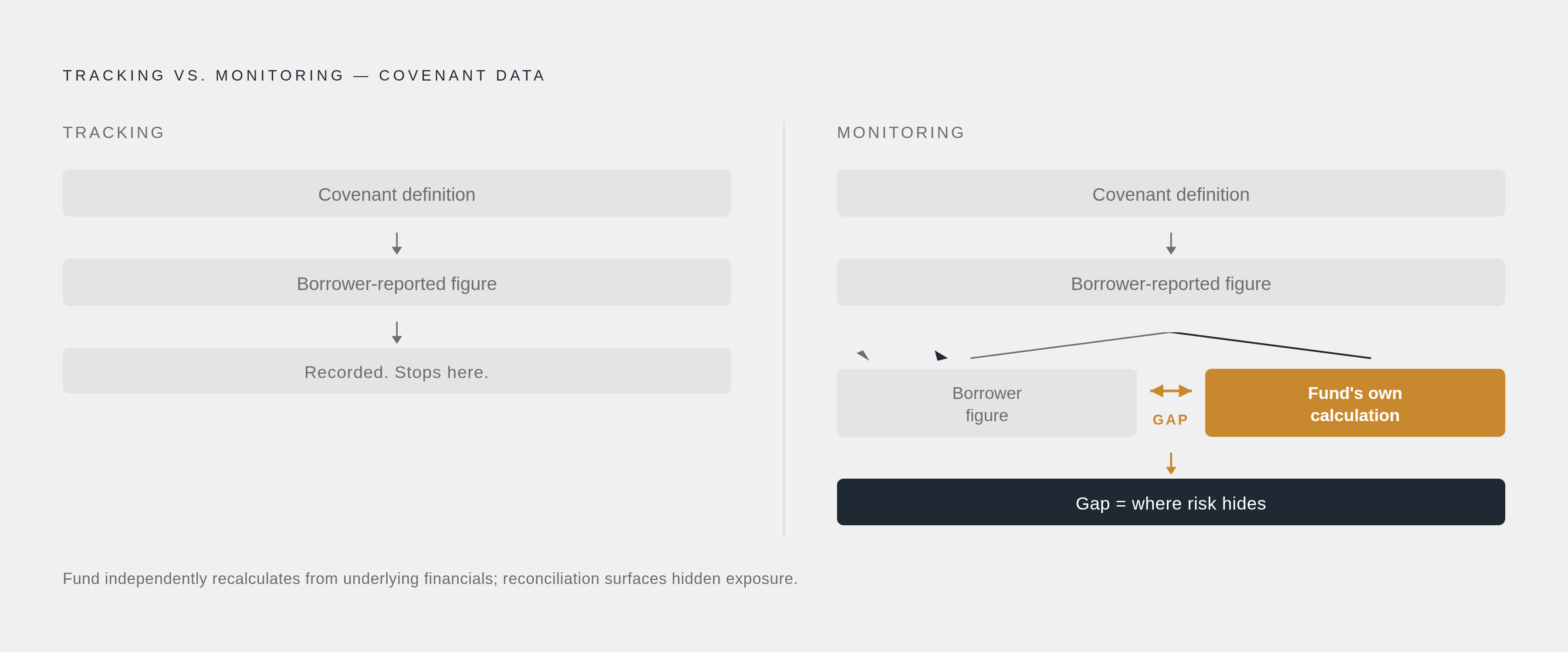
There's a distinction worth being precise about here, because a lot of credit risk hides inside it. Tracking software records the covenant definition and whatever number the borrower reported, full stop, end of story. Monitoring software calculates the fund's own version of that figure independently, straight from the underlying financials, and reconciles it against what the borrower claimed. Private credit deals are stuffed with borrower-favorable definitions and generous add-back baskets, and the gap between the reported number and the independently calculated one is exactly where the real risk hides. A system that only tracks will surface that gap slowly if at all; a team monitoring by hand will find it eventually, but only as fast as the data shows up and someone actually has the hours to run the numbers.
When valuations are due on a tight timeline, then, the bottleneck almost never turns out to be the model. It's the data, stalling everything downstream of it. Delayed data isn't just a scheduling inconvenience: a valuation built on stale inputs describes conditions that no longer exist, which is a governance problem even when the methodology behind it is flawless on paper.
What purpose-built infrastructure changes about the valuation and monitoring workflow
The core need is easy to describe and hard to build: something that takes raw CRE documents, operating statements, rent rolls, loan agreements, covenant compliance certificates, and turns them into structured data you can query, without someone retyping numbers into a spreadsheet at 11pm the night before a board meeting. Automated financial spreading removes the extraction bottleneck outright. The data's sitting there, ready, when the valuation cycle opens, well ahead of the pressure that builds once the cycle is already underway.
Covenant monitoring that calculates independently from the underlying financials, rather than just logging whatever figure the borrower submitted, is what makes the tracking-versus-monitoring distinction operational instead of theoretical. Source citations attached to every extracted data point let a valuation team, or an auditor, trace a number straight back to the original document, which matters a great deal when Level 3 documentation gets pulled apart line by line in review. Dashboards surfacing covenant exceptions, upcoming test dates, and positions that have moved meaningfully let a valuation committee spend its limited attention where it's actually needed, weighted by risk rather than spread evenly across every position regardless of how much attention it warrants.
For regulated funds working against compressed publication windows, that speed is what lets rigorous governance and a tight cadence coexist instead of fighting each other for the same three days. Generic AI tools can summarize a document and draft a memo, and they treat loan covenants, waterfall mechanics, and CRE financial statement conventions as generic text. Purpose-built tools structured around those conventions from day one, with CRE treated as the foundation rather than an afterthought, make a real difference in an audit or an SEC exam, where a methodology resting on manually assembled data with no real chain of custody is a much harder thing to defend than one built on a documented, repeatable process.
What sound NAV and fair value reporting actually requires from a CRE credit operation
NAV and fair value reporting works best understood as a live readout of portfolio quality, closely tied to operations rather than sitting downstream waiting for clean numbers to arrive eventually. It's only as trustworthy as the data and governance underneath it happen to be on that particular day.
A credible process needs methodology that fits the instrument, calibration that keeps pace with a moving market instead of lagging a quarter behind it, a governance structure that keeps preparation and oversight genuinely separate, and data that's current the moment the cycle opens rather than close enough for government work. None of this is optional texture for CRE credit professionals to admire from a distance. The instruments are genuinely complex, the collateral is illiquid by nature, and the data arrives in formats that resist automation unless the system underneath was actually built to handle them, not retrofitted onto something else after the fact. Covenant monitoring that calculates independently, instead of just writing down what it's told, is the difference between a valuation cycle that catches deterioration as it happens and one that documents it thoroughly, carefully, and far too late for anyone to do much about it.