Loan Loss Provision Accounting for Credit Funds
How credit funds account for loan losses under CECL and recent rule changes.

Loan loss provision accounting for credit funds comes down to a handful of mechanics: the ACL equation, CECL's life-of-loan loss model, and a fresh amendment in ASU 2025-08 that changes how acquired loans hit the books. Get any one of these wrong and the error doesn't stay in a footnote. It moves straight into reported net income, NAV, and whatever a regulator decides to ask about next.
The ACL equation
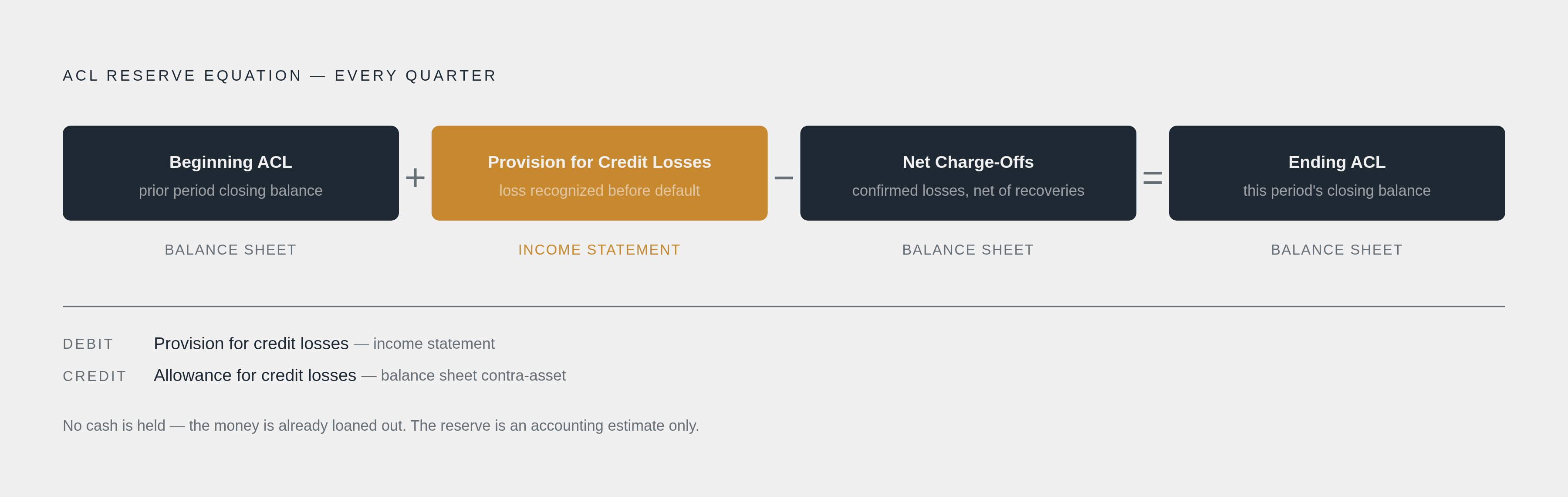
A loan loss provision is an income-statement entry that recognizes an expected credit loss before any borrower has actually missed a payment, not a pot of money set aside for a rainy day. The balance sheet holds something different, called the allowance for credit losses (ACL), and the two connect through one equation that governs every quarter's reserve math: Beginning ACL plus Provision for Credit Losses minus Net Charge-Offs equals Ending ACL. Every figure a fund discloses about reserve adequacy traces back to that identity, whether the fund's CFO realizes it or not.
The accounting mechanics behind this are plain double-entry bookkeeping: debit "provision for credit losses" on the income statement, credit "allowance for credit losses" on the balance sheet. No cash sits in a vault labeled "in case of default." The money is already out the door, loaned to a borrower, and the allowance is an accounting adjustment that says, honestly, some of this isn't coming back.
Miss the equation in either direction and the consequences aren't abstract. Under-provision and the fund is reporting a NAV that doesn't reflect its real credit exposure, a problem that tends to appear at the worst possible moment, usually right when an LP asks a pointed question or an auditor pulls a sample.
CECL's effect on loss recognition timing and scope
The old incurred-loss model waited for trouble. Banks and funds only had to book a loss once it was "probable and estimable," typically on a 12 to 18 month horizon, which meant losses got recognized only after they'd basically already happened. CECL, the current expected credit loss standard, throws that sequencing out. It requires lifetime expected losses to be recognized at origination, the moment the loan is booked.
For private credit funds, this isn't a future concern to plan around. Any calendar-year fund has been living under CECL since its 2023 year-end close. A long-duration CRE loan now demands a bigger day-one reserve than a short-duration loan to the same borrower, because that reserve calculation is visible in loan duration: the fund reserves against the loan's entire life, not just the next year or so. Duration becomes a capital planning variable in its own right, not just a pricing input. The accounting choice bleeds directly into the price of credit.
Segmenting CRE loans and running the PD/LGD model under CECL
Applying CECL to a CRE portfolio starts with segmentation. Loans get pooled by the property type backing them, office, multifamily, industrial, retail, because loss behavior differs enough across these categories that lumping them together would make the model meaningless. An office loan in a market with rising vacancy doesn't behave like a multifamily loan with stable occupancy, and treating them identically would understate risk in one pool while overstating it in the other.
ACRES Commercial Realty Corp.'s 10-Q for fiscal year 2026 shows what this looks like for a real, disclosed CRE lender. Forecasting CRE losses with any confidence more than a year out is genuinely hard, and regulators accept the mean-reversion approach as long as a fund applies it consistently and documents why.
Every CRE loan gets evaluated for credit deterioration at least quarterly, at each reporting period, under CECL and ASC 326. The standard doesn't specify which employee has to run that review, which leaves real latitude in how a fund staffs the function, but it does require that the review happens on schedule. And collateral, even strong collateral, doesn't make the reserve go away. Even when the current fair value of the collateral exceeds the loan's amortized cost basis, a reserve is still required, because that value can erode before or during a default proceeding. A building worth more than the loan today isn't worth more than the loan the day the special servicer gets involved.
How active CRE stress translates into provision movements
The mechanics above are actively generating provision pressure across CRE portfolios right now, and the aggregate numbers show it, if you know where to look. Dig one layer down and the picture gets uneven fast, with conditions varying a lot across CRE sub-sectors and across bank-size cohorts.
The stress isn't a broad sectoral collapse. Deutsche Bank's mid-2026 disclosures (for the period ending June 30, 2026) put a number behind this pattern, attributing the quarter's provision for credit losses to specific cases, mainly in U.S. West Coast commercial real estate, along with the planned exit of certain non-performing exposures. The bank describes proactive borrower engagement around maturities, and plenty of those conversations end in forbearance arrangements that trigger Stage 2 classification under IFRS 9.
That sequence, maturity stress leading to forbearance negotiation leading to Stage 2 or Watch classification leading to a bigger provision, isn't specific to IFRS reporters. It applies equally under CECL's expected-loss logic, just with different labels on the stages. What's notable right now is that CRE charge-off ratios remain low relative to how much sector stress is actually out there. CECL was built to make reserves move before the losses appear in the charge-off line, and that's exactly what's happening. It's also exactly what auditors and investors are going to scrutinize most closely: is the reserve actually big enough for what's coming, or is it just a number that looks responsible on paper?
How sentiment and managerial discretion distort CECL provisions
CECL asks managers to make a judgment call about where the economy is headed, and judgment calls are where things get interesting. Research by Bae, Berger, Choi, and Kim found that banks showing more negative sentiment raise their loan loss provisions beyond what the actual economic fundamentals and future charge-offs would justify. The provision, in other words, can track the mood in the room as much as the math on the page.
That distortion doesn't stay contained to the income statement. The effect gets stronger during recessions specifically, which is almost a cruel irony: CECL was designed to reduce pro-cyclicality, yet a discretion-based framework can amplify it instead, right when the dampening effect matters most, if managerial pessimism isn't tied back to documented, specific fundamentals.
None of this is an argument against CECL's discretion. Regulators gave managers judgment on purpose, because no formula captures every forward-looking risk a CRE portfolio faces. The governance task is making that discretion legible: every economic forecast, every qualitative overlay, every PD assumption used in the model needs enough documentation behind it that an auditor, an LP, or an examiner can tell the difference between a reserve built on evidence and one built on a bad mood. That documentation discipline is the hinge the next two sections turn on.
Covenant monitoring failures and provisioning risk under CECL
Stale covenant data is a provisioning failure under this standard, not just sloppy asset management, because the number feeding the ACL equation is no longer current.
The latency problem here is built into how CRE lending works. A debt service coverage ratio (DSCR) covenant tested quarterly depends on trailing financial statements that can arrive months after the period they actually cover. The breach happened. The fund just didn't find out about it on schedule.
What follows from an undetected breach is a chain of understatement: the loan doesn't get reclassified into a higher-risk category when it should, the provision tied to that loan stays too low, and a gap opens up between the reserve the fund reports and the reserve the portfolio actually needs. Undocumented waivers and inconsistent treatment, waiving a covenant violation for one borrower while enforcing it for another with no written rationale for the difference, register as findings on their own, regardless of whether the final provision number turned out to be right or wrong.
ASU 2025-08 changes for acquired loans in secondary transactions
Buying loans, rather than originating them, has its own accounting problem, and until recently CECL handled it badly. Under the prior framework, acquiring a non-PCD loan (one not purchased with credit deterioration) meant booking the full expected credit loss as an income-statement expense immediately on acquisition. That created an odd day-one loss, even though the purchase price the fund paid already reflected the market's view of the loan's credit risk. The fund was effectively penalized twice for the same risk: once in the price it paid, and again in the forced expense recognition.
ASU 2025-08 fixes this through what's called the gross-up approach. The gross-up approach removes the day-one credit loss expense from the income statement. What's left to recognize over time is just the non-credit discount, the gap between the loan's par value and its grossed-up amortized cost, which accretes into interest income across the life of the loan instead of hitting the books all at once.
Qualifying for this treatment depends on seasoning criteria. Loans acquired through a business combination using the acquisition method skip this test altogether and are automatically treated as seasoned, though the fund still has to determine first whether the loan counts as PCD before reaching that conclusion. Credit cards are explicitly excluded from the ASU's scope, while other open-ended credit lines, home equity lines of credit among them, are included.
For credit funds that buy loan portfolios in the secondary market, participate in note sales, or pick up exposures through VIE consolidations, this amendment changes two things at once: the immediate hit to the income statement on the day of acquisition, and the shape of interest income recognized afterward. Both are mechanical changes with real reporting consequences, not just a tweak to disclosure language.
Automated document extraction and covenant monitoring
Fixing the latency described above takes more than a reminder to check covenants more often. It takes infrastructure that pulls, structures, and monitors loan-level data continuously, without a person having to manually go fetch it at each reporting date. Agentic AI systems available in 2026 can retrieve documents on their own, extract structured financial data out of almost any format, PDFs, scanned images, spreadsheets that don't follow any consistent template, reconcile the inevitable conflicts between sources, and feed the output into a fund's existing financial models. The human handoff that used to sit between a borrower's submission and the covenant calculation is removed from the process.
Applied to CECL provisioning, that means a DSCR breach is visible the moment the underlying financials get processed, not whenever the next quarterly portfolio review happens to land on the calendar.
The lending technology market already shows two different approaches to this. Abrigo added Lending Assistant, a set of generative AI features, onto its existing loan origination system in September 2025, adding data extraction, loan narrative drafting, and document checking to a platform that already serves broad lending workflows. Archer took a narrower path, building a multifamily-focused platform that pulls from a large database of rent and financial comparables through machine learning and turns out a first underwriting in 15 minutes or less. One is a general lending tool picking up AI capability; the other is purpose-built for one CRE asset class.
That distinction carries real weight for CECL compliance specifically. The output has to already speak the language the reserve model is built on.
What reserve adequacy signals mean
The ACL coverage ratio, allowance measured against total loans and leases, is the main number outsiders use to judge reserve adequacy, and it cuts both ways. The St. Louis Fed's analysis points out that a high ratio can mean expected losses are coming, or that the portfolio is simply riskier by design, while a low ratio could mean a genuinely higher-quality book, economic optimism that turns out to be justified, strong collateral, or just an underestimate of the losses actually coming. Neither reading is automatically the right one, so readers need the explanation behind the number, not just the number itself.
Auditors reviewing a CECL-compliant allowance check three things in particular: whether the segmentation choices are documented and make sense, whether the economic forecasts behind the model are defensible and applied the same way across the whole portfolio, and whether qualitative overlays trace back to specific identified risk factors rather than to a manager's general sense that things feel shaky. LPs are asking something adjacent but distinct: does the NAV they're looking at reflect current expected losses, or is it running a quarter or two behind reality? That question turns a fund's provisioning methodology and its covenant review cadence into something closer to investor relations material than a back-office accounting detail.
Regulatory examiners with CRE concentration on their desks focus on timeliness of breach detection, documentation of any waivers, and consistency of treatment across the portfolio. A deficient process is enough on its own to draw a citation, independent of whether the ending ACL happened to land in the right place.
What ties all of this together is a single standard: a credit fund's CECL allowance has to be auditable at any point in time, with its data inputs, segmentation logic, model assumptions, and qualitative adjustments all traceable back to documented sources. Not reconstructed after the fact from an analyst's personal workbook when someone finally asks for backup. CECL's design places that documentation burden on the practitioner by intention, and meeting it takes both a methodology built with that scrutiny in mind and the infrastructure to maintain it quarter after quarter, not just assembled the week before the audit shows up.
Sources
- Recognition of Credit Losses for Some Purchased Loans
- Banking Analytics: Allowance for Credit Losses Remains Stable at U.S. Banks
- FASB Amends the Accounting for Purchased Loans (November 13, 2025)
- Bank Sentiment and Loan Loss Provisioning Junsung Bae ∗ Allen N. Berger†
- Financial Instruments—Credit Losses (Topic 326) No. 2025-08 November 2025