Loan Loss Reserve Accounting for Private Lenders
Private lenders must adopt forward-looking reserve practices or risk capital constraints.

CECL changed the basic premise of loan loss reserve accounting, but most private commercial real estate lenders have not fully absorbed what that means for how they run their portfolios. The current expected credit loss standard asks lenders to treat reserve-setting as a forward-looking risk discipline rather than a quarterly bookkeeping task, and for CRE specifically, that discipline demands continuous visibility into collateral values, covenant status, and loss trajectories across every loan on the book.
The break CECL marks from the incurred-loss era
Picture a CRE lender the day before CECL took hold. CECL, codified in ASC 326, throws out that waiting room. Every financial asset now carries a reserve from the day it is booked, built on what the lender expects to lose over the life of the loan, not what has already gone wrong. The Congressional Research Service has called this shift one of the most significant accounting changes in the banking industry in roughly four decades, which is a strong claim for an accounting rule but not an exaggerated one given how it rewires the core logic of loss recognition.
The mechanics bear this out. Earnings now move with expected losses the lender has not yet taken, not just the losses already realized. That is the conceptual hinge the rest of this piece turns on: CECL did not tighten an old process, it replaced the question lenders are required to answer, and everything that follows, from scope to data infrastructure, is downstream of that replacement.
Which private CRE lenders are in scope
Private CRE lenders are not watching CECL from the sidelines. They sit squarely inside its scope, and the adoption clock has already run out. The Federal Reserve's CECL guidance makes clear that ASC 326 applies to banks, savings associations, credit unions, and financial institution holding companies of every size, covering loans held for investment, held-to-maturity securities, and off-balance-sheet credit exposures such as loan commitments and standby letters of credit. By 2024, every U.S. bank operated under CECL. Federally insured credit unions moved onto the same timeline, with required regulatory reporting starting with the March 31, 2023 Call Report, and only credit unions under $10 million in total assets get an exemption, unless state or NCUA regulators say otherwise.
None of this is a planning question anymore. No private CRE lender gets to say it is "getting ready" for CECL. Whether the reserve process built to satisfy that 2022 deadline would survive an examiner asking how each number got there is what the rest of this piece works through.
Why forward-looking reserve-setting is structurally harder for CRE
CECL asks lenders to build reserves from three inputs: historical loss data, current conditions, and reasonable, supportable forecasts. The collateral being a building instead of a credit card balance or an auto loan makes each one harder.
Start with history. Private CRE lenders, especially newer entrants and non-bank platforms, often don't have a loss history that is long enough to be statistically credible on its own. The standard allows peer data to fill that gap, but choosing the right peer group for a bridge, construction, or mezzanine strategy takes judgment, and judgment is what examiners probe hardest.
Current conditions pose a separate problem. Appraisals happen periodically, so a broker opinion of value only captures a single moment, and when office properties have fallen well off their prior peaks, a reserve built on a stale appraisal fails the current-conditions test before anyone even gets to the forecast.
Then there is the forecast itself. Stretch that forecast across a five- or seven-year loan life, the typical span for a CRE instrument, and the degree of difficulty climbs again.
The Federal Reserve's CECL guidance lists acceptable methods, loss-rate, roll-rate, vintage analysis, discounted cash flow, and probability of default paired with loss given default, and notes that the method chosen has to match the portfolio's complexity. A reserve process built to satisfy a consumer loan auditor will likely fall short for a CRE book, because that book needs this kind of continuous refresh.
The CRE credit environment in 2026 and reserve adequacy
Reserves built on pre-2022 loss averages are working from a dataset the current market has already outrun. The Federal Reserve's Supervision and Regulation Report confirms that commercial real estate headwinds have persisted, with CRE loan delinquency rates sitting above their decade-long historical averages, and it flags elevated interest rates and lower property values as factors weighing on borrowers' ability to refinance or pay off loans.
Supervisors have kept their attention trained on office and multifamily, and banks carrying heavy CRE concentrations should expect examiners to dig into workout strategies, stress-testing assumptions, and ACL methodology with real intensity. That sector split matters for how reserves get segmented. Credit stress is not evenly distributed across CRE: office carries the most visible strain, while other property types show more selective pockets of deterioration. A lender that pools office with industrial or multifamily into a single reserve bucket will get the number wrong in both directions, overstating risk in the properties that are fine and understating it in the ones that are not.
Add to that the sheer volume of loans maturing in 2026 and 2027, described in current research as very large, and workout teams at many private lenders are facing triage pressure at a scale they were not staffed to handle. Expected loss trajectories on loans approaching maturity cannot be treated as fixed assumptions carried forward from origination.
New York Community Bancorp offers a concrete illustration of what happens when reserves fall short of that reality. Its 2024 drawdown and 2025 reorganization showed how quickly CRE concentration can force capital action once a reserve proves inadequate, previewing the speed at which an under-reserved CRE book can move from an accounting footnote to a balance-sheet emergency.
How CECL reserve levels affect lending capacity
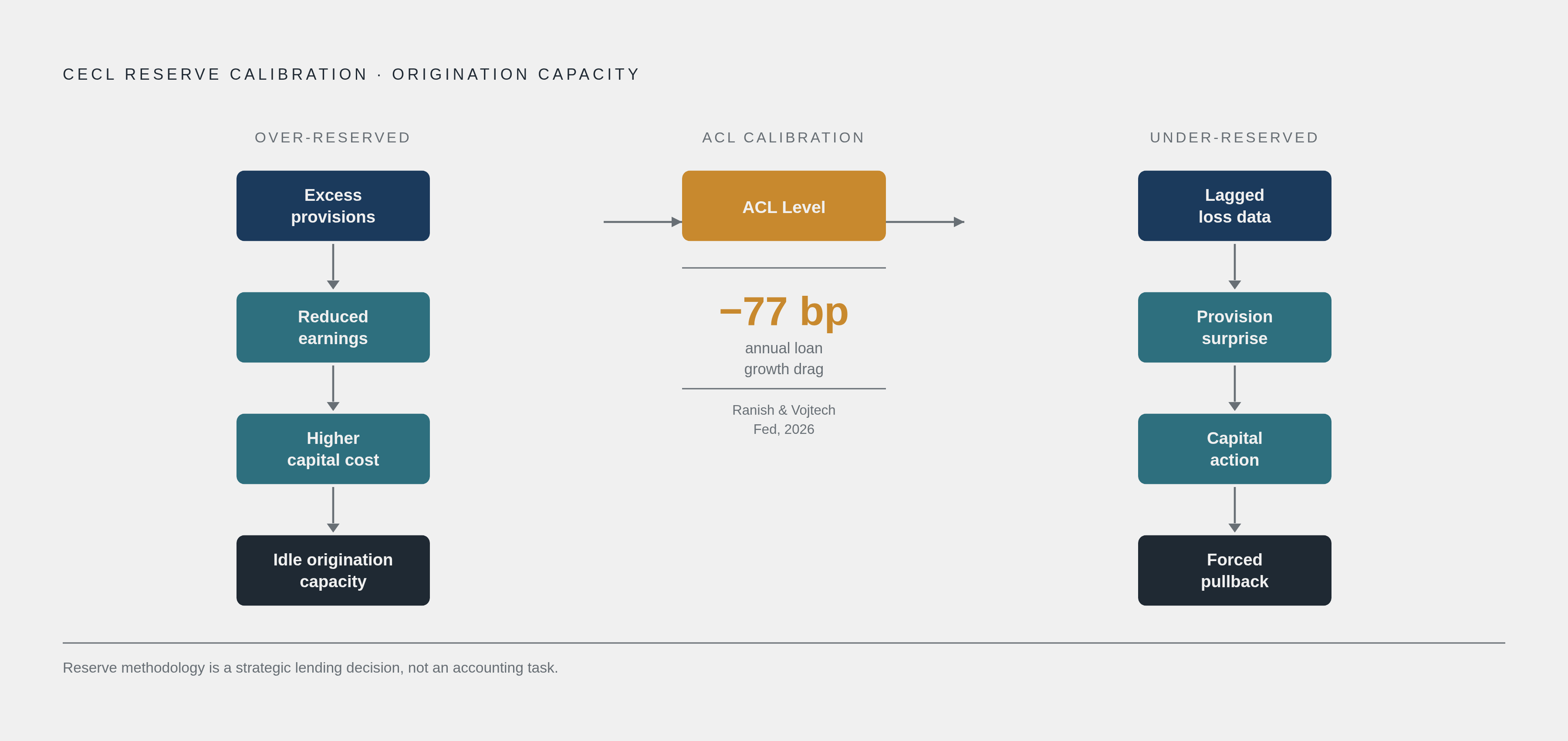
Reserve levels are visible in more than the income statement. They affect how much a lender can actually lend, through a mechanism that works much like capital requirements. A September 2026 Federal Reserve working paper by Ben Ranish and Cindy M. Vojtech, circulated as a staff paper rather than settled Fed policy, found that loan loss allowances exert a causal effect on credit supply similar to capital requirements, and that CECL adoption reduced loan growth by roughly 77 basis points annually in the years following adoption within their sample.
The logic runs through capital costs. Provisions reduce earnings, lower earnings reduce capital, and capital is a more expensive funding source than deposits or other forms of debt. So reserve methodology is a strategic decision about lending capacity, not a defensive accounting posture. A lender whose ACL tracks actual expected loss, neither padded by excess caution nor flattered by optimistic assumptions, is lending at the real edge of its capacity. If a lender's ACL drifts off that mark in either direction, it is either sitting on unused origination room or building toward a provision surprise that lands all at once.
You might argue that conservative reserving carries no real downside, since it just builds a buffer against the unexpected. The Ranish and Vojtech finding, along with the Congressional Research Service's note on CECL's pro-cyclical risk, suggests otherwise: during downturns, CECL may push banks to pull back on credit availability precisely when forecasts turn gloomy and capital preservation takes priority, which can deepen the very contraction the reserve was meant to guard against. If a private CRE lender has not stress-tested its ACL methodology against a real downturn scenario, it may find itself living that dynamic with little runway to adjust.
Requirements for continuous portfolio visibility in a CRE lending operation
A defensible CECL reserve is not something a lender produces once a quarter and files away. It runs on current property financials, live covenant status, fresh collateral valuations, and loan-level loss trajectories that need to be ready to support the number at any point an examiner asks. Both the Federal Reserve's CECL guidance and the NCUA's standards stress that the estimation method chosen has to come with documentation behind it, because a reserve figure is only as solid as the data and reasoning holding it up.
For a CRE lender, that means keeping several things current at every reporting date: borrower operating statements and rent rolls, property-level net operating income trends, updated appraisals or valuations, covenant compliance testing, and the macroeconomic variables tied to relevant property markets. If any one of these is missed, the reserve reflects an older version of the portfolio than the one actually sitting on the books.
Covenant monitoring deserves particular attention here, because it is easy to treat as a compliance task separate from reserve-setting when it is actually feeding the same number. If a covenant breach signals that a borrower's condition is deteriorating, that deterioration belongs in the ACL as a current-conditions input. A lender whose covenant team and reserve team work in separate silos will find repeatedly that the reserve lags what the portfolio is actually doing.
Segmentation matters just as much. CECL requires grouping loans with similar risk characteristics before estimating losses against them. A private CRE lender running a single loss rate across office, industrial, multifamily, and construction loans is not segmenting at all, and the allowance is probably wrong in every one of those buckets simultaneously. Layered on top of all this sits the qualitative adjustment, the "Q-factors" regulators consistently flag in CECL guidance, where current market conditions, examiner-identified risks, and forecast elements not captured in historical data get folded in. Heading into 2026 conditions, if a lender fails to use Q-factors to account for elevated office risk or sector-specific refinancing pressure, it has left a documentation gap that examiners will find without much effort.
How AI-driven portfolio monitoring closes CECL's data gaps
You cannot solve the problem of keeping property financials, covenant status, and collateral valuations current across every loan in a portfolio just by hiring more analysts and asking them to work faster. It is a problem of continuous data flow, and that calls for automation built to extract, validate, and surface the inputs the ACL methodology actually depends on.
Several applications map directly onto that need: automated financial spreading from borrower operating statements and rent rolls, covenant testing run continuously against live property financials rather than on a quarterly cycle, collateral tracking tied to market valuation signals, and portfolio dashboards that flag loans approaching covenant thresholds or refinancing stress before they turn into provision events. The MBA CREF 2026 Technology Council pointed to exactly this shift, from periodic to continuous monitoring, as the direction the industry is heading, and it lines up precisely with what CECL's current-conditions requirement actually demands. The ACL was never meant to be a once-a-quarter exercise, so the data feeding it should not be collected on a once-a-quarter schedule either.
A general-purpose AI tool, however capable, runs into trouble here. A CRE lender's ACL methodology is built on that firm's own historical loss data, its loan templates, its covenant structures, and its own property-type segmentation. If a horizontal tool does not understand CRE document conventions or loan structures, it will extract data with errors, and those errors compound as they move through the reserve calculation. The productivity case backs up the capacity argument too: professionals using AI assistance complete more tasks, faster, and at higher quality. In a lending operation where document review and financial analysis sit at the center of daily work, that translates into the ability to keep data current across a larger portfolio without scaling analyst headcount at the same rate.
Turning CECL from a compliance cost into a portfolio management advantage
A private CRE lender that builds its CECL process with real rigor ends up holding something more useful than a reserve that satisfies an auditor. It holds a continuously updated, loan-level view of expected loss trajectories, collateral conditions, and stress concentrations across the portfolio, the same intelligence a well-run lending operation needs regardless of what the accounting standard requires.
Early warning is the clearest payoff. Continuous covenant monitoring and financial spreading turn a deteriorating loan into a managed situation. Lenders who catch that deterioration early keep more workout options open, buy more time to work with borrowers, and build a documented record of their management process that holds up if the reserve methodology ever gets challenged.
The reverse direction matters too. In the second quarter of 2026, several major banks released CRE credit loss reserves as conditions improved in specific sectors, so you can see that the ACL runs in both directions. A lender with a credible, data-grounded methodology can release reserves when the data supports it, freeing that capital back into lending capacity. But a lender working off manual, lagged data cannot make that case with the same confidence. The Ranish and Vojtech finding on reserves and credit supply cuts the same way: over-reserved lenders leave origination capacity sitting idle, while reserves calibrated precisely against real-time portfolio data put that capacity to work.
Exam readiness follows from the same infrastructure. The supervisory posture described in the Federal Reserve's June 2026 report, heavy scrutiny of ACL methodologies, stress-testing assumptions, and workout strategies for CRE-concentrated lenders, means the documentation trail an AI-assisted, source-cited reserve process generates is the evidence package examiners will ask to see. CECL arrived as a mandate to comply with. The infrastructure it demands, continuous data, loan-level visibility, documentation that holds up to scrutiny, is the same infrastructure that separates a well-run CRE portfolio from one flying on quarterly snapshots. The lenders positioned to gain ground in the next credit cycle are the ones who treated that requirement as a reason to build real portfolio intelligence, not the ones who hit the minimum documentation bar and called it done.