Financial Statement Data Extraction for Credit Analysis
AI extraction cuts document processing from hours to minutes, letting lenders move faster on deals.

The workflow that decides how many commercial real estate deals a lender can chase, how fast it can commit to one, and how many it loses to a faster competitor is financial statement extraction, a competitive liability rather than a back-office inconvenience, not underwriting judgment or capital availability. A single CRE acquisition can throw off hundreds to over a thousand pages of legal, financial, and operational paperwork: loan agreements, rent rolls, financial statements, lease abstracts, insurance certificates, title reports, property records. Every one of those documents has to be read, understood, and turned into numbers that feed a credit decision before anyone can say yes or no to a deal. The analyst hours spent getting through that pile cluster at exactly the points in the calendar where speed decides who wins the deal: origination, credit approval, and quarterly reporting. A team that can read documents faster does not just save time. It gets first look at better deals, because sellers and brokers route opportunities to lenders who can move before the exclusivity window closes.
What manual extraction costs per deal cycle
The cost of manual extraction is the sum of every document type across a full deal cycle, not what any single document takes to read, and that sum caps how many deals a team can carry at once and how carefully each one gets underwritten. A loan agreement alone takes 4 to 8 hours to review by hand, and that is one document among the hundreds in a single file. A regional bank originating loans every month racks up well over a hundred analyst hours per cycle just on this initial round of document review, before anyone touches portfolio monitoring, renewal review, or a compliance check. Those hours do not buy a finished credit file. They buy the raw material for one.
The harder, more expensive part of the job is pulling all the documents into agreement under a deadline, comparing figures by hand, normalizing numbers that never arrive in the same format twice, and assembling a memo before anyone gets to make an actual credit call. Rent rolls appear in whatever format each borrower happens to use, so an analyst has to restructure each one before it can be compared to anything else. NOI normalization differs from analyst to analyst, so two people working the same file can land on two different numbers. DSCR stress cases get rebuilt from scratch, by hand, for every new scenario a credit committee wants to see. None of that is the easy part of the job getting done slowly. It is the hardest reasoning work in the file, done under time pressure, using methods that were never built to scale.
How domain-trained AI extraction works differently from generic OCR
AI extraction built specifically for CRE reads documents at the level of what a clause means, not at the level of what characters sit on a page. That distinction is what decides whether a lender can trust the extracted numbers enough to feed them straight into a credit model, or whether someone still has to double-check everything by hand anyway. A generic OCR tool can tell you that a page contains the words "co-tenancy." A domain-trained system knows that a co-tenancy clause changes a tenant's rent or termination rights depending on who else occupies the building, which makes it operationally different from a subletting clause even though both might appear in the same lease exhibit. The same holds for an insurance certificate's loss payable endorsement, which carries specific compliance weight a keyword search would never flag, and for a kick-out clause buried in an exhibit, which is a materially different risk than a plain base termination right.
Four capabilities moved from promising to something lenders can actually run in production during 2026. Unstructured document understanding lets AI pull risk factors out of narrative paragraphs in an offering memorandum as well as out of structured fields with labels attached. Entity resolution, the task of recognizing that "ABC Holdings LLC," "ABC Holdings," and "ABC" are the same tenant across documents, went from unreliable to functional. Context windows expanded enough that a system can now process an entire 50-plus-page lease with exhibits in one pass, holding onto the thread from the definitions section through whatever gets attached at the back. And confidence scoring improved to the point where a high score reliably means the extraction is correct, which lets a firm route confident outputs straight to production and send only the uncertain ones to a human reviewer.
What makes this matter for an analyst's day-to-day is that what comes out the other end is structured data that drops directly into an underwriting model or database without anyone retyping it, regardless of whether the AI "reads" the document in some human sense. That is the entire value proposition in one sentence: information that used to require manual re-entry now moves on its own.
None of this is complete. Handwritten rent rolls, scanned financial statements with odd column layouts, and tables trapped in formats a machine cannot parse still trip up even well-trained systems. Those cases end up in an exception queue, a small, specific pile of hard documents, rather than spread across the whole workflow the way manual review used to be. That shrinking exception queue reshapes the analyst's job.
The new division of labor between AI and the analyst
The most common misread of AI extraction is the assumption that it replaces the credit decision itself, which it does not. It replaces the data assembly that used to stand between an analyst and the point where a credit decision becomes possible. The job shifts from retrieving numbers to reviewing exceptions and making calls.
The split in practice looks fairly clean. AI standardizes rent rolls in any borrower format, normalizes NOI with every adjustment cited, calculates DSCR from a documented baseline, pulls more than 50 lease fields, spreads sponsor and guarantor financial statements, and drafts credit memos from structured inputs. The analyst still decides whether rollover risk is acceptable given how deep the market is and who the sponsor is, still weighs whether a medical office building with two large anchor tenants carries the same risk profile as a strip center anchored by two local restaurants, still owns every override and the reason behind it, and still makes the final credit call.
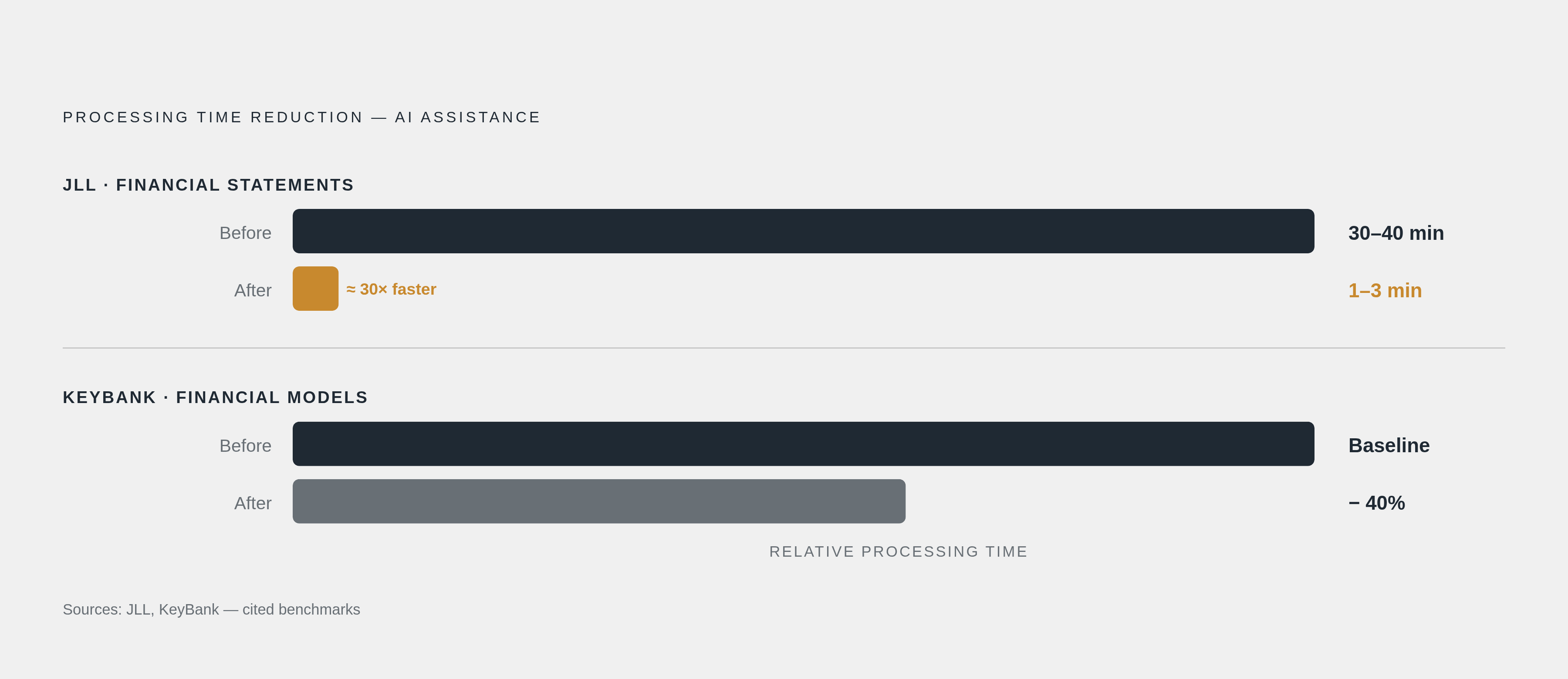
Two real numbers anchor what that shift looks like outside of theory. Financial statement processing at JLL dropped from 30 to 40 minutes per statement down to 1 to 3 minutes after an AI extraction layer went into production there, a roughly 30-times gain on one of the slowest steps in underwriting. KeyBank cut the time needed to prepare a financial model for a loan by 40 percent. Those hours are hours an analyst gets back to spend on the part of the job that still requires a person.
Fully autonomous underwriting, meaning AI making a credit decision with no human in the loop, is not mature and is not practical right now. The value sits entirely in what AI clears off the analyst's desk before judgment is needed. For this division of labor to hold up under scrutiny, the system needs a clean audit trail. When an analyst overrides an AI-extracted figure, the system has to keep the original output alongside the override and the stated reason for it, so the credit file shows both what the AI produced and what the human decided to do about it.
Cross-document reconciliation as the capability that changes credit quality, not just speed
Everything covered so far is a speed story: documents get read faster, numbers get normalized faster, memos get drafted faster. The capability that actually changes credit quality, beyond the clock, is cross-document reconciliation: catching the places where what a seller claims and what the documents actually show do not line up. Two years ago this barely existed outside of pilot projects. It is now treated as a baseline expectation for any serious platform.
Consider how a rent roll, a lease, and a tenant estoppel can each describe the same tenant slightly differently; a rent figure that is current on one document might be stale or aspirational on another. AI built for this reconciles a rent roll, lease, and estoppel against each other and surfaces discrepancies automatically. Firms running mature versions of this can feed an entire data room into the system and get a variance report back within hours, naming every place where the represented numbers and the actual numbers disagree.
The appraisal is a good test case for why this matters. Appraisals are long, repetitive documents, and the assumptions that actually drive the valuation, rent comps, cap rate support, extraordinary assumptions, the gap between as-is and as-complete value, sit buried inside pages of boilerplate. Whether the appraisal assumes a rent level the property has never actually hit is not a question either document answers on its own. It only becomes visible by comparing the appraisal against the rent roll directly. That is the kind of error cross-document reconciliation is built to catch, and it is the kind of error that manual review, document by document, is structurally prone to miss.
This capability points forward to fraud detection as a natural extension of the same logic. Smart Capital Center's Fraud Alert capability, launched after the MBA CREF 2026 conference, detects inconsistencies across documents and data sources in real time and surfaces early warning signals before they turn into actual exposure. That is cross-document reconciliation aimed specifically at fraud risk rather than general underwriting accuracy, and it is the same underlying mechanism doing a more targeted job.
Extracted data as continuous covenant monitoring rather than a point-in-time check
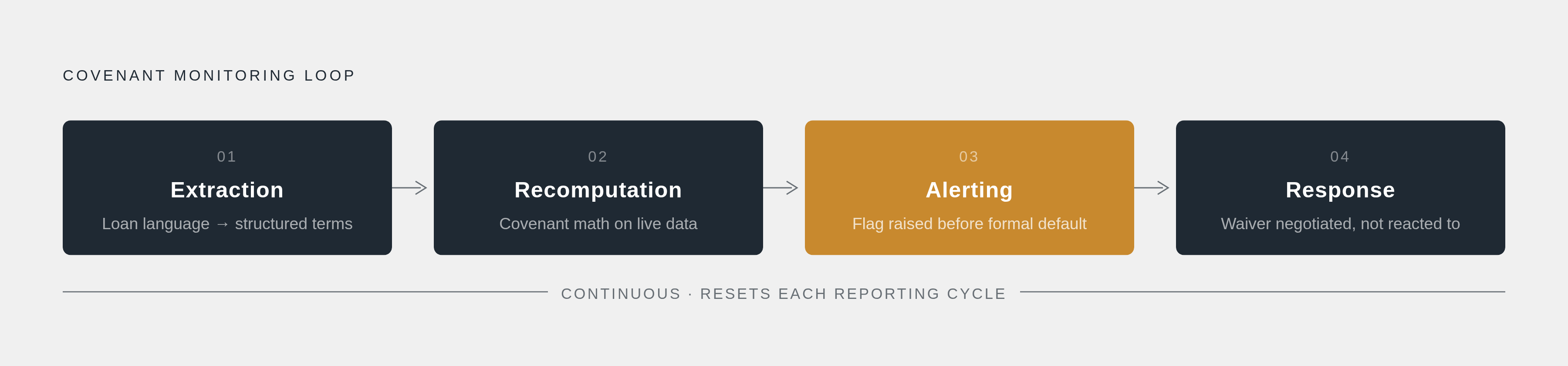
Connect extraction infrastructure across the full life of a loan, not just at origination, and covenant monitoring turns into a continuous early-warning system instead of a quarterly compliance exercise. That shift changes how risk gets managed across an entire portfolio rather than on any one loan. The mechanism works by having AI continuously read the loan agreement itself, pull live property financials from the accounting platforms borrowers already use, like Yardi or AppFolio, and recompute every covenant on a rolling basis, so a breach gets flagged weeks before it turns into a technical default.
That early warning matters because a technical default does not require a missed payment. A covenant breach counts as a technical default even when every payment is current, and it can trigger a cash sweep, default interest, or acceleration of the loan regardless of whether the borrower is paying on time. Catching the breach weeks ahead of that outcome gives a lender room to negotiate a waiver or a modification instead of discovering the problem only after it has already triggered contractual consequences.
The shift from point-in-time review to continuous monitoring runs through four stages. Extraction turns the loan agreement's covenant language into structured, machine-readable terms the first time the document is processed. Recomputation runs the covenant math on a rolling basis as new financial data comes in, instead of recalculating once per reporting period. Alerting surfaces a flag the moment a covenant trips, early enough that the lender has time to act before the breach becomes a formal default.
That four-stage loop is the same extraction capability described throughout this piece, just pointed at a different part of the loan's life. The technology that shortened a JLL financial statement review from 40 minutes to 3 is the same technology now watching a covenant in the background between one quarterly report and the next. What started as a fix for a document-reading bottleneck at origination ends up as the infrastructure for watching an entire portfolio continuously, which is a considerably bigger claim than "AI reads documents faster" and one the data above backs up at every stage of the deal cycle.