Technology Tools for Private Credit Portfolio Operations
Manual monitoring workflows hide portfolio risks as private credit scales.

Private credit has outgrown the operational model that built it. Portfolios have doubled while credit teams have not, and the tools that worked at sixty borrowers cannot see the risks hiding at one hundred and twenty. This piece looks at where manual workflows break, what continuous monitoring actually requires, and how a connected technology stack turns fragmented documents into portfolio-level intelligence.
Why private credit portfolios have outgrown the manual review model
The mismatch is structural, and it is not subtle. Direct lending platforms managing 60 borrowers in 2019 were managing roughly twice that by 2024 with largely the same credit team. Monitoring capacity did not. That is not a staffing shortfall a few good hires can fix. It is a mathematical impossibility that any manual process eventually runs into. The private credit market itself is expanding from approximately $3 trillion toward a projected $5 trillion by 2029, per a Morgan Stanley report cited at the February 2026 launch of Alkymi Private Credit. As Alkymi CEO Harald Collet put it at that launch: "Private credit is scaling faster than the infrastructure that supports it."
Consider what a 100-borrower portfolio actually demands. None of these arrive on a convenient annual schedule. They arrive monthly, quarterly, and unpredictably, on continuous cycles that do not pause for the analyst who is also running originations and managing amendments. The workflow never stops, which means the review never catches up.
The hiring solution fails on two fronts. First, the economics: scaling analyst headcount to match a 2x borrower count would compress returns in an asset class where margins are already under pressure. Second, the quality problem: even a fully staffed team cannot maintain uniform rigor across 100 borrowers while simultaneously running originations and managing amendments. Some borrowers get a thorough review, others get a quick scan, and the difference is determined by analyst bandwidth that week, not by which borrowers most need attention.
How fragmented data across loan stages turns a manageable workflow into a systemic blind spot
The deeper problem is not that CRE lenders lack data. It is that their data is trapped in stage-specific silos that prevent it from doing analytical work across the loan lifecycle. Operational teams re-review the same information at different stages, sometimes within the same quarter.
The result is that data availability is high but actionable intelligence is low. Deloitte's 2026 Commercial Real Estate Outlook, as discussed at the MBA CREF 2026 Technology Council, found that more than 60% of CRE finance organizations cite data fragmentation and manual reconciliation as their primary barriers to operational efficiency. That is a remarkable admission from an industry that has spent a decade digitizing.
The objection that firms have already digitized much of their process deserves an answer, because it misses the architectural point. Digitization without connection does not close the gap: documents in separate systems are still siloed, just electronically. What the MBA CREF 2026 Technology Council discussion centered on was a connected intelligence layer, extracting structured information from documents and routing it across workflows. That is the architectural shift that converts fragmented data into portfolio-level decisions, and it is a different problem from simply having the documents in digital form.
What continuous monitoring actually means, and why periodic review can no longer substitute for it
The difference between periodic and continuous monitoring is not speed. It is the number of credit events that get managed proactively versus discovered after the window for intervention has closed. In a quarterly-review model, an analyst reviews the portfolio in batches. The schedule drives the review when the risk should drive it.
An AI monitoring agent inverts that logic. It ingests each financial package as it arrives, scores the borrower against prior period, year trajectory, and the original underwriting model, and surfaces any borrower whose metrics are crossing a defined threshold, without waiting for the review cycle. The signal types a continuous agent monitors simultaneously include revenue declining across consecutive periods, EBITDA margin compression, fixed-charge coverage trending toward threshold, payment delays, management changes, and market shocks. No single analyst watches all of these for all borrowers at once, but the agent does, and it does not get distracted by an amendment that needs processing or a term sheet that needs returning.
It is also worth considering whether continuous monitoring creates noise rather than signal. The short answer is that thresholds and scoring models impose discipline that periodic review lacks. The agent flags what crosses a defined line. The quarterly review flags what an analyst happened to notice. One of those is a system. The other is a lottery.
Covenant extraction and tracking: where manual workflows create the most silent risk
Covenant monitoring is the workflow where manual transcription errors, growing covenant complexity, and tightening regulatory expectations combine into the most consequential risk a portfolio carries silently. The transcription risk is structural and easy to underestimate: when covenant data is manually re-keyed from a loan agreement into a monitoring spreadsheet, a 1.25x DSCR minimum entered as 1.52x creates a monitoring system testing against the wrong threshold. The portfolio never knows it, because the error is invisible by design. The spreadsheet does not alert anyone that its threshold disagrees with the loan agreement, because no one told the spreadsheet what the loan agreement said.
Covenant-lite structures add complexity without removing the monitoring requirement. A meaningful share of deals with EBITDA above $50 million were covenant-lite in 2025, reducing the number or frequency of maintenance tests. The underlying credit risk remains and must still be watched, but the formal tripwires are fewer, which means the analyst must watch more carefully with less structure to guide the attention. That is a strange place to rely on manual review.
The regulatory environment has removed the option of treating covenant traceability as a best practice. OCC Bulletin 2026-13 on Model Risk Management establishes non-binding principles for model risk management, including documentation and traceability of model outputs. The record is audit-ready by default rather than reconstructed after the fact. Alkymi Private Credit, launched February 2026, automates extraction of principal balances, interest rates, amortization schedules, payment events, covenant ratios, borrower financials, and key deal data from loan agent notices and compliance certificates, with built-in cross-validation against covenant thresholds. It is one named example of what the category looks like in practice, not a recommendation.
Financial spreading and underwriting automation: compressing decision timelines across origination volume
The operational efficiency problem is not unique to portfolio management. It begins at origination, where the manual spreading workflow becomes the rate-limiting step for institutions trying to grow without proportionally growing headcount. The Mortgage Bankers Association projects commercial mortgage origination will reach $806 billion in 2026. That volume cannot be absorbed by manual document review and spreading workflows without either expanding teams or accepting longer decision cycles.
Traditional spreading still relies on analysts to key in figures, map line items, and assemble credit memos by hand. The quality of that work varies with the analyst and the deadline, not the borrower's actual risk profile. The most advanced implementations benchmark extracted assumptions against market data in real time, surfacing discrepancies before a credit memo reaches committee.
Speed to decision is a competitive advantage in private credit. When time kills deals, the institution that can return a term sheet faster because its spreading and underwriting pipeline is automated closes deals that slower competitors lose. The same infrastructure that catches a covenant breach in month thirty also compresses a credit memo in week one. That symmetry matters more than most procurement teams acknowledge.
Portfolio-level intelligence: surfacing concentration risk and maturity walls that borrower-by-borrower review cannot see
Individual borrower reviews, however rigorous, cannot reveal the portfolio-level exposures that represent the largest source of systemic risk in a private credit book. None of these are visible in a loan-level review, because each borrower looks fine on its own. The problem is the pattern, not the parts.
Portfolio risk and concentration agents map sector, sponsor, and maturity concentration continuously. They identify cross-portfolio correlations that are invisible in individual borrower reviews and can model stress scenarios across the full book. Altus Group's ARGUS Intelligence, for example, automatically resolves tenant name variants into a single record, surfacing concentration risk, lease expiry cliffs, and mark-to-market opportunity at the tenant level. That is what structured portfolio intelligence enables and spreadsheet-based tracking cannot.
The maturity wall context makes this urgent in the current environment. Special servicers are managing higher workout volumes than at any point since 2013. AI-powered portfolio intelligence produces a weekly credit health digest, a ranked list of all borrowers by health score with flags for those requiring attention, replacing the periodic portfolio review with a continuous prioritization signal. Beyond risk, portfolio intelligence creates opportunity: when a platform surfaces refi windows, maturing loans, or mark-to-market opportunities across the whole book automatically, the institution can act on them proactively rather than discovering them deal by deal.
Data security and MNPI controls as non-negotiable infrastructure, not vendor checkbox items
The same document volumes that make AI monitoring valuable are full of material non-public information, and the architecture through which AI processes that data is a compliance requirement, not a vendor differentiator. The gain is measured in basis points. The exposure is measured in enforcement actions.
The baseline requirements are now well-established: SOC 2 Type II, AES-256 encryption, SSO/MFA, and clear data-handling policies are non-negotiable for institutional CRE firms. AI processing for MNPI-adjacent workflows must occur in a private, dedicated cloud environment: Azure OpenAI Service, AWS with appropriate controls, or on-premises, with no shared infrastructure across clients. Anything less is a data leak waiting to be discovered.
AI also introduces a new category of compliance risk it simultaneously helps detect. Financial statements, rent rolls, and borrower narratives can now be generated or modified in ways that appear plausible on the surface. The evaluation question for institutions is not whether a vendor is SOC 2 certified. It is whether the data pipeline is architecturally isolated, whether outputs are traceable to inputs, as OCC Bulletin 2026-13 requires, and whether the firm's own IP remains its own.
The adoption gap: why AI has moved fastest in origination and slowest where portfolio risk actually compounds
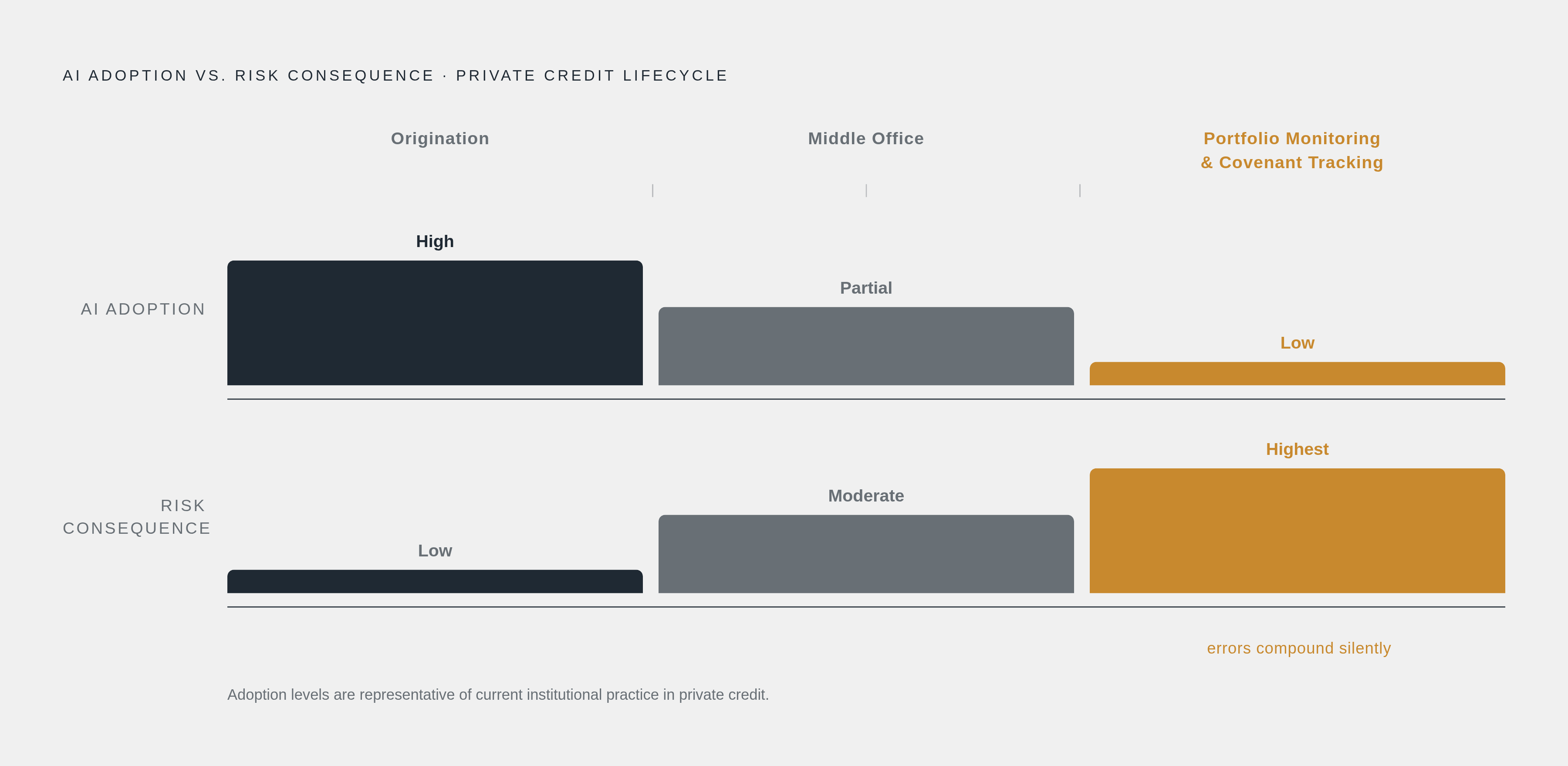
AI adoption in private credit has concentrated at the front of the loan lifecycle precisely where the portfolio risk is lowest, leaving monitoring and portfolio management, where errors compound silently, the least automated workflows in most institutions. The workflows with the highest risk consequence are the most underserved by automation. That is not a vendor problem. It is an institutional behavior pattern.
A majority of senior private credit leaders report implementing AI or automation in middle-office operations, but implementation does not equal deployment at portfolio scale. The pilot proves the concept. The deployment requires rearchitecting the workflow, retraining the team, and accepting that the old quarterly review is no longer the primary line of defense. That is an organizational change, and it is harder than buying software.
The consequence of that stall is asymmetric. The risks compound differently, and the monitoring side is the one that produces forced workouts, regulatory findings, and LP concerns. The institutions pulling ahead are not the ones deploying the most AI tools. They are the ones deploying AI where risk compounds: borrower monitoring, covenant tracking, and portfolio concentration analysis, grounded in the firm's own underwriting IP rather than generic model outputs.
What a modern private credit technology stack looks like when built for continuous intelligence
A continuous intelligence stack for private credit is not a collection of point tools. It is a connected layer that routes structured data extracted from documents across the full loan lifecycle, from origination through portfolio monitoring, into a single decision surface. Six AI agent categories are generating consistent value in private credit operations. Borrower monitoring and early warning agents ingest monthly financials, score credit health continuously, and surface deterioration signals before they become credit events. Covenant extraction and tracking agents read full credit agreements, build structured covenant models, and track headroom in real time across the entire portfolio. Credit origination and pipeline intelligence agents score opportunities against credit criteria and track relationship touchpoints to surface refinancing opportunities. Credit committee memo preparation agents draft structured CC memos from data rooms, financial models, and credit agreements, compressing preparation time from days to hours. Portfolio risk and concentration agents map sector, sponsor, and maturity concentration continuously and model stress scenarios across the full book. LP reporting automation agents normalize portfolio data to LP templates, generate narrative sections, and handle DDQ and investor questionnaire responses at scale.
Named platforms active in the covenant monitoring and loan operations space include Alkymi Private Credit, launched February 2026 and focused on document-to-data automation across the private credit lifecycle. CR Equity AI, an AI-driven private credit and valuation platform, INC 5000-recognized, with announced technology and pricing changes in June 2026. And Smart Capital Center, an end-to-end CRE investment and analysis platform with automated covenant compliance, portfolio monitoring, and fraud detection, with clients including KeyBank, JLL, and The RMR Group.
Purpose-built CRE AI platforms, engineered specifically for CRE document types, underwriting conventions, and covenant structures by teams with direct deal experience, offer a material advantage over generic horizontal AI tools in workflows where document fidelity, source traceability, and institutional IP grounding are non-negotiable. The evaluation framework for any tool in this stack comes down to four questions. Does it run in an architecturally isolated environment safe for MNPI? The institutions that build this stack correctly are not replacing credit judgment. They are removing the operational drag that currently prevents credit judgment from operating at portfolio scale.