Automated Operating Statement Spreading Tools for Commercial Real Estate Lenders
Automated spreading replaces manual keying with audit-ready extraction.

Picture the actual desk work: a scanned offering memorandum open on one monitor, a blank spreadsheet open on the other, and an analyst keying numbers from one into the other, line by line, for hours. That is financial spreading as most CRE shops still practice it: transcription that eats the most skilled hours in the underwriting process before anyone makes a single credit judgment. At a pace of ten to fifteen offering memoranda a week, the keying alone adds up across an analyst's entire workweek before a single kill decision gets made. That is the baseline cost, and it is paid whether or not the deal ever reaches committee.
Speed is only half the bill. Re-keying hundreds of data points by hand off scanned documents introduces transcription errors, and those errors do not stay contained to a cell in a spreadsheet. They propagate into DSCR calculations, into global cash flow figures, and eventually into whatever a credit committee reads when it decides whether to fund a loan. A fat-fingered digit at the data-entry stage becomes a risk assessment problem three steps downstream, and nobody flags it as a typo anymore. It shows up as a lending decision.
The error risk does not scale evenly either. It compounds with borrower complexity, and CRE borrowers are rarely simple. A deal with K-1 attachments, partnership returns, and an interim QuickBooks export sitting next to a compiled statement multiplies the odds of a mis-keyed figure, because no two borrowers file their paperwork the same way. One sponsor's "net operating income" line sits three rows from where the last one put it. An analyst spreading deals across different borrower formats is not doing the same task repeatedly, but closer to solving slightly different puzzles with the same blunt instrument, and that is the setup the rest of this piece works from.
What automated spreading does to that workflow
Automated spreading tools replace manual keying with structured extraction. Every figure gets pulled from the source document programmatically and linked back to the exact page and line it came from, which turns the analyst's job from building the spread into auditing one that already exists. That is a real shift in what the human is doing all day, not a cosmetic one. Extraction, at the mechanical level, covers document classification, splitting multi-document packages apart, normalizing inconsistent formats, and reconciling figures across financial statements, tax returns, rent rolls, and interim financials, all inside one workflow.
The audit trail that comes out of this matters because it is not just a byproduct of going faster. Every extracted number carries a pointer back to the document and location it came from, and that source fidelity is what satisfies examiner and compliance review, the exact thing that makes manual spreads so hard to defend under audit in the first place. A manual spread is a set of numbers someone typed. An automated spread with source citations is a set of numbers with a paper trail attached to each one. That difference matters more at examination time than at origination, which is a detail easy to miss when a lender is shopping for speed.
Rent rolls get the same treatment under the hood: structured lease data is pulled out, normalized against a standard format, and reconciled against whatever the operating statements say income should be, using the same citation discipline applied to a different kind of document. Nothing about the extraction logic changes when the document class changes.
What does change is where the analyst's time goes. The one to two hours that remain after extraction are spent reviewing the output, checking the handful of edge cases that always need a human eye, like depreciation add-backs and non-recurring income items, and flagging anything that looks off. That is judgment work. It looks nothing like the four to six hours of keying it replaces, and it is the part of the job an analyst was presumably hired to do in the first place.
Why CRE documents are harder to spread than standard commercial financials
Not every spreading tool handles that handoff equally well, and the reason comes down to architecture. The category splits into three distinct types: legacy tools that still leave the keying to the analyst, template-extraction tools that automate the straightforward portion but break the moment a document gets complicated, and AI-native systems built to handle the full task end to end. That three-way split predicts, more than any marketing page does, where a given tool will actually hold up.
"Breaks" Breaks" here means the software quietly hands the hard part back to the analyst, defeating the entire productivity case a lender bought the tool to solve. The documents that trigger that handback tend to be the same ones that define CRE lending rather than general commercial credit, and reconciling them is standard practice in CRE: tiered K-1 structures where multiple Schedule K-1 attachments sit across multiple layers of partnership ownership, multi-entity consolidation where a single deal involves a corporate borrower plus personal guarantors plus co-borrowers plus holding entities, each needing its own independent read, and rent rolls that have to reconcile against whatever the operating statement says about income.
A tool that looks great on a clean GAAP statement stalls on the paperwork that actually drives most CRE credit decisions: 1065 partnership returns, K-1 attachments, and 80-page scanned tax returns that bear no resemblance to whatever polished demo document sold the lender on the product in the first place. If a demo runs on a tidy ten-page financial statement, it tells a lender almost nothing about how the tool performs on a file that looks like it survived a filing cabinet fire. That gap between demo performance and production performance is where the template-extraction category tends to live, and it is a fair question to ask any vendor directly: what happens on a tiered K-1 package, not what happens on the sample file.
Required Output for CRE Underwriting
Evaluating one of these tools during a demo comes down to a short list of concrete questions. The first is traceability: does every extracted figure link to a specific document, page, and line item, so an examiner could trace a number back to its source without asking anyone to remember where it came from? That audit trail is the requirement compliance officers hold automated output to before they will accept it. Document breadth matters too: the tool needs to handle 1065 partnership returns, Schedule K-1 attachments, rent rolls, personal tax returns, and interim QuickBooks exports inside one workflow, not only the clean GAAP statements that make for a good demo.
The third question is the one lenders tend to underweight, and it is a genuine trade-off rather than a simple feature gap. Does the tool produce a full narrative memo with risk factors and a recommended deal structure, or does it stop at a populated spread template? Tools that spread exceptionally well tend to be weaker at memo generation, and platforms built around full memo output often give up some of that granular source traceability in exchange for a narrative that reads smoothly. No tool on the market maximizes both simultaneously, so a lender has to decide upfront which half of the job it most needs automated: the extraction or the write-up.
Fourth, there is the question of where the tool lives day to day. A system that forces analysts into a separate platform, instead of plugging into the loan origination system they already use, creates a new kind of friction that offsets some of the time it saves.
The last question reaches past origination entirely: does the spread feed into DSCR and covenant monitoring, or does that normalized data die the moment the loan closes? A spread that does not connect downstream forces a second manual handoff later, and some of the value captured at extraction gets undone the moment someone has to re-key the same figures for post-close monitoring. That question sets up the last section of this piece, because the stakes of getting it wrong extend well past the underwriting desk.
How the tools in this category differ in practice
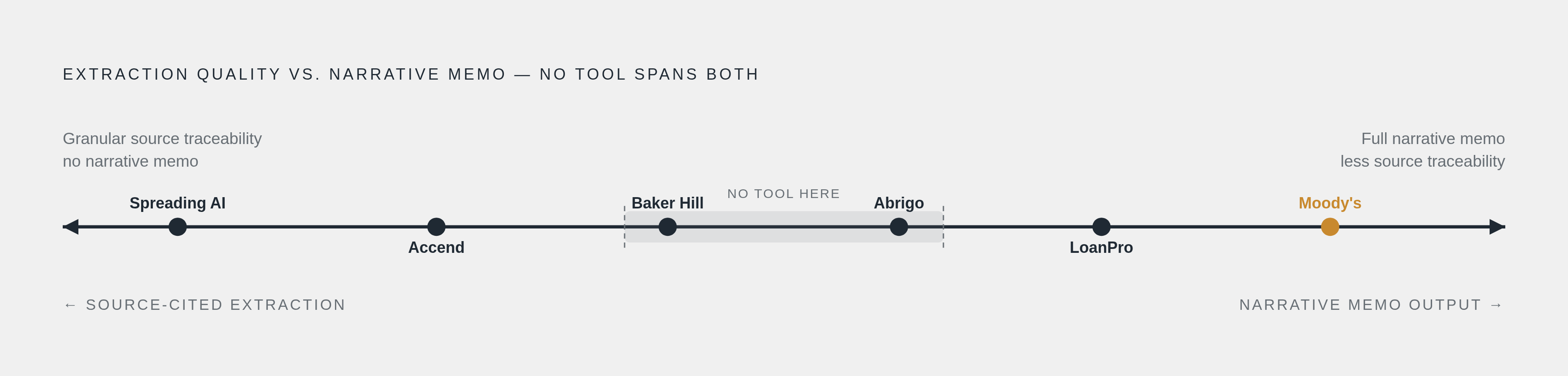
Running the named tools in this space produces no clean winner, because no single product scores well on all four of the core criteria at once: document ingestion, memo drafting, post-close covenant monitoring, and full loan lifecycle management. Which one fits a given lender depends almost entirely on which bottleneck hurts most.
Spreading AI is at the narrow end of the spectrum, built almost entirely around extracting and normalizing borrower financial statements, personal and business tax returns, compiled statements, and rent rolls. It maps everything it extracts to a standardized chart of accounts, and that matters for lenders who need to compare borrowers across a portfolio where every borrower files differently. Source fidelity is its clearest strength, it does not draft narrative memos, and pricing runs custom and quote-driven, which makes it a natural fit for banks and credit unions running high volumes of CRE deals where spreading speed is the actual bottleneck.
Accend takes on more of the credit workflow than a pure spreading tool: financial statement extraction, global cash flow spreading, and covenant monitoring all inside one platform, which cuts down on handoffs between systems during underwriting. The covenant monitoring piece stands out because most spreading tools stop the moment the loan closes.
Abrigo operates at a different scale. It is a dominant lending platform across community banks and credit unions, with thousands of financial institution customers, and it combines loan origination with CECL and ALLL compliance, AML, and portfolio risk management under one vendor. That makes it a strong fit for smaller institutions that want one connected credit-risk ecosystem rather than a set of modular point tools stitched together.
Baker Hill is built for banks and credit unions focused on commercial loan origination, with credit analysis and financial spreading as its standout capabilities, and it serves as an origination and credit workflow tool rather than a full servicing platform.
Moody's markets a broader suite covering both ends of the problem: Credit Assessment AI, launched in 2024, handles GenAI credit memo generation at enterprise scale, CreditLens covers spreading and lending workflow, and RiskCalc handles probability of default and loss given default modeling. Together, that is a suite that spans both the spreading layer and the credit scoring layer.
LoanPro takes the opposite design philosophy: an API-first lending and credit platform built around configurability, supporting business installment loans, lines of credit, equipment leases, and custom credit programs, with commercial-specific functionality covering receivables factoring, curtailment dates, collateral, and interest reserves. Getting the most out of that flexibility tends to require technical resources on the lender's side.
A buy-versus-layer decision functions as the real tiebreaker beneath all of these choices. LOS-bundled platforms like nCino and Abrigo argue that deep integration removes reconciliation risk between systems. AI-native overlay tools argue the opposite case: they deploy in days to weeks because the lender's existing loan origination system stays exactly where it is, making implementation timeline the concrete differentiator, with a full LOS replacement typically measured in months of configuration.
Why spreading must connect to covenant monitoring after close
A spread that stops working the moment a loan closes only delivers half of what it is capable of. The same normalized, source-cited financial data extracted during underwriting should keep powering covenant monitoring for the life of the loan, and the gap between them is where CRE credit risk accumulates silently.
A technical default illustrates why that gap carries real weight. A covenant breach can happen even when a borrower has made every payment on time, and it can still trigger a cash sweep, default interest, or loan acceleration. Catching a covenant trend early matters operationally in a way that catching a missed payment does not, because the missed payment already announces itself. A covenant drifting toward breach, by contrast, hides inside a spreadsheet nobody is actively watching, not spraying warning lights across a cockpit no one is in.
Scale is the second half of the argument. A 100-loan portfolio with quarterly reporting produces a heavy volume of covenant review events every year, before anyone adds in waivers, amendments, borrowing base certificates, and the inevitable chasing down of missing documents. Multiplying that across a full portfolio means the data has to carry forward automatically rather than get re-keyed a second time. The same transcription risk that made origination spreading slow and error-prone returns, in a different costume, if the figures have to be manually re-entered for monitoring.
That is the throughline connecting every section of this piece back to the first one. Manual spreading at origination is transcription dressed up as analysis, and manual re-entry at the monitoring stage is the same problem wearing a different hat, on a portfolio-wide scale, for the entire life of every loan on the books.