Accounts Payable Automation for Real Estate Operators
Automation cuts processing costs and payment delays across multi-property portfolios.

Accounts payable in commercial real estate isn't a bookkeeping chore that scales linearly with headcount. It's a coordination problem that gets structurally harder every time a portfolio adds a property, because each new asset brings its own entity, its own vendors, and its own paper trail. Most operators still run that coordination through manual workflows built for a ten-property portfolio, even after the portfolio has grown to a hundred. This piece walks through what that costs, what automation actually fixes, who's building the tools, and what to look for before signing anything.
Start with the entity problem, because it's the one general accounting software gets wrong from the jump. Each property or LLC in a portfolio usually keeps separate books, which means every invoice has to land in the right ledger before anyone can pay it. Get that wrong repeatedly and two things happen: vendors start wondering if anyone's paying attention, and auditors start asking questions about compliance exposure. Add to that the fact that some vendors bill per property while others send one invoice covering six buildings at once, and you've got two incompatible invoice formats landing in the same inbox, both needing to be split, matched, and coded correctly before anyone signs off.
The workflow layer doesn't help. Approvals in a decentralized portfolio move through site offices, regional managers, and central finance, often as a physical piece of paper changing hands. If the one person who approves large invoices is on vacation, the invoice sits. It doesn't route around them. It just waits, and everything behind it in the queue waits too. Layer onto that the sheer variety of what's being invoiced, maintenance calls, emergency repairs, routine landscaping, capital improvements, each with different approval thresholds and different urgency, and you start to see why QuickBooks was never going to cut it here. General ledger software has no concept of a tenant ledger, no trust account management, no property-level reporting. It was built for a business with one set of books, not eighty.
That mismatch matters more now than it used to, given where the industry is headed. The North American property management market was valued at $8.59 billion in 2024 and is projected to pass $16.5 billion by 2032. Portfolios are growing. Back offices, largely, are not.
What the manual workflow actually costs, in time, money, and vendor trust
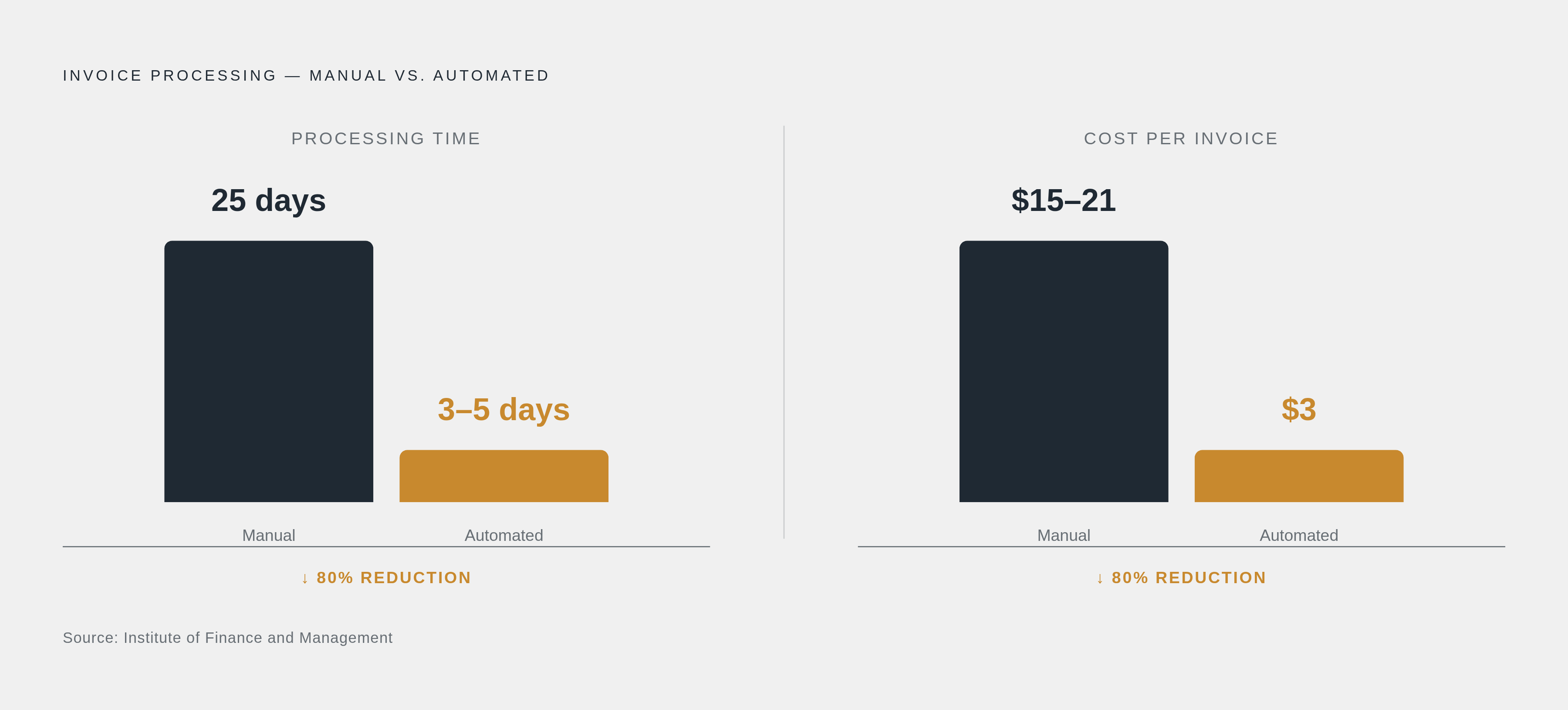
The numbers behind "manual AP" are worse than most operators assume going in. A large share of AP teams, 68%, still key invoice data into their ERP by hand. Paper invoices haven't gone away either: 37% of companies still process them on paper. Put those two things together and the result is predictable: most small to mid-sized firms take around 25 days to move a single invoice from receipt to payment.
That delay has a price tag. Industry estimates put the cost of processing a single invoice manually, factoring in labor, paper handling, approvals, and error correction, at around $15. One real-world example puts it higher: two staff members earning $40 an hour, spending 40 hours a month processing invoices for 150 properties, works out to roughly $21 per invoice. Multiply that against a portfolio processing hundreds of invoices a month and the inefficiency stops looking like a rounding error. Property expenses hit $8,657 per unit in 2024. Every dollar bled to processing friction is a dollar not going toward the building.
The knock-on effects show up everywhere. Late payments delay maintenance work, which tenants notice immediately, whether it's a broken cooling system or a leaking roof that took three weeks longer to fix than it should have. Inconsistent coding across properties makes month-end reporting unreliable, and reconciliation delays stretch the close cycle out further than anyone budgeted for. One documented case, cited in research from Ramp, pushed month-end close to 15 business days. Invoices get lost entirely, especially the ones that have to physically travel between three different offices before landing on the desk of whoever can actually approve them.
The part operators tend to underweight is vendor trust. Economist Anirban Basu put it plainly in a webinar with AvidXchange: "When businesses fail, it's often not because they're late on taxes. They fail because they lose their vendor relationships." Contractors who don't get paid reliably start deprioritizing those jobs, or they stop bidding on the work altogether. Preferred pricing, the kind that comes from being a contractor's easy, reliable customer, evaporates once payment starts feeling like a chase.
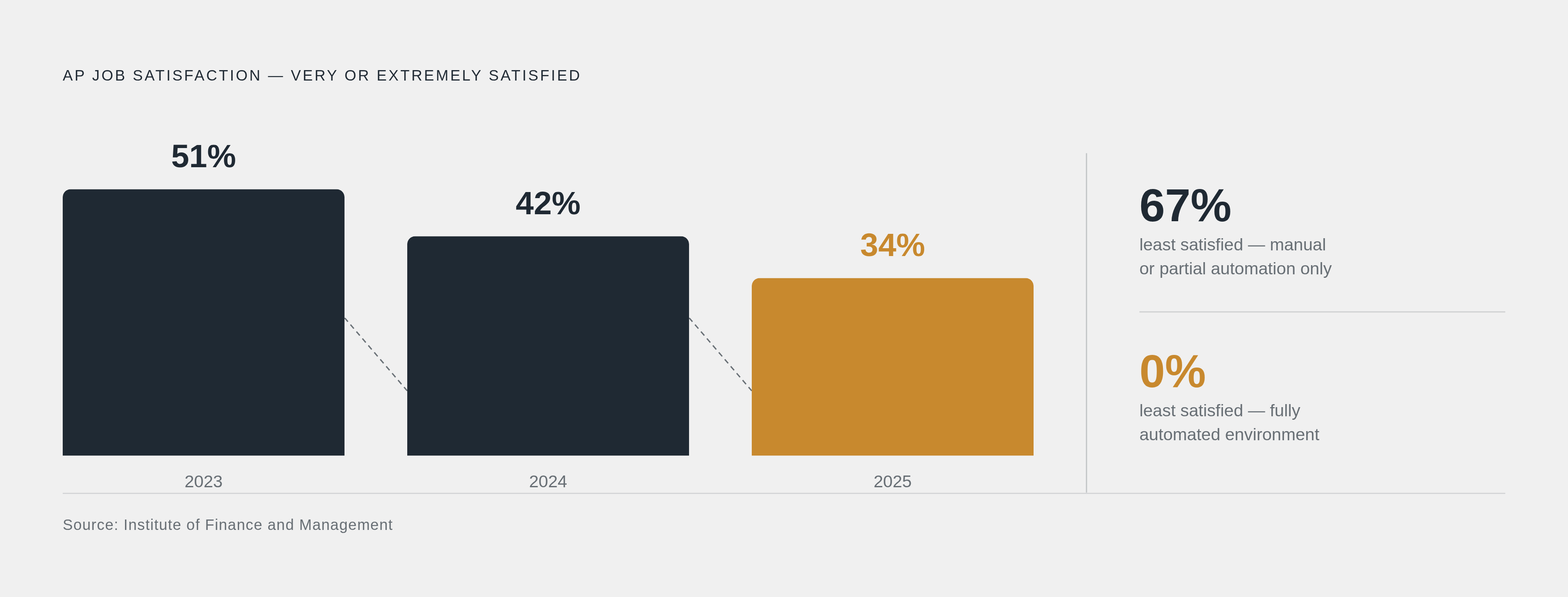
And the people doing the chasing aren't thrilled about it either. AP job satisfaction has been sliding for three years straight, from 51% reporting "very or extremely satisfied" in 2023, down to 42% in 2024, and 34% in 2025, according to the Institute of Finance and Management. Of the professionals who report being "not at all satisfied," 67% work in fully manual or only partially automated environments. None of the least-satisfied group work somewhere fully automated. That's not a coincidence.
What AP automation actually does inside a real estate operation
Strip away the marketing language and AP automation for real estate breaks down into a handful of concrete capabilities, each addressing a specific piece of the mess described above.
Invoice capture comes first. OCR technology pulls data off an invoice regardless of whether it arrived as a scanned PDF, an email attachment, or a paper document someone photographed on their phone, and it does this with accuracy above 95%. That alone removes the manual keying that 68% of AP teams are still doing. From there, AI-assisted coding takes over: machine learning models trained on past transactions learn to auto-categorize a new invoice to the right property, unit, cost center, or entity. This is the part that matters specifically for real estate, because it's solving the entity-matching problem that trips up general accounting software entirely.
Approval routing gets automated too, based on rules an operator sets: dollar amount, property, vendor type, department. No more physically walking an invoice down the hall or waiting for someone to check email while out of office. Centralized dashboards give asset managers and finance teams real-time visibility into spend by property or region, instead of waiting until month-end to find out what actually happened. Payments themselves run through the same platform, ACH, check, virtual card, or wire, and vendors get automated status notifications, which cuts down the "where's my check" phone calls considerably.
Underneath all of it sits an audit trail: role-based permissions, multi-level approval logs, system-generated records that support both compliance work and investor reporting. And there's a fraud layer that demands the same scrutiny. AI models can flag duplicate invoices or unusual payment requests before anyone approves them, not after the money's gone. One platform, Ramp, has identified a substantial sum in fraud before invoices ever reached the approval stage.
There is a line to draw here between two different kinds of automation, because they solve different problems. Rule-based automation handles deterministic, repeatable tasks well, the kind of thing where an invoice always looks the same and always routes the same way. AI-assisted systems earn their keep specifically on the messy stuff: inconsistent vendor formats, unstructured documents, judgment calls about which entity an invoice belongs to. That messy stuff happens to be almost the entire AP workload in a multi-entity real estate portfolio, which is exactly why generic automation tools built for single-ledger businesses tend to underperform here.
None of this replaces human judgment, and it shouldn't. Segregation of duties still matters: AI prepares, classifies, flags, and recommends, but a qualified person still approves the payment. The upside, when it's implemented well, is substantial. Processing time drops from around 25 days to somewhere between 3 and 5. Cost per invoice drops to about $3, an 80% reduction on both fronts, according to Institute of Finance and Management data. None of that materializes, though, unless the automation actually syncs with the operator's property management and accounting systems. Bolt on an AP tool that doesn't talk to the ERP, and all that's been built is a second silo standing next to the first one.
The four platforms operators evaluate most seriously
No single platform wins outright here. What follows isn't a ranking so much as a fit map: what each tool does well, where it slots into an existing stack, and what an operator gives up by choosing it.
AvidXchange, through its AvidSuite for Real Estate, has spent more than two decades focused specifically on property management, and thousands of real estate businesses run on it today. Its integration list covers more than 240 accounting systems, including deep, named partnerships with MRI, Rent Manager, ResMan, and RealPage, which means it plugs into the tools most CRE operators already use rather than asking them to change systems. The suite breaks into three pieces: AvidBuy handles purchase order automation with two-way and three-way matching, AvidInvoice processes invoices with access from anywhere, and AvidPay manages bill payment with real-time status tracking. There's a vendor portal too, letting contractors check payment status themselves instead of calling the office. Ja'Net Penn of Peak Property Management reported vendor satisfaction increasing by 30 to 35% after rolling it out. Hannah Scherer, Accounting Supervisor at Security Properties Residential, put the value proposition simply: "AvidXchange is worth the investment because you'll be able to onboard additional properties with ease while keeping up with existing payables." That's the kind of scalability operators running complex portfolios tend to prioritize. AvidXchange fits operators scaling fast who need integration depth with the property management systems they already run.
Yardi Smart AP, available through Yardi Breeze Premier at no additional cost, removes the separate buying decision for firms already inside the Yardi ecosystem. It uses OCR and machine learning to process invoices submitted either as PDF email attachments to a dedicated address or dropped directly into Breeze Premier, pulling out the essential details without manual entry. The platform supports setup through its standard onboarding resources. A second tier, Yardi PayScan Full Service, adds a layer of human oversight on top of the AI automation, aimed at firms handling high volumes of paper invoices or operating under heavier compliance requirements. Smart AP suits firms already committed to Yardi who want AI-assisted processing without adding a new vendor relationship to manage.
Ramp Bill Pay takes a different approach entirely: it's a general spend management platform, not built exclusively for real estate, but structured well enough for multi-entity operators to use effectively. OCR extracts invoice data, rules-based routing handles approvals, and ERP sync closes the loop, with multiple payment rail options available from one dashboard. Where Ramp earns its keep is consolidation, for operators whose spend is currently scattered across separate card programs, reimbursement tools, and bill-pay systems that don't talk to each other. That's the fragmentation that produced the extended close cycles described earlier. Ramp's fraud detection has flagged a substantial sum before invoices reached approval, and its custom fields let expenses get tagged by department, location, or vendor, giving property-level tracking without the same integration depth as a purpose-built real estate tool. It connects with accounting platforms including NetSuite and QuickBooks. Ramp fits operators whose core pain point is fragmented spend and approval chaos, particularly those not already locked into the Yardi or MRI ecosystem.
Tipalti rounds out the group with broad ERP integration coverage, an AI Smart Scan feature for auto-coding, and a reputation for strong fraud detection. It supports multi-property management and, notably, handles global and multi-currency payments, which matters for larger operators with cross-border vendor relationships or international capital partners. Tipalti fits operators whose needs extend past domestic real estate AP into more complex payment rails, or who are prioritizing fraud controls as the deciding factor.
For CRE lenders and institutional asset managers, AP automation is really just one layer of a much bigger unstructured-document problem. Loan documents, financial statements, covenant compliance tracking, portfolio monitoring, all of it involves the same kind of document intelligence work that AP automation does at the property level, just applied to a different set of documents at a larger scale. Platforms built specifically for that CRE document intelligence work, by people who've actually closed transactions rather than repurposing a horizontal AI tool, tend to handle financial spreading and covenant monitoring the way AvidXchange or Yardi handle invoice coding. The underlying principle holds across both contexts: AI prepares, classifies, and flags. Qualified humans approve. And every output ought to carry a source citation the reviewer can actually trace back to the original document.
When AP automation stops being optional, five signals from operating portfolios
Signal one: the portfolio is scaling faster than the accounting team can keep up. Every new property adds its own utility vendors, its own maintenance contractors, its own approval chain. Without automation, the only response available is more headcount, which is a scaling ceiling dressed up as a hiring plan. Once an operation is consistently processing at least 50 invoices a month, the time and labor savings from automating tend to outweigh the friction of switching systems.
Signal two: vendor relationships are showing strain. Watch for contractors deprioritizing jobs, pushing for shorter payment terms, or quietly declining to bid on new work. These are early warnings, not final verdicts, but they're worth taking seriously before the relationship is gone for good. Peak Property Management's 30-to-35% jump in vendor satisfaction after adopting a vendor-facing portal suggests this dimension is measurable, not just a feeling.
Signal three: the finance team is burning out. AP satisfaction has fallen three years running, from 51% to 42% to 34%, and the least satisfied professionals are disproportionately the ones stuck in manual or partially automated environments. There's a recruiting angle here too. New hires coming up now expect modern tools, and a paper-heavy AP process is a quiet liability when trying to attract talent.
Signal four: decentralization is creating bottlenecks and lost invoices. Site offices, regional managers, remote staff, invoices moving physically between them are easy to misplace and nearly impossible to track without a central system. One absent approver stalls the entire queue behind them. And without centralized visibility, finance leadership can't answer a basic question, what's been paid and what's still pending, without a manual reconciliation exercise that eats up hours it shouldn't.
Fraud risk sits unmanaged as the fifth signal, since manual review, at volume, simply can't catch every duplicate invoice or vendor impersonation attempt. AI-assisted systems flag anomalies before approval, not after the money's already out the door. Check fraud specifically tends to be the kind of event that forces an operator's hand, and by the time that happens, prevention was already off the table.
What to evaluate when choosing an AP automation solution for a real estate portfolio
Integration comes first, before anything else gets considered. An AP tool that doesn't sync with the existing ERP or property management platform just creates a second data entry job instead of eliminating the first one. Operators running MRI, Rent Manager, RealPage, or ResMan should push past the question of whether a connector exists and ask what actually flows in both directions, GL codes, vendor records, purchase orders, payment history. API-based integrations tend to sync more reliably and in closer to real time than file-based ones, and both types exist across the major platforms discussed above.
Multi-entity and property-level coding support is the second filter, and arguably the one that matters most for real estate specifically. A platform needs to handle separate books at the entity level, match invoices correctly whether a vendor bills per property or across a batch, and apply approval thresholds that vary by property or by expense type. This is the exact capability that separates a real-estate-aware AP tool from a generic one, so test it directly with sample invoices before signing anything, not just taking a vendor's word for it.
Beyond those two, weigh implementation timeline against portfolio size (a 50-property operator has different onboarding needs than one running a portfolio many times larger), vendor portal quality if contractor relationships are already strained, and fraud detection depth if check fraud or vendor impersonation has ever been a live concern. None of these tools solve the underlying complexity of a multi-entity portfolio on their own. What they do is take a coordination problem that used to require more people every time the portfolio grew, and turn it into a problem that scales with software instead. Whether that trade makes sense depends entirely on where a given portfolio sits on the five signals above, and how much longer the manual workflow can realistically hold.