Change Management for CRE Technology Implementations
CRE firms waste billions on AI tools that never get used—here's how to make them stick.

Proptech funding hit $16.7 billion in 2025, up 67.9% year over year, according to Commercial Observer's year-end analysis. That's money going in. What comes out the other side is a different question, one this piece actually cares about: why commercial real estate firms keep buying AI tools that never make it into daily use, and what separates the rollouts that stick from the ones that turn into six-figure shelf-ware.
Here's the shape of the gap. Per JLL, the share of CRE firms running AI pilots jumped from 5% to 92% in three years, about as fast as an adoption curve gets. But JLL's 2025 Tech Survey also found only 5% of firms have achieved most of their AI program goals, and JLL's 2026 Future of Work Survey put just 15% of firms at the "optimization" stage, meaning the tool has actually settled into how people work. Conviction is high. Wallets are open. Execution keeps stalling somewhere between the signed contract and the actual habit change, and that stall, not the funding number, is where this piece spends its time.
What the failure data actually shows about where implementations break down
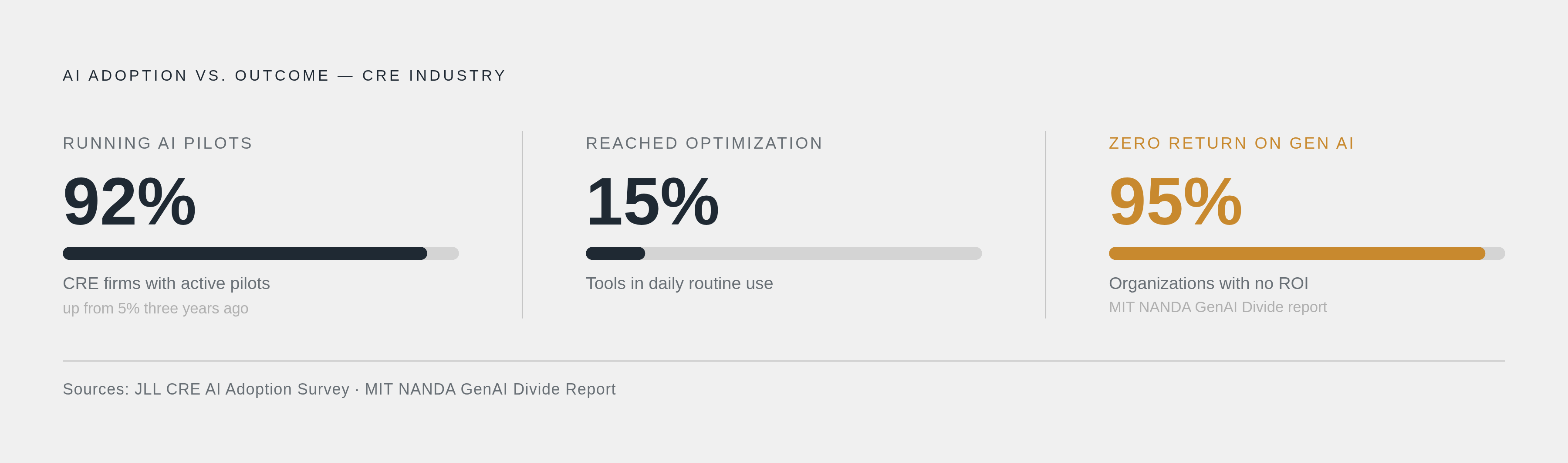
MIT's NANDA initiative, in its GenAI Divide report from July 2025, found that 95% of organizations are getting zero return on their generative AI investments. Sit with that for a second. Ninety-five percent isn't bad luck, it's close enough to universal that the cause has to be structural: something built into how these projects get run, not which vendor got picked.
Flexera's 2025 State of ITAM Report backs this up from the spending side: roughly 25% of SaaS spend goes underused or unused entirely. Shelf-ware is a literal description here, a line item somebody has to justify at renewal.
The most useful number isn't about the software at all. Tieto's 2025 analysis found that 59% of change management practitioners highlight cultural awareness, not technical readiness, as a key factor in whether an implementation survives. That reframes the whole problem. Resistance is a signal that demands attention before it hardens into something costlier to fix. It's a rational response to being asked to abandon something.
CRE has its own version of this baked into daily habits: rekeying T12s by hand, routing PDFs through an email chain, rebuilding rent rolls from scratch every reporting cycle. These aren't dumb habits, they're workflows people trust precisely because they've been checked and re-checked enough times to feel safe, even slow ones. Asking someone to drop a process they've debugged over a decade is a harder sell than most sales decks account for.
And failure doesn't always look like failure. Sometimes the tool just sits there, ignored until the license lapses, which is at least honest about what happened. The sneakier version is inconsistent use: some analysts run deals through the tool, others skip it, and now there are two sets of assumptions feeding the same pipeline at exactly the point where consistent inputs matter most. A tool half-adopted can do more damage than a tool never adopted at all, because half-adoption looks like progress on a dashboard somewhere.
How CRE firms actually progress through AI adoption, and where most get stuck
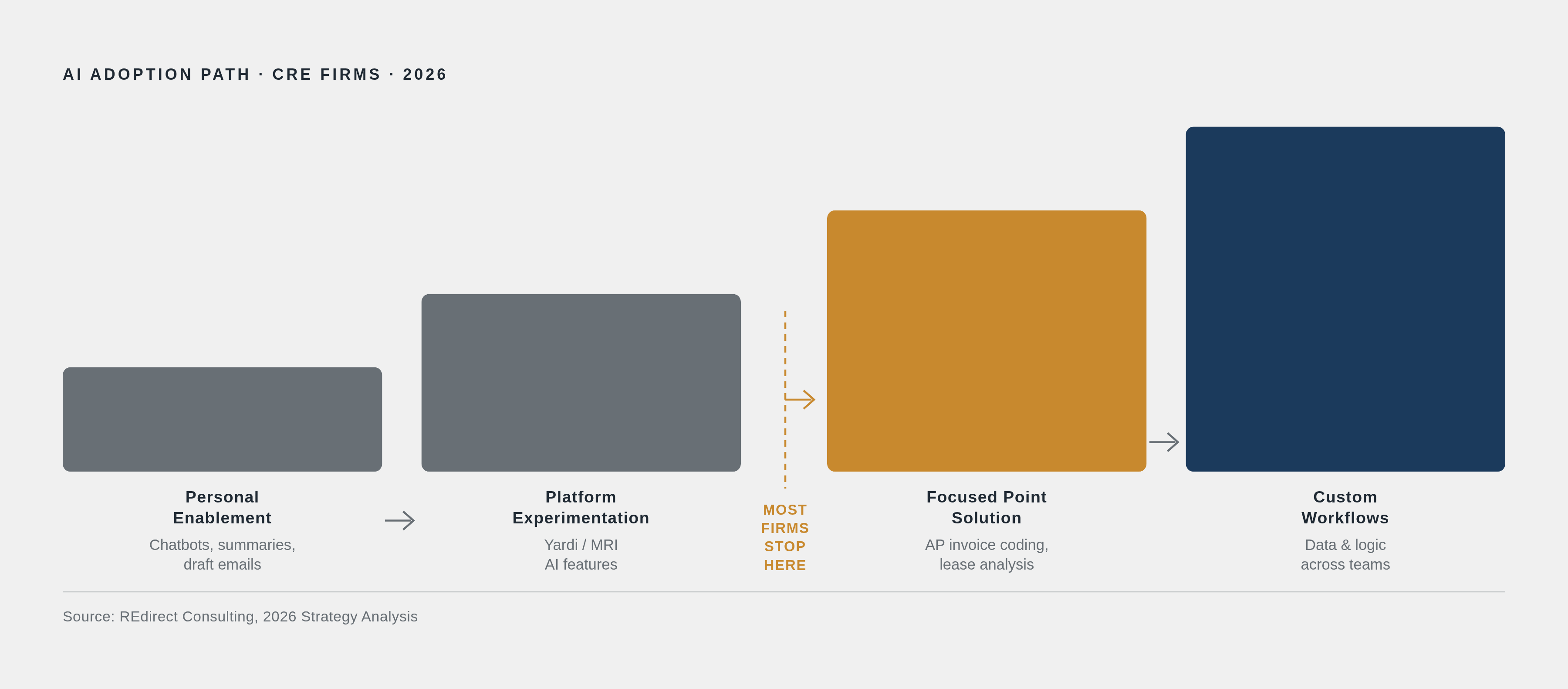
REdirect Consulting's 2026 strategy analysis lays out a four-stage path most firms walk whether they've named it or not. Stage one is personal enablement: individual employees use an approved chatbot to summarize a lease or draft an email. Stage two is platform experimentation, poking at the AI features already sitting inside Yardi or MRI. Stage three is a focused point solution, where a team picks one defined problem, AP invoice coding or lease document analysis, and builds a real tool around it. Stage four is custom workflows, data and business logic stitched together across teams.
Most CRE firms are camped at stage one or two, a condition that reflects the actual state of adoption rather than a temporary lag. Employees testing chatbots amounts to experimentation. It's curiosity with a login.
REdirect's instruction to clients is blunt: start with the business problem, not the technology. Firms that skip from stage one straight to enterprise-wide deployment, without ever proving a single workflow, run into the widest resistance, because nobody on the team has watched the thing actually work yet. When a firm skips the proof-of-concept stage entirely, nobody on the team has watched the tool actually work yet, and the first time outputs don't match existing models, the credibility damage extends to every workflow that comes after it.
Starting with the right workflow: how to identify the highest-leverage entry point
Pick one high-impact workflow and automate that. Don't try to transform everything at once, and don't let anyone talk the rollout into a platform-wide launch before a single use case has proven itself. The entry point matters more than most implementation plans give it credit for.
Look for four things in that first workflow. It should happen often enough that the win touches a wide slice of the team, not just one person's inbox. It needs a baseline that can actually be measured, hours or dollars, something concrete enough that "it's working" isn't a vibe someone asserts in a meeting. It shouldn't require rebuilding the firm's data architecture just to plug in. And it needs to be a pain point people already complain about, because resistance drops fast when the tool solves something everyone already hates doing.
Financial spreading and document analysis check every box for lenders and asset managers. Per V7 Labs' 2026 field guide, analysts spend 4 to 8 hours manually abstracting a single commercial lease, with error rates running 10% or higher. That's most of a workday spent on a task that's still wrong one time in ten. Purpose-built CRE document platforms compress that same task to 15 to 30 minutes at 95-to-99% accuracy, which is the kind of gap that makes the case for itself without anyone needing to sell it.
The baseline matters as much as the workflow choice. Benchmarking the current state before deployment is what makes the improvement visible to skeptical users, and visibility drives accountability. Skip the baseline, and even a genuine improvement goes unnoticed because there's no "before" to point at. Treat that first workflow win as a receipt, the kind that buys the next deployment its hearing.
Building the stakeholder map before the implementation begins
The failure pattern here is common enough to be its own genre: leadership picks the tool, IT deploys it, and when analysts push back, someone files that under "change management problem." It's actually a design failure that happened months earlier, before anyone in the room had a name for it.
A real stakeholder map separates three groups that want three different things, and conflating them is where most maps go wrong. Sponsors (the C-suite, the investment committee) care about ROI and risk reduction, and need the case framed in portfolio terms, not feature terms. Workflow owners (asset managers, loan officers) care whether the tool fits how they already work, and need to be treated as co-designers, not people the decision gets announced to after the fact. End users (analysts, associates) care about one thing: does this make today easier or harder. They need a win in their own work, fast, or the tool becomes one more thing to quietly route around.
GP Strategies' research on technology adoption found that when a new tool becomes an instinctive part of daily work rather than a mandated extra step, organizations are three times more likely to land a healthy adoption outcome. Adoption gets trained into people. It doesn't get ordered into existence by a memo from the top, no matter how firmly worded.
CRE firms complicate this further because deal teams, asset management, and lending often run as separate silos, each with its own data definitions, templates, and tolerance for disruption. A stakeholder map that treats "the firm" as one unit misses all of that texture. What actually gets built is a responsibility grid: who approves, who uses it daily, who trains the rest of the team, who holds veto power, built before a single configuration decision gets made. The goal is sustained behavior change that outlasts the conference room where a kickoff slide deck once got everyone nodding. It's alignment sturdy enough to survive the moment the tool surfaces something uncomfortable, like a covenant breach nobody wanted to find.
Sequencing adoption so early wins create momentum rather than resistance
Deploy to the most motivated people first, not the most senior ones. That runs against the instinct most firms default to, which is handing the new tool to a VP so it looks like it has executive backing on day one. But an early adopter who actually wants to use the thing produces a visible proof point, and a proof point does more to reduce skepticism than an org chart ever will.
Three phases tend to work. Phase one is a pilot with volunteers on one clearly defined workflow, measured against the baseline set during selection. Phase two expands that same workflow to the full team, resisting the urge to bolt on new use cases before the first one is stable. Phase three adds adjacent workflows, but only once users can explain, in their own words, why the first one works. That "why" test is the actual tell for internalization: if the only answer is "because IT told us to," the tool hasn't landed.
Name the trap directly: the "big bang" rollout, every feature deployed to every team on day one. It maximizes disruption and minimizes the odds that any single workflow becomes the proof point people point back to later. Purpose-built CRE platforms lower this risk somewhat, since the workflows arrive pre-configured for CRE data structures instead of getting built from a blank slate, meaning less setup at each phase and a lower chance that a phase-one flop poisons everything downstream.
Re-Leased's 2026 guide to AI tools for real estate professionals found that agents using these tools report spending 40 to 60% less time on administrative tasks. A gain that size, visible in phase one, turns phase two into something teams pull toward instead of something pushed on them. Time to first value works as a change management variable as much as a product one: the longer people wait to see something real, the more their resistance sets like concrete while they're waiting.
Integrating the tool into existing workflows rather than replacing them wholesale
A tool that replaces a workflow asks people to abandon something familiar. A tool that embeds inside an existing workflow asks them to accept one new step. Those are very different asks, and they produce very different adoption rates even when the underlying technology is identical, which is the part most vendors underplay.
In CRE lending specifically, that means the spreading output from an AI platform has to land inside the templates and models the credit team already trusts, not in a separate dashboard that forces a context switch every time someone checks a number. Re-Leased's 2026 analysis points to two-way sync with existing CRM and accounting systems, Xero, NetSuite, or their equivalents, as a recurring requirement for tools that move beyond proof-of-concept into daily use.
There's a data prerequisite that gets skipped more than it should. Per REdirect Consulting's 2026 analysis, AI can adapt to complexity, but it doesn't replace sound processes, reliable data, controls, or human judgment. Firms that skip a data audit before go-live find the mess after launch instead, when fixing it means disrupting a live workflow rather than doing the setup work properly the first time.
For asset managers and lenders, integration is a strategic question that shapes how the business itself operates. It's institutional: the tool has to speak the firm's own dialect, its templates, its add-back definitions, its covenant structures. Miss that, and outputs won't match what a credit committee or regulator expects, so someone ends up reconciling two versions of the same number by hand. A tool that produces accurate results in a format nobody downstream can use creates a shadow workflow, where the team runs the AI, then manually re-keys its output into the system they actually rely on. That doesn't remove manual error risk. It just relocates it.
Defining metrics before deployment so adoption progress is measurable
Without a benchmark set before go-live, "is this working" becomes a matter of opinion, and skeptical users will reach for "it isn't" the first moment anything feels slower than the old way, even briefly and even if the slowdown is temporary.
Sound implementation practice lays out the sequence: benchmark the current state with existing tools and processes, set improvement goals, then define specific metrics, time saved, dollars saved, before the new system goes live. Doing this early resets expectations up front and gives the rollout something concrete to answer to later, instead of a vague sense of whether people like the tool.
Four categories of metric actually matter. Time per task covers lease abstraction time and comparable manual workflows, and the 4-to-8-hour to 15-to-30-minute compression cited earlier is a documented figure, not an aspiration. Error rate tracks the baseline 10%-or-higher manual extraction rate against the 95-to-99% accuracy documented on purpose-built platforms. Adoption breadth is the percentage of eligible users actually completing the workflow inside the tool, checked weekly for the first 90 days. Decision latency measures time from document received to actionable output, which matters most for lenders trying to compress an underwriting cycle.
Share these numbers with the people doing the work, not just up to leadership in a quarterly deck. That single choice changes the psychology of the rollout: the tool stops being something imposed from above and becomes something the team tracks together. Monthly reviews for the first six months catch drift before it turns into quiet abandonment. Quarterly reviews after that confirm the workflow has taken root rather than just surviving on inertia.
Training that fits CRE professional workflows rather than generic software onboarding
Most enterprise software training gets built for IT administrators clicking through every menu option, and that's exactly the wrong model for this audience. CRE professionals, analysts, asset managers, loan officers, need training anchored in their actual deals and their actual portfolios, not a guided tour of every button on the screen.
Good CRE tech training shares a few traits. It's role-specific rather than product-specific: an underwriter's session uses real documents, real templates, real covenant definitions, while a portfolio manager's session runs through the actual reporting cycle. It's short and repeated, timed to moments that already matter, right before quarter-end reporting or a loan maturity wave, rather than one long onboarding day that happens once and gets forgotten by the following Monday. And it works better peer-led. When a senior analyst everyone respects walks through the tool's output on a real deal, resistance drops faster than when the same demo comes from a vendor rep nobody on the team has ever met.
Adventures in CRE's "AI.Edge" program, referenced in its Summer 2026 edition, is one example of the industry building its own training infrastructure instead of leaning on generic vendor onboarding, on the premise that the gap between the two is too wide to paper over.
Tieto's 59% figure on cultural awareness applies directly here, because training design is exactly where that awareness gets built in or quietly dropped. A session that treats seasoned CRE professionals like software novices, instead of domain experts learning a new tool, speeds up resistance rather than shrinking it. Platforms built by people who've actually closed CRE deals, rather than technologists guessing at workflows from the outside, carry a real advantage in this one spot: the tool's logic already maps to how these professionals think, which cuts the mental translation work generic software tends to demand.
Sustaining adoption past the first 90 days when implementation energy fades
Ninety days out is where the real test happens, a point most rollout plans quietly stop planning for. Implementation teams wind down, vendor support deprioritizes the account now that the deal's closed, and executive attention has already moved to next quarter's initiative. That's exactly when users who never fully internalized the new workflow slide back to the old one, quietly, without announcing it, because the old way is still sitting right there and nobody's watching closely enough to catch the drift.
Everything in the sections above exists to prevent that slide. A workflow was chosen for its measurability, a stakeholder map was built before configuration started, a phased rollout earned trust instead of demanding it, and metrics were tracked from day one instead of invented afterward to justify the spend. None of that guarantees survival past 90 days on its own, and nothing here should be read as a formula that removes the risk entirely. But skip any one piece, and the tool doesn't fail because it stopped working. It fails because nobody was watching closely enough, at the moment it mattered, to notice it had already been abandoned.