CRE Technology Implementation Failure Patterns
Most CRE firms adopt AI pilots but fail to embed them into actual workflows.

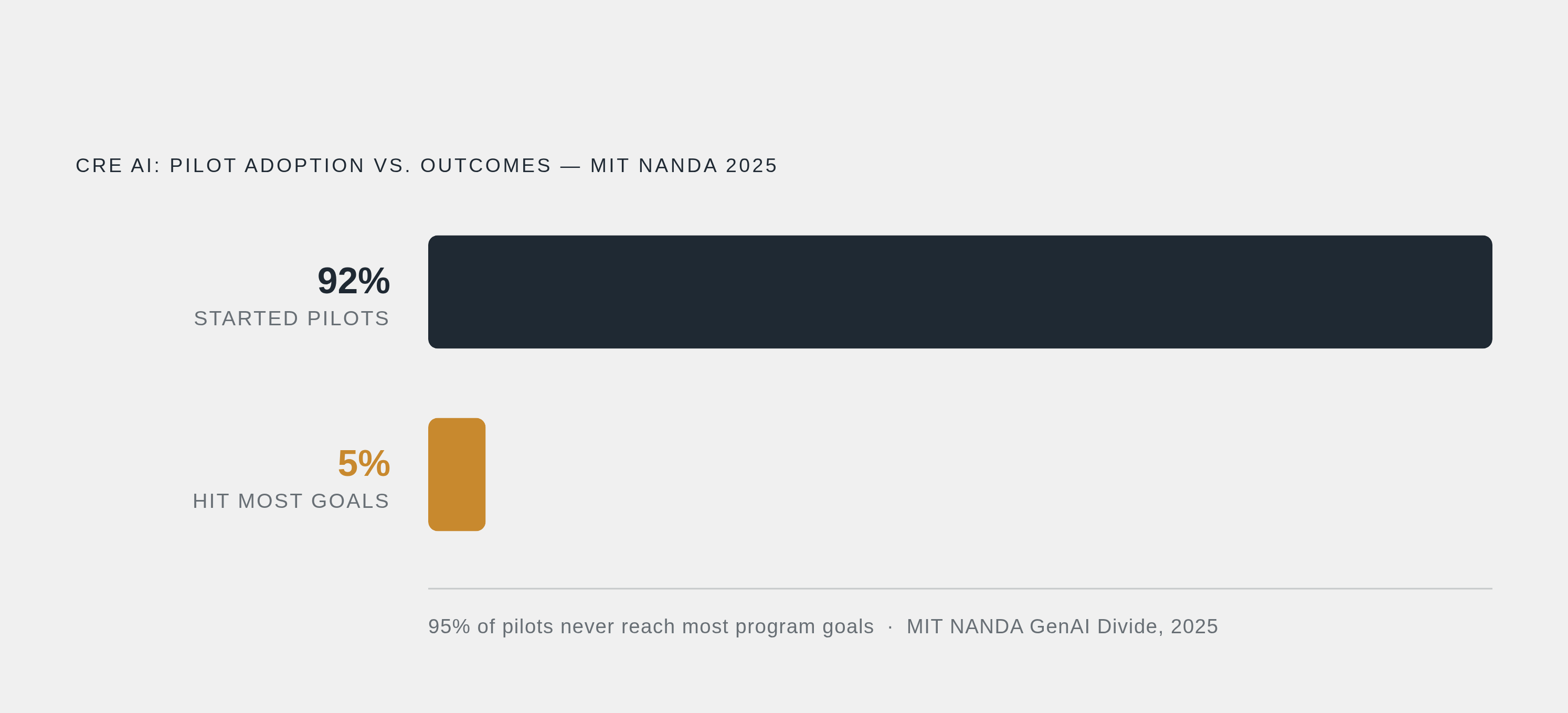
CRE technology adoption is having a strange moment: nearly everyone is trying it, and almost no one is getting anywhere with it. JLL's 2025 Global Real Estate Technology Survey, which polled more than 1,500 senior decision-makers, found 88% of investors and owners and 92% of occupiers have started AI pilots. Only 5% report hitting most of their program goals. That's the whole piece in one ratio: an industry paying more every year for a system that works for one firm in twenty, and worth asking why, in specific, mechanical terms, rather than shrugging it off as growing pains.
MIT NANDA's 2025 GenAI Divide report put the failure rate for enterprise generative AI pilots at 95%, measured by whether they produced measurable P&L impact. CRE shows the pattern with unusual clarity, because commercial real estate deals involve exactly the kind of document-heavy, high-stakes, multi-system workflow where an integration gap turns into financial exposure fast, sometimes inside a single quarter.
In most of these cases, the technology works fine sitting on a shelf by itself. The workflow it's supposed to slot into, the data it's supposed to draw from, the people who are supposed to trust its output enough to act on it without double-checking: that's where things break down. None of that is random, and it isn't six unrelated problems either. It's one problem showing up in six different forms, and worth naming each one so it stops getting mistaken for something new every time it shows up at a different firm.
Why layering new tools onto old processes reliably fails
JLL estimates that 35% to 45% of CRE tech spend is wasted, and technical debt already sitting inside these organizations is most of the reason why, not the new tool itself. Deloitte's 2025 CRE Outlook says the same thing more bluntly: quick-fix technology bolted onto legacy systems and manual processes doesn't deliver the ROI it promised, and the damage doesn't stay contained to that one project.
Here's the part that gets underpriced consistently. A failed implementation doesn't just burn its own budget line, it poisons the next funding request, because now there's an internal case study proving "the new system" doesn't work, and nobody stops to ask whether the system was ever actually integrated into anything. Organizational resistance to the next attempt gets baked in, sometimes for years.
The pattern repeats almost word for word across firms. Someone buys a genuinely capable tool. It gets routed around the existing workflow instead of into it, so underwriters or asset managers keep running the old process and treat the new tool as an extra step, a second opinion, a thing to check on Fridays if there's time. Adoption gets measured by license activations rather than by outcomes, so usage looks strong on paper regardless of whether the tool is changing anyone's decisions. When outcomes don't show up, the tool takes the blame and lands on the pile of things that "didn't work here."
This distinction helps explain why scaled AI impact stays invisible even in organizations where adoption looks widespread on paper. A tool sitting adjacent to a workflow is a different animal from a tool embedded in one. Adjacent means the human still does the real work and consults the tool as a side reference. Embedded means the tool's output is the workflow, the thing the underwriter acts on directly.
Take the miscalculation seriously: a mediocre tool actually embedded where decisions get made will beat a best-in-class tool sitting one click away from where the work happens. This holds every time, without exception. Integration discipline matters more than the tool's feature list, which is not the pitch any vendor wants to open with, but it's the one the failure rate keeps confirming.
How data silos turn integration gaps into deal-level risk
Ask anyone who's spent real time inside a CRE tech stack what the "holy grail" integration is, and the answer comes back fast, almost rehearsed: CRM, property data, and financial modeling, all actually talking to each other. People reach for "holy grail" language when they're describing a load-bearing gap, not a convenience.
The failure mode itself is specific and mechanical. A loan officer or asset manager works out of one system. A risk signal, a covenant breach, a maturing lease, sits in a different one entirely, and the two don't talk, so a human has to remember to go check, across hundreds of assets, by hand, forever. That's exactly the kind of task where things fall through, and the gap between systems is where risk sits undetected until it's already a problem on someone's desk.
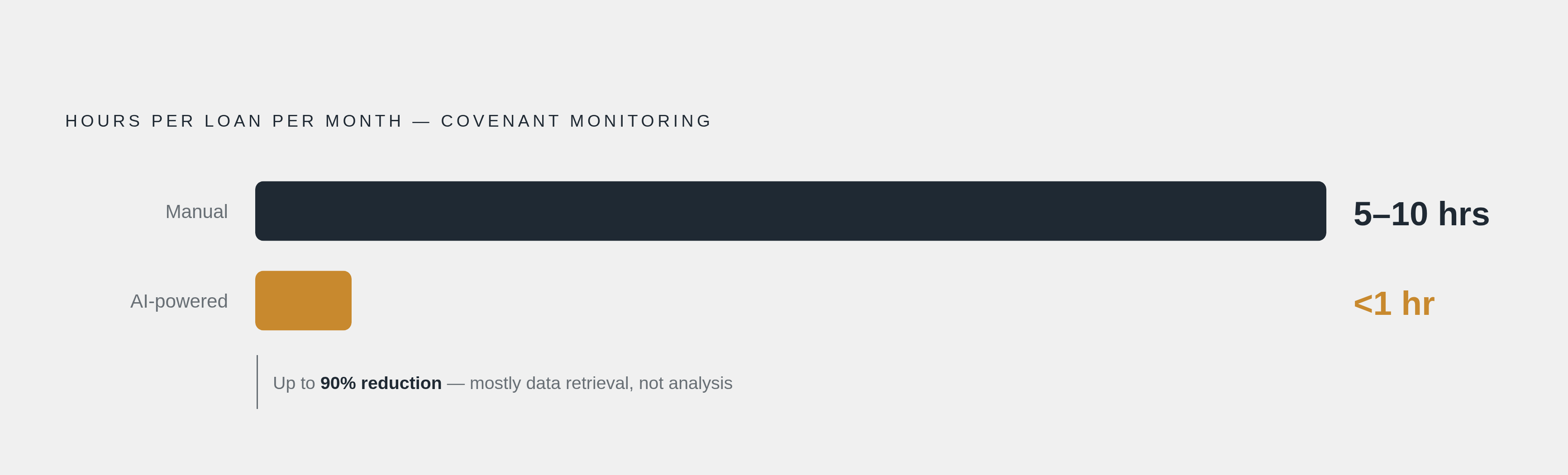
Covenant monitoring makes the case concretely, because it's countable rather than anecdotal. Manual covenant tracking runs 5 to 10 hours per loan per month. AI-powered monitoring brings that under 1 hour per loan per month, and the difference between those two numbers is almost entirely data retrieval, not analysis. Time gets spent chasing numbers across systems that were never built to share them in the first place.
Scale that up and the story changes shape. A few extra hours on one loan is an inconvenience worth grumbling about, but the same gap replicated across a few hundred loans is a systemic blind spot, one that stays invisible until a covenant breach surfaces three months after it should have been caught. Good integration, by comparison, looks almost boring: covenants, spreads, borrower communications, and risk signals flowing into one continuously updated view per asset, instead of getting stitched together by hand every time someone asks for a report.
Why the build-vs.-buy miscalculation is still burning CRE firms
Building an AI agent has gotten easy enough that, in some configurations, it's genuinely a weekend project. That ease is precisely what makes the build decision feel safer than it actually is. If the agent takes a weekend, the logic goes, how hard can the rest of it be?
Fairly hard, it turns out, and this is the miscalculation worth naming directly: the agent is the smallest part of the structure it sits on top of. Underneath it: the data foundation, the integrations connecting it to everything else, the security layer, the monitoring, the iteration cycles, the operational overhead of keeping all of that running without someone babysitting it daily. That build typically runs 18 to 24 months when accounting for data foundation, integrations, security, monitoring, iteration, and operational overhead — not a laptop and a long weekend.
What gets missed almost every time is that ongoing maintenance outweighs the initial build. Model drift needs correcting, data pipelines need rebuilding as source systems change underneath them, and regulatory requirements shift as workflows evolve, so the tool built around last year's process needs rework this year. None of that is a one-time cost. It's a standing engineering commitment with no expiration date.
CRE data makes the whole problem worse than a more standardized industry would face. Rent rolls, operating statements, loan documents, and covenant packages vary by firm, by lender, by property type, by the decade the lease was drafted. A generic build tested on clean sample data hits production and discovers the real documents look nothing like the test set. That's the recurring story: proof of concept works, the team estimates a few months to production, and a year later they're still finding new edge cases buried in document formatting nobody anticipated.
There's an opportunity cost that never shows up in the build-versus-buy spreadsheet, either. Eighteen to twenty-four months of internal engineering time spent building a platform is eighteen to twenty-four months not spent integrating something that already exists and already works. Building isn't always the wrong call, but the true cost of building rarely gets estimated honestly before the decision gets locked in, and that's the actual failure, not the choice itself.
The pilot-to-production stall: when success on paper doesn't become scale in practice
Sit with this scenario for a second. The pilot finishes on schedule, hits its defined success metrics, the vendor delivers exactly what was promised, and the pilot team recommends expanding it. Twelve months later, the tool is still running on the same three assets or the same one region. No new adopters, no expansion, nothing.
That's a failure, full stop, even though it never registers as one. "In progress" and "quietly stalled" look identical from the outside, and nobody schedules an intervention for a project that technically succeeded on paper. The stall hides in plain sight precisely because nothing about it looks broken from a dashboard.
The root cause is a design flaw baked into how pilots get built. Pilots prove the technology works, but they almost never prove the operating model around the technology can absorb it at scale, because nobody built them to test that in the first place. So the pilot wraps, and there's no expansion plan sitting ready, no change management process, no one whose job it explicitly is to own the rollout. The tool got proven. The organization didn't.
MRI Software research found 82% of CRE professionals think AI is important to the industry's future, which is worth sitting with for a moment given what comes next. JLL's 2025 survey found 60% of firms describe themselves as strategically, organizationally, and technically unprepared to execute their own AI ambitions, and that includes firms that already ran a successful pilot. Belief without readiness produces enthusiasm with nothing underneath it to carry the weight.
The fix belongs inside the pilot's original definition of success, not bolted on after the fact. Expansion readiness has to sit alongside performance metrics as a criterion: who owns the rollout, what the integration roadmap looks like past the pilot's original three assets, how the tool connects to the workflows sitting right next to the one it was tested on. Skip that step, and the pilot proves something true and almost entirely irrelevant.
Where the technology-to-team gap creates implementation friction no vendor can solve
A dynamic easy to miss because it sounds abstract right up until it isn't: technology adoption cycles are moving faster than human learning curves can keep pace with. That mismatch produces pressure, burnout, and capability gaps sitting entirely outside a vendor's implementation scope, because it was never a product problem to begin with.
The underwriters, asset managers, and loan officers being asked to use these tools trained inside workflows that AI is actively redesigning underneath their feet. The learning curve isn't purely technical, a matter of which button does what. It's conceptual: someone has to trust a different process for reaching a conclusion they used to reach line by line, spreadsheet cell by spreadsheet cell, by hand.
Adoption moves through recognizable stages, and most firms badly underestimate how long the full progression actually takes: individual staff experimenting with approved tools on their own, then broader platform trials, then a focused point solution solving one specific task, then custom multi-step workflows, and eventually enterprise-wide transformation with real governance behind it. Firms that try to skip a stage, usually jumping straight from point solution to enterprise rollout, tend to slide backward instead of forward, because the capability underneath the leap was never built.
The trust gap is the sharpest version of this problem in CRE specifically, because the decisions are high-stakes and mistakes are expensive to unwind. A loan officer who doesn't trust an automated covenant alert simply won't act on it; the alert fires, gets acknowledged, and gets manually re-checked anyway, erasing whatever time the tool was supposed to save. An underwriter who doesn't trust an AI-generated spread redoes it by hand, and now the firm is paying for the tool and the labor it was supposed to replace.
Trust gets built through specifics, rarely through reassurance: source-cited outputs showing exactly where a number came from, explainable logic instead of a black-box recommendation nobody can interrogate, and tools grounded in a firm's own templates and institutional knowledge, rather than a generic model trained on data nobody at the firm can inspect. Any implementation plan that skips the trust-building arc and jumps straight to technical onboarding is skipping the one part of the project that actually decides whether the tool gets used at all.
What the 5% that reach real outcomes are doing differently
JLL's 2025 survey is direct about what separates the 5% getting real results from the 95% still circling the runway: strategic choices, organizational capability, and systematic execution, more than which tool they bought. Slightly deflating if a silver-bullet product recommendation was the hope, but it lines up with every pattern above.
The successful applications share one trait: narrow, bounded, and repeatable, rarely aspirational. Lease abstraction, financial spreading, covenant monitoring, invoice coding: document-heavy tasks with a clear right answer and high volume, not an open-ended "AI transformation initiative" with no defined edges. Nobody in the 5% is running the latter.
Institutional investors using AI for market analysis jumped from 22% to 61% in JLL's most recent survey, and that growth curve tracks cleanly with use cases that are bounded and measurable, tied to workflows analysts were already running rather than replacing the analyst outright.
Embedded, in production, looks almost boring by design: covenant alerts routing straight into a lender's existing review queue, spreads landing in the same format analysts already use, portfolio dashboards surfacing refi windows and lease expirations without anyone pulling a manual report. The friction gets removed at the exact point where the decision happens, not one step upstream where it still requires someone to go looking for it.
The IP-grounding principle from the trust section resurfaces here, because it's the same mechanism at a different scale. Tools trained against a firm's own templates, models, and institutional knowledge outperform generic tools because the output doesn't need translation before anyone can use it. It already speaks the firm's language, in the firm's format, against the firm's own definition of what a covenant breach or a renewal risk actually looks like.
That leaves one practical question worth asking before signing anything: does the tool embed into the workflow where the decision actually gets made, or does it add a step somewhere upstream of it? The bolted-on tool, the siloed data, the two-year build, the pilot that never expands, the underwriter who quietly redoes the AI's work by hand: every pattern in this piece traces back to that same question, answered wrong.
Scale is what makes the question urgent instead of academic. Firms the size of Blackstone and Brookfield are pushing toward enterprise-wide AI for portfolio intelligence because manual discovery, someone combing leases by hand looking for refi windows or tenant credit deterioration, stops being physically possible once a portfolio crosses a certain size. With a substantial volume of CMBS-backed leases expiring over the next several years and renewal terms getting shorter, continuous automated monitoring stops being a nice-to-have and becomes the only way to catch the risk before it shows up on a covenant report three months late.