Vendor Consolidation Trends in CRE Fintech
Fragmented vendor stacks are killing deal velocity and exposing lenders to regulatory risk.

Walk into most CRE lending shops and the signature move is still the PDF forwarded by email. A rent roll gets rebuilt by hand for the third time this quarter. A key document gets rekeyed into a spreadsheet that looks suspiciously like last quarter's spreadsheet, except for the one cell someone forgot to update. None of this counts as an edge case. It's Tuesday.
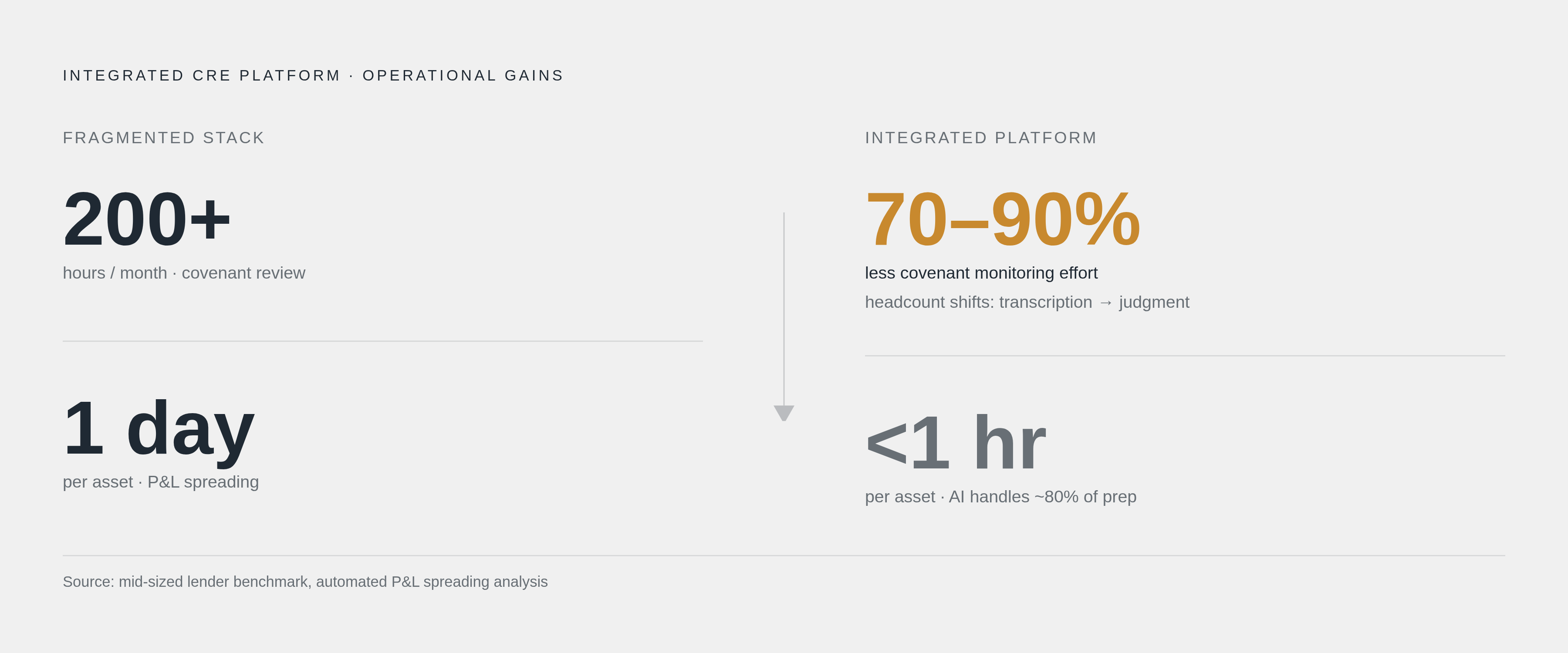
Financial spreading is the cleanest example of the drag, because it's the step where a human takes a borrower's income and expense statement and manually types it into a model, aligns it against historical comps, and hopes the fat-fingered entry three rows down doesn't skew the valuation. It usually does, eventually, to somebody. Covenant monitoring runs the same play at portfolio scale: lenders tracking dozens or hundreds of loans off spreadsheets and inboxes, which works fine until the month it doesn't and a breach sits unnoticed for weeks. One mid-sized CRE lender clocked over 200 hours a month of staff time on covenant review before automating the process, hours going toward transcription instead of judgment.
That gap between effort and insight is the whole story in miniature. Firms bolted AI onto workflows that were never unified in the first place, so the tool got smarter while the plumbing stayed broken. Time kills deals, and when the data lives in four different systems that don't talk to each other, the delay is a structural cost baked into the setup. It's the architecture working exactly as built, which is a much harder problem to fix than a bad quarter of software spending, because nobody signed off on it. It just accumulated, one point solution at a time, until the stack looked like a junk drawer with API keys.
How the broader fintech market is responding: consolidation as an industry-wide pattern
The CRE fintech story is a major event. It's the local version of something happening across financial services generally, and the direction is unambiguous: capital and deals are both consolidating toward fewer, more proven platforms, and away from the long tail of single-function tools that defined the last cycle.
Late-stage point solutions built during the zero-interest-rate years are facing a much harder fundraising and exit environment than their founders anticipated. Getting folded into a platform has become a more common exit path, and acquirers aren't shopping clearance racks for whatever's cheap. They're paying for durable revenue and a clear strategic fit inside something bigger. That's the tell. When deal flow and capital concentrate toward integrated platforms rather than single-function tools, the market is correcting a mistake it made for a decade rather than chasing a fad.
The standalone tracker, the one that does covenant checks well and nothing else, is dying for reasons that have nothing to do with its quality as software. It's dying because being good at one thing stopped being enough. Worth sitting with that, because most buying committees still evaluate tools on exactly the axis that stopped mattering.
Where AI capability is accelerating the case for integrated platforms over point solutions
Call 2026 AI's execution phase in CRE. The leading institutional shops are running AI across the full deal lifecycle, not just market screening or just underwriting, but the whole chain through closing and into portfolio surveillance. That's a different animal from a single-task tool, and it exposes exactly why point solutions hit a ceiling: a tool built to do one job, however well it does that job, cannot become an execution engine by definition. You can't bolt your way to integration after the fact.
Financial spreading makes the case again. An AI engine that maps extracted line items to a firm's Chart of Accounts, calculates NOI, OER, and DSCR on the fly, and flags anomalies only works if the same system holds the origination data, the financial statements, and the covenant structure all at once. Split those across three vendors and the engine is guessing, no matter how good its underlying model is. A smart engine fed disconnected data is still just a smart engine guessing, dressed up in a nicer interface.
The strongest underwriting systems in 2026 connect onboarding, document digitization, spreading, servicing data, and reporting into one workflow, so the covenant set defined at underwriting gets calculated later from the exact same financial statements, using the same spreading logic. Change the system halfway through the deal, and the math changes without anyone deciding it should. This failure mode has already occurred. That's what happens by default the moment origination and monitoring live in different vendors' databases.
What the risk management case for consolidation looks like in practice
The CMBS delinquency rate sat around 7.1% in December 2025, or about 8.75% once performing matured balloons get counted in, per Trepp and CREFC data from that month. Against that backdrop, "the covenant breach got caught two months late" stops being a minor operational note. It's the kind of line that shows up on a loss report with someone's name attached to it.
Regulators have opinions about this, and they're specific ones. Regulators and examiners expect lenders to demonstrate that covenant monitoring aligns with their written credit policy and that breaches are caught and addressed promptly. That means a lender has to show what was monitored, when, and against what data. If covenant monitoring lives in a system separate from origination and spreading, the audit trail has a hole in it by design, and an examiner comparing the credit agreement to what was actually tracked will find that hole without much effort.
Lenders that connect the systems report cutting covenant monitoring effort by 70 to 90% within months of switching over. That mid-sized lender mentioned earlier didn't just save hours: early alerts flagged loans showing stress in time to intervene before losses materialized. Risk caught late looks, from the outside, identical to risk that was never managed at all. Fragmented systems don't produce that outcome by accident. They're built to produce it, which is the part vendors selling point solutions tend to leave out of the pitch deck, understandably, since it's the whole pitch falling apart in one sentence.
The underwriting throughput argument: where consolidation creates competitive separation
The Federal Reserve's January 2026 survey found banks holding CRE lending standards steady even as loan demand strengthened. Translation: lenders need to process more deals without loosening underwriting standards or hiring their way through the volume increase. That's a genuinely hard combination to pull off with a fragmented stack, and it's exactly the combination a fragmented stack is bad at.
Automated P&L spreading compresses underwriting cycle times by up to 70%, and sharpens risk stratification along the way. What used to take a full day per asset now takes under an hour, with AI handling roughly 80% of the prep and calculation work. Two lenders bidding on the same deal aren't separated by who cut corners. They're separated by whose pipeline is architecturally faster, and that gap compounds every quarter it goes unaddressed, the way compound interest works against whoever's on the wrong side of it.
Trust is the catch that most vendors underestimate. Investment committees are, by and large, skeptical of AI-generated underwriting analysis, and that skepticism gets worse when the output can't be traced back to a source document. Platforms built around the firm's own templates and documents, with citations pointing back to the source, close that gap. Trust follows traceability, not the other way around. It's a lesson every vendor selling an underwriting tool eventually learns the hard way, usually after losing a deal to the platform that showed its work instead of just asserting it.
How to evaluate whether a platform is genuinely integrated or a point-solution bundle in disguise
Most firms buying CRE fintech right now are asking the wrong question. They're asking "what can this tool do" instead of "what happens the moment a financial statement gets updated." That second question is the one that actually separates a platform from a bundle wearing a platform's clothes, and it's worth asking before anything else.
Does origination data flow automatically into monitoring, or is there a manual setup step somewhere between closing and surveillance? If a human has to re-enter the covenant structure and draw schedule after closing, the platform has a seam pretending to be a connection. Does it cover the full chain, loan onboarding, document digitization, spreading, servicing data, reporting, or just two or three of those, leaving the firm to stitch the rest together itself? Are its outputs grounded in the firm's own documents with visible source citations, or are they generic AI answers that can't be traced back to anything, which fails both the investment committee's trust test and the examiner's audit trail test?
The covenant monitoring segment includes tools like BankStride, Cync Software, and Teslar Software, each built around tracking and exception management with slightly different emphases. Abrigo and nCino build covenant tracking into broader platforms, and Yardi's Debt Manager sits inside the wider Yardi Investment Suite. None of that makes one category automatically wrong, but it does mean the buyer has to look under the hood rather than trust the login screen, which is the one thing every vendor, integrated or not, makes look the same.
A platform engineered specifically for CRE's document-heavy, model-intensive workflow, built by people who understand what a key document actually looks like at 11pm before a closing deadline, is a different animal from a horizontal AI tool retrofitted for real estate, or a bundle of acquired point solutions wearing one login screen. Ask where data enters the system and how it moves between functions before asking what the dashboard looks like. The answers tell you whether the firm is buying a platform or renting a very well-organized filing cabinet.
What firms that have consolidated their stacks are actually gaining
Speed shows up first, and it shows up fast enough that it's usually the metric that gets quoted in the board meeting. With spreading, covenant monitoring, and portfolio surveillance running in one system, the gap between a document landing in the inbox and a decision being possible shrinks from days to hours, sometimes less.
Risk surfaces earlier too, and that matters more than it sounds like it should on paper. Portfolio-level exceptions, maturing loans, covenant pressure building on a specific asset, show up automatically instead of waiting for the next scheduled manual review. Given where CMBS delinquencies sit, that's the difference between managing a workout on the firm's own timeline and discovering the problem the same week everyone else does. Regulatory posture improves alongside it: a single audit trail running from origination through monitoring outputs, grounded in the actual source documents, satisfies FDIC and interagency expectations without a scramble to reconstruct evidence after the fact.
Headcount gets used differently, not necessarily reduced. A 70 to 90% cut in covenant monitoring hours frees the operations team to actually analyze what they're looking at instead of transcribing it, and the same logic runs through underwriting, where AI handling 80% of prep leaves analysts room to exercise judgment instead of typing numbers into cells. The firms pulling ahead aren't the ones running the most pilots or collecting the most vendor demos, and that cuts against how most procurement teams still operate. They're the ones that moved past point-solution experimentation into something actually stitched together, where the payoff isn't a faster spreadsheet but a portfolio-wide view of opportunity and stress, visible in one place, acted on while a competitor with six disconnected tools is still figuring out which one has the current rent roll.