Emerging PropTech Vendors Serving CRE Lenders and Credit Funds
Private credit's rapid growth is spawning specialized software that horizontal tools can't match.

Private credit lenders now close 40% of non-agency CRE loans, up from 23% a year prior, and that shift is dragging a whole new class of software into existence around it. This piece maps that software: what it does, where it works, and where the marketing gets ahead of the machinery underneath.
Start with the demand side, because the vendor surge only makes sense once you see who's buying. Alternative lenders captured that near-doubling of market share in twelve months, and alternative debt sources made up 24% of U.S. lending volume in 2025, well above the 10-year average of 14%, according to Deloitte. Private debt fundraising in the first nine months of 2025 hit $252.7 billion, according to JPMorgan Private Bank. These funds run lean, with small teams, high deal velocity, and no decades-old core banking system to protect. That's exactly the buyer profile that adopts purpose-built software instead of bending some horizontal tool into shape.
Traditional banks face a mirror-image squeeze. They're being asked to close more loans without hiring proportionally more underwriters, all while holding the line on credit standards. Traditional banks are being pressed to hold the line on credit standards even as loan demand strengthens. That's a throughput problem, and throughput problems get solved with software. Put the two buyer types together and you get a market that's larger than typical enterprise software categories and far more specific about what it needs. That specificity is why the vendor ecosystem covered here, spreading, underwriting automation, covenant monitoring, portfolio intelligence, has specialized as fast as it has. This piece focuses on the tools built for the desk where a loan gets underwritten, monitored, and eventually either refinanced or written down, rather than on brokerage platforms or residential proptech.
How the PropTech funding surge is shaping which vendors survive and which stall
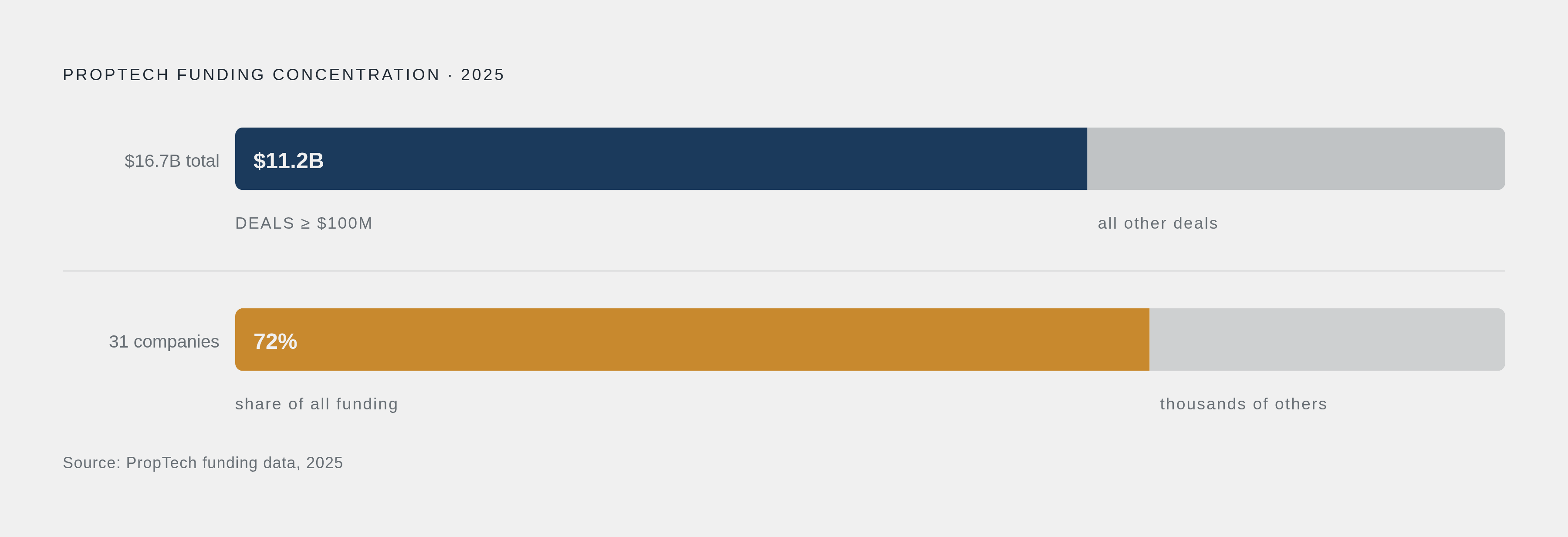
$16.7 billion went into PropTech globally in 2025, a 67.9% jump year-over-year and enough to blow past the roughly $14 billion pre-pandemic high from 2019, according to CRETI. It sounds like a boom for everyone, but the numbers underneath say otherwise.
More than $11.2 billion of that total came from deals over $100 million, and just 31 companies pulled in over 72% of all the money invested. One in three seed rounds in 2025 included at least one institutional co-lead, a real break from how seed rounds used to get funded, back when they were mostly angels and small funds testing an idea. Capital is concentrating early rather than spreading across the field, and piling into the names it expects to win.
What that means for anyone shopping for lender-tech: there's a two-tier market forming, and the tiers aren't close. On one side, platforms with real data moats and enough runway to survive a slow enterprise sales cycle. On the other, a long tail of undifferentiated tools that raised a seed round, built a demo, and are now racing the clock. CRETI called 2025 "one of the most disciplined and strategically concentrated funding years in the sector's history," and disciplined capital chases defensible niches rather than horizontal plays, the kind where a vendor has trained specifically on rent rolls and T12s rather than trying to be everything to every real estate business.
Here's the number that matters most for buyers: of roughly 7,000 PropTech companies operating globally, only about 700, 10%, actually provide AI-powered solutions, according to JLL Spark research. And within that 10%, functional capability spans a wide range, from genuinely production-grade to barely functional. Marketing language doesn't sort those two groups for you. That's the evaluation problem this whole article is built around, and it doesn't get easier in the sections that follow.
The adoption gap between piloting AI and actually transforming lender workflows
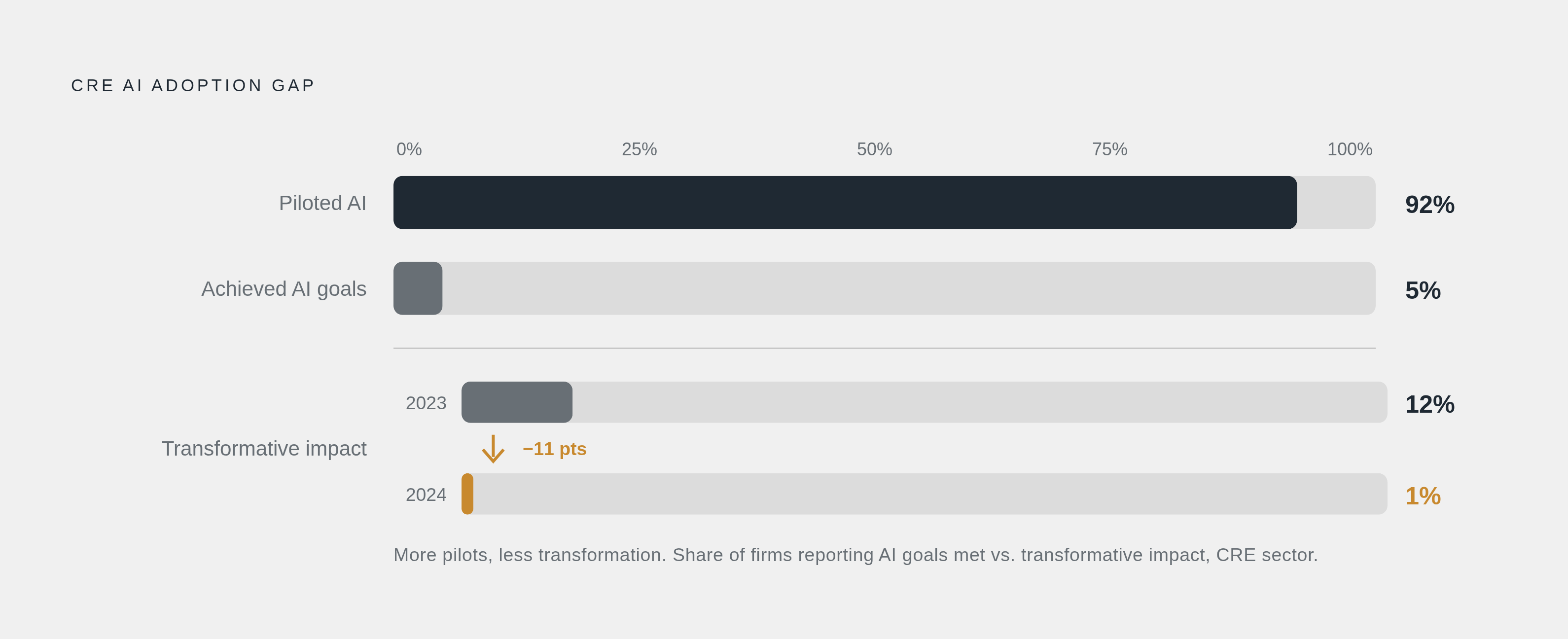
92% of CRE firms have piloted AI in some form, yet only 5% report achieving their AI goals, per JLL's 2025 Global Real Estate Technology Survey. That gap looks like an AI failure story on the surface, but the deeper issue is one of aiming.
Deloitte's 2026 CRE Outlook found something stranger still: the share of executives reporting transformative AI impact actually fell, from roughly 12% down to about 1%, year over year. Fewer firms report transformation now than did a year earlier, even with more piloting happening. More experimentation is producing less transformation because most of that experimentation got aimed at scheduling assistants, search tools, and basic data lookups, the surface-layer stuff, rather than at the document-heavy, model-intensive work that actually decides whether a loan gets made and on what terms.
There's a clean split here worth sitting with. Financial spreading, document extraction, covenant testing, portfolio-level exception flagging: these are high-leverage jobs for AI, because they're rules-based, repetitive, and drowning lenders in manual hours. Unstructured deal sourcing, relationship management, judgment calls that depend on knowing a specific submarket cold: AI is a weak fit there, at least for now, because the work depends on context no model has been fed.
Generic horizontal AI tools are mostly the reason transformation numbers look so thin in lending specifically. CRE underwriting runs on rent rolls, T12s, operating statements, and agency workbooks (Fannie Mae and Freddie Mac forms with their own quirks and formatting rules), and none of that is something a general-purpose OCR tool or an off-the-shelf LLM handles out of the box. The vendors that actually move the needle are the ones trained specifically on those document types, with the workflow logic of an actual lender credit team built into how the tool reads and structures the output. 85% of CRE professionals say they plan to increase tech spending, per JLL's 2025 survey. The real question is whether that money goes toward tools built for the document-heavy core of lending, or just funds another round of surface-layer pilots that won't move the transformation number past 1%.
Financial spreading and underwriting automation: what the leading platforms actually do
Spreading, taking a borrower's financials and normalizing them into a lender's underwriting model, is the single slowest manual step in CRE loan origination. It typically involves hours of retyping numbers from a PDF into a spreadsheet, cross-checking K-1s against tax returns, and confirming figures ahead of a credit committee meeting.
The category has split cleanly into two camps. AI-native platforms built from the ground up to read documents and produce a spread automatically, and legacy underwriting platforms that still expect a human to key in the numbers. A common workaround is pairing the two, bolting an AI extraction layer onto a legacy model, but that pairing adds its own integration overhead, and it's worth asking any vendor how clean that handoff actually is before assuming it's seamless.
On the AI-native side, Aloan reads full loan packages, tax returns, accountant-prepared statements, interim financials, personal financial statements, and traces K-1 distributions across ownership structures that might be three or four tiers deep. It applies a bank's own configured add-back rules and produces a global cash flow statement with click-to-source citations on every number, so an underwriter can trace a figure straight back to the page it came from. Crediflow AI positions itself as end-to-end, document intake through spreading, memo generation, approvals, and ongoing monitoring, with teams reportedly moving from raw documents to a full credit assessment in under 10 minutes. It connects into 17-plus other systems, including nCino, Salesforce, QuickBooks, and Experian.
Legacy platforms like Argus Enterprise, Dealpath, Moody's CreditLens, Abrigo, nCino, and Baker Hill still earn their keep. Argus remains the standard for institutional DCF modeling, and Dealpath tracks deal pipelines well. Moody's CreditLens ties underwriting to Moody's own credit data and ratings, and it's a strong choice for lenders who want formal covenant tracking built into a broader portfolio oversight framework. What most of these platforms need, though, is pairing with an AI extraction layer to get the manual data entry out of the workflow, and that pairing question deserves real scrutiny in any vendor evaluation rather than a rubber stamp.
What actually separates a genuine AI-native tool from repackaged OCR? Three things worth checking. Does it handle more than text: computer vision that reads property photos, floor plans, handwritten adjustments scrawled in a margin, graphs buried in a market analysis? Does it manage the whole process from document intake to a finished output, or does it hand off to a manual step halfway through and call that automation? And was it actually trained on CRE-specific documents, the rent rolls and agency workbooks that look nothing like a generic small-business P&L? Any vendor evaluation should also press on the accuracy number itself. A claim of very high accuracy means little without knowing whether it was measured against your borrowers' actual document mix or against a curated test set the vendor built to look good. Ask whether the platform maps to your existing templates, or whether your team is expected to remap its whole process around the platform's defaults.
Covenant monitoring and ongoing portfolio risk: where manual processes create the most exposure
There's something that should worry anyone running a loan book off borrower-reported numbers: when financials go stale, risk ratings lag reality, and the exposure isn't badly written covenants. Most lenders simply lack machinery testing those covenants against live data on any real schedule.
What does covenant monitoring actually require if it's going to work at scale? Automated testing of DSCR, LTV, occupancy, and lease-up milestones on a recurring cycle, not a quarterly manual pull across a dozen spreadsheets. Portfolio-level exception reporting that flags a breach before it turns into a default rather than after. And a record that survives an examiner's questions: who reviewed this, when, and what document did the number come from?
Here's the uncomfortable reality at a lot of institutions: loan books still get tracked through spreadsheets, email threads, and generic project management tools never built for financial covenant logic. That slows down how fast risk gets flagged and leaves documentation gaps examiners notice immediately. At small scale, that's an annoyance. At the scale of a credit fund carrying a hundred loans, manual monitoring stops being a bandwidth issue and becomes something closer to a structural liability sitting on the balance sheet.
A handful of platforms address this directly. Some debt portfolio analytics tools offer ongoing monitoring built for CRE credit teams that need visibility across a whole book at once. Some platforms tie covenant tracking to a formal risk rating framework, which suits lenders who want monitoring embedded in a broader credit oversight system rather than bolted on separately. Some spreading-focused platforms are also positioning themselves around monitoring capabilities, though how deep their covenant testing logic actually goes varies by vendor and is worth testing directly rather than taking on faith.
Regulation shapes this whole category from above. Evolving regulatory guidance on model risk management spells out the audit trail and source-document discipline a tool has to preserve; it doesn't mandate a specific product, but it does mandate the paper trail. Practically, that means source-page citations on every covenant test are a requirement, not a nice-to-have feature. They're what turns a monitoring output from a vendor's claim into something that survives an examiner actually asking to see it.
Portfolio intelligence and opportunity surfacing: the capability most lenders haven't bought yet
Monitoring tells a lender when a covenant just broke. Portfolio intelligence tells them which loans are heading toward a refinance window, where concentration risk is quietly stacking up, and where the next problem, or the next opportunity, is most likely to surface before it does. Most lenders have built the first capability, and almost none have systematized the second, and that gap is arguably the single biggest unbought category in lender-tech right now.
Why has this taken so long to build out? Historically, surfacing a portfolio-level opportunity meant a dedicated analyst manually pulling data across half a dozen systems, and most credit funds simply don't staff for that. Compounding the problem, the data itself lives scattered: origination systems, servicing platforms, rent roll files, monitoring spreadsheets, none of them talking to each other without a human acting as the connector.
What does a genuine portfolio intelligence platform actually surface, when it's built right? Maturing loan alerts flagged early enough to actually restructure or market the asset, not two weeks before the balloon payment is due. Refi window identification based on where rates sit and how much term is left on the loan. Concentration flags across sector, geography, sponsor, or LTV band, catching exposure building past a policy limit before it becomes a regulatory conversation. And exception queues that tell a credit team which loans in a hundred-loan book need eyes this week, versus which ones are just performing quietly within parameters.
McKinsey estimates generative AI could unlock somewhere between $110 billion and $180 billion in value across real estate broadly, according to reporting in Commercial Observer from May 2026. A meaningful chunk of that number likely sits in portfolio intelligence rather than in faster document processing alone, because catching one maturity cliff early or flagging one concentration breach before it compounds can justify a platform's entire annual cost by itself. That's an asymmetric return profile: most months the tool just runs quietly in the background, and then one flagged exception pays for the whole year.
Some platforms are pushing into this layer already. Certain debt portfolio analytics dashboards give CRE credit teams visibility across a full loan book. Dealpath handles structured deal pipeline and asset tracking well, though it leans less into unstructured document intelligence and more into organized deal data. The evaluation question worth asking any vendor claiming this capability: does the insight come out of the platform natively, or does a team still need a separate BI layer and manual spreadsheet work to actually get there?
Where AI accuracy claims in lender-tech outpace what buyers can verify
Every vendor in this space has a number: 99% accuracy, 90% time reduction, sub-10-minute turnaround. These numbers show up on landing pages with the confidence of a fact, and buyers have almost no consistent way to check them before signing a contract.
Here's the actual problem: accuracy against what? A vendor's internal test set, built from documents chosen because the model already handles them well, produces a very different number than accuracy against a real, messy borrower package with three interim statements, a handwritten adjustment in the margin, and a K-1 structure four tiers deep. Neither number is dishonest exactly. They're just answering different questions, and a buyer comparing two vendors' 99% claims might be comparing two entirely different tests without realizing it.
The honest move, for any institution evaluating this software, is to treat a headline accuracy figure as the opening question rather than a finished answer. Run the platform against actual borrower documents from the institution's own pipeline, the weird ones, the ones with handwritten notes and inconsistent formatting, not the clean sample a sales rep sends over. Ask what happens when the model isn't confident: does it flag the extraction for human review, or does it silently guess and move on? That single behavior, confidence flagging versus silent guessing, probably separates more genuinely production-grade tools from marketing decks than any accuracy percentage ever will.
The category itself is real, tied to private credit's genuine and measurable expansion into CRE lending. But the accuracy gap between what's claimed and what a buyer can independently verify is exactly where due diligence earns its keep, and exactly where the next twelve months of this vendor market will sort the durable platforms from the ones that raised a round, made a claim, and couldn't quite back it up when a real credit committee started asking pointed questions.