Invoice Processing Automation in Lending Operations
Automation cuts lending invoice processing from weeks to hours while building an audit trail.

Invoice processing automation takes a workflow that used to take two weeks and a headache, and turns it into something that finishes before lunch, with a paper trail attached. That's the whole story here: what the automation actually does at each stage, where manual review quietly fails without anyone noticing until audit season, and why lending operations in particular have more to gain (and more at risk) than almost any other back-office function running invoices through a system.
Most lending teams already have some automation. This isn't a story about laggards refusing to adopt technology. According to the 2025 AP Automation Trends Report, 66% of finance teams still manually enter invoice data into their ERP or accounting systems, and heading into 2026, only 8% of finance teams call themselves fully automated. Somewhere between 60% and 64% remain partially or significantly dependent on manual work. So the tools exist. What doesn't exist, at most shops, is the will (or the budget cycle, or the internal champion) to push adoption from pilot to production.
Lending gets hit harder by this gap than most industries, and the reason is document volume. A commercial loan file can carry anywhere from 20 to 50 separate document types, no two laid out the same way, and manual extraction eats up 60% to 70% of underwriter time on a given deal. Document-related delays account for roughly 30% of total mortgage cycle time. Commercial underwriting cycles of 10 to 21 days are common because someone is still retyping numbers off a rent roll PDF into a spreadsheet, not because the judgment calls take that long. And manual processing doesn't bend, it scales linearly: twice the deal volume means twice the labor, every time, forever, unless something structural changes.
The cost of leaving this alone isn't theoretical. Ardent Partners' State of ePayables 2024 report, cited by Tipalti, puts average invoice processing cost without AI at $10.89 per invoice and processing times that stretch well beyond best-in-class benchmarks. Every day an invoice sits in someone's inbox waiting for a signature is a day a faster, more automated competitor is closing the deal instead. The gap between where most lending teams operate today and what's actually achievable is measurable, it's closeable, and ignoring it has a price tag. The rest of this piece walks through that gap stage by stage.
What invoice processing automation covers in a lending context
Lending invoice workflows aren't standard accounts payable, and treating them like standard AP is where a lot of automation projects go sideways. Lending operations process vendor invoices, construction draws, appraisals, title work, inspections, legal fees, alongside an entirely separate category of loan-level financial documents: rent rolls, annual operating statements, covenant agreements. A single commercial loan file might contain 20 to 50 different document types, and no two borrowers or vendors format them the same way. Generic OCR tools, built to read a standard invoice template, run into a rent roll or an agency workbook and basically shrug.
So what does "invoice processing automation" actually mean, end to end, in an environment like this? Break it into five pieces. Data capture pulls vendor names, line items, amounts, due dates, and GL codes out of PDFs, scans, email attachments, even paper faxed in from a job site. Validation and matching runs the classic three-way match, invoice against purchase order against goods receipt, flagging anything that doesn't line up before a payment goes out. Coding predicts and assigns the correct GL code based on transaction history and vendor behavior. Fraud and duplicate detection flags abnormal totals, changed banking details, near-duplicate submissions. Workflow routing sends each invoice to the right approver based on business rules, then chases that approver down without a human coordinator nagging anyone by email.
There are three generations of this technology, and they are not interchangeable. Generation one is rules-based OCR, template matching that works fine until a vendor redesigns their invoice and the whole thing breaks. Generation two is machine-learning extraction, often called intelligent document processing, which reads variable layouts and gets better with more data, but still kicks exceptions back to a human. Generation three is agentic AP: the system investigates a mismatch itself, applies business logic, takes action (emails the vendor, codes from history), and posts the invoice, reserving human attention for the genuine judgment calls. Mindsprint's 2026 analysis identifies this distinction as a key question a lending team should work through before buying anything. Most of what gets sold as "automation" today is generation one or two. The real performance gap opens up in generation three, before signing any contract.
How each stage of an automated invoice pipeline works
Stage one is document classification and intake. The moment a document lands, an AI agent sorts it: invoice type, vendor identity, which loan or project it belongs to. It flags what's missing before an analyst ever opens the file, because chasing down a missing lien waiver after the fact costs far more time than catching the gap on arrival. In a lending shop, this means handling a mixed bag: PDFs, scanned paper, email attachments, portal uploads, all without someone maintaining a template library that breaks every time a vendor switches software.
Stage two is data extraction, pulling header and line-item data (vendor name, invoice number, amount, due date, cost codes, project ID) out of the document itself. Production IDP systems now report error rates below 1% on structured documents. For commercial real estate lending specifically, extraction has to reach further, pulling DSCR inputs, covenant terms, and draw-schedule line items out of documents that overlap and reference each other. Work that used to take an analyst several hours is now sitting in a review queue within minutes.
Stage three, cross-document validation, is where automation starts doing things a person genuinely struggles with at volume. Three-way matching runs automatically, clean matches pass through untouched, and the system cross-checks vendor data against prior submissions to catch a changed bank account number or a duplicate invoice filed twice. In construction lending, this stage validates a draw request against the inspection report, the budget variance, and lien waiver status before it ever triggers a disbursement. Cross-referencing a dozen documents at once, under deadline pressure, is not something humans do well. Software has more bandwidth than people do, and bandwidth is the real constraint, not skill.
Stage four handles GL coding and approval routing. The system predicts the right code from transaction history, so coding becomes a quick glance rather than a manual lookup. Medius SmartFlow auto-fills coding, tax, and approver fields for non-PO invoices at 95% precision after just two invoices from a given vendor, a fast learning curve by any standard. Routing logic sends each invoice to the correct approver based on cost center, dollar threshold, project code, loan file, and the system follows up on stalled approvals without anyone needing to remember to check.
Stage five is posting, and it makes audit season survivable. Validated, coded, approved invoices post straight to the ERP, no re-keying, no manual journal entries. Every action gets logged with a source citation: what document, what field, what the agent decided, who signed off. The audit trail builds itself as the workflow runs, instead of getting assembled after the fact by someone piecing together email threads, which matters enormously for SOX compliance and regulatory review. The integration layer matters a lot here, since SAP, Oracle, and legacy core banking systems each impose their own constraints, and a system that's ERP-agnostic earns its keep in a large lending shop running more than one platform.
Where manual workflows break
Manual AP in a lending shop generates exceptions faster than any team can realistically resolve them. Month-end turns into a scramble: invoices pile up, approvers go dark, and the whole team spends the week firefighting instead of actually controlling the process. Approval chains for construction draws, appraisal invoices, and legal fees cross multiple departments and multiple loan files, and manual routing loses the thread constantly.
What specifically slips through? Duplicate invoice submissions, the same invoice filed twice by a vendor, or the same draw request logged under two different project codes. Changed vendor banking details, a modified account number on an otherwise ordinary-looking invoice, which is one of the more common fraud vectors and one that manual review catches mostly by luck. Coding errors post an invoice to the wrong GL account or the wrong loan file entirely, and manual review catches these only at reconciliation or, worse, at audit. Late payments that stall on someone's desk long enough to trigger late fees or damage a vendor relationship mid-construction-project. And missing documents in draw packages, disbursing funds before an inspection report has actually confirmed the completion percentage claimed.
This isn't an invoice-specific problem, it's a monitoring problem that appears wherever data updates faster than a human checks it. A DSCR covenant breach that only surfaces during the next annual review, instead of the quarter it actually happened, is functionally the same failure as a duplicate invoice caught only at audit. Both share the same root cause: the underlying data changed, but the layer meant to watch it didn't reflect that change until a person happened to look, and by then the window to act on it had already narrowed. Automated extraction with source citations closes that gap by making every figure traceable back to its original document, reviewable at any point rather than reconstructed after the fact, which supports the kind of model output traceability that regulators and auditors increasingly expect.
So what should humans actually spend their time on once the repetitive extraction and matching work moves to software? Exceptions that genuinely require judgment: vendor disputes, policy calls, relationship decisions nobody wants an algorithm making unilaterally. Strategic oversight of cash flow positioning and discount capture. Fraud review, but specifically the anomalies the system flags and escalates, not scanning every single invoice line by line hoping to catch something. The shift is from doing the work to deciding the hard cases, which is a real change in what the job is, not a euphemism for cutting headcount.
The measurable performance gap between manual and automated invoice operations
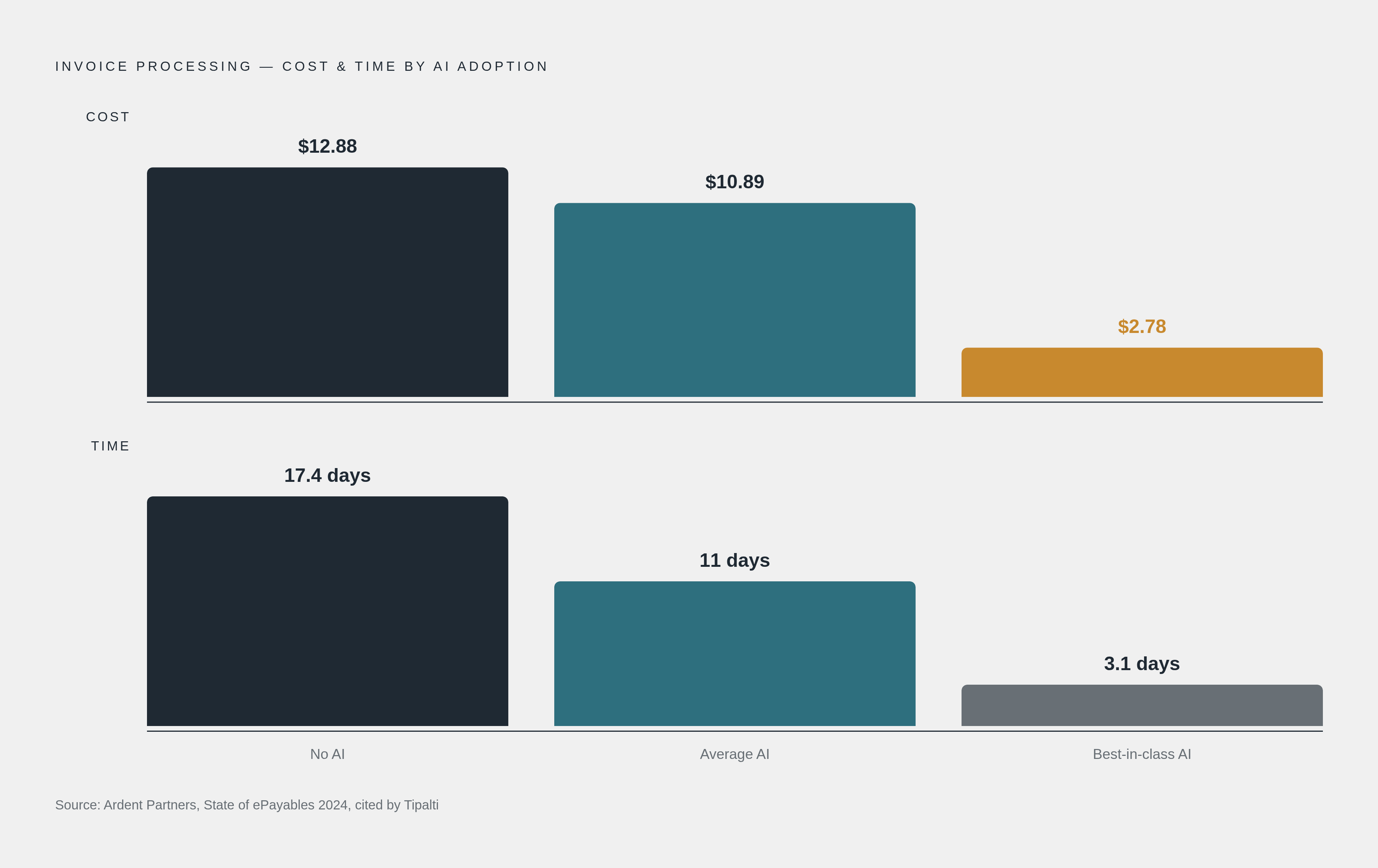
Start with the cost and time comparison, because it's the cleanest before-and-after in the data. Ardent Partners' State of ePayables 2024 report, cited by Tipalti, puts best-in-class AI invoice processing at $2.78 per invoice, completed in 3.1 days. The broader average sits at $10.89 per invoice and 11 days; operations without AI in the mix at all average $12.88 per invoice and 17.4 days according to Ardent Partners' own comparison figures, an efficiency gain that becomes substantial at the volume a mid-size lending operation actually processes. That's a structural cost advantage that compounds every quarter.
Speed matters more in lending than in almost any other back office, because speed is the product. Industry analysis consistently reports that banks using automated underwriting systems see substantial reductions in time-to-decision on commercial loans. Commercial mortgage origination volumes are projected to grow significantly in 2026, and at that scale, every extra day spent on manual processing is a day a competitor spends closing the deal instead. A draw invoice sitting in a manual review queue delays a disbursement on an active construction site, and construction delays carry direct, dollar-denominated consequences, not abstract ones.
Payback timelines depend on scale, and the honest answer is a range rather than one number that fits every institution. Smaller and mid-sized operations typically see payback within six to nine months. Larger enterprises often see it in three to six months, simply because higher invoice volume means the automation pays for itself faster. Institutions that have cut per-loan processing costs by 30% to 40% through AI automation now hold a cost advantage that a competitor can't easily out-hustle its way back to parity from.
The broader market is voting with its budget, too. Mindsprint's 2026 analysis puts the AP automation market at $6.94 billion in 2026, growing roughly 12% annually toward $12.46 billion by 2031. Gartner reports 59% of financial services firms had adopted AI-augmented document processing by late 2025, a figure that's hard to write off as hype. Separately, 88% of financial institutions now list document automation as a central piece of their digital transformation strategy, not a side project bolted onto an existing system. Industry forecasts project a 15% to 20% cost disadvantage for institutions that haven't deployed production-grade models by the end of 2026. Whether that specific number holds exactly, the direction is clear enough: standing still here has a cost, and it's not a small one.
Construction loan draw processing as the highest-complexity case in lending invoice automation
If invoice automation has a final boss, it's the construction draw. Every draw request is really a bundle of documents that all have to agree with each other, including an inspection report, a budget variance analysis, a completion percentage certification, lien waivers, contractor invoices, and sometimes stored materials documentation on top of all that. Approval conditions run sequentially, and disbursement can't move forward until each prior condition checks out against the actual, current state of the project, not last month's state. A single active construction portfolio might run dozens of projects in parallel, each on its own draw schedule with its own approval thresholds, which is a scheduling nightmare even before anyone gets to the paperwork.
What did this cost in analyst hours before automation? Industry research puts it at roughly one dedicated analyst per five to eight active construction projects, just to track inspection reports, budget variance, completion percentages, and lien waiver status across that portfolio. At scale, this is the single lending workflow where automation delivers the fastest return measured in analyst hours freed up, more than any other application in the pipeline.
What does the automated version actually do differently? AI agents track inspection reports, budget variance, completion percentages, and lien waiver status across every parallel project at once, something no single analyst can realistically hold in their head past project number six or seven. The system triggers a draw disbursement the moment conditions are actually met, not whenever someone finally gets to that file in the queue. It flags budget overruns, completion shortfalls, or missing lien waivers before money goes out the door, not during the reconciliation that happens weeks later. And it builds an audit-ready record of every condition checked and every document reviewed, each output linked back to its source, which turns "prove this disbursement was justified" from a multi-day forensic exercise into a query.
The construction draw case makes the broader point of this whole piece pretty concrete: document structures specific to commercial real estate, rent rolls, agency workbooks, and the rest, need systems actually trained on that domain, not general-purpose OCR asked to stretch beyond what it was built for. That's true at the level of a single invoice and it's true at the level of an entire draw schedule spanning forty active projects. The tools that treat lending documents as just another invoice template are the ones that break first, and usually at the worst possible moment, mid-disbursement, with a contractor on the phone asking where the money is.