Automating Operating Statement Spreading
AI automation cuts operating statement processing from 30 minutes to minutes.
A CRE loan file lands on an analyst's desk as three years of tax returns, a T-12 operating statement, an Excel rent roll with its own idiosyncratic column headers, bank statements, a stack of leases, a borrower's schedule of real estate owned, and a scanned appraisal summary. The question this article answers is why that pile of documents, not the credit decision itself, is where CRE underwriting actually slows down, and what happens when the sorting and normalizing of those documents gets automated instead of keyed in by hand. Manual processing of each document takes 30 to 40 minutes, compared to minutes with AI agents, and this is where errors compound into miscalculated NOI, DSCR, and valuation.
The Bottleneck in CRE Credit Decisions: Operating Statement Spreading
Every one of those documents describes the same property in a slightly different dialect. One owner's T-12 calls it "R&M," another calls it "Repairs & Maint.," a third writes out "Repairs and Maintenance" in full, and before any of those numbers can mean anything to an underwriting model, somebody has to decide they're the same line item. That reconciliation work has historically fallen to an analyst, manually, every time, and the keying-in step that follows is where a misclassified expense, a missed vacancy adjustment, or a transposed figure sneaks into the math and quietly skews NOI, pushes DSCR past a covenant threshold, or moves a valuation by a margin that matters. None of this is hypothetical: among the applications of AI in commercial real estate, document processing, not autonomous underwriting, not AI making investment calls on its own, is the one that has actually moved from pilot project to production use at leading firms.
The pressure to fix this has gotten sharper because the clock firms are working against has gotten shorter. Deloitte's 2025 CRE Outlook found that bid timelines in competitive CRE deals have compressed meaningfully in recent years; a firm still screening deals by hand is competing against firms that aren't. The same lag appears at the other end of the deal lifecycle: a lender that spreads statements slowly loses mandates to one that doesn't, and an asset manager reviewing a portfolio once a quarter instead of continuously is the last one to notice a property sliding toward covenant stress, usually after the slide has already done its damage.
What automated spreading does, technically
Calling this "better OCR" undersells it. Automated spreading is a multi-stage pipeline: it classifies the document, maps whatever non-standard line items it contains onto a shared chart of accounts, and resolves the ambiguous cases using models trained specifically on CRE terminology, all before a single number touches the underwriting model.
The first stage is classification. A machine learning model looks at an incoming file and figures out whether it's a T-12, a rent roll, a tax return, or a lease, then routes it to the extraction logic built for that document type, because the normalization rules that apply to a T-12 are not the rules that apply to a Schedule E. The second stage is where the "R&M" problem gets solved: natural language processing trained on CRE-specific vocabulary recognizes that "R&M," "Repairs & Maint.," and "Repairs and Maintenance" are the same expense category wearing different hats, and semantic mapping sends that line item to the correct spot in the chart of accounts. Once that's settled, the structured output flows straight into the firm's underwriting model, so the manual re-entry step and the transcription errors that live there drop out.
Rent rolls are where this mechanism earns its keep most visibly. By 2026, you get automated extraction with chart-of-accounts normalization as a working production capability for operating statements, and rent rolls reach high accuracy on standard formats, so human attention goes to the exceptions that fall outside the pattern. A rent roll isn't just a list of tenants and rents: per JLL's audit of missed escalation clauses, a single overlooked clause can represent real money left on the table, and checking for that clause across an entire portfolio rather than one deal at a time is a different kind of discovery than a faster spreadsheet.
Where the time savings and accuracy gains come from
The time savings live almost entirely in extraction and normalization, not in the credit judgment that comes after, and the accuracy gains depend on the quality of the documents and the training behind the model. Is it too good to be true? Only if the inputs are messy enough to break the pattern-matching that makes it work, which is a conditional problem, not a reason to dismiss the number.
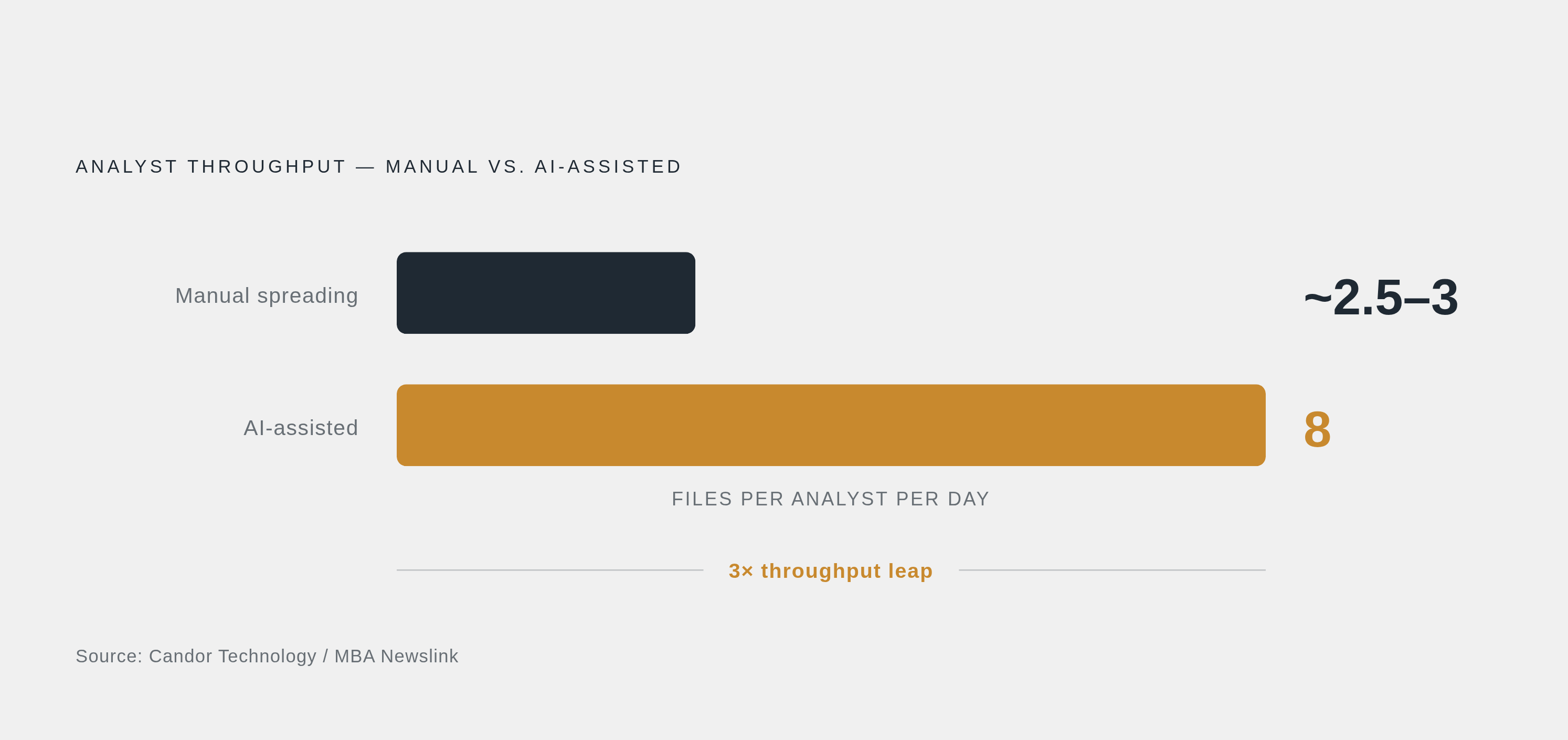
Institutions running AI-enhanced commercial underwriting report meaningful reductions in analyst time per loan, concentrated specifically in spreading and first-pass normalization rather than spread evenly across the whole underwriting process. Candor Technology's implementations, reported by MBA Newslink, took underwriter throughput from roughly 2.5 to 3 files a day up to 8 files a day, which is the kind of productivity jump that changes staffing math, not just morale.
The accuracy story is less about the AI getting smarter and more about where human attention gets spent. Instead of treating every line item as a potential transcription error and re-checking all of them, analysts focus on the extractions the system flags as uncertain, which is a better use of a trained person's time than blanket re-verification of numbers that were probably fine to begin with. Document legibility, consistent input formatting, and how deeply the model's chart-of-accounts logic has been trained on CRE-specific data each raise or lower the accuracy gain this shift produces. If you drop a generic tool trained on general financial documents into this workflow without that CRE-specific grounding, it will misclassify line items that a purpose-built model handles correctly as a matter of course. That sets up the next question directly: what, specifically, does a generic tool lack that a purpose-built one has?
Why generic AI tools underperform on CRE operating statements
General-purpose AI tools don't fail at spreading because they can't read or write well. They fail because they lack chart-of-accounts logic built for CRE, awareness of what kind of document they're looking at, and institutional context, and without those, an extracted number can look plausible while being wrong. That's a meaningful distinction, because a wrong-but-plausible number is more dangerous than an obviously broken one. Nobody double-checks a figure that looks right.
Tools like ChatGPT and Claude are flexible enough to read almost any document a firm hands them, but they don't know a firm's data unless someone feeds it to them, and they carry no built-in understanding of CRE chart-of-accounts conventions or underwriting templates. They can read and summarize a lease competently, but summarizing is not the same as normalizing it into a firm's existing framework, which requires institutional context these tools simply don't have. The "R&M" problem returns here in sharper form: a human analyst who knows the domain treats "R&M," "Repairs & Maint.," and "Repairs and Maintenance" as the same thing without a second thought, but a general-purpose model with no CRE training may treat them inconsistently from one document to the next, and the resulting normalization error usually stays invisible until the NOI output comes out looking wrong.
The problem compounds when documents need to talk to each other. Matching the same tenant across a rent roll, a lease, and an estoppel certificate requires entity resolution logic trained specifically on how CRE naming conventions actually work, not general business language, and this is exactly the terrain where general tools produce matches that look confident and turn out to be incorrect. A firm's own underwriting templates, its line-item definitions, and its years of accumulated spreading conventions represent institutional knowledge that produces a quieter issue: a model's outputs should be anchored to that knowledge. A generic tool has no access to any of that, so its outputs need to be entirely re-mapped by hand afterward, which eats up most of the time it was supposed to save.
None of this means general-purpose assistants are useless in CRE. The strongest practitioners use a tool like ChatGPT or Claude as a starting point for other tasks and bring in purpose-built software specifically where the time savings justify the switch. For spreading, where the value comes from the normalization logic itself, purpose-built is the category that does the job. Practitioners quoted in current industry research describe large language models as unable to process financial data accurately on their own, which puts full reliance on general-purpose tools in an "early stage" bucket, even while purpose-built document extraction gets rated as something that already works well.
What good spreading platforms require in production
So what should you check for in a platform built for this job? Production performance turns less on a vendor's headline accuracy number and more on four conditions: how well the platform handles real document ingestion, how deep its CRE-specific training goes, how well it integrates with the firm's existing underwriting templates, and whether its review process is built around exceptions instead of re-checking everything.
Document ingestion quality comes first, because the documents a firm actually receives include scanned PDFs, handwritten annotations, and Excel exports with inconsistent formatting, not the clean digital files vendor demos tend to favor. A vendor's accuracy figures typically reflect those clean inputs, so you should check them against your firm's actual file stack before you trust the number.
CRE-specific model training needs to cover the asset classes you actually underwrite. Multifamily, office, industrial, retail, and hospitality properties carry materially different expense structures, and the chart-of-accounts logic has to be trainable on a firm's own historical spreads, not just a generic template.
Whether the output saves time or just moves the re-formatting work downstream depends on template integration. Outputs should map directly into a firm's own underwriting model rather than landing in some generic format that then has to be reshaped by hand. Archer's platform, as one example, offers Bring Your Own Model integration that plugs directly into a firm's proprietary Excel underwriting model, which is the kind of feature that addresses this requirement directly rather than working around it.
An exception-first review workflow is what keeps the efficiency gain from disappearing. If every single output still needs full manual review, the automation hasn't automated anything; it has just moved the typing somewhere else. A platform that calibrates its own confidence well enough to route high-confidence extractions straight through and flag only the uncertain ones is what makes the time savings real rather than theoretical.
Audit trail rounds out the list. Every AI-driven extraction should carry a timestamp, a note on the source document and page it came from, the specific mapping logic that was applied, and a plain-language explanation for why a line item landed where it did, and that record lets an analyst actually verify and correct the output quickly instead of re-deriving it from scratch.
How spreading feeds covenant monitoring and portfolio-level risk detection
Everything above describes spreading as a one-time event at origination. Its bigger value appears later, as the recurring engine behind covenant monitoring across an entire portfolio. When spreading only happens manually and periodically, a portfolio's DSCR and LTV positions are always a step behind reality. A lender finds out about covenant stress when the quarterly report lands on a desk, not when the operating performance that caused the stress actually started slipping.
Automate the spreading and make it continuous, and the same pipeline that processed the original loan documents can keep ingesting updated T-12s, rent rolls, and bank statements as they come in, producing a running, current view of NOI, occupancy, and debt coverage measured against the assumptions made at origination. Agentic AI platforms now automate the financial spreading itself, monitor covenant compliance against DSCR and LTV thresholds, and generate early warnings when a property starts showing signs of trouble, whether that's NOI compression, rising vacancy, or a cap rate drifting away from what the deal assumed at the start.
That matters most at the moment a loan approaches maturity. Capex assumptions made at origination need validating against the property's actual current condition before a workout begins, not after, and platforms that pull capex figures from rent rolls, trailing financials, the original appraisal, and inspection reports can expose that gap automatically during routine monitoring rather than waiting for someone to notice it during a crisis.
The time savings compound at the portfolio level too. Portfolio managers used to spend a large chunk of each month consolidating performance data across every asset in the book, but now they can get automated reports that calculate NOI variance asset by asset, flag occupancy trends against historical benchmarks, and write up narrative summaries of what's actually driving performance. The JLL escalation-clause example scales the same way: finding one missed clause in one lease is a nice catch, but running that same check across an entire portfolio turns it into an audit that surfaces value and risk nobody was tracking, because nobody had the hours to check every lease by hand.
Where human judgment remains structurally necessary
None of this adds up to AI running the underwriting process. The consensus coming out of CREFC in 2026 is specific: AI automates the information assembly that happens before underwriting, and the credit judgment applied once that information is clean and structured stays a job for an experienced person. That's a narrower claim than "AI underwrites loans," and it's the more honest one.
The operational line falls in a specific place. Automation delivers real value when it extracts, normalizes, benchmarks against comparable deals, and drafts first-pass commentary. Choosing which assumptions to apply to a stressed asset, pricing risk into a deal structure, and making the final call on whether to lend are tasks that stay with the credit officer, because a clean, well-normalized spreadsheet still has to be interpreted by someone who understands what the numbers mean for this borrower, this market, and this moment. Automated spreading hands that officer a better spreadsheet, faster. It doesn't hand them the decision.