Document Automation ROI in Loan Origination
Automation handles document work so underwriters can focus on lending decisions.

An analyst opens a rent roll, scrolls to unit 4B, and retypes the figure into a underwriting spreadsheet by hand. Then unit 4C. Then another financial statement next to it, then the appraisal after that, and somewhere around the fortieth line item, a digit gets transposed and nobody notices until the credit committee asks why the debt yield doesn't tie out. That single moment, repeated across thousands of deals a year, is the operational reality manual CRE origination runs on, and the entire cost of manual processing originates there. Commercial real estate lending is not spared the generic slowness of commercial lending; it is worse, because CRE documents carry structures generic loan processing was never built to read. Total loan production expenses hit $11,898 per loan in the first quarter of 2026, well above the historical average, and manual workflows have no mechanism to close that gap on their own. Underwriting a single CRE deal under manual conditions runs one to four weeks, and the institutions most exposed to that lag are disproportionately the community banks that hold a large share of CRE loans while lagging behind in AI adoption.
The structural pattern underneath that single rent roll explains why the problem gets worse rather than better over time, because every new compliance requirement, every new loan type, and every new investor guideline adds another manual checkpoint between borrower onboarding and loan repayment tracking. Nobody designed it that way on purpose. It accumulated one well-intentioned control at a time, until the workflow that used to take a week now takes a month and the analyst pool strains to keep pace. Volume pressure doesn't create this fragility; it exposes it. The automation priority is not the lending decision but the document work surrounding it, intake, classification, extraction, validation, and data entry into downstream systems. A lender chasing a maturity wall on a fixed calendar cannot absorb that same fragility.
The CRE origination market accelerating faster than manual capacity can absorb
Origination volume and loan maturities are converging on the same calendar year, and that convergence has turned processing throughput into the variable that decides which lenders capture the recovery and which ones watch it pass by. The loan origination software market stood at $6.58 billion in 2025 and is projected to grow substantially by 2029, reflecting the scale of investment institutions are committing to closing this gap. MBA data shows total CRE lending rose year over year in 2024, with fourth-quarter originations surging sharply, and the MBA projects significant further growth in commercial and multifamily origination in 2026. That would be manageable on its own. It is not on its own.
A large volume of U.S. commercial mortgages come due in 2026, and industry estimates place total CRE maturities in the trillions of dollars across 2025 through 2027. Multifamily maturities alone are forecast to grow by more than half from 2025 to 2026, and office-backed CRE debt makes up a large share of the 2026 total, which means the maturity wall isn't spread evenly across the calendar or the asset class. It's concentrated, dense, and arriving on a fixed schedule that doesn't care whether a lender's underwriting team is fully staffed. A loan that matures in June needs a refinancing decision that respects June, rather than one that arrives in August once the backlog clears.
That fixed timing is what turns throughput from an efficiency question into a competitive one. Bank market share in non-agency CRE closings has already dropped sharply while alternative lenders picked up the difference, which is a fairly blunt signal that institutions unable to match processing speed are already losing deals to competitors who can move faster. One might argue that volume alone would eventually force every lender to modernize regardless of the maturity wall. But what if the maturity wall is the mechanism that actually forces the decision, by putting a deadline on it that ordinary market growth never would? A lender can ignore rising application volume for a few quarters and just hire more analysts. A lender cannot ignore a borrower's loan maturing on a specific date. The wall doesn't negotiate.
Where document automation intervenes in the CRE origination workflow
Document automation earns its keep in the space between a CRE package landing on a desk and a credit decision getting made, not by replacing the judgment that decision requires. That distinction matters because it reframes what automation is actually for. Nobody is proposing that software decide whether a shopping center in a secondary market deserves a loan. The proposal is narrower and, frankly, less controversial: let software handle intake, classification, extraction, validation, and data entry, because those are the tasks that eat analyst hours without requiring analyst judgment.
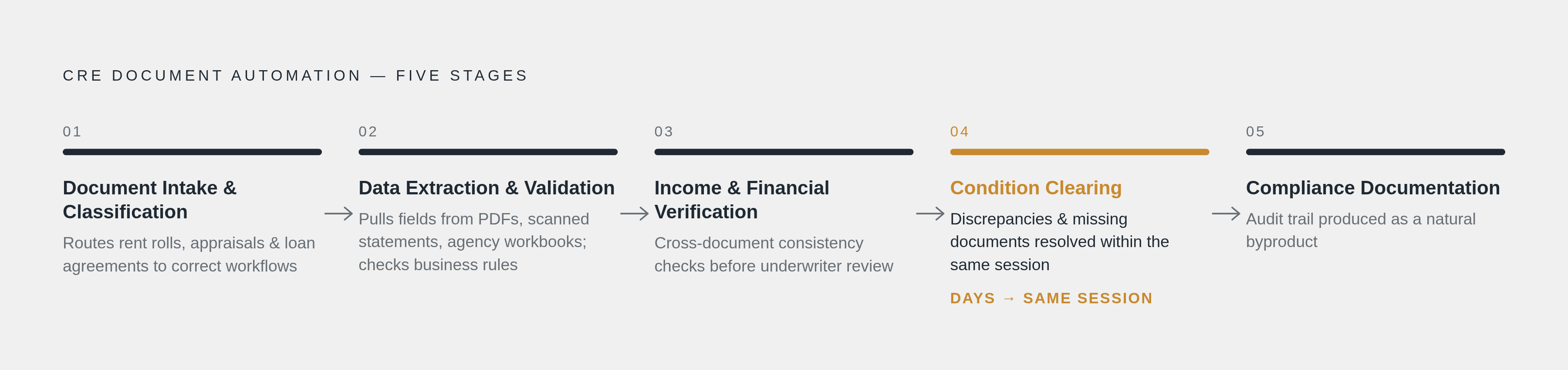
Financial spreading sits at the center of the friction. Analysts have historically copied figures from operating statements, rent rolls, and borrower financials into underwriting models by hand, a task that is repetitive precisely at the stage where precision matters most. Automation intervenes across five linked stages: document intake and classification, data extraction and validation, income and financial verification, condition clearing, and compliance documentation, with each stage feeding cleaner data to the next one. Classification routes an incoming CRE package, a rent roll here, an appraisal and a loan agreement alongside it, to the correct workflow automatically, without manual sorting. Extraction then pulls fields out of whatever format the documents happen to arrive in, PDFs, scanned operating statements, agency workbooks, and checks those fields against business rules and cross-document consistency before an underwriter ever sees the file.
Condition clearing is where the compounding savings become visible. Outstanding items, flagged discrepancies, and missing documents that used to generate days of back-and-forth between lender and borrower can now get resolved inside the same session for qualifying files. Compliance documentation, instead of being assembled afterward as a separate task, comes out the other end of the process as a natural byproduct, an audit trail regulators want without anyone having to build it manually. Intelligent document processing chains these steps together: classify, extract, validate, flag for review, deliver into the loan origination system, and the net effect is that loan teams get their time back for the parts of the job that actually require a human being to think. AI automates the overwhelming majority of the document handling that used to consume an underwriter's week, without automating the lending decision itself, which frees analyst capacity for the judgment calls that remain stubbornly human.
The measurable ROI that CRE lenders see when document automation is deployed
The return on document automation in CRE appears first in cycle time, and the compression is substantial. Lenders deploying AI across origination are cutting the process from weeks down to days, with leading institutions clearing most conditions automatically and collapsing what used to be weeks of back-and-forth into same-session or next-day resolution for qualifying borrowers. Banks running automated document processing report large reductions in processing cost alongside gains in both accuracy and speed, and lenders who fully use Freddie Mac's Loan Product Advisor report a production cycle that runs five days shorter along with meaningful per-loan cost savings.
Two named examples make the pattern concrete rather than abstract. A deployment at Bellwether Enterprise cut the time spent processing operating statements and rent rolls enough to enable a 24-hour underwriting turnaround for CRE and commercial lending teams. KeyBank reduced financial model prep time by a significant margin using Smart Capital Center's Agentic AI, a gain measured in the specific work of CRE financial analysis rather than a generalized productivity metric. That specificity is the point. Generic loan processing benchmarks tend to understate what CRE lenders should expect, because CRE documents are denser and more idiosyncratic than a standard commercial loan file, so the hours saved per document run higher than a horizontal benchmark would predict.
Analyst throughput follows the same curve without requiring proportional headcount growth. Institutions that have automated financial spreading report substantial cuts in analyst time per commercial loan, so the same underwriting team can carry more deals through the same maturity cycle described earlier. Broader research on professional AI use backs this up at the task level: BCG found that professionals using AI assistance completed more tasks, finished them faster, and produced work rated meaningfully higher in quality, findings that translate directly into CRE lending, where document review, financial analysis, and covenant monitoring are the core functions consuming analyst time. Adding those numbers up shows the ROI in CRE outpaces what generic lending automation delivers. It's larger, because the starting friction, dense documents with no standard format, was larger to begin with.
Faster origination without automated monitoring creates a new exposure
Speeding up origination while leaving covenant monitoring on a spreadsheet doesn't close the risk gap, it relocates it downstream, and the timing could not be worse given the maturity wall already described. Most credit portfolio managers say underwriting is where they are most likely to apply AI first, while only a small fraction currently treat AI-enabled portfolio monitoring as a priority, a wide spread that has opened at exactly the wrong moment. Faster origination means more loans entering the portfolio at a faster rate. If monitoring hasn't kept pace, the portfolio is growing exactly where visibility is weakest.
Covenant breaches in CRE, under manual conditions, tend to surface in credit reviews months after they occur. Most CRE borrowers still have their covenant tracking sitting in a spreadsheet that gets updated once a quarter, so a lender only learns about a problem after the borrower's financials have already deteriorated for a stretch of time. That lag is bad on its own, and it's worse because several structural risk factors have moved against lenders at the same time. Covenant-lite structures grew from a small share of private credit deals to a significantly larger share between 2023 and 2025, caps on EBITDA add-backs have been disappearing, and payment-in-kind interest converts cash signals into silence. The Proskauer default index climbed for three consecutive quarters through the first quarter of 2026 before easing back in the second quarter. Together, those shifts mean the warning signs that used to be visible are getting quieter at the exact moment origination volume is accelerating.
AI covenant monitoring addresses this by testing every active covenant, minimum DSCR, maximum LTV, minimum debt yield, continuously rather than quarterly, flagging a breach weeks before it hardens into a technical default rather than months after the fact. The same monitoring infrastructure extends naturally into a watch-list function, tracking DSCR, debt yield, occupancy, NOI variance, and covenant compliance across an entire portfolio, with maturity calendars and risk scores updating in real time and surfacing opportunities like refinance windows and early payoffs alongside the risks. This also doesn't require a second technology stack. The same infrastructure behind KeyBank's model prep time reduction extends into continuous portfolio monitoring rather than demanding a separate tool bolted on afterward. The ROI case from the previous section, in other words, is incomplete if it stops at closing. It only compounds fully once monitoring catches up to origination speed.
The 2026 regulatory environment and compliant document automation
Regulation in 2026 has not slowed document automation down. Regulation has told lenders what a compliant system needs to produce, and that specificity has made the case for purpose-built automation stronger to justify. An OCC bulletin updated model risk management guidance for financial services this year but explicitly excludes generative and agentic AI from its scope, takes a principles-based rather than prescriptive approach, and stops short of mandating granular logging requirements like source traceability for every extracted field or validation decision. The CFPB's April 2026 final rule under Regulation B eliminated disparate impact enforcement under ECOA and updated provisions on discouragement of applicants and special purpose credit programs, while AI explainability requirements for adverse actions arrived separately through CFPB Circular 2026-03 in May. Fannie Mae's Lender Letter LL-2026-04 laid out a formal governance framework for how seller and servicers use AI and machine learning in origination and servicing, and updated interagency guidance now addresses AI and machine learning specifically rather than leaving lenders to guess how older rules applied. Taken together, the uncertainty that made a lot of institutions cautious about deploying AI has largely been resolved by regulators actually specifying what they want to see.
Institutions with any European exposure carry an added layer to track. The EU AI Act reached general application in August 2026, though full enforcement of high-risk obligations under Annex III for financial services was pushed back to December 2027 by a separate EU regulation, and those obligations require explainability, bias auditing, and human oversight for any qualifying system.
What all of this adds up to is a fairly direct argument for automation built specifically around CRE document types. Systems engineered around CRE document types produce source-cited extraction and traceable decision logic as a design output, because the documents are complex enough to require it. Generic horizontal AI tools pointed at CRE documents as an afterthought tend to create exactly the black-box exposure regulators are trying to root out: outputs with no traceable lineage, decisions with no explainable logic behind them. SOC 2 Type II compliance, AES-256 encryption, and integration with property management systems like Yardi, SS&C Precision, and Midland Enterprise now function as the baseline security floor for any CRE-specific platform handling institutional data. Regulators, in effect, have described the shape of a compliant system in enough detail that lenders can check a platform against it directly.
Building the right CRE automation stack
What determines whether document automation pays off is whether the tool was built around CRE's document types, workflows, and institutional knowledge in the first place. Speed without domain fit is a fast way to get a fast wrong answer.
That question matters more right now because lenders are actively trying to shrink their vendor lists, not grow them. A 2026 survey found that a strong majority of tech leaders plan to actively cut their vendor portfolios in the near term, aiming for a meaningful reduction, driven by integration debt, data silos, and security vulnerabilities that multiply every time another point solution gets bolted onto the stack. That pressure argues for consolidation around a smaller number of well-chosen platforms rather than assembling a patchwork of specialist tools that each solve one narrow problem. The ideal shape for a CRE stack tends to center on a single deal management platform functioning as the system of record, paired with a financial analysis tool and a market data subscription, three layers covering the deal lifecycle from sourcing through close.
Should a lender build this internally instead of buying it? For most institutions, the honest answer is no. Building a proprietary AI underwriting layer demands an engineering investment that most CRE lenders can't justify, particularly with purpose-built platforms already available on the market. What actually separates a platform built for CRE from a generic tool repurposed for real estate comes down to a short list of concrete differences:
- Extraction logic trained on rent rolls, T12s, operating statements, and agency workbooks, not generic financial documents.
- Covenant monitoring logic that understands CRE-specific covenants, DSCR, LTV, debt yield, and tests them continuously against a property's live financials rather than on a quarterly lag.
- Source-cited extraction and traceable decision logic built in as a design output rather than added afterward to satisfy an auditor.
- SOC 2 Type II compliance with AES-256 encryption and integration with property management systems such as Yardi, SS&C Precision, and Midland Enterprise represents the security floor for CRE-specific platforms handling sensitive institutional data.
Lined up against the maturity wall, the cost-per-loan figures, and the monitoring gap covered earlier, those criteria form a clear throughline. The lenders positioned to capture the 2026 refinancing wave are the ones whose software understands what a rent roll is. They're the ones whose software actually understands what a rent roll is.