AI Tools Landscape for CRE Professionals
The problem isn't whether AI works—it's whether you're using it on the right workflow.

Most CRE firms failing to achieve their AI goals have a tool-fit problem, not a technology problem. They pilot AI tools, get underwhelming results, and conclude the technology is not ready. The technology usually is ready. The firm pointed it at the wrong workflow.
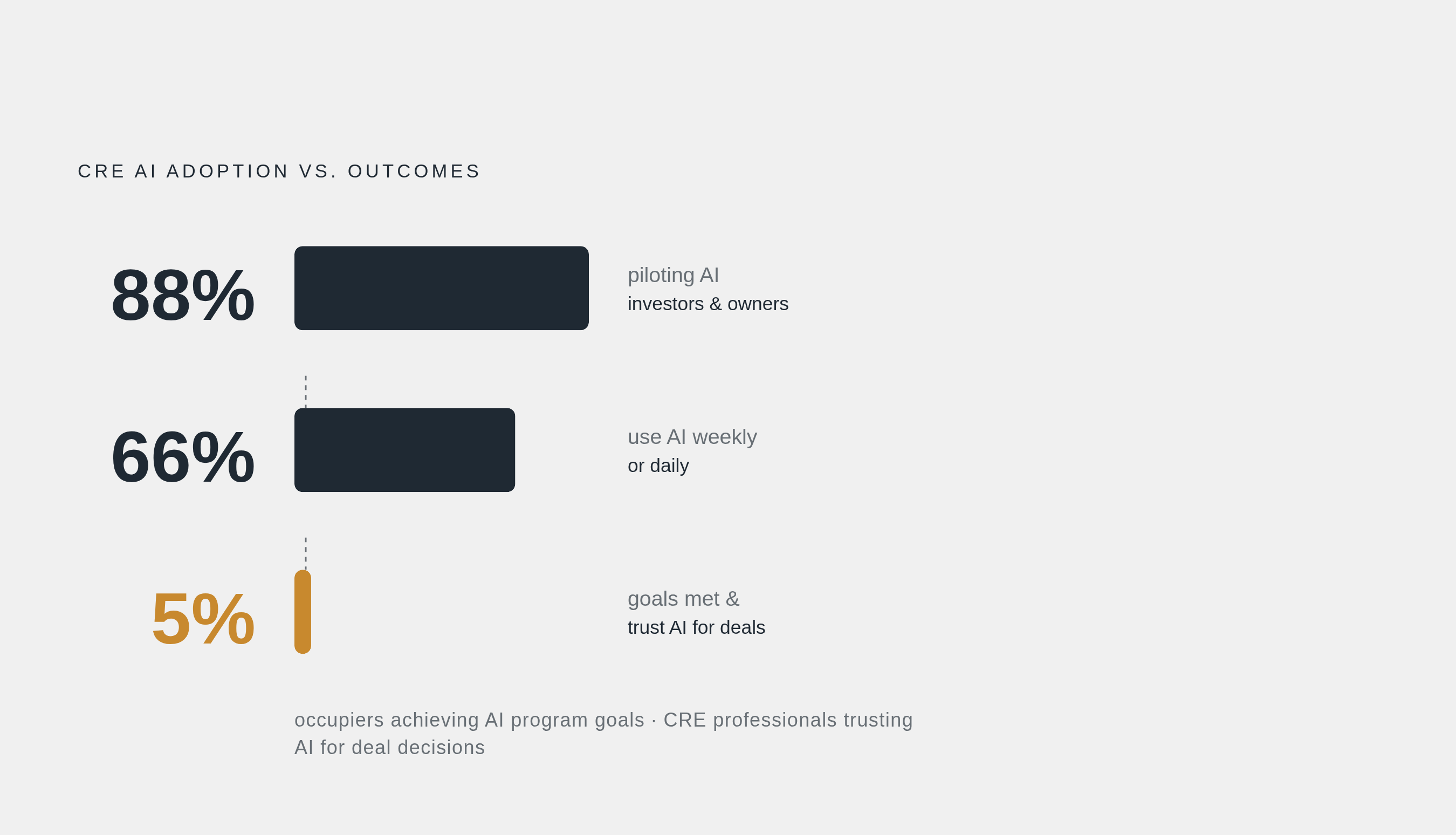
JLL's 2025 Global Real Estate Technology Survey of more than 1,500 senior decision-makers across 16 markets found that 88% of investors, owners, and landlords were piloting AI. Yet only 5% of CRE occupiers reported achieving all their AI program goals in a follow-up JLL study from October 2024. A 2024 study by First American Data & Analytics and DealGround adds a sharper edge: 66% of CRE professionals use AI weekly or daily, yet only 5% trust it enough to inform real deal decisions. People are touching AI constantly and integrating it almost nowhere. That gap deserves more than a shrug.
The most defensible explanation is not technical immaturity. It is a tool-fit problem, and a surprisingly specific one. Firms are running multiple use cases simultaneously without a clear framework for which system belongs where.
So what actually separates CRE-specific AI from the general-purpose variety? Tools purpose-built for this industry are trained on CRE document structures: rent rolls, T-12s, offering memoranda, leases, estoppels. They operate on CRE-specific metrics, NOI, DSCR, LTV, cap rates, expense recovery structures, and they draw from live comp databases, property records, and zoning filings. A general-purpose LLM like Claude or ChatGPT can help with document review and first-pass narrative drafting. What it cannot do is integrate natively with a deal pipeline, enforce an audit trail, or pull from a live comp database. One is a drafting aid. The other is a workflow system. They are not interchangeable — treating them as if they were is precisely how firms tend to land in the 5% goal-achievement cohort.
That raises the only question worth asking: not "should we use AI?" but "which system fits this specific workflow problem?" And to answer that, you need to know what problem each category was actually built to solve. "CRE AI tools" as a label is too broad to be operationally useful. An acquisition team, a lender, a property manager, and a broker have different bottlenecks, different data dependencies, and different tolerances for model error. A single recommendation spanning all four is not a recommendation; it is a shrug dressed up as strategy.
Deal Sourcing and Property Intelligence Tools
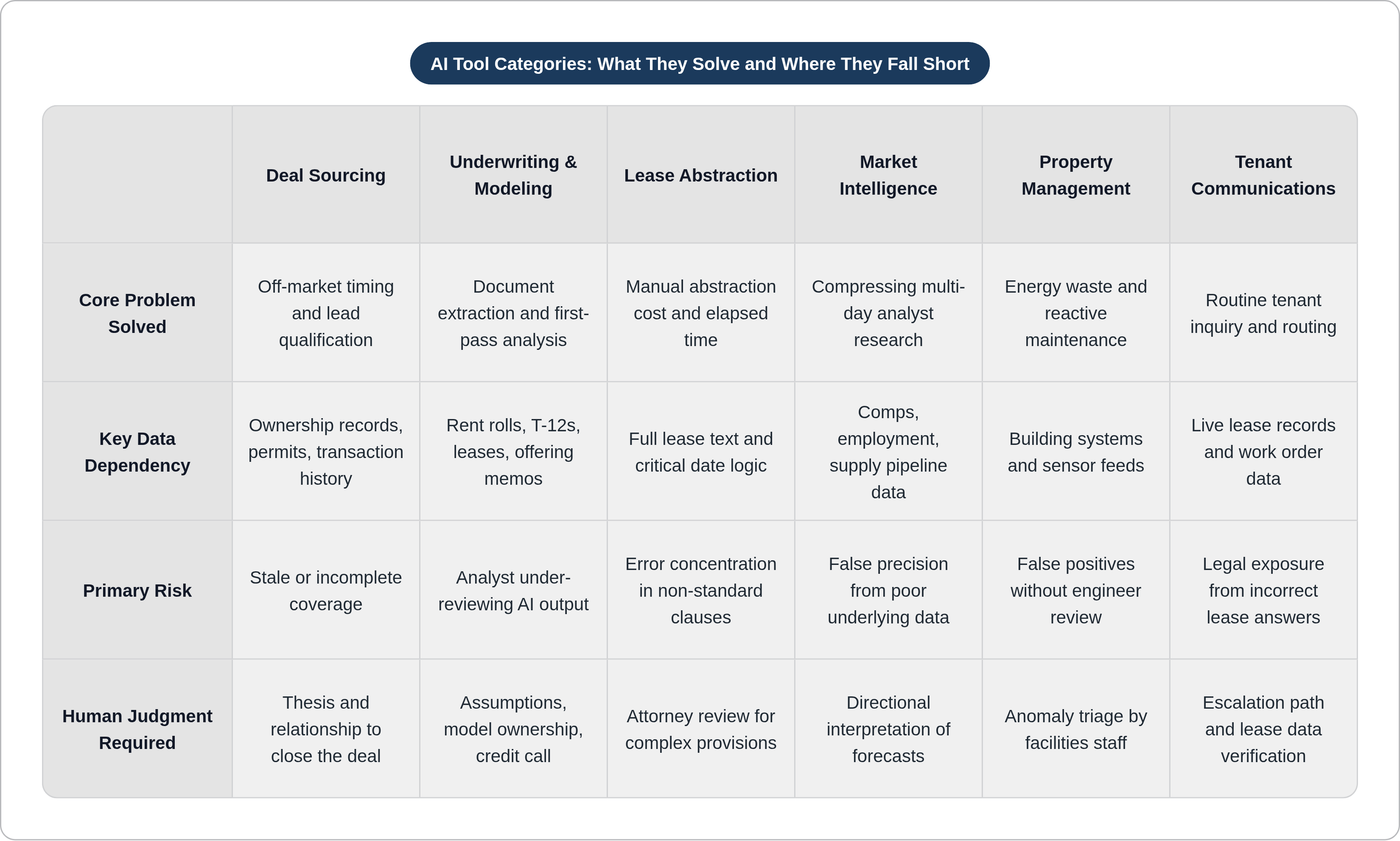
The core problem deal sourcing tools solve is not data access. It is timing. Traditional prospecting is largely reactive: an analyst reviews listed inventory and waits for brokers to surface opportunities. By the time a property is marketed, the most competitive buyers are often already positioned. AI sourcing platforms invert that sequence.
These systems crawl ownership records, permit filings, and transaction histories at a scale no analyst team can replicate manually, flagging properties that match a specific investment thesis before the asset hits marketed inventory. The more sophisticated platforms layer in non-traditional signals: zoning board filings, satellite imagery that can identify micro-market shifts before they register in transaction data, and social sentiment around a submarket. Some vendors have reported lead-qualification accuracy improvements of up to 40% with AI-assisted sourcing; that figure varies considerably by asset class and market coverage, and vendors should be pressed to demonstrate it against your actual deal criteria, not their demo datasets.
Reonomy built its core value proposition around commercial property intelligence and ownership data for off-market discovery. Cherre operates differently, constructing a Universal Data Model that standardizes disparate data sources into a knowledge graph connecting over 3.3 billion addresses, powering institutional investors, REITs, and lenders managing more than $3.3 trillion in AUM globally. Crexi reports its AI solutions helped users market over $5 trillion in property value. Cotality, formerly CoreLogic and rebranded in March 2025, brings more than 50 years of historical data; its Total Home ValueX AVM claims 99% accuracy across scenarios, covering 99.9% of U.S. properties.
But here is what none of these platforms touch: the investment thesis, the relationship that actually closes an off-market deal, and the directional judgment call on a market. The tool surfaces the signal. Someone still has to decide what it means.
One practical note for anyone evaluating platforms here: the value of a property intelligence tool is largely a function of data coverage and data freshness. A platform with sophisticated modeling on stale or incomplete records is worse than a junior analyst with a phone. Ask vendors specifically about update cadence and geographic depth before signing anything. Watch how comfortable they are answering that question.
AI in Underwriting and Financial Modeling
Underwriting is where the productivity case for AI in CRE is clearest, and where the organizational design risk is highest. Those two things travel together.
What AI actually does here: it reads offering memoranda, rent rolls, T-12 income statements, and leases; extracts structured inputs; flags inconsistencies between documents; and drafts a first-pass analysis. Some banks deploying AI underwriting on commercial loans have reported 50 to 75% reductions in time-to-decision, though these figures vary by institution and loan type. McKinsey has estimated that generative AI could unlock $110 to $180 billion in value across real estate through productivity gains and better decision-making. A team that used to evaluate four deals per quarter can scale to eight or twelve without adding headcount.
But what AI does not do is own the model, set the assumptions, or make the investment or credit judgment. That stays with the analyst. Which sounds obvious until you watch a team under deadline pressure. The AI produces a clean, well-structured first pass. The analyst reviews it less carefully than they would a blank spreadsheet. That handoff point is the critical design question in underwriting. The choice of platform is secondary to it.
Firms that treat AI output as analysis rather than as a draft requiring validation are producing the low goal-achievement numbers the JLL survey documented. The failure mode is rarely the model. It is the workflow around the model.
The platform landscape has meaningful tiers. General-purpose tools like Claude and ChatGPT are useful for document review and narrative drafting but limited on structured data extraction and native deal pipeline integration. CRE-native platforms automate the extraction of structured data from rent rolls and T-12s and carry that output forward into deal memos and portfolio dashboards. Workflow-integrated platforms like Dealpath are built for higher-volume or institutional settings, with integrations, audit trails, and version control that a general-purpose tool typically does not offer. And Excel or ARGUS should remain the scenario and sensitivity engine unless a firm has formally approved and tested a replacement. AI works upstream of that step, not instead of it.
Lease Abstraction Tools and What They Actually Save
Of all the AI use cases in CRE, lease abstraction has the clearest ROI. The math is not complicated.
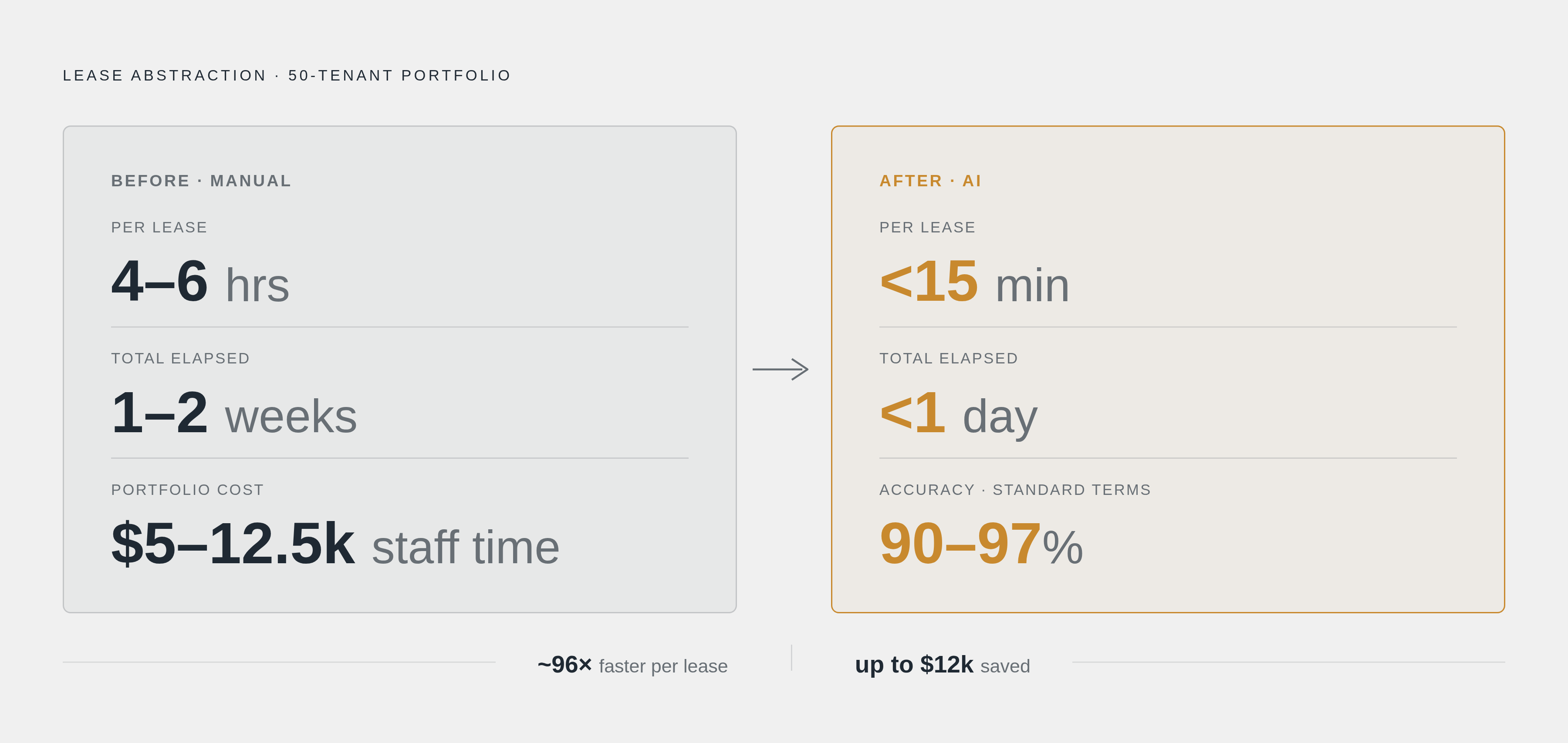
Manual abstraction of a 50-page commercial lease by a paralegal or junior analyst takes four to six hours, costs $200 to $500 per lease in staff time, and carries meaningful error rates under deadline pressure. At portfolio scale, acquiring a 50-tenant asset means somewhere between $5,000 and $12,500 in staff costs and one to two weeks of elapsed time for full abstraction. AI lease abstraction tools read the full lease, extract key business terms including base rent, escalations, renewal and termination options, expense recovery structures, and critical dates, and return a structured, reviewable summary in under 15 minutes. Leading platforms report 90 to 97% accuracy on standard commercial lease terms, though any firm should validate those claims against its own document types before relying on vendor figures.
JLL documented discovering $1 million in missed lease clauses after implementing AI lease review. Cushman & Wakefield's AI Impact Report lists lease intelligence among the top use cases driving measurable ROI. This is one of the more operationally validated categories in the market right now — which is either reassuring or a reminder of how much money was left sitting in manila folders before.
Dealpath AI Extract abstracts OM data and lease terms in under one minute and feeds directly into the deal pipeline. For smaller teams or one-off transaction needs, LeaseLens offers AI lease abstraction at $25 per commercial lease, making the technology accessible without an enterprise commitment.
One caveat that should not be buried in a footnote: accuracy rates in the 90 to 97% range apply to standard lease structures. Highly negotiated, non-standard, or complex joint venture leases still require attorney or senior analyst review. The 3 to 10% error band is not random noise; it concentrates in exactly the provisions that matter most when a lease departs from boilerplate. That is the part worth knowing before you trust the output.
Market Analysis and Data Intelligence Platforms
Market analysis AI compresses what used to be a several-day analyst project, assembling transaction comps, demographic trends, employment data, and supply pipeline data, into something closer to a continuous, automatically updated intelligence feed. For submarket selection, rent growth forecasting, competitive supply monitoring, and portfolio exposure analysis, that compression has real value.
Deloitte's 2024 Commercial Real Estate Outlook frames AI and data infrastructure as an increasingly primary determinant of competitive positioning. Market intelligence is where that argument is most concrete. Firms with continuous, current, well-sourced market intelligence tend to make better timing decisions on acquisitions and dispositions than firms assembling reports episodically.
But there is a specific failure mode in this category worth dwelling on. Market analysis AI produces outputs that look more precise than they are. A point forecast for rent growth presented to three decimal places is no more accurate than a directional range; it is styled to look that way. The underlying data quality determines output quality, and a platform drawing on stale or incomplete comps produces confident-looking but inaccurate analysis. The model does not know what it does not know, and neither do you unless you understand the data sources underneath it.
Ask any vendor exactly where their data comes from and how often it is updated. Discomfort there is informative.
Property Management and Smart Building Operations
Honeywell's 2024 AI in Buildings study found that 84% of commercial building decision-makers planned to increase AI use in 2025 to improve security, streamline energy management, and integrate predictive maintenance. The energy savings case is where the numbers are most credible. A 2024 meta-analysis in Energy and Buildings, reviewing peer-reviewed studies on AI-driven building energy optimization, found meaningful reductions in energy consumption depending on building type and methodology. A Colliers pilot using AI-driven HVAC optimization showed reductions in the range of 10 to 20%. For a 500,000 square foot Class A office tower, that is material annual utility savings, and the kind of number that gets a CFO's attention in a way that "improved tenant experience" does not.
Predictive maintenance is the second headline application. AI flags equipment degradation before failure, shifting maintenance from reactive to scheduled, reducing emergency repair costs and minimizing tenant disruption. That combination flows directly into tenant satisfaction scores and renewal probability, which are the numbers property managers actually lose sleep over.
Platforms worth noting: Honeywell's building management AI suite; Noda.ai for portfolio-level energy analytics; Building Engines, now part of Yardi, for tenant communications and work order management integrated with operational data.
It is also worth considering where this category still requires significant human involvement. AI-flagged anomalies in building systems require engineer interpretation before action. False positives in predictive maintenance generate unnecessary service calls if outputs are not filtered by experienced facilities teams. The technology is a sensor layer. The judgment layer still sits with people who have actually been in a mechanical room.
Tenant Communications and Leasing Support Tools
44% of CRE firms already rely on AI chatbots, per Gitnux's 2024 market research, making this one of the more widely deployed categories. It is also one of the most unevenly implemented, and the gap between those two facts is where the actual risk lives.
For routine use cases, a general-purpose chatbot is often sufficient: answering FAQs, routing maintenance requests, scheduling tours. Where CRE-specific tools add value is when the tenant communication layer connects to actual lease data. A tenant inquiry about their renewal option window should be answered from the abstracted lease record, not from a generic script written by someone who has never read a co-tenancy clause. Renewal outreach should be triggered by critical date logic from the lease abstraction system. Portfolio-level tenant health monitoring, flagging at-risk tenants by payment patterns or space utilization signals before a lease event, requires integration across multiple data layers simultaneously.
The brand and legal risk in this category is underappreciated. A chatbot that gives a tenant incorrect information about their lease terms creates both legal and relationship exposure. Any tenant-facing AI deployment needs a clear escalation path to a human and a verified connection to the underlying lease data. Isolated chatbots that cannot access live lease or work order data create no efficiency; they just automate the frustrating part of a bad experience, which is worse than not automating it at all.
How to Evaluate and Choose Tools Across These Categories
The evaluation framework here is not complicated, but it runs opposite to how most firms actually approach tool selection. The typical sequence: watch a vendor demonstration, get impressed by the interface, and then try to find a workflow to fit it into. That sequence is backwards, and it is why so many pilots look good in a conference room and quietly stall six months into implementation.
Start with the workflow. Identify which specific step in which specific process is the bottleneck or error source before evaluating any platform. That specificity is what makes vendor conversations productive. Without it, you are just being sold to, and you will be.
Once the workflow problem is defined, the evaluation dimensions that apply across categories are consistent. Data specificity: is the model trained on CRE document types and metrics, or is it a general model applied to CRE data? Data currency: how frequently are underlying feeds updated, and who are the source vendors? Integration depth: does the tool connect to existing deal pipeline, asset management, or property management infrastructure, or does it create a new data silo? Accuracy claims: are stated accuracy rates validated on the firm's own document types, or on vendor test sets that do not reflect actual portfolio complexity? Audit trail: for regulated or institutional workflows, does the platform log inputs, outputs, and analyst overrides? Human override design: where in the workflow does human review happen, and is it structurally enforced, or merely noted somewhere in a user guide nobody reads?
That last question is the one most firms skip. It is also the one most correlated with the difference between firms that achieve their AI goals and the 95% that do not.
The scaling trap Deloitte's CRE research and JLL's execution data both identify is the more pernicious problem: firms that pilot successfully but cannot scale because they have not built the data infrastructure or internal process the tool actually requires. Successful pilots create enthusiasm. Enthusiasm drives premature expansion. Expansion exposes the infrastructure gaps the pilot was too small to reveal.
The firms getting real results are not the ones that moved fastest or spent the most. Take Heitman, which spent 18 months mapping its underwriting workflow before selecting a platform and building reviewer checklists around AI output before going live — or Greystar, which piloted lease abstraction on a single 200-unit portfolio before rolling it out across 800,000 units. Both connected a specific tool to a specific workflow problem, then built the organizational scaffolding to actually use the output. That part is rarely in the demo.