Machine Learning for Property Valuation
ML models are replacing appraisers for collateral assessments across lending.

Automated Valuation Models are not a recent innovation in borrowed clothing. Algorithmic property valuation has been commercially active since the 1990s, embedded in mortgage lending workflows and automated underwriting systems long before machine learning became a cultural fixation: preliminary valuations, portfolio monitoring, appraisal waiver decisions, and as a quantitative check alongside human appraisers. If you have applied for a home equity line of credit in the past decade, a model, not a person, almost certainly assessed your collateral.
What has changed is not the concept but the convergence. Richer architectures, real-time data pipelines, and a regulatory environment growing more comfortable with algorithmic outputs have elevated AVMs from a back-office convenience to a front-line credit instrument. Constellation Data Labs figures from late 2025 show approximately 35% of home equity loans used AVMs or Property Condition Reports for collateral assessment in the prior year, a jump of twenty percentage points in a single year. That is not incremental adoption.
Consumer-facing products did something decades of back-office lending usage never quite achieved: they gave the public a number to argue with. Zillow's Zestimate made algorithmic estimates culturally legible. Whether any given Zestimate is accurate is, as we will see, a more complicated question than its confident interface implies.
The tension the AVM was designed to resolve is genuine. Property value is complex, but the industries built around it, lending, taxation, investment, need assessments that are scalable, consistent, and fast. A tax assessor running a mass appraisal program across hundreds of thousands of parcels cannot dispatch inspectors to each one. A lender processing refinance applications in a competitive rate environment cannot wait weeks for a straightforward property. The traditional comp-based approach, grounded in hedonic pricing assumptions, works well when good comparables exist and strains badly when they do not, in thin markets, unusual properties, and conditions shifting faster than recent sales reflect. That gap is where ML enters, with a fundamentally different premise: rather than finding the best analogue, it learns the pricing function itself. Think of it this way — the old model was a matchmaker, scanning a room for the closest resemblance. The new one is a student of human nature, trying to understand why attraction happens at all.
What ML Models Actually Take In: The Feature Landscape
Property valuation is, at its core, a prediction problem. The interesting question is which inputs the model is predicting from.
Structured attributes remain the foundation: square footage, age, bedroom and bathroom count, lot size, construction type. Location signals layer on top: proximity to transit, schools, amenities, neighborhood boundaries. Market context adds another dimension: comparable sales prices, local price trend direction, prevailing interest rate conditions. This is recognizable as an algorithmic version of what a human appraiser already considers.
What has genuinely changed is the incorporation of unstructured and visual inputs. Exterior listing photographs, street-view imagery, satellite data for roof condition and vegetation canopy, and narrative listing text processed through large language models are now active inputs in leading AVM architectures. Research on over fifteen thousand single-family homes in California found that visual features extracted from photographs reduced the estimated price elasticity of square footage by roughly 14%. In practical terms: square footage had been doing work in the model that actually belonged to visual quality. A numeric model cannot distinguish between a well-maintained home and a deteriorating one of identical size. An image-aware model is beginning, imperfectly, to approximate what an appraiser internalizes during a physical walkthrough.
But what if the data simply cannot be collected? Every feature the model cannot observe must be estimated from proxies, and every proxy introduces error. The expansion of the feature landscape, and the feature engineering required to make raw inputs usable, is not about accumulating data for its own sake. It is about reducing the error that compounds when important value determinants are invisible to the model.
Patent filings from 2024 through 2026 show active development in applying large language models to extract structured features from appraisal reports, deed records, and zoning filings. The feature set is still being defined, which is either exciting or concerning depending on your appetite for unresolved questions in consequential decisions.
How the Main Algorithm Families Approach the Valuation Problem Differently
The choice of algorithm is not a technical footnote. It determines what relationships the model can perceive at all.
Linear regression assumes each feature contributes independently and proportionally to price. Add a bedroom, add some value; increase square footage, add proportional value. It is interpretable, auditable, and almost certainly a simplification of the world it is modeling. The value of a garage is not independent of the neighborhood. The contribution of a school district rating is not linear across price tiers. Linear regression earns its place precisely because legibility is valuable, but legibility here comes at a cost.
Decision trees address the interaction problem by partitioning data: if square footage exceeds a threshold and the zip code matches a criterion, price approximates a given value. The resulting structure is intuitive, almost diagrammable. The problem is overfitting: a tree grown deep enough memorizes training data rather than generalizing from it, inflating in-sample accuracy while degrading out-of-sample performance.
Ensemble methods, chiefly random forests, gradient boosting, and XGBoost, are the current workhorses of applied valuation modeling. They combine many individually weak learners, averaging outputs in ways that reduce variance and capture non-linear interactions simultaneously. Multiple peer-reviewed studies identify XGBoost as the highest-performing algorithm for land valuation tasks; a 2024 study comparing eight algorithms on Dubai property data found gradient boosting and ensemble approaches consistently leading. These methods do not require a human analyst to specify in advance that the value of a finished basement depends on whether the market is suburban or urban. The model learns those interactions from data.
Neural networks and deep learning extend this further. Research published in Cities finds deep learning architectures outperform hedonic regression precisely because of their capacity to represent complex non-linearity. A 2025 study on the Hong Kong market adds a meta-learner trained to combine base learners' outputs, capturing what no single algorithm captures alone.
Here is what that progression actually means in practice. A linear model applies fixed coefficients regardless of context. An ensemble adjusts each feature's contribution based on what the others are doing. A deep network keeps adjusting without ever needing to name what it is responding to. Each generation is less constrained by human assumptions about what matters — which is simultaneously the appeal and, as we will see, part of the problem. The model went from reading from a script, to improvising from notes, to performing entirely by ear.
What Accuracy Benchmarks Actually Show, and What They Obscure
Median error rates for leading commercial AVMs have fallen substantially, with some models achieving figures in the low single digits on certain property segments. That is a genuine achievement. It also deserves aggressive interrogation before anyone acts on it.
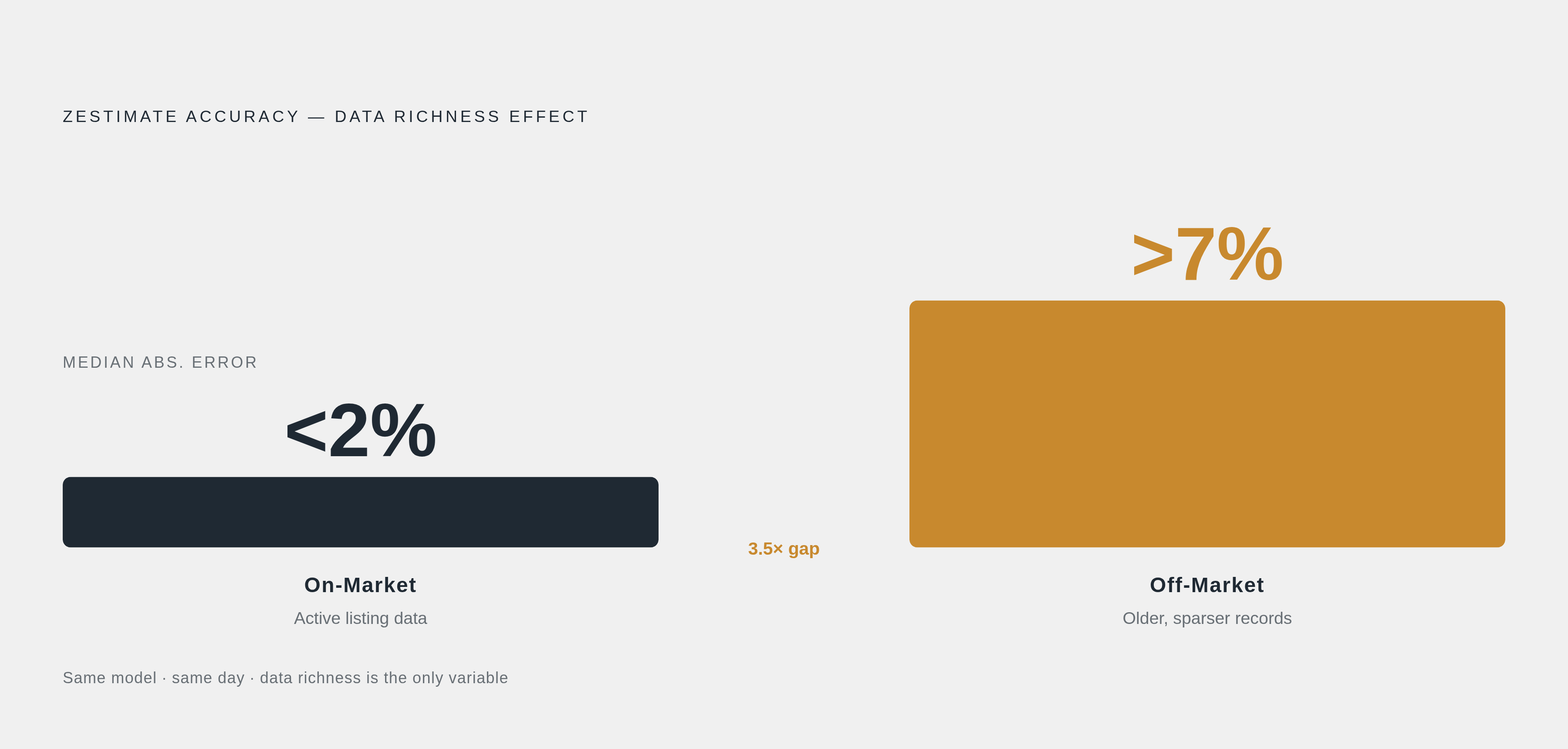
Zillow's Zestimate is the most publicly scrutinized AVM benchmark. The stated median absolute percentage error for on-market homes is under 2%. For off-market properties, that figure rises above 7%. That gap is the story. On-market homes carry active listing data, recent price signals, current condition information; the model has abundant, timely signal. Off-market homes rely on older, sparser data, and the model defaults to neighborhood-level patterns and historical transaction records. The same underlying model, on the same day, behaves very differently depending on data richness. A median error rate averaged across both conditions flatters the model considerably.
Zillow's iBuying collapse in 2021 is the stress test that benchmark figures could never anticipate. The algorithm overpaid systematically during a period of rapid market shift, resulting in losses exceeding $880 million and the program's closure. High median accuracy describes model performance under conditions similar to training. It says nothing about regime change.
A January 2026 study in Scientific Reports, using over twenty-one thousand transactions from the Vienna market, found an XGBoost-based model achieving accuracy comparable to human expert appraisers. That result warrants recognition, with a caveat: the same study found that experts working with ML output outperformed both the model alone and the experts alone. Which raises an important question: if the best outcome is human plus model, why does the industry persist in benchmarking them against each other as if they were competing for the same job?
The pattern across the literature is consistent. ML matches or exceeds human appraisers in stable, data-rich markets with plentiful comparable transactions. Accuracy degrades in thin markets, on unusual properties, and when conditions shift faster than training data reflects. The conditions under which ML performs best are the conditions least in need of its help. The conditions under which it performs worst are the ones where reliable valuation matters most.
The Black-Box Problem and the Push for Explainable Outputs
Here is the practical problem with a gradient boosting model achieving 2.8% median error: if it tells you a property is worth $480,000, you cannot ask it why, not in any satisfying way. You cannot examine its comparable sales. You cannot follow its reasoning the way you can read an appraisal narrative. The model has distributed its judgment across hundreds of trees and thousands of interaction terms, and that judgment is, in the technical sense, not human-readable.
This matters differently depending on where you sit. A homeowner disputing a tax assessment cannot interrogate the model. A lender making a credit decision on an AVM output cannot identify which features drove the estimate or whether they should have. A regulator examining potential fair lending violations cannot determine whether protected characteristics are being proxied through location features in ways that produce disparate impact.
Two technical responses have become dominant. SHAP, SHapley Additive exPlanations, applies a concept from cooperative game theory: each feature is treated as a player, the model's output is the collective payoff, and that payoff is allocated across players based on their marginal contributions. Applied to a property valuation, SHAP can tell you that proximity to a transit stop added a measurable amount to this specific estimate while the structure's age subtracted another, with figures attached. LIME takes a different approach, fitting a simpler local model around a single prediction that approximates the complex model's behavior near that point.
The RE-VAL framework, described in a 2026 publication in Urban Sciences, applies SHAP-based decomposition alongside geographically informed feature processing to produce adjustment tables in monetary terms: this feature adds X dollars, this feature subtracts Y dollars. An appraiser or regulator can read it without a machine learning background. That is not cosmetic progress. It is the translation of opaque model judgment into the vocabulary of the profession it is disrupting.
The regulatory environment has accelerated this work. An interagency AVM rule effective October 2025 requires quality control standards for AVMs used in credit decisions, and explainability is embedded in those requirements. The academic push for interpretability and the regulatory push for auditability are now pointing the same direction.
One position holds that explainability is a distraction: if the model is accurate, does it matter whether we can explain it? But that position assumes accuracy is stable and unbiased, and both assumptions deserve scrutiny. The most accurate models remain the least interpretable, and buying explainability often costs some accuracy. That is a policy choice, not merely a technical one, and it is worth naming it as such.
How Biased Training Data Surfaces as Biased Valuations
ML models learn from historical transaction data. They are, in a precise sense, mirrors held up to market history. And market history in the United States is not neutral.
Historical redlining designated neighborhoods by race and restricted mortgage access accordingly. Those restrictions suppressed property values in affected areas for decades by constraining demand, limiting investment, and reducing transaction volume. A model trained on that price history has learned those patterns. It will reproduce them.
The mechanism is not that the model receives race as an explicit input. Modern AVMs do not use race as a feature. The mechanism operates through location proxies: zip code, neighborhood boundary designations, proximity features that correlate tightly with race when those boundaries trace historical segregation lines. The model learns that certain locations predict lower prices. It is historically correct. Whether it should continue to be is the operative question.
Data sparsity compounds this in a specific way. In markets where fewer transactions are recorded, often lower-income or minority neighborhoods, the model has weaker signal, wider error ranges, and defaults more heavily to neighborhood-level features. Those neighborhood-level features encode the most historical inequity. The model becomes simultaneously less precise and more biased in exactly the places where precision and fairness matter most.
Research cited by fair lending policy organizations suggests data quality issues, including missing attributes and outdated records, can distort valuations by meaningful margins. This is not an edge case. It is a structural feature of using historical market data to price current properties in markets shaped by discriminatory policy.
The October 2025 interagency AVM rule includes nondiscrimination as an explicit quality control requirement. That is a beginning, not a resolution. The bias question is active in both policy and litigation, and any characterization of it as settled would be premature by a wide margin.
Where ML Falls Short Regardless of Data Quality
Even a perfect dataset cannot supply information that was never collected.
No AVM conducts a physical inspection. It cannot observe water intrusion behind drywall, structural settlement, a furnace at the end of its service life, or a kitchen renovation completed last year with high-end finishes that materially affect sale price. It registers a house built in 1975. It has no access to whether that house has been maintained with care or neglect. Permitted renovation work appears in public records. Unpermitted work, cosmetic upgrades, and material quality improvements typically do not. The model prices the structure on paper. It cannot price the substance of what is actually there.
Thin and illiquid markets expose the model's foundational dependency on transaction volume. Rural areas, highly distinctive properties, and properties at the extreme upper end of local price distributions share a characteristic: few genuinely comparable recent sales. Training signal is weak, error bands are wide, and the headline accuracy figures do not represent performance on these cases. The model is quietly least reliable where comparables are hardest to find, which is also the situation where humans struggle most and where errors carry the largest financial consequences.
Market regime change is the failure mode that attracted the most attention after Zillow's iBuying losses. A model calibrated on transaction patterns during a period of rising prices and predictable demand will not contain within its weights any representation of a sudden liquidity crisis, a rate shock, or a neighborhood transformation. Historical data cannot teach a model about a future it has not encountered.
Hyperlocal conditions move prices in ways that precede formal data records by months: a planned commercial development, a school rezoning, a neighbor's property falling into disrepair, a flood event affecting one block and not the next. The model learns about these when transaction data reflects them. By then, the estimate has already been acted upon.
ML handles the average case well and the unusual case poorly. That is a less devastating limitation than it sounds, until you recognize that the unusual cases are precisely where valuation judgment matters most.
How Hybrid Models Combine ML Speed with Human Judgment
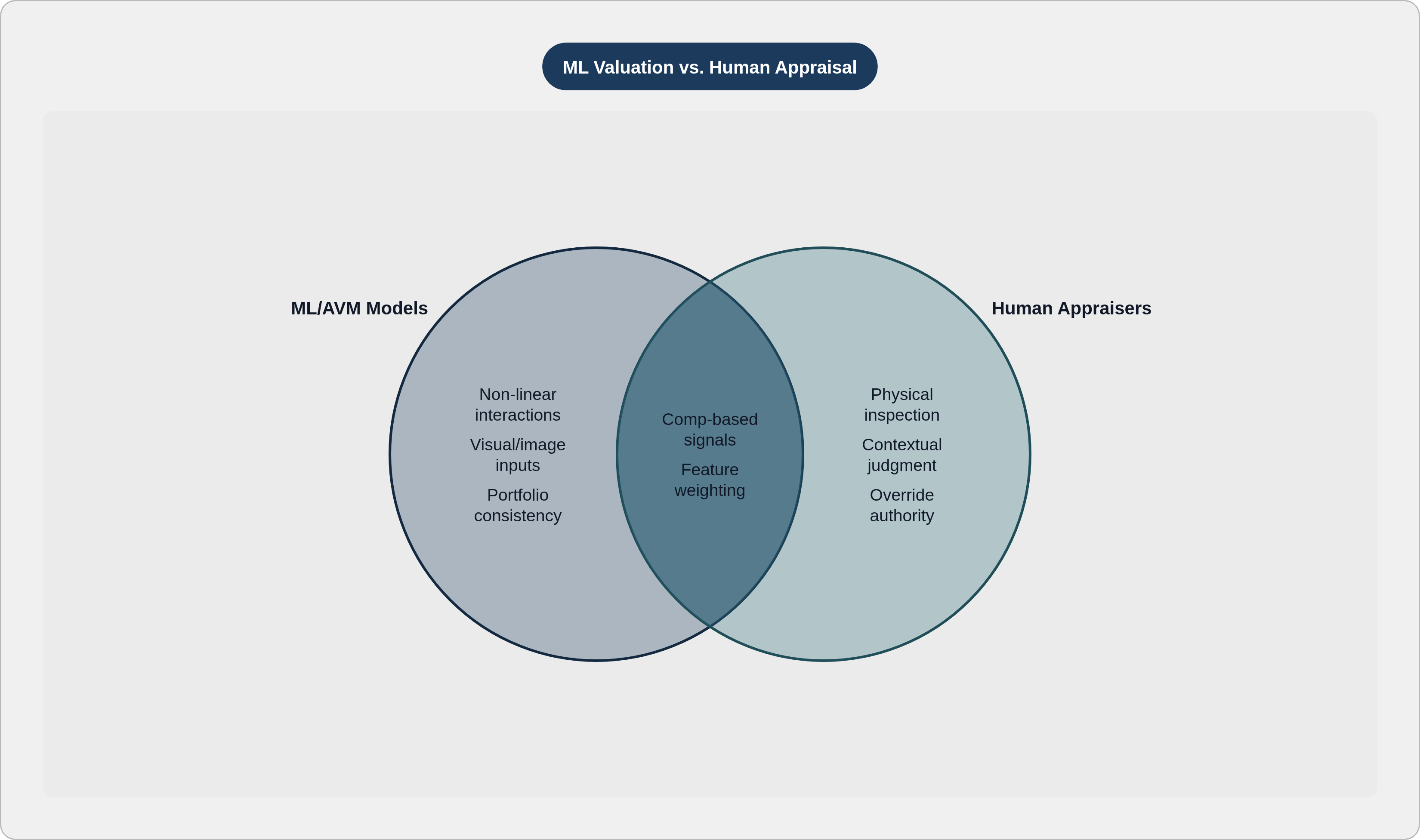
The Vienna study result is worth restating because it is structurally important: ML alone matched expert accuracy; experts working with ML output exceeded both. That is not a finding about which tool is superior. It is a finding about how different tools compound each other's strengths, which is a different and more useful question.
What ML contributes to a hybrid workflow is real. A rapid baseline estimate, generated across a comprehensive feature set without fatigue or anchoring effects, gives the human appraiser a defensible starting point. SHAP-based outputs flag which features are driving the estimate, functioning as both checklist and prompt: the model thinks proximity to transit is doing significant work here; does the physical inspection confirm that? Portfolio-level consistency, the same model behavior applied uniformly across a dataset, eliminates the drift that accumulates when human reviewers work independently across large volumes.
What the human appraiser contributes is what the model structurally cannot: physical inspection, contextual judgment about conditions shifting faster than recent sales reflect, and override authority on cases where comparable data is absent or the property falls outside the model's training distribution.
Fannie Mae and Freddie Mac's AVM acceptance programs operationalize this at scale. Appraisal waivers apply on qualifying loans, typically lower-risk, data-rich properties where model confidence is demonstrably high. Full human appraisals are preserved for complex cases. That is not a compromise forced by political considerations. It is a rational allocation of scarce expert attention to the cases where it generates the most value.
The question of whether ML is replacing appraisers is probably the wrong frame entirely. The better question is which cases actually require the irreplaceable inputs that only a physical inspection and contextual human judgment can supply, and whether the industry is directing human expertise toward those cases or distributing it indiscriminately.
What Understanding ML Valuation Means for Anyone Who Uses or Is Affected by a Property Estimate
Start with the number on the screen. An AVM estimate is a starting point, not a verdict.
The gap between on-market and off-market performance in Zillow's published accuracy data illustrates that data richness, not model sophistication, is often the binding constraint. The estimate is only as reliable as what the model could observe, and the model will not volunteer what it could not see.
For buyers and sellers, condition matters in ways the model cannot fully capture. A recently renovated home and a comparably sized but deteriorating property may receive similar AVM estimates if the renovation is unpermitted and the deterioration has not yet surfaced in transaction records. The model's median accuracy applies to the middle of the distribution. At the edges, where the unusual properties and the significant recent investments live, confidence intervals widen considerably.
For lenders and investors, point estimates without uncertainty ranges are a red flag worth taking seriously. The technical infrastructure now exists to produce SHAP-based explanations of which features drove a specific valuation. Those explanations are auditable; a single dollar figure is not. Zillow's iBuying experience should have retired the practice of acting on model outputs without examining the underlying feature contributions. Whether it has is a separate question.
For policymakers and anyone operating under fair lending obligations, the bias risk is structural, embedded in training data, and reproducible at scale. The October 2025 AVM interagency rule establishes a floor of accountability. The actual work of auditing training data, feature selection, and model outputs for disparate impact is ongoing and not yet standardized across the industry.
ML valuation's accuracy advantage is real and, by most evidence, still improving. But it is conditional: on data richness, market stability, property typicality, and the absence of structural shifts the training data cannot anticipate. Knowing those conditions is how you know when to trust the model and when to look harder. The model will not make that determination for you. That judgment still belongs to whoever is reading the output.