AI Applications Across the CRE Deal Lifecycle
Firms deploying AI across the entire deal lifecycle outcompete those using it for single tasks.
There is a version of this conversation that happened at every major CRE shop between 2022 and 2024, probably in a conference room with bad lighting and a whiteboard that still had last quarter's deal pipeline on it. Someone from technology or strategy presents an AI tool. The investment team nods politely. Someone asks whether it can do the whole rent roll or just part of it. The meeting ends. The tool gets deployed for one task, two at most, and then sits adjacent to the existing workflow rather than inside it.
That is not a story about AI failing. It is a story about how point solutions get adopted: narrowly, defensively, and without a theory of where they fit in the broader sequence of work. The more interesting question now, given that Deloitte's 2024 Commercial Real Estate Outlook found 76% of CRE firms already exploring or implementing AI, is what happens when the deployment philosophy changes. Not AI for one stage. AI across the lifecycle.
The deal lifecycle is not a single moment. A transaction from first screen to asset disposition can span years, touching sourcing, due diligence, underwriting, closing, covenant monitoring, and portfolio management in sequence. For most of that history, each stage ran on its own manual stack: spreadsheets, PDFs, email chains, and periodic reviews that were periodic by design, not by choice. The competitive question today is not whether to use AI. It is whether you are using it in one place or across the chain. The gap between those two postures is widening.
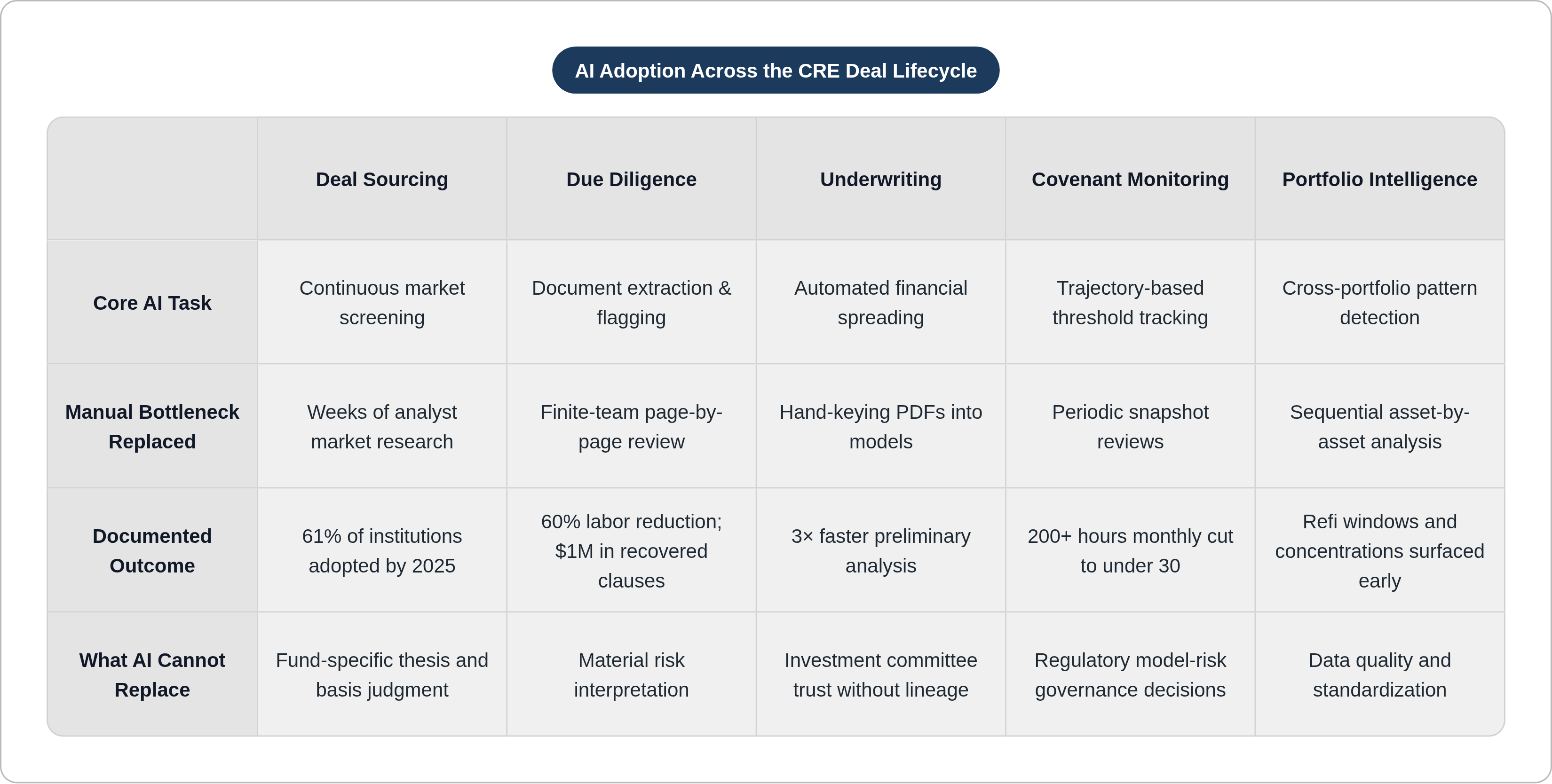
Deal sourcing and market screening: compressing the opportunity identification window
Traditional sourcing, for all its institutional ritual, is slow by design. An analyst manually scans listings, pulls comps, synthesizes submarket reports, cross-references against a firm's investment criteria, and delivers a shortlist somewhere between a few days and a few weeks later. The process is thorough in isolation. It is also a bottleneck the moment deal velocity increases or the opportunity set expands.
AI changes the geometry of this problem. Rather than a single analyst processing markets sequentially, AI systems scan listings, market data, and internal records continuously, surfacing assets that match a firm's specific investment profile, risk flags, historical comparisons, and yield forecasts included. What took weeks of research can surface in a morning review.
JLL's 2025 Global Real Estate Technology Survey measured something worth sitting with: 61% of institutional investors used AI for market analysis in 2025, up from 22% in 2023. That is not a gradual adoption curve. It is a step change, and it represents the steepest adoption rate of any deal stage in that survey.
But what if speed at the sourcing stage just means more noise? That is the reasonable objection. Broader coverage without better filtering is not an advantage; it is a different kind of inefficiency. The practical answer is that sourcing AI is not a firehose, it is a screen. Firms using it well are expanding into more markets and more asset types without adding headcount because BCG's 2026 Global Asset Management Report frames this as expanding the opportunity set without diluting attention. The system handles coverage; the team handles judgment.
And that distinction matters. AI at this stage surfaces; it does not decide. Whether an asset fits a firm's actual investment thesis, given current portfolio positioning, team bandwidth, and LP preferences, is still a human call. No model running on public market data knows your fund's specific basis problem on a similar asset you closed eighteen months ago. That context lives with the deal team.
Once the shortlist exists, the next bottleneck is not capital or capacity. It is documents.
Due diligence: what AI finds in the document stack that manual review misses
A single portfolio acquisition can mean thousands of pages: environmental reports, estoppel certificates, master service agreements, leases with riders and amendments going back years. Every page is theoretically material. In practice, under deadline pressure with a finite team, some pages get more attention than others. That asymmetry is where deals go wrong.
Goldman Sachs estimated in mid-2025 that AI tools can reduce CRE due diligence costs by 20–35% for large institutional portfolios. The cost reduction is the headline. The more important implication sits underneath it: if AI is reducing costs primarily by catching what manual review misses, then the ROI calculus includes not just efficiency but loss avoidance. One missed clause in one lease is not academic. JLL's AI lease abstraction deployment cut review labor by 60% and, separately, surfaced $1 million in missed clauses. The labor reduction is operationally meaningful. The missed-clause finding is existentially meaningful.
What AI does mechanically here is automated document classification and extraction: reading and categorizing unstructured documents at a scale no analyst team can match, flagging inconsistencies, missing exhibits, and clause anomalies that reviewers under time pressure tend to skip. It is also worth considering what AI cannot do here, because that boundary is real. The system can flag that a lease contains an unusual co-tenancy provision. It cannot tell you whether that provision, given the borrower's specific tenant mix and your fund's exit strategy, represents a material risk or a manageable one. That interpretation still requires an experienced practitioner.
The trust question at this stage is not whether AI is accurate. It is whether the output is interpretable. Source citations tied to extracted data are not a feature; they are the precondition for utility. Investment committees and legal counsel will not act on a summary output with no provenance trail. They need to know exactly which document, which clause, and which sentence the AI is referencing. Platforms that provide that chain of custody are defensible. Platforms that do not are a liability.
Once due diligence surfaces the data, the next step is getting it into the financial model. Which has its own bottleneck, and it is tedious enough that most practitioners know exactly what it costs.
Financial spreading and underwriting: the manual data-entry problem AI eliminates first
Ask any analyst who has spent a Tuesday afternoon transferring figures from a twelve-page operating statement into Argus while fielding emails about a closing timeline whether the current underwriting workflow is optimal. The answer involves a facial expression more than words.
The manual bottleneck is structural: operating statements, rent rolls, and tax returns arrive as unstructured PDFs, and someone has to move those numbers into a model by hand. Every copy-paste step is delay; every delay is also an error vector. This is not a critique of analysts. It is a critique of a workflow that uses skilled human capital to perform a task that degrades the quality of the output it is feeding.
AI eliminates this bottleneck at the entry point. Extraction models pull financial data from unstructured PDFs automatically, preserving context from footnotes and narrative sections, while analytical layers calculate metrics, compare against benchmarks and historical trends, and flag anomalies. CBRE's 2025 Tech Adoption Report found that development teams using AI for underwriting completed preliminary analysis three times faster than those without. Banks using AI underwriting have reported 50–75% reductions in time-to-decision for commercial loans. The analyst's time is freed for the analysis itself, not the data entry that precedes it.
That scale effect compounds when you consider volume. The Mortgage Bankers Association projected $806 billion in commercial mortgage origination for 2026, up from $633.7 billion in 2025. Leading institutions have reported handling substantially more loan applications with existing staff because of AI-assisted spreading. That is not a marginal efficiency gain; it is a structural change in throughput capacity.
One argument holds that speed is irrelevant if investment committees do not trust what comes out. And the 2025 Keyway survey shows that investment committees broadly distrust AI-generated analysis for high-stakes financial decisions, even while they accept it for document extraction and research summarization. That distrust is rational. It is also a solvable problem. AI-generated spreading that shows exactly which line in which document produced which number is far more defensible to a committee than a black-box output that simply reports a conclusion. Transparency of lineage is the trust mechanism at this stage.
One more precondition worth naming plainly: firms with clean, standardized data extract materially more value from these systems. The technology works as advertised. What it works on has to be organized first.
Covenant monitoring and risk surveillance: why quarterly reviews leave lenders exposed
Here is the design problem with traditional covenant monitoring, stated plainly. Periodic reviews are periodic by construction. Monthly reporting, quarterly covenant checks, annual credit reviews. Risk, however, does not operate on a quarterly schedule. Tenants lose anchor neighbors in October. Interest rate caps expire in February. The quarterly review cycle is not a risk management system; it is a documentation system.
The scale problem makes this worse. A mid-sized lender with 500 active commercial loans is tracking an estimated 1,500 to 2,500 covenant thresholds each quarter, and approximately 70% of banks still rely on spreadsheets and manual processes to do it. That is not a technology gap; that is an exposure.
The trajectory insight is the one that reframes this problem. A single quarter at 1.30x DSCR against a 1.25x covenant is noise. Three consecutive quarters drifting from 1.45x to 1.32x to 1.28x is signal. The breach is coming. The difference between a loan workout and an avoided default is whether the system surfaces that trajectory before the covenant is technically violated or only after. Manual quarterly review, by definition, sees each point in time independently. AI continuous monitoring sees the line.
A documented example illustrates the operational magnitude: a $200 million CRE lender's team was spending more than 200 hours monthly on covenant review. After deploying automated tracking, time dropped below 30 hours monthly, and early alerts helped prevent two potential defaults, saving an estimated $1.2 million in write-downs. The labor reduction is real. The prevented defaults are the actual value proposition.
A 2025 Federal Reserve working paper reinforces this at the systemic level: banks relying on borrower-reported performance data are slower to update risk ratings as information becomes stale, and borrowers with stale financials are more likely to default. Continuous monitoring is a structural answer to that staleness problem.
One regulatory clarification worth noting, because practitioners are getting confused about this: the April 2026 revised interagency guidance clarifies that deterministic ratio calculations, computing a DSCR against a threshold, are not models for model risk governance purposes. Document classifiers and extraction models are. Lenders need to understand which parts of their AI stack sit inside the model risk governance perimeter and which do not. The distinction has compliance implications.
Portfolio-level intelligence: surfacing refi windows and concentrations that loan-by-loan review never reaches
There is a structural limitation in deal-by-deal review that gets underappreciated until a portfolio is large enough to make it obvious. Review a portfolio of 200 assets sequentially and the 200th gets less analytical attention than the first, simply by attrition of time and attention. More importantly, patterns that exist only at the portfolio level, maturity concentrations in a single vintage, sector drift from original investment mandates, refi windows clustering in a tight twelve-month window, are invisible at the individual-asset level. You have to see the whole thing at once.
Portfolio AI aggregates DSCR trends, vacancy movement, tenant credit signals, lease rollover concentration, and market condition changes into composite risk indicators across the entire portfolio, updated continuously. It surfaces emerging refi windows, maturity clusters, and concentration risks before they become crises. It allows scenario stress-testing across positions simultaneously rather than asset by asset.
With $957 billion in CRE and multifamily mortgages maturing in 2025, lenders without automated portfolio surveillance are identifying maturity risk reactively. That is a problem with a known solution.
BCG's 2026 Global Asset Management Report estimates AI has the potential to improve risk-adjusted returns for managers meaningfully, with analysts able to redeploy a substantial portion of time previously spent on data gathering toward higher-order decisions. The portfolio level is where that redeployment has the most leverage, because it is where data aggregation has historically consumed the most human time for the least analytical output.
Two platforms worth naming as production-grade deployments rather than pilots: ARGUS Intelligence from Altus Group for benchmarking and scenario stress-testing, and CBRE's Ellis AI for portfolio-level trend detection across CBRE's proprietary dataset. These are not proofs of concept; they are live infrastructure.
That said, a caveat from Acuity Analytics' 2026 Annual Survey is directly relevant here: 69% of respondents cite data quality and access as the main barrier to further AI adoption, and firms with clean, standardized data see two to three times the value from portfolio AI platforms as those feeding them inconsistent, siloed data. The technology is sound. The precondition is data discipline, not budget.
Where agentic AI fits into this picture and what it changes about the lifecycle
Every stage described above still involves, at some level, a human prompting a system. Someone runs the screening query. Someone initiates the document review. Someone requests the covenant report. Generative AI, in its current dominant deployment model, answers when asked.
Agentic AI is a different architecture. It acts on a continuous basis, anticipating needs and surfacing insights without prompting. A sourcing agent monitors deal flow around the clock and flags opportunities against the firm's investment criteria without waiting for an analyst to log in Monday morning. A research agent maintains competitive intelligence and activates when a new deal enters the pipeline. A monitoring agent tracks covenant performance and portfolio metrics without waiting for the quarterly review cycle to arrive on the calendar.
Why does this matter structurally? Because the friction in the current lifecycle is not only within each stage; it is at the handoffs between stages. Sourcing output has to be manually packaged and passed to the due diligence team. Due diligence findings have to be manually translated into the underwriting model. Underwriting decisions have to be manually entered into the monitoring system. Each handoff is a delay, an error opportunity, and a moment where context gets lost.
Agentic orchestration is what makes the stages feel connected rather than siloed. The output of sourcing feeds underwriting, feeds monitoring, without a manual handoff at each transition. That is not a marginal improvement in workflow efficiency; it is a different model of how the deal lifecycle operates.
But here is the honest caveat, and it is worth stating without qualification: agentic AI in CRE is early. The firms deploying it at scale in 2026 are a minority. The governance questions, specifically who reviews what the agent decided, how errors are caught, and what the audit trail looks like, are not fully resolved. This is the frontier of what is possible, not a description of current standard practice at most institutions. Anyone claiming otherwise is selling something.
Why lifecycle-wide AI adoption requires security and data governance to be solved first
Real estate firms experienced a 284% increase in cyberattacks between 2022 and 2024. The average CRE firm runs somewhere between twelve and fifteen different software systems. Each is a potential ingress point. This is the baseline threat environment before any AI deployment; lifecycle-wide AI adoption expands the surface area considerably.
The logic is direct: the more stages of the deal process running through AI platforms, the more sensitive data flows through those systems. Borrower financials, loan covenants, portfolio positions, proprietary underwriting criteria. A breach at one node in a lifecycle-integrated stack is not a single-application problem; it potentially compromises the entire sequence.
Enterprise-grade security requirements are now baseline expectations, not differentiators, for institutional-grade platforms: SOC 2 compliance, end-to-end encryption, regular security audits, data residency controls, and access protocols that ensure a firm's proprietary models and deal data are not shared across tenants or used to train shared models. A platform that cannot provide clear answers on these points is not ready for institutional deployment, regardless of how impressive the demo was.
There is a governance dimension specific to CRE AI that goes beyond security. AI outputs grounded in a firm's own underwriting criteria, its own covenant definitions, its own risk thresholds, are materially more defensible to investment committees and regulators than outputs generated by a generic model with no institutional grounding. Firms that invest in building their proprietary data and decision logic into the AI stack get better outputs and get to defend those outputs. Firms that do not are essentially borrowing someone else's judgment.
That raises an important question about untapped asset value. Industry research shows 89% of CRE firms analyze less than 20% of their available data. The security and governance infrastructure required for lifecycle-wide AI deployment also unlocks that untapped analytical asset. Solving the governance problem is not only a compliance exercise; it is also, practically, the unlock for the full value of the data a firm already possesses.
What the full lifecycle picture means for how CRE teams should think about their AI stack now
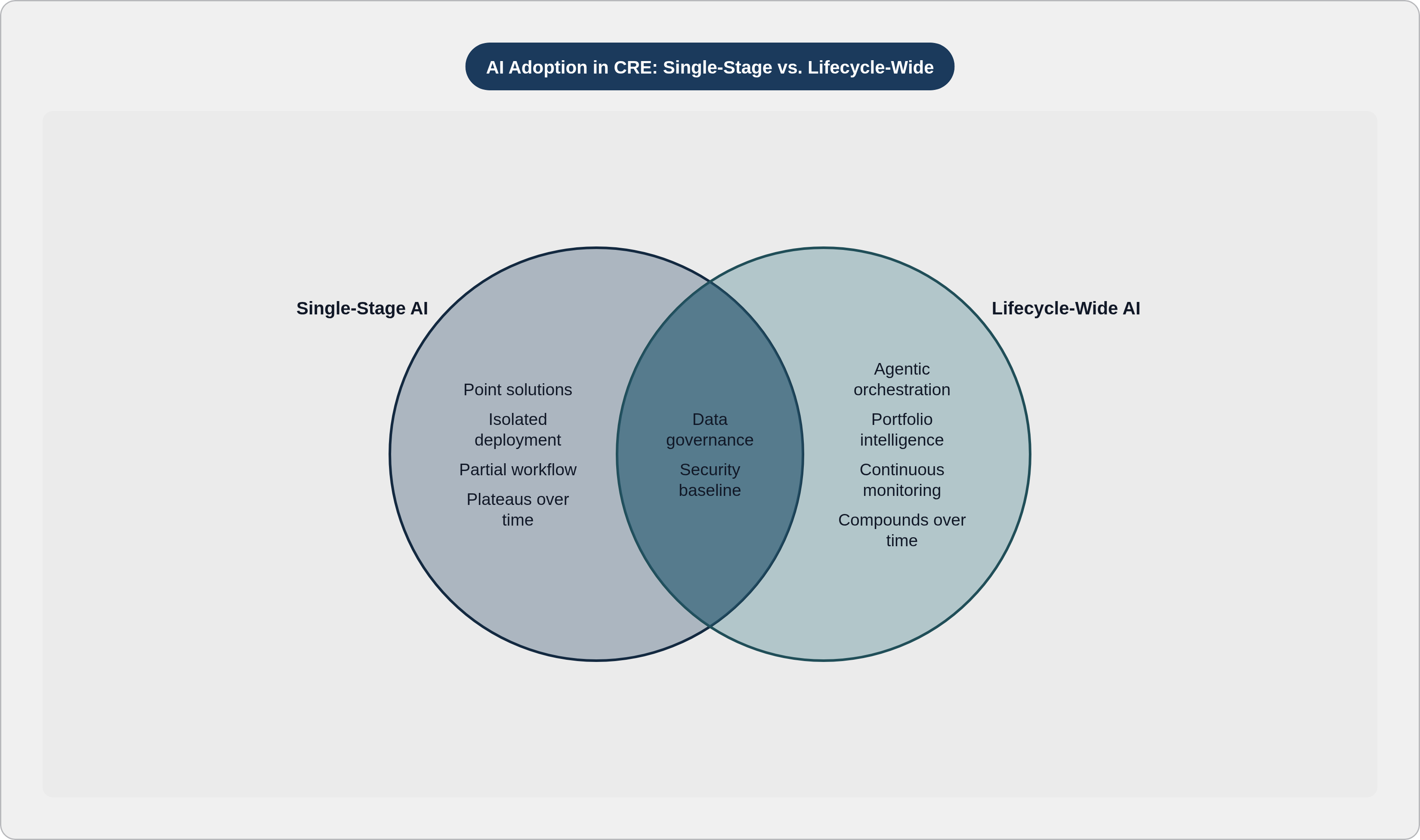
The stages described above are discrete on paper. Sourcing, due diligence, underwriting, monitoring, portfolio intelligence. In practice, the value is not in any single stage; it is in the compounding effect across all of them. Each point of friction eliminated early reduces the cost of every subsequent stage. A deal screened more precisely in sourcing creates a shorter due diligence document stack. A cleaner due diligence extraction creates a more accurate underwriting model. A better underwriting model creates a more reliable monitoring baseline. The lifecycle is a chain, and AI shortens each link.
The 2025 Keyway survey data offers a practical sequencing logic for firms figuring out where to start. Document extraction and financial spreading are the highest-acceptance, lowest-trust-barrier entry points for investment committees. That is where to begin, not because the other stages matter less, but because starting there builds the institutional comfort and data infrastructure that makes the subsequent stages tractable.
The competitive gap that matters now is not between firms using AI and firms not using it. That gap has largely closed as a matter of adoption statistics. The gap that is widening is between firms deploying AI across the lifecycle, with the data governance and security infrastructure to support it, and firms using it in one or two isolated applications while the rest of the workflow remains manual. The former compounds. The latter plateaus.
The firms that move first on lifecycle integration are not just faster. They are surfacing opportunities, risks, and portfolio patterns that firms with partial adoption structurally cannot see. That is not a speed advantage. It is an information advantage, and in this business, information is the asset.