Underwriting Bridge Loans vs Permanent CRE Debt
Bridge loans underwrite business plans; permanent debt underwrites existing income streams.

Bridge loans and permanent CRE debt get sold as points on the same price spectrum: one costs more, one costs less, pick the cheaper one when you qualify. That framing is wrong in a way that matters more than any rate differential ever will, because the two instruments underwrite entirely different things and answer entirely different questions.
Why bridge loans and permanent debt underwrite differently
Treating a bridge loan and a permanent loan as the same product at different prices leads straight to a term sheet that reads like it was written by two different professions, because it was. Permanent debt prices a stream of income that already exists. The lender tests what the asset is earning right now against coverage ratios and yield thresholds, and if the numbers clear the bar, the loan gets done. Bridge debt prices something that does not exist yet: a probability. The lender is betting on whether a transitional asset, mid-renovation or mid-lease-up, will reach stabilization on a defined timeline, and the collateral that matters most is not this year's rent roll but the projected value once the plan works.
The word "transitional" does real descriptive work rather than serving as a euphemism, naming the fact that the asset hasn't yet cleared the gates permanent lenders require. Permanent lenders require stabilized cash flow, a target occupancy level, and a seasoning period before a loan becomes available at all, and an asset either clears those gates or it does not. Bridge lenders step in before the gates are cleared, pricing the extra risk into a higher rate and a shorter term.
The payment mechanics make the logic visible without anyone having to explain it. Bridge loans run interest-only, floating off SOFR, which keeps the borrower's cash flow manageable during a period when net operating income is climbing but hasn't reached target. Every section that follows in this piece is really just an elaboration of that one divide: what each lender is willing to underwrite, and why mismatching the instrument to the asset's actual condition costs far more than the spread between their interest rates.
The occupancy and income gates that determine which instrument is even available
Permanent debt becomes available only once an asset clears specific, measurable thresholds, and falling short by a small margin disqualifies a deal as completely as falling short by a wide one.
Occupancy is the most common forcing function. An asset that hits the occupancy number on a single rent roll and dips the following month hasn't satisfied the requirement, and the permanent lender isn't going to split the difference.
On the income side, permanent lenders underwrite to debt service coverage ratio and debt yield floors. Bridge lenders work from a different baseline entirely: they size loans against as-stabilized value rather than in-place income, which is why the loan-to-value math looks unfamiliar to anyone used to permanent underwriting. Most bridge lenders order both an as-is and an as-stabilized appraisal and size proceeds against a defined LTV ceiling on the stabilized number, effectively lending against where the asset is headed.
Speed creates a second, independent forcing function that has nothing to do with whether the asset could theoretically qualify for permanent debt. A sponsor racing to close on a well-leased building may reach for bridge financing purely because the clock, not the underwriting, is the binding constraint.
A third gate involves capital expenditure. Permanent lenders fund once, at closing, against the income the asset is producing that day. A sponsor who locks into one of those structures before the asset has genuinely stabilized risks a prepayment bill that can run into seven figures if the business plan requires an early exit.
What bridge lenders underwrite: business plan, sponsor, and exit
A bridge lender is financing a plan rather than a balance sheet, and that single difference reorganizes the entire underwriting process around three variables: the credibility of the business plan, the strength of the sponsor, and the viability of the exit.
The business plan functions as the primary underwriting document, more central to the file than any historical operating statement. Use of funds gets specified in detail: in a value-add deal, the loan documents spell out how bridge proceeds get applied, and if the structure includes future advances, the milestones triggering each release have to be defined before closing, not worked out later.
Sponsor financials still matter, but they carry less weight than they would in a permanent file, because the asset and the plan are doing more of the lifting. Personal guaranties from principal sponsors are standard practice, yet what a bridge lender weighs most heavily is the sponsor's track record of actually executing plans like this one before.
The exit gets underwritten with the same rigor as the entry, because a bridge lender is effectively taking a bet on whether permanent takeout financing will exist when the loan matures. Prepayment flexibility becomes a genuine point of negotiation at origination rather than a detail to sort out later: a borrower who manages to stabilize early and refinance into permanent debt ahead of schedule shouldn't run into a penalty structure that wipes out the benefit of exiting early.
Hotel bridge lending shows just how specific this underwriting can get depending on asset type. Lenders in that sector evaluate projected performance under a new brand flag, the risk that a property improvement plan won't finish on schedule, and the shape of the RevPAR recovery curve, rather than focusing on the revenue dip that happens mid-conversion. Permanent hotel lenders don't touch that level of operational detail at origination, because permanent underwriting assumes the operating story has already finished.
What permanent lenders underwrite
Permanent CRE debt underwrites the durability of an income stream that already exists, which sets it apart from bridge debt's bet on a stream that doesn't exist yet. Every piece of the structure assumes the cash flow is established and can be tested directly.
The core inputs are NOI, DSCR, and debt yield, and the lender's job is to confirm that in-place income can service the proposed debt load with a margin of safety built in. That margin is what separates a loan that actually closes from one that merely clears the minimum on paper: a deal sized exactly to the DSCR floor has no cushion if income softens even slightly, while a deal with real breathing room above the floor can absorb a bad quarter without tripping a covenant.
The term structure carries consequences that need to be worked out at origination, long before anyone is thinking about exit. Fixed-rate permanent products, whether agency, CMBS, or life company debt, typically come with prepayment protections such as yield maintenance, defeasance, or step-down penalties that make leaving early expensive. Freddie Mac's Optigo Lease-Up Loan complicates the clean split between the two instruments: it lets a newly constructed property lock a rate and fund before reaching stabilization, using a reduced coverage test at origination, which narrows the gap between bridge and permanent in specific new-construction situations.
Permanent debt funds once, at closing, against the income the asset produces that day, so it can't accommodate any plan where real value gets created after the loan funds. The whole structure assumes a long hold, and lender and borrower both are optimizing for a five-year-plus relationship. If you hold both frameworks side by side, bridge debt pricing a plan's probability and permanent debt pricing an income stream's durability, you can see the sequencing question that follows much more easily.
The sequencing decision: how the permanent takeout shapes bridge underwriting from day one
The permanent takeout is not a problem to solve once the renovation is finished. It functions as a constraint on the bridge loan from day one, because the bridge lender is, whether explicit about it or not, co-underwriting the exit alongside the current deal.
What does that look like in practice? If you miss that distinction, a sponsor can hit every operational target and still arrive at maturity without a permanent loan ready to fund. Extension options need to be built into the bridge facility at origination for exactly this reason, because extension fees are a real cost, and a sponsor who leans on an extension instead of a clean exit is absorbing that cost directly against the deal's return.
The target permanent loan also sets a ceiling on bridge proceeds: if the stabilized asset will only support a permanent loan at a given LTV and DSCR, the bridge sponsor cannot structure a deal that needs more proceeds or thinner coverage than the permanent market will bear once the asset is ready to refinance. A bridge deal sized to exactly the permanent market's coverage floor carries no margin for execution shortfall, so any underperformance against the plan doesn't just slow things down. It closes the permanent window entirely and forces a sale or an extension instead.
An interest rate cap acts as structural insurance across this whole sequence. A floating-rate bridge loan in a rising-rate environment can erode debt service coverage before the business plan even finishes executing, and a cap protects both the borrower and the bridge lender from a rate spike undermining the exit everyone is counting on. For value-add deals specifically, if you negotiate the future-advance structure at origination and tie each capital release to a verified renovation milestone, initial interest expense stays down and the lender gets a built-in accountability mechanism that supports the whole timeline, not just the closing date.
The distinction between underwriting a business plan and underwriting an existing income stream shapes every line of the eventual loan documents, from how payments are structured to how collateral gets defined. Platforms built specifically for CRE deal analysis, Hypha among them, can extract and stress-test the financial assumptions in deal documents, so you can compare a bridge loan's stabilization assumptions against the income thresholds a permanent lender will require at takeout. If you surface that gap early, before the bridge loan even closes, a timing mismatch won't quietly turn into a term mismatch six months before maturity.
How the bridge-to-permanent sequence breaks down
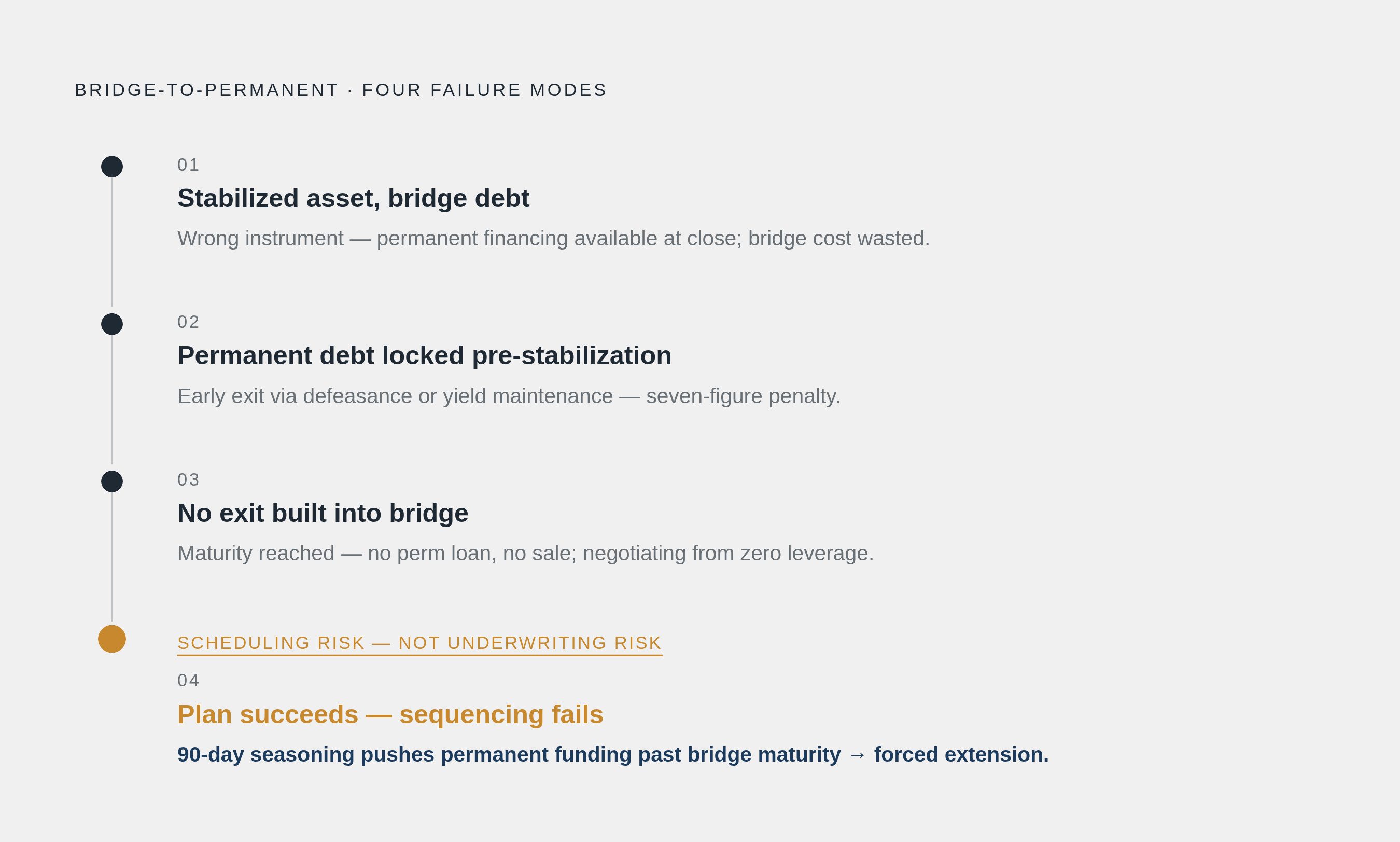
The sequence fails in a small number of predictable ways, and each one compounds into a problem bigger than a delayed exit.
The first failure mode: a sponsor uses bridge financing on an asset that's already stabilized, purely to close faster or cheaper than a permanent process would allow.
The second failure mode runs the opposite direction: a sponsor locks into permanent debt before the asset has genuinely stabilized. Income looks durable enough on paper, but coverage or occupancy turns out softer than underwritten, and if the asset later needs recapitalization or repositioning before the fixed term is up, the exit cost from defeasance or yield maintenance isn't a rounding error. It can reach seven figures, a lesson plenty of value-add sponsors chasing a "cheaper" coupon have learned the hard way.
The third failure mode is a bridge loan built without a real exit attached to it. The sponsor arrives at maturity having failed to meet permanent lenders' thresholds, with no sale proceeds in hand, and is left negotiating an extension at whatever fee the bridge lender chooses to charge, a negotiation conducted from close to zero leverage.
The fourth failure mode is purely a timing error. The business plan executes exactly on schedule, but the three-month stabilization seasoning period pushes the permanent loan's funding date past the bridge loan's maturity date anyway. The plan succeeded and the sequencing still broke, forcing either a bridge extension or an emergency refinance into something more expensive than either original option.
None of these failure modes are abstract right now. A large volume of commercial and multifamily mortgages is scheduled to mature in the near term, and a meaningful share of those properties will need bridge capital to stabilize before they can refinance into permanent debt. Properties that haven't planned that sequence carefully are going to run into these four failure modes under real time pressure, not as a hypothetical exercise but as a scheduling problem with a hard deadline attached.
The document and data challenge that underlies both underwriting workflows
Underwriting a bridge loan's business plan and stress-testing a permanent loan's income coverage look like different exercises on paper, but they run into the same bottleneck: turning a large, inconsistent pile of documents into financials a lender can actually trust, fast enough to matter.
A commercial loan file pulls from rent rolls, operating statements, tax returns, lease abstracts, and covenant packages, each formatted differently, often covering different entities and overlapping time periods, and someone has to reconcile all of it before any real analytical judgment can get applied. That reconciliation work is where hours disappear, and it's the same work whether the loan in question is a nine-month bridge facility or a ten-year permanent note.
The accuracy bar in regulated lending leaves little room for error. A mistake rate that might be tolerable in an ordinary business context isn't tolerable in a credit memo an examiner is going to review line by line, where every figure needs a clear path back to the document it came from. The occupancy and income gates covered earlier are hard, measurable thresholds with real timing consequences, and the three-month seasoning clause in particular gets underestimated constantly by sponsors juggling more than one asset at a time. Portfolio-monitoring software, Hypha being one example, can track occupancy milestones and maturity dates across an entire loan book, and it can flag an asset approaching one of these qualification gates well before maturity, so both lender and sponsor get room to plan the bridge-to-permanent handoff instead of scrambling for takeout financing once the clock has already run out.